


Scat Encounter Rate Calculator
Calculate scat detections per kilometre across walked transects — a robust sign-based abundance index for carnivore monitoring, mammal sign surveys, and field ecology research.
1 Data Input
Drop your file here or browse
Supported: .csv, .txt, .xlsx, .xls
| # | Transect Label | Scat Count |
|---|
Enter values for each transect.
2 Summary Results
📊 Click Calculate above to compute the scat encounter rate and view results.
3 Visualizations
4 Detailed Interpretation of Results
Run the analysis above to see a detailed interpretation of your scat encounter rate results.
5 How to Write Your Results in Research
📝 Run the analysis above to generate ready-to-use write-up examples for journals, theses, policy reports, conference abstracts, and monitoring reports.
6 Research Poster Panel
🪧 Run the analysis above to render a publication-ready research poster panel.
7 When to Use Scat Encounter Rate
✅ Use this index when:
- You are surveying elusive or wide-ranging carnivores (wolves, coyotes, bears, mountain lions, bobcats, foxes) where direct sightings are rare.
- You want a low-cost, field-friendly relative abundance index across multiple sites or seasons.
- You are conducting long-term monitoring (annual or seasonal) where the same transects are walked repeatedly.
- You need a rapid assessment of carnivore presence and activity across a large landscape.
- You have access to clearly defined, repeatable transects (forest roads, trails, ridge lines, dry stream beds).
❌ Avoid this index when:
- Defecation rate or decay rate are unknown and you need absolute density (use distance sampling or DNA-based methods instead).
- Scats cannot be reliably identified to species (use molecular ID or paired camera traps).
- Transect lengths are not standardized — encounter rate becomes biased.
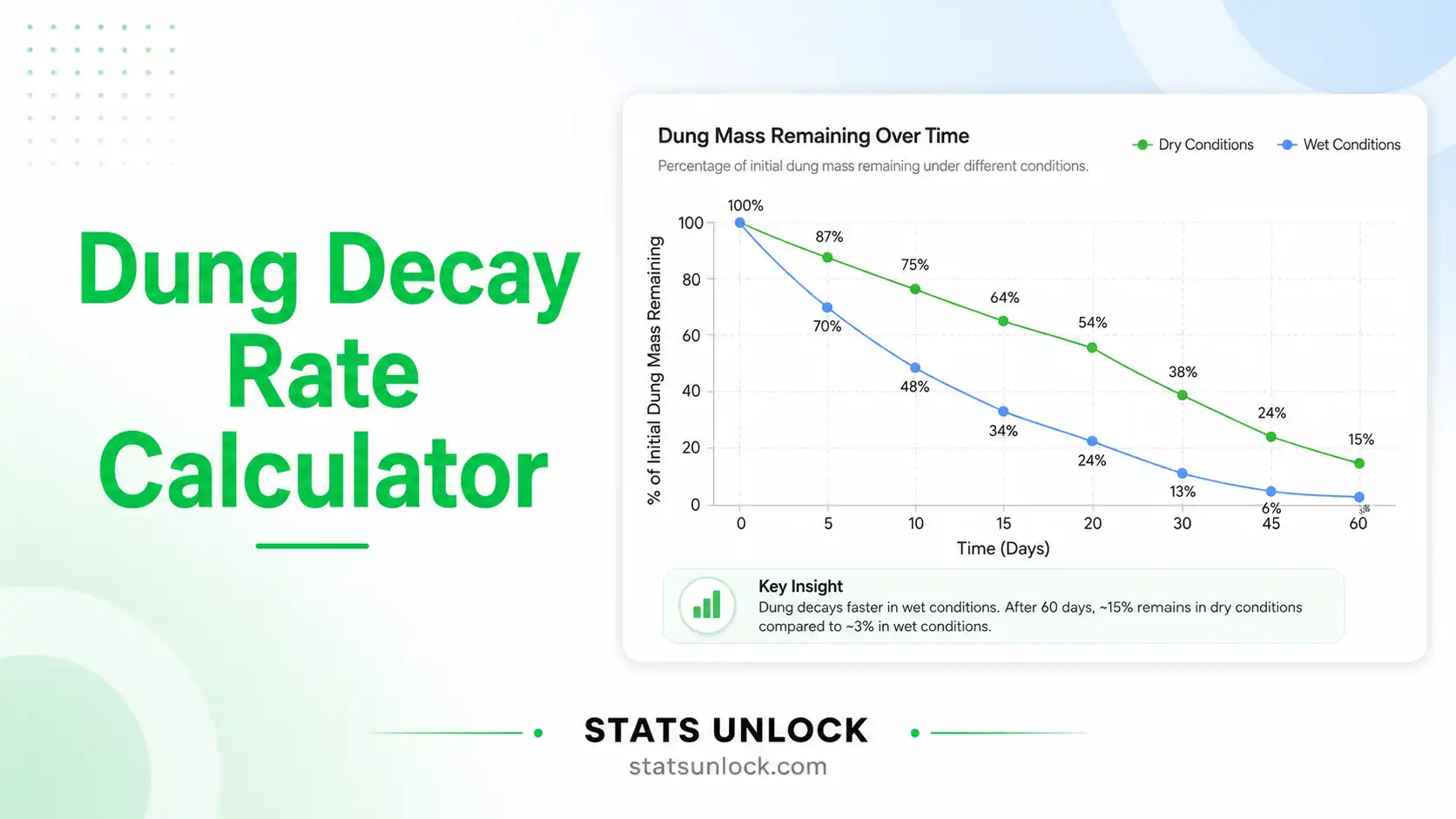
- Habitat heavily decays scats (heavy rain, dense undergrowth) without correction for scat persistence.
🌍 Real-world examples (USA)
- Yellowstone wolf monitoring: rangers walk 3 km transects monthly to compute scat encounter rate per pack territory.
- Florida panther conservation: Everglades scat surveys quantify panther presence in different vegetation strata.
- Rocky Mountain black bear research: seasonal scat encounter rates compared between berry-rich and berry-poor years.
- Sonoran Desert bobcat studies: sandy washes are walked to compute seasonal scat encounter trends.
8 Detailed Conclusion
📌 Run the analysis above to generate a detailed, four-block conclusion summarizing your survey findings.
9 How to Use This Calculator
52, 48, 55, 61, 47), use Column Entry to label each transect, upload CSV/Excel, or fill the manual table.10 Frequently Asked Questions
What is scat encounter rate?
How is scat encounter rate calculated?
Is scat encounter rate the same as density?
Which species are commonly surveyed with scats?
How long should each transect be?
How many transects do I need?
What encounter rates should I expect?
Can I use this for pellet group counts?
Should I clear old scats before starting?
Is this tool free and private?
12 References
The scat encounter rate index, sign-based wildlife survey methodology, and confidence interval estimation are described in the following peer-reviewed sources, manuals, and protocols.
- Karanth, K. U., & Nichols, J. D. (2002). Monitoring Tigers and Their Prey: A Manual for Researchers, Managers and Conservationists in Tropical Asia. Centre for Wildlife Studies. https://www.fs.usda.gov/research/treesearch/72013
- Wilson, G. J., & Delahay, R. J. (2001). A review of methods to estimate the abundance of terrestrial carnivores using field signs and observation. Wildlife Research, 28(2), 151–164. https://doi.org/10.1071/WR00033
- Stander, P. E. (1998). Spoor counts as indices of large carnivore populations: the relationship between spoor frequency, sampling effort and true density. Journal of Applied Ecology, 35(3), 378–385. https://doi.org/10.1046/j.1365-2664.1998.00313.x
- Long, R. A., MacKay, P., Ray, J., & Zielinski, W. (Eds.). (2008). Noninvasive Survey Methods for Carnivores. Island Press. https://islandpress.org/books/noninvasive-survey-methods-carnivores
- Gese, E. M. (2001). Monitoring of terrestrial carnivore populations. In Carnivore Conservation (pp. 372–396). Cambridge University Press. https://www.cambridge.org/core/books/carnivore-conservation/
- Sadlier, L. M. J., Webbon, C. C., Baker, P. J., & Harris, S. (2004). Methods of monitoring red foxes Vulpes vulpes and badgers Meles meles: are field signs the answer? Mammal Review, 34(1‐2), 75–98. https://doi.org/10.1046/j.0305-1838.2003.00029.x
- Stephens, P. A., Zaumyslova, O. Y., Miquelle, D. G., Myslenkov, A. I., & Hayward, G. D. (2006). Estimating population density from indirect sign: track counts and the Formozov–Malyshev–Pereleshin formula. Animal Conservation, 9(3), 339–348. https://doi.org/10.1111/j.1469-1795.2006.00044.x
- Buckland, S. T., Anderson, D. R., Burnham, K. P., Laake, J. L., Borchers, D. L., & Thomas, L. (2001). Introduction to Distance Sampling: Estimating Abundance of Biological Populations. Oxford University Press. https://global.oup.com/academic/product/introduction-to-distance-sampling-9780198509271
- Krebs, C. J. (1999). Ecological Methodology (2nd ed.). Benjamin Cummings. https://www.zoology.ubc.ca/~krebs/books.html
- U.S. Fish & Wildlife Service. (2019). Carnivore Survey Protocol. https://www.fws.gov/library
- Yellowstone Wolf Project. (2023). Annual Report. National Park Service. https://www.nps.gov/yell/learn/nature/wolf-reports.htm
- Florida Fish and Wildlife Conservation Commission. (2022). Florida Panther Annual Report. https://myfwc.com/wildlifehabitats/wildlife/panther/
- Sutherland, W. J. (Ed.). (2006). Ecological Census Techniques: A Handbook (2nd ed.). Cambridge University Press. https://doi.org/10.1017/CBO9780511790508
- Gompper, M. E., Kays, R. W., Ray, J. C., Lapoint, S. D., Bogan, D. A., & Cryan, J. R. (2006). A comparison of noninvasive techniques to survey carnivore communities in northeastern North America. Wildlife Society Bulletin, 34(4), 1142–1151. https://doi.org/10.2193/0091-7648(2006)34[1142:ACONTT]2.0.CO;2
- Mills, L. S., Citta, J. J., Lair, K. P., Schwartz, M. K., & Tallmon, D. A. (2000). Estimating animal abundance using noninvasive DNA sampling: promise and pitfalls. Ecological Applications, 10(1), 283–294. https://doi.org/10.1890/1051-0761(2000)010[0283:EAAUND]2.0.CO;2