

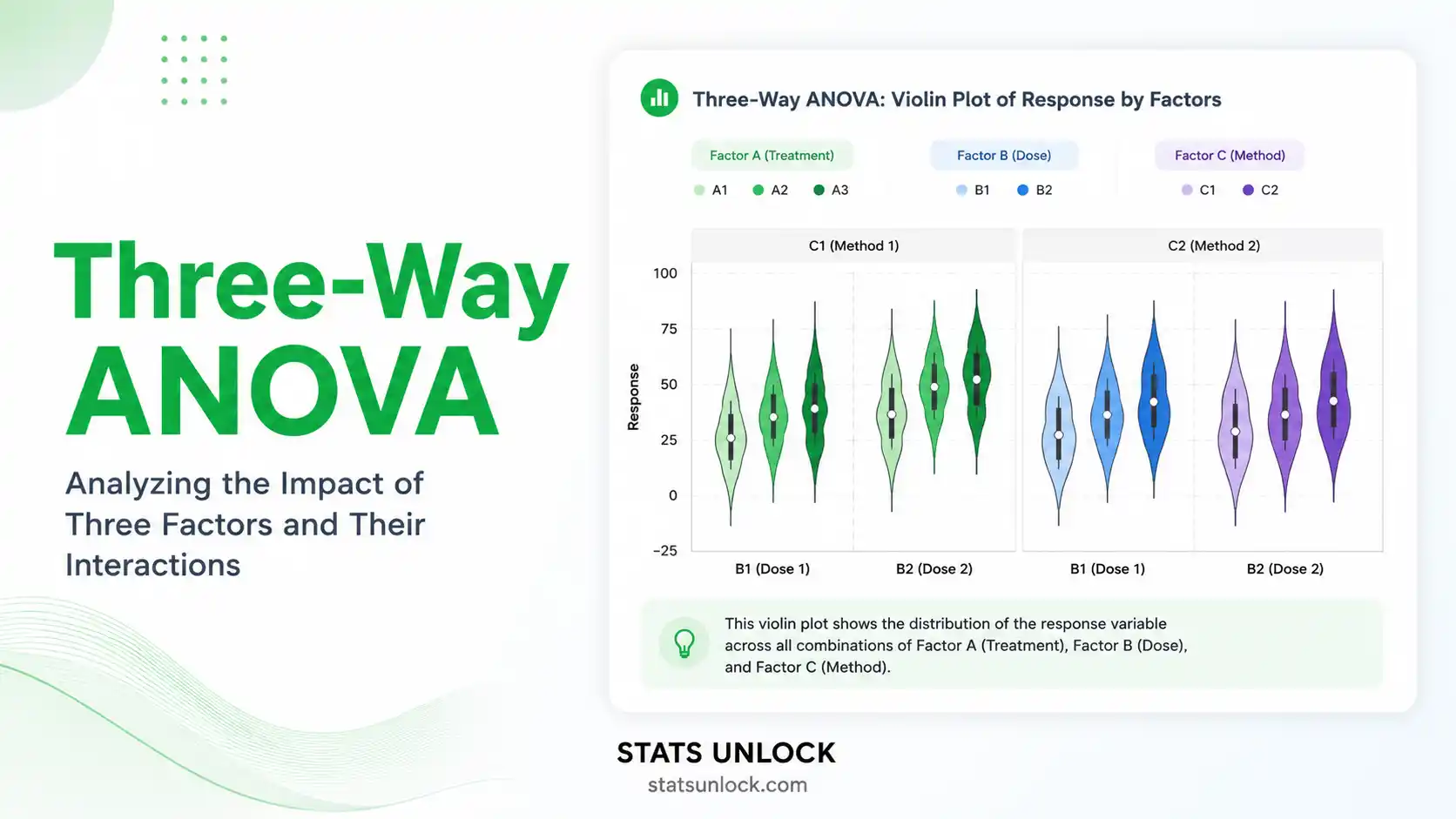

Three-Way ANOVA Calculator
A free online three-way ANOVA calculator for 3-factor factorial designs — compute F-statistics, p-values, partial eta squared effect sizes, three-way interactions, and APA-format results instantly.
📊 Enter Your Data
Enter comma-separated values for each cell (combination of factor levels). Group names are editable above.
🎯 Results Summary
ANOVA Table
SS = Sum of Squares · df = degrees of freedom · MS = Mean Square · F = F-statistic · ηp² = partial eta squared
📈 Visualizations (4 Charts)
Chart 1 — Cell Means with SE Bars
Chart 2 — Two-Way Interaction (A × B by C)
Chart 3 — Main Effect Means (A, B, C)
Chart 4 — Box Plot of All Cells
📝 Plain Language Interpretation
Interpretation Results
How to Write Your Results in Research (5 Templates)
🎓 Detailed Conclusion
✅ Assumption Checks
⬇️ Export Results
📐 Technical Notes & Formulas
Sum of Squares Decomposition
For a three-way factorial design with factors A, B, C (with a, b, c levels) and n replicates per cell:
SS_total = SS_A + SS_B + SS_C + SS_AB + SS_AC + SS_BC + SS_ABC + SS_error

SS_A   = n·b·c · Σᵢ (Ā_i − Ḡ)²
SS_B   = n·a·c · Σⱼ (B̄_j − Ḡ)²
SS_C   = n·a·b · Σₖ (C̄_k − Ḡ)²
SS_AB  = n·c · Σᵢⱼ (ĀB̄_ij − Ā_i − B̄_j + Ḡ)²
SS_AC  = n·b · Σᵢₖ (ĀC̄_ik − Ā_i − C̄_k + Ḡ)²
SS_BC  = n·a · Σⱼₖ (B̄C̄_jk − B̄_j − C̄_k + Ḡ)²
SS_ABC = n · Σᵢⱼₖ (X̄_ijk − ĀB̄_ij − ĀC̄_ik − B̄C̄_jk + Ā_i + B̄_j + C̄_k − Ḡ)²
SS_error = Σ_all (Xᵢⱼₖₗ − X̄_ijk)²

F = MS_effect / MS_error
MS_effect = SS_effect / df_effect
Partial η² = SS_effect / (SS_effect + SS_error)
Degrees of Freedom
- df_A = a − 1
- df_B = b − 1
- df_C = c − 1
- df_AB = (a−1)(b−1)
- df_AC = (a−1)(c−1)
- df_BC = (b−1)(c−1)
- df_ABC = (a−1)(b−1)(c−1)
- df_error = a·b·c·(n−1)
- df_total = N − 1
Where: N = total sample size, n = replicates per cell, a/b/c = levels of each factor, Ḡ = grand mean, Ā_i / B̄_j / C̄_k = marginal means, X̄_ijk = cell mean, Xᵢⱼₖₗ = individual observation.
📘 How to Write Your Three-Way ANOVA Results
When reporting three-way ANOVA results in APA 7th format, always present each effect separately and prioritise interactions over main effects. Always include effect sizes (partial η²) and follow up significant interactions with simple effects analyses.
Methods Section Template
A three-way between-subjects ANOVA was conducted with [Factor A], [Factor B], and [Factor C] as independent variables and [Dependent Variable] as the outcome. Levene's test was used to evaluate homogeneity of variance across cells. Type III sum of squares was used. Significant interactions were probed with simple effects analyses using Bonferroni correction. All analyses used α = .05.
Results Section Template
The three-way ANOVA revealed a [significant / non-significant] main effect of [Factor A], F(df1, df2) = X.XX, p = .XXX, ηp² = .XX, [significant / non-significant] main effect of [Factor B], F(df1, df2) = X.XX, p = .XXX, ηp² = .XX, and [significant / non-significant] main effect of [Factor C], F(df1, df2) = X.XX, p = .XXX, ηp² = .XX. The A × B interaction was [significant / non-significant], F(df1, df2) = X.XX, p = .XXX, ηp² = .XX. The A × C interaction was [...]. The three-way A × B × C interaction was [significant / non-significant], F(df1, df2) = X.XX, p = .XXX, ηp² = .XX.
Reporting Rules
- Write "p < .001" when p < .001 (never "p = .000")
- Report exact p-values when p ≥ .001 (e.g., "p = .023")
- Italicise statistical symbols: F, p, M, SD, ηp²
- Always report effect size alongside the F-statistic
- Interpret interactions first; only interpret main effects in the absence of higher-order interactions
- Provide cell means with SDs in a table
📌 When to Use Three-Way ANOVA
This free three-way ANOVA tool is designed for researchers and students testing the simultaneous effect of three categorical independent variables on a continuous outcome in a single factorial model.
Decision Checklist
- You have exactly three categorical independent variables
- Your dependent variable is continuous (interval or ratio)
- Observations are independent
- Residuals are approximately normally distributed within each cell
- Variances are approximately equal across cells (Levene's test)
- Do NOT use if you have repeated measurements on the same subjects → use a mixed-design or repeated-measures ANOVA
- Do NOT use if your outcome is binary or count → use logistic or Poisson regression
- Do NOT use if normality is severely violated and n < 30 per cell → use a non-parametric alternative or rank-transformed ANOVA
Real-World Examples
- Medical research — Does the effect of a new drug on blood pressure depend on sex and age group? (Drug × Sex × Age)
- Education — Do exam scores depend on teaching method, course difficulty, and study time? (Method × Difficulty × Time)
- Agriculture — Does plant growth depend on fertilizer type, soil pH level, and light exposure? (Fertilizer × Soil × Light)
- Business — Do sales depend on brand, geographic region, and seasonality? (Brand × Region × Season)
Sample Size Guidance
- Minimum recommended: ≥ 10 observations per cell
- For a 2×2×2 design with medium effect (f = 0.25), α = .05, 80% power: ≈ 128 total (16 per cell)
- For a 3×3×3 design: ≥ 270 total recommended
- Balanced designs are strongly preferred — unequal cell sizes complicate SS interpretation
Decision Tree
3 categorical IVs → continuous DV → independent observations → THIS TEST (Three-Way ANOVA)
                                  → repeated on same subjects   → Mixed/Repeated-Measures ANOVA
2 categorical IVs → Two-Way ANOVA
1 categorical IV  → One-Way ANOVA (3+ levels) or t-test (2 levels)
Outcome is binary → Logistic Regression
Outcome is count  → Poisson/Negative Binomial Regression
🛠️ How to Use This Three-Way ANOVA Calculator
- Step 1 — Enter Your Data. Use the "Type Data" tab for comma-separated values per cell, or "Upload CSV/Excel" to import a spreadsheet. Each cell represents one unique combination of factor levels (e.g., Drug·Male·Young).
- Step 2 — Choose a Sample Dataset. The dropdown loads 5 ready-to-use datasets spanning medicine, education, agriculture, and business. Dataset 1 is pre-loaded.
- Step 3 — Rename Factors and Levels. Update Factor A, B, C names and level labels at the top — these flow through every chart, table, and APA report.
- Step 4 — Configure Settings. Set α (default 0.05) and choose your effect size metric (partial η² is recommended for factorial designs).
- Step 5 — Click "Run Three-Way ANOVA". Results appear instantly with no page reload.
- Step 6 — Read the Summary Cards. Each F-statistic, p-value, and partial η² is displayed at a glance.
- Step 7 — Read the Full ANOVA Table. Rows are colour-coded: significant effects highlighted in dark green with a ✓ icon.
- Step 8 — Examine the 4 Visualizations. Cell means, two-way interaction plot, main effect means, and a box plot of every cell.
- Step 9 — Read the Plain-Language Interpretation. Five APA-style writing templates are auto-filled with your numbers.
- Step 10 — Export. Download as Doc (.txt) or PDF for inclusion in reports, theses, and publications.
❓ Frequently Asked Questions
Q1. What is a three-way ANOVA and when should I use it?
A three-way ANOVA tests the simultaneous effect of three categorical independent variables (factors) on a continuous outcome. Use it when you want to examine three main effects, three two-way interactions, and one three-way interaction in a single factorial design — for example, testing whether a drug's effect on blood pressure depends on both sex and age group.
Q2. How do I interpret a significant three-way interaction?
A significant three-way interaction (A × B × C) means the two-way interaction between any pair of factors is itself moderated by the third factor — i.e., the A × B interaction looks different at level 1 of C than at level 2 of C. Always follow up with simple effects: fix one factor and examine the remaining two-way interaction at each level.
Q3. What is partial eta squared and how do I interpret it?
Partial eta squared (ηp²) is the proportion of variance in the dependent variable explained by an effect after removing variance attributable to other effects. Cohen's benchmarks: 0.01 = small, 0.06 = medium, 0.14 = large. ηp² is preferred over classical η² in factorial designs because it does not depend on the size of other effects in the model.
Q4. What assumptions does three-way ANOVA require?
Independence of observations, approximate normality of residuals within each cell (less critical with n > 30 per cell by the Central Limit Theorem), homogeneity of variance across cells (Levene's test), and ideally balanced cell sizes. If assumptions are violated, options include log/sqrt transformation, robust ANOVA (e.g., Welch-James), or rank-transformed ANOVA.
Q5. How large a sample do I need?
For a 2×2×2 factorial design with medium effect size (Cohen's f = 0.25), α = 0.05, and power = 0.80, you need approximately 128 participants total (16 per cell). For 3×3×3 designs, plan for ≥ 10 per cell minimum and ≥ 270 total. Use G*Power for exact sample-size planning.
Q6. What is the difference between main effects and interactions?
A main effect tests whether a single factor has an overall impact on the outcome, ignoring other factors. An interaction tests whether the effect of one factor depends on the level of another factor. Interactions take priority in interpretation: if a higher-order interaction is significant, the main effects should not be interpreted in isolation.
Q7. Can I run a three-way ANOVA with unequal cell sizes?
Yes, but unbalanced designs require careful choice of sum-of-squares type. Type III SS (used by this tool) is recommended when interactions are of interest, as it tests each effect after adjusting for all others. Type I is order-dependent; Type II ignores the highest-order interaction when testing lower-order effects.
Q8. How do I report three-way ANOVA results in APA 7th format?
Report each main effect, each two-way interaction, and the three-way interaction separately, in this order: F(df1, df2) = X.XX, p = .XXX, ηp² = .XX. Follow significant interactions with simple effects. Provide a table of cell means and SDs. See "How to Write Your Results" above for five complete reporting templates.
Q9. Can I use this calculator for my published research?
This tool is designed for educational use, teaching, and exploratory analysis. For formal research publications, verify results with peer-reviewed software (R, Python statsmodels, SPSS, SAS). Cite as: STATS UNLOCK. (2025). Three-way ANOVA calculator. Retrieved from https://statsunlock.com.
Q10. What if my three-way interaction is non-significant?
If the three-way interaction is non-significant, focus interpretation on the lower-order two-way interactions and main effects. A non-significant interaction does not prove the absence of an effect — it may reflect low statistical power, especially in small studies. Consider effect size (ηp²) and confidence intervals alongside the p-value, and run a post-hoc power analysis to evaluate adequacy.
📚 References
The following references support the statistical methods used in this three-way ANOVA calculator, covering p-value interpretation, effect size estimation, and best practices in hypothesis testing for factorial designs.
- Fisher, R. A. (1925). Statistical methods for research workers. Oliver & Boyd. https://psychclassics.yorku.ca/Fisher/Methods/
- Fisher, R. A. (1935). The design of experiments. Oliver & Boyd. archive.org
- Cohen, J. (1988). Statistical power analysis for the behavioral sciences (2nd ed.). Lawrence Erlbaum Associates.
- Keppel, G., & Wickens, T. D. (2004). Design and analysis: A researcher's handbook (4th ed.). Pearson.
- Field, A. (2018). Discovering statistics using IBM SPSS statistics (5th ed.). SAGE Publications.
- Maxwell, S. E., Delaney, H. D., & Kelley, K. (2017). Designing experiments and analyzing data: A model comparison perspective (3rd ed.). Routledge. https://doi.org/10.4324/9781315642956
- Howell, D. C. (2013). Statistical methods for psychology (8th ed.). Cengage Learning.
- Lakens, D. (2013). Calculating and reporting effect sizes to facilitate cumulative science: A practical primer for t-tests and ANOVAs. Frontiers in Psychology, 4, 863. https://doi.org/10.3389/fpsyg.2013.00863
- Cumming, G. (2014). The new statistics: Why and how. Psychological Science, 25(1), 7–29. https://doi.org/10.1177/0956797613504966
- Olejnik, S., & Algina, J. (2003). Generalized eta and omega squared statistics: Measures of effect size for some common research designs. Psychological Methods, 8(4), 434–447. https://doi.org/10.1037/1082-989X.8.4.434
- American Psychological Association. (2020). Publication manual of the American Psychological Association (7th ed.). APA. https://doi.org/10.1037/0000165-000
- Searle, S. R. (1987). Linear models for unbalanced data. John Wiley & Sons.
- R Core Team. (2024). R: A language and environment for statistical computing. R Foundation for Statistical Computing. https://www.R-project.org/
- NIST/SEMATECH. (2013). e-Handbook of statistical methods. National Institute of Standards and Technology. https://www.itl.nist.gov/div898/handbook/
- Faul, F., Erdfelder, E., Lang, A.-G., & Buchner, A. (2007). G*Power 3: A flexible statistical power analysis program for the social, behavioral, and biomedical sciences. Behavior Research Methods, 39(2), 175–191. https://doi.org/10.3758/BF03193146