

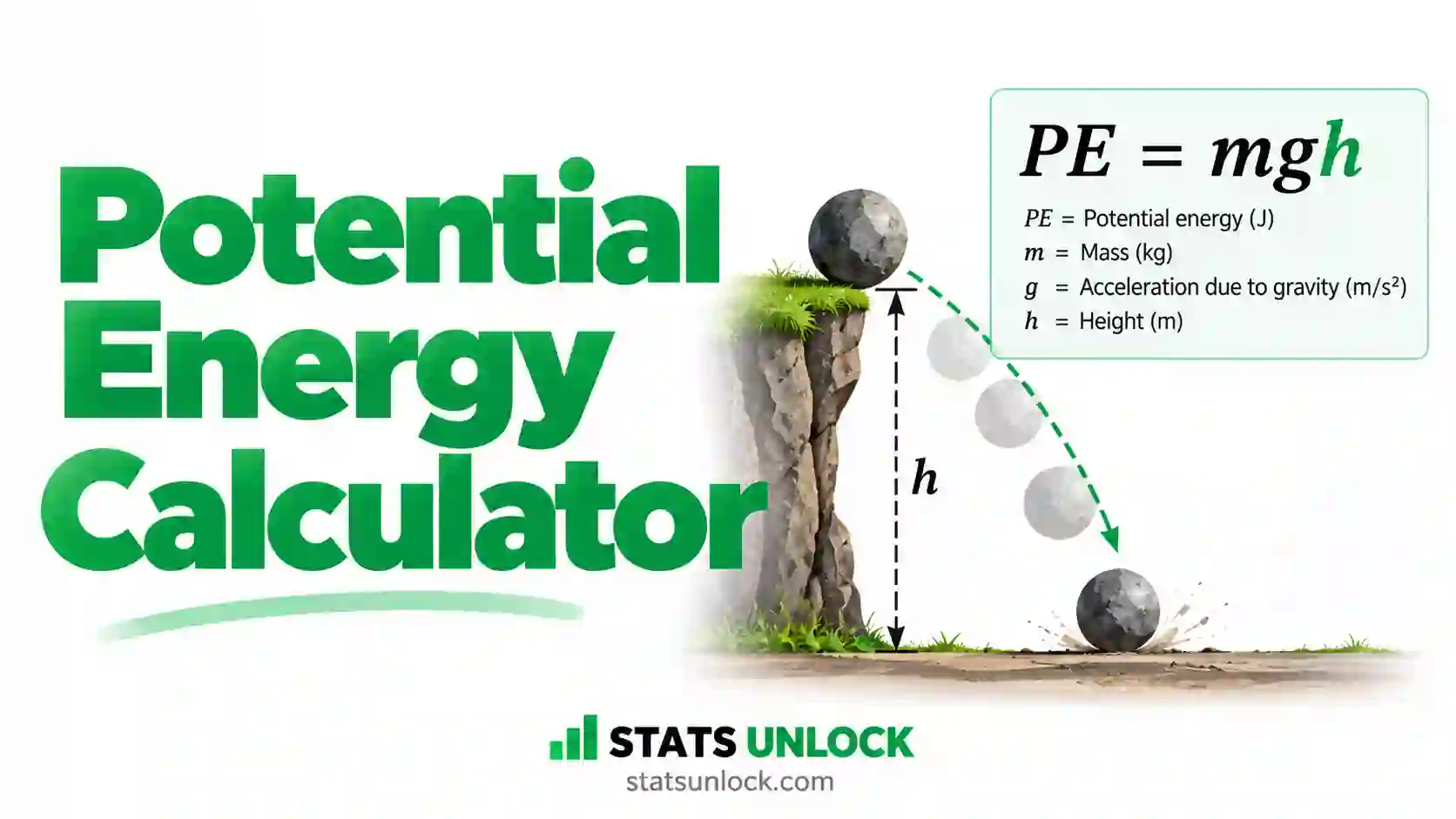

Potential Energy Calculator
Calculate potential energy with steps: gravitational PE = mgh, change in PE, elastic spring PE, electric PE, orbital PE and the speed it turns into. Solve for any variable, in any units, with a units check and a diagram drawn from your numbers.
⚡ 0. Quick Answer
A potential energy calculator finds the energy an object stores because of its position, using PE = m g h for height. A 2.50 kg book lifted 4.00 m onto a shelf stores 2.50 × 9.81 × 4.00 = 98.1 J.
Rule of thumb: lifting 1 kg by 1 m stores about 9.8 J. Double the mass or the height and the energy doubles. For a spring use PE = ½kx²; for charges use U = kq₁q₂ ÷ r.
Key Takeaways
- A potential energy calculator multiplies mass, gravity and height: a 2.50 kg book 4.00 m up stores 98.1 J.
- Use g = 9.81 m/s² on Earth (9.8 in CBSE and AP, 10 for quick estimates); the Moon is only 1.62 m/s².
- Only the change in height matters: a 72 kg hiker climbing 650 m gains about 4.6 × 10⁵ J, whatever level you call zero.
- A spring stores ½kx², so k = 250 N/m stretched 4.0 cm holds 0.20 J, and twice the stretch holds four times the energy.
- Dropped from 20.0 m, any object reaches about 19.8 m/s, because the PE lost equals the KE gained and the mass cancels.
📚 1. What Is a Potential Energy Calculator?
A potential energy calculator works out the energy stored in a system because of the positions of its parts. Potential energy (PE) is stored energy, measured in joules (J). It is called "potential" because it can turn into motion later: a raised book can fall, a stretched spring can snap back, and two opposite charges can rush together.
The most common type is gravitational potential energy, the energy an object has because it sits at a height h above a chosen zero level. You calculate it as the product of mass, gravitational field strength and height: PE = m g h. The quantities used in the calculation are mass in kilograms, g in metres per second squared, and height in metres. The answer comes out in joules, because 1 kg × 1 m/s² × 1 m = 1 J.
A worked one-liner: lift a 2.50 kg book 4.00 m onto a high shelf with g = 9.81 m/s². PE = 2.50 kg × 9.81 m/s² × 4.00 m = 98.1 J. If the book falls off, that 98.1 J becomes kinetic energy, and the book hits the floor at about 8.86 m/s.
Who uses it: students in CBSE and ICSE Class 9 to 12, IGCSE, GCSE and A level, AP Physics 1 and 2, JEE and NEET, and first-year university physics and chemistry. Engineers use the same formula to size pumped-hydro storage, lifts and cranes. The idea of a stored, position-based energy grew through the 18th and 19th centuries; the Scottish engineer William Rankine named it "potential energy" in 1853.
| Type of potential energy | Formula | Zero level | Use it when |
|---|---|---|---|
| Gravitational, near a surface | PE = m g h | Any level you choose | Heights small compared with the planet (under about 10 km) |
| Change in gravitational PE | ΔPE = m g (h₂ − h₁) | Cancels out | Lifting, climbing, a ball rising or falling |
| Elastic (spring) | PE = ½ k x² | Natural length | Springs, bungee cords, bows, within the elastic limit |
| Electric (two charges) | U = k q₁ q₂ ÷ r | Infinite separation | Point charges, atoms, ions |
| Gravitational, far from a surface | U = −G M m ÷ r | Infinite separation | Satellites, rockets, orbits |
| Electrochemical (chemistry) | ΔG° = −n F E° | Standard state | Batteries and galvanic cells |
Kinetic energy (KE = ½mv²) is the energy of motion. Potential energy is the energy of position. When friction is negligible, their sum, the mechanical energy, stays constant, which is how this page turns PE into a landing speed.
🧮 2. Enter Your Values
Pick a type of potential energy, choose what to solve for, then type your values in any units.
Solve for:
Formula: PE = m g h
Scientific notation works: type 6.2e-3 or 6.2×10^-3. Heights below your zero level can be negative. The unit beside the answer box sets the unit of the answer.
📊 3. Results and Step-by-Step Working
🧠 4. Understanding Your Answer, In Detail
4.1 What the number means
Potential energy is the work you would have to do to move the object into its position, slowly and against the force. Lift a 2.50 kg book 4.00 m and you push up with about 24.5 N over 4.00 m, which is 24.5 N × 4.00 m = 98.1 J of work. That work is now stored. It is not lost, it is waiting.
Gravitational PE belongs to the object and the Earth together, not to the object alone. Physics teachers stress this because the energy is stored in the gravitational interaction between the two. For everyday problems you can say "the book has 98.1 J" as long as you remember the Earth is part of the system.
4.2 Is it a sensible size?
Use 10 J per kilogram per metre as a quick mental check. A 60 kg student climbing a 3 m flight of stairs gains about 1800 J. One food Calorie is 4184 J, so that climb uses less than half a Calorie of stored energy, although the body burns more because muscles are only about 20 to 25% efficient. A 1000 kg car on a 100 m hill stores about 1 MJ. A full tank of a pumped-hydro station stores millions of megajoules.
4.3 How it scales
PE = m g h is directly proportional to each of its three inputs. Double the mass, the energy doubles. Halve the height, the energy halves. Take the same book to the Moon, where g = 1.62 m/s², and the 4.00 m lift stores only 16.2 J. Elastic PE is different: it grows with the square of the stretch, so a spring stretched twice as far stores four times as much energy. Electric PE falls as 1 ÷ r, so halving the gap between two charges doubles their energy.
4.4 Sign and the zero level
You can put the zero of gravitational PE anywhere: the floor, a table top or sea level. A book on the floor has PE = 0 if the floor is your zero, and a negative PE if your zero is the table top. Only differences have physical meaning, so ΔPE = m g (h₂ − h₁) gives the same answer whatever zero you choose. For orbits and charges the zero is fixed at infinite distance, which is why gravitational PE far from the Earth, U = −G M m ÷ r, is always negative.
4.5 What the charts show
Chart 2 is a straight line through the origin for gravitational PE: a graph of PE against height has a gradient of m g. For a spring the same chart becomes a parabola, and the force-stretch chart is a straight line whose shaded area equals the stored energy. In every energy-during-the-fall chart, the green PE line and the blue KE line cross halfway down, and their sum (the dashed black line) stays flat. That flat line is conservation of energy.
4.6 When the simple model breaks down
PE = m g h assumes g is the same at every height. That is true to better than 0.3% for anything below about 20 km on Earth, so it is fine for buildings, mountains and aircraft. For satellites the error grows: at 408 km, the height of the International Space Station, m g h overestimates the lifting energy by 6.4%. Use the Orbital PE mode there. For springs the limit is the elastic limit; for falling objects it is air resistance, which always makes the real landing speed lower than √(2 g h).
4.7 Special cases
- h = 0: PE is zero by definition at the reference level.
- Negative h: the object is below your zero level, so PE is negative. That is allowed.
- Negative mass: not physical. The calculator stops and says so.
- Compression versus stretch: a spring squashed by 4 cm stores the same energy as one stretched by 4 cm.
- Opposite charges: negative U, a bound pair. Like charges give positive U and fly apart when released.
4.8 Where this leads next
Potential energy is the starting point for almost every energy problem. Add kinetic energy and you get the conservation of mechanical energy, which solves roller coasters, pendulums and projectiles. Add work done by friction and you get the full work-energy theorem. In chemistry, the same idea becomes Gibbs free energy, and in electricity it becomes voltage, which is simply electric potential energy per coulomb.
✍ 5. How to Write the Answer
📌 Conventions
- Write Given, Required, Equation, Substitute, Solve on separate lines.
- Put the unit on every number you substitute, not only the answer.
- Box or underline the final answer.
- Round to the smallest number of significant figures in the data.
📌 Conventions
- Leave a space between the number and the unit: 98.1 J, not 98.1J.
- Use scientific notation for very large or small answers: 4.6 × 10⁵ J.
- Keep a minus sign when the PE is below the zero level or bound.
📌 Conventions
- Name the method and the value of g used.
- Give the uncertainty with the same number of decimal places as the value.
- Report the mean of repeat measurements, not a single reading.
- The uncertainty here assumes ±1 in the last digit of each value, combined in quadrature. Replace it with the spread of your repeat readings when you have them.
📌 Conventions
- State which g the key expects, because 9.8, 9.81 and 10 give different last digits.
- Accept answers within one unit in the last significant figure.
- Award a separate mark for the correct unit.
📌 Conventions
- Write m/s^2 for m/s² and x10^5 or e5 for powers of ten.
- Use * for multiply and / for divide so the line pastes anywhere.
∑ 6. Formulas Used
🔀 7. Potential Energy Calculation Flowchart, Step by Step
This flowchart shows how to calculate potential energy step by step, from a word problem to a checked answer with units. Every box uses the same worked example as the Excel, R and Python sections: a 2.50 kg book is lifted 4.00 m onto a shelf. Find its gravitational potential energy.
Check any box yourself: the Excel sheet in Section 9, the R script in Section 10 and the Python script in Section 11 all return 98.1 J for this book. Section 14 shows the same method written out by hand.
📝 8. How to Use This Calculator
- Choose the type of potential energy. Pick Gravitational PE for PE = mgh, Change in PE for a height difference, Elastic for springs, Electric for charges, Orbital for satellites, PE to KE for a falling object, or Cell potential for ΔG° = −nFE°.
- Choose what to solve for. Click a Solve for chip. That field turns into a dashed answer box, and any value it does not need is greyed out.
- Type the known values. Plain numbers, decimals and scientific notation all work: 2.50, 0.040 or 6.2e-3.
- Pick the unit beside each value. Grams, pounds, feet, centimetres, microcoulombs, kilometres and more are converted to SI for you.
- Set g for your syllabus. Use 9.81 for IGCSE, A level and most US courses, 9.8 for CBSE and AP, or 10 for quick estimates. Moon, Mars and Jupiter are also listed.
- Pick the answer unit. The unit menu on the answer field sets the unit of the result, such as J, kJ, kWh, eV or ft·lbf.
- Press Calculate. Nothing is worked out until you do, and changing any input clears the old answer so you never read stale numbers.
- Read the answer box and the two checks. Units check ✓ confirms the units balance, and Verified confirms the answer substituted back into the formula.
- Follow the working and the charts. The GRESS table, numbered steps, results table, diagram and four charts explain the answer.
- Copy or download the working. Section 5 gives five ready-to-paste answers, and Download Doc or Download PDF saves the whole solution.
📈 9. How to Calculate Potential Energy in Excel
Excel has no potential energy function, and it does not need one. PE = m g h is a single multiplication, so one formula per row handles a whole class worth of problems. The two things worth doing properly are keeping g in its own cell, so you can switch between 9.81, 9.8 and 10 in one place, and putting the units in every column header.
=B2*$H$1*C2. For the 2.50 kg book 4.00 m up, Excel returns 98.1, in joules.9.1 The functions you need
| You want | Excel formula | Note |
|---|---|---|
| Gravitational PE | =B2*$H$1*C2 | The $ signs keep g fixed when you fill down |
| Height from PE | =D2/(B2*$H$1) | Brackets matter: divide by the product |
| Mass from PE | =D2/($H$1*C2) | Height cannot be zero |
| Change in PE | =B2*$H$1*(C3-C2) | Negative when the object goes down |
| Elastic PE | =0.5*B2*C2^2 | k in B2 (N/m), x in C2 (m) |
| Landing speed | =SQRT(2*$H$1*C2) | Returns #NUM! for a negative height |
| Pounds to kilograms | =CONVERT(150,"lbm","kg") | Mass is "lbm", not "lb" |
| Feet to metres | =CONVERT(35,"ft","m") | Unit strings are case-sensitive |
| Joules to calories | =CONVERT(D2,"J","cal") | "cal" is the IT calorie (4.1868 J); "c" is 4.184 J |
| Joules to watt-hours | =CONVERT(D2,"J","Wh") | Divide by 1000 for kWh |
| Fit a lab line | =SLOPE(D2:D9,B2:B9) | Gradient of PE against mass = g h |
9.2 Step by step
1 Set up the columns and the g cell
Put one problem per row with the unit in each header. Type g once, in H1, so every formula points at the same value.
Three objects in rows 2 to 4. H1 = 9.81 is the only place g appears.
2 Type the PE formula and fill it down
=B2*$H$1*C2Press Enter, then drag the fill handle down to row 4. The $H$1 reference stays fixed while B and C move with each row.
The book gives 98.1 J, the apple 4.905 J and the student 1765.8 J. Round them to the data’s significant figures when you report them.
3 Add the landing speed beside it
=SQRT(2*$H$1*C2)This is the speed each object would reach if it fell from that height with no air resistance. Mass is not in the formula, because it cancels.
The book lands at 8.86 m/s after a 4.00 m fall.
4 Convert US units with CONVERT
=CONVERT(150,"lbm","kg")=CONVERT(35,"ft","m")Convert first, then use the same PE formula. Here a 150 lb person climbs 35 ft of stairs.
68.04 kg × 9.81 × 10.668 m = 7120 J, about 7.1 kJ to 2 significant figures.
9.3 The awkward cases
=CONVERT(150,"lb","kg") returns #N/A, because mass in pounds is "lbm". Feet is "ft", metres is "m", and "M" is not metres. The calorie "cal" is the International Table calorie (4.1868 J), while "c" is the thermochemical calorie (4.184 J) used in nutrition.- Powers:
=-3^2returns 9 in Excel, not −9, because the minus sign binds first. Write=-(3^2)when a minus sign and a power meet, such as a negative height squared in a spring problem. - Scientific notation: large answers such as 2.94E+13 J appear in E format. Use Format Cells → Scientific with two decimal places for three significant figures.
- Precision: Excel keeps about 15 significant digits, far more than any lab measurement, so round only in the final displayed cell with
=ROUND(D2,1)or the number format. - Solve for anything: for harder rearrangements use Data → What-If Analysis → Goal Seek. Set the PE cell to a target by changing the height cell.
9.4 Why Excel might disagree with R, Python or this page
| Value of g | PE for 2.50 kg at 4.00 m | Who uses it |
|---|---|---|
| 9.80665 m/s² | 98.0665 J → 98.1 J | Standard gravity; scipy.constants.g in Python |
| 9.81 m/s² | 98.1 J | IGCSE, A level, most US textbooks, this page’s worked example |
| 9.8 m/s² | 98.0 J | CBSE, NCERT, AP Physics |
| 10 m/s² | 100 J | Quick estimates and some exam boards |
So a "wrong" last digit is usually a different g, not a different method. The other common causes are rounding (Excel and R round 2.5 differently: Excel half away from zero, R half to even) and typing a constant to fewer figures than the CODATA value.
9.5 Charting it
- Select the Height and PE columns.
- Insert → Charts → Scatter with Straight Lines. Do not use the Line chart type, which spaces the x values evenly whatever they are.
- For lab data, use Scatter only, then click a point → Add Trendline → Linear → tick Display Equation on chart.
- The gradient of PE against height is m g. Divide it by the mass to get your measured g.
- Label the axes with units: Height h (m) and Potential energy PE (J).
9.6 Errors you will hit
| Excel shows | Why | Fix |
|---|---|---|
#VALUE! | A unit typed in a cell, such as "2.5 kg" | Keep units in the header; cells hold numbers only |
#DIV/0! | Height or mass is zero or blank when solving for the other | Fill the cell, or wrap with =IFERROR(...,"") |
#NUM! | SQRT of a negative height | A drop height must be zero or positive |
#N/A | A CONVERT unit string Excel does not know | Use "lbm", "ft", "m", "J", "cal", "Wh" |
| Answer 1000 times too big | Mass typed in grams | Divide by 1000, or use =CONVERT(B2,"g","kg") |
| Every row gives the same PE | Relative reference to g changed as you filled down | Use $H$1, not H1 |
📈 10. How to Calculate Potential Energy in R
R works out potential energy in one line, PE <- m * g * h. The script below does more: it solves for mass and height, adds a spring and a hydrogen atom, prints every answer with its unit, runs a substitution check, and saves one 300 dpi figure of the energy changing during a fall. It uses base R only, so there is nothing to install.
Rscript pe.R. Change only the three lines under "Your values" to solve your own problem.10.1 The complete script
R, base only, saves potential_energy_plot.png
# ============================================================
# Potential energy calculator in R, with one 300 dpi figure
# StatsUnlock - https://statsunlock.com/potential-energy-calculator/
# Base R only. No packages to install.
# ============================================================

# ---- 1. Your values (SI units) -----------------------------
m <- 2.50      # mass in kg
h <- 4.00      # height in m
g <- 9.81      # gravitational field strength in m/s^2
               # use 9.80665 (standard), 9.8 (CBSE, AP) or 10 to match your book

# ---- 2. Gravitational potential energy ---------------------
PE <- m * g * h                  # joules (kg m^2 s^-2)
v  <- sqrt(2 * g * h)            # landing speed if dropped, m/s

# ---- 3. Rearrangements (solve for any variable) ------------
m_back <- PE / (g * h)           # mass from PE and h
h_back <- PE / (m * g)           # height from PE and m

# ---- 4. Elastic and electric PE, same idea -----------------
k <- 250; x <- 0.040             # spring: N/m and m
PE_spring <- 0.5 * k * x^2       # joules
eps0 <- 8.8541878188e-12         # F/m, CODATA 2022
kC <- 1 / (4 * pi * eps0)        # Coulomb constant, N m^2 C^-2
e  <- 1.602176634e-19            # elementary charge, C (exact)
U_H <- kC * (e) * (-e) / 52.9e-12   # hydrogen atom, joules

# ---- 5. Print the answers with units -----------------------
cat(sprintf("PE        = %.3g J\n", PE))
cat(sprintf("v (drop)  = %.3g m/s\n", v))
cat(sprintf("check m   = %.3g kg, check h = %.3g m\n", m_back, h_back))
cat(sprintf("spring PE = %.2f J\n", PE_spring))
cat(sprintf("hydrogen  = %.3g J = %.3g eV\n", U_H, U_H / e))
stopifnot(abs(m * g * h - PE) < 1e-12)          # substitution check
cat("Units: kg x m/s^2 x m = kg m^2/s^2 = J\n")

# ---- 6. One figure: energy during the fall -----------------
d  <- seq(0, h, length.out = 100)                # distance fallen, m
PEd <- m * g * (h - d); KEd <- m * g * d
png("potential_energy_plot.png", width = 7, height = 4.5, units = "in", res = 300)
plot(d, PEd, type = "l", lwd = 3, col = "#16a34a", ylim = c(0, PE * 1.08),
     xlab = "Distance fallen (m)", ylab = "Energy (J)",
     main = sprintf("2.50 kg book falling 4.00 m: PE = %.3g J", PE))
lines(d, KEd, lwd = 3, col = "#2563eb")
abline(h = PE, lty = 2, lwd = 2, col = "#0f172a")
legend("right", c("Potential energy", "Kinetic energy", "Total"),
       col = c("#16a34a", "#2563eb", "#0f172a"), lwd = 3, lty = c(1, 1, 2), bty = "n")
invisible(dev.off())
Output when run: PE = 98.1 J, v (drop) = 8.86 m/s, spring PE = 0.20 J, hydrogen = -4.36e-18 J = -27.2 eV. These match Sections 3, 7, 9 and 11.
10.2 What each part does
| Line | What it does |
|---|---|
| m, h, g | Your inputs, in SI units. Convert grams, feet or pounds before this point. |
| PE <- m * g * h | The gravitational potential energy formula. The answer is in joules. |
| sqrt(2 * g * h) | Landing speed if the object falls from h, with no air resistance. |
| PE / (g * h) | The same formula rearranged for mass, as a solve-for check. |
| 0.5 * k * x^2 | Elastic PE. In R, ^ is the power operator. |
| 1 / (4 * pi * eps0) | The Coulomb constant from the CODATA 2022 ε₀, about 8.988 × 10⁹. |
| sprintf("%.3g") | Prints 3 significant figures, to match the data. |
| stopifnot(...) | Stops with an error if the answer does not substitute back. |
| png(..., res = 300) | Saves a print-quality figure; dev.off() closes the file. |
R traps: round(2.5) gives 2 because R rounds half to even; -2^2 is −4 in R (the opposite of Excel); log() is the natural log; and sin() takes radians. Keep SI units inside the calculation and convert only when you print.
10.3 What the figure shows
The green line is the book’s potential energy as it falls, from 98.1 J at the top to zero at the floor. The blue line is its kinetic energy, rising from zero to 98.1 J. They cross halfway down at 49.05 J each, and the dashed total stays flat at 98.1 J. That flat line is conservation of mechanical energy.
10.4 Common problems and fixes
| Problem | Fix |
|---|---|
| Error: object 'm' not found | Run the script from the top, so the inputs are defined first. |
| The PNG is blank | dev.off() did not run; run the last line again. |
| Answer 1000 times too big | Mass in grams. Divide by 1000 before calculating. |
| Different last digit from a classmate | A different g. Check the g line. |
10.5 Useful one-liners
# PE for a vector of heights
2.5 * 9.81 * c(1, 2, 4, 8)
# height needed to store 1 kJ with 5 kg
1000 / (5 * 9.81)
# change in PE from 1200 m to 1850 m for 72 kg
72 * 9.81 * (1850 - 1200)
# pounds and feet to SI, then PE
(150 * 0.45359237) * 9.81 * (35 * 0.3048)
📈 11. How to Calculate Potential Energy in Python
Python does the same job with NumPy, SciPy and Matplotlib. SciPy’s constants module carries the CODATA values, so the electric and orbital examples use the same constants as this calculator. The script prints every answer with its unit and saves one 300 dpi figure.
Install once with pip install numpy scipy matplotlib. Google Colab already has all three.
11.1 The complete script
Python 3 with SciPy constants, saves potential_energy_plot.png
# ============================================================
# Potential energy calculator in Python, with one 300 dpi figure
# StatsUnlock - https://statsunlock.com/potential-energy-calculator/
# pip install numpy scipy matplotlib
# ============================================================
import numpy as np
import matplotlib.pyplot as plt
from scipy import constants as C

# ---- 1. Your values (SI units) -----------------------------
m = 2.50          # mass, kg
h = 4.00          # height, m
g = 9.81          # m/s^2; scipy's C.g is 9.80665 (standard gravity)

# ---- 2. Gravitational potential energy ---------------------
PE = m * g * h                    # joules
v = np.sqrt(2 * g * h)            # landing speed if dropped, m/s

# ---- 3. Rearrangements (solve for any variable) ------------
m_back = PE / (g * h)
h_back = PE / (m * g)

# ---- 4. Elastic, electric and orbital PE --------------------
k, x = 250, 0.040                                  # N/m, m
PE_spring = 0.5 * k * x**2                         # J
kC = 1 / (4 * np.pi * C.epsilon_0)                 # Coulomb constant
U_H = kC * C.e * (-C.e) / 52.9e-12                 # hydrogen atom, J
GM, R = 3.986004418e14, 6.371e6                    # Earth, m^3/s^2 and m
U_ISS = -GM * 1500 / (R + 408e3)                   # 1500 kg at 408 km, J
dG = -2 * C.physical_constants["Faraday constant"][0] * 1.10   # Daniell cell, J/mol

# ---- 5. Print the answers with units -----------------------
print(f"PE        = {PE:.3g} J")
print(f"v (drop)  = {v:.3g} m/s")
print(f"check m   = {m_back:.3g} kg, check h = {h_back:.3g} m")
print(f"spring PE = {PE_spring:.2f} J")
print(f"hydrogen  = {U_H:.3g} J = {U_H / C.e:.3g} eV")
print(f"ISS orbit = {U_ISS:.2g} J")
print(f"Daniell   = {dG / 1000:.3g} kJ/mol")
print(f"with C.g  = {m * C.g * h:.3g} J")
assert abs(m * g * h - PE) < 1e-12               # substitution check

# ---- 6. One figure: energy during the fall -----------------
d = np.linspace(0, h, 100)
fig, ax = plt.subplots(figsize=(7, 4.5))
ax.plot(d, m * g * (h - d), lw=3, color="#16a34a", label="Potential energy")
ax.plot(d, m * g * d, lw=3, color="#2563eb", label="Kinetic energy")
ax.axhline(PE, ls="--", lw=2, color="#0f172a", label="Total")
ax.set_xlabel("Distance fallen (m)")
ax.set_ylabel("Energy (J)")
ax.set_title(f"2.50 kg book falling 4.00 m: PE = {PE:.3g} J")
ax.legend(frameon=False)
fig.savefig("potential_energy_plot.png", dpi=300, bbox_inches="tight")
Output when run: PE = 98.1 J, v (drop) = 8.86 m/s, spring PE = 0.20 J, hydrogen = -4.36e-18 J = -27.2 eV, ISS orbit = -8.8e+10 J, Daniell = -212 kJ/mol, and with C.g = 98.1 J.
11.2 What each part does
| Line | What it does |
|---|---|
| from scipy import constants as C | Loads CODATA values: C.e, C.epsilon_0, C.g (9.80665). |
| PE = m * g * h | Gravitational PE in joules. |
| np.sqrt(2 * g * h) | Landing speed from the drop height. |
| x**2 | Powers use **. The ^ sign is bitwise XOR in Python and gives nonsense. |
| -GM * 1500 / (R + 408e3) | Orbital PE. The distance is from the Earth’s centre, R + h. |
| physical_constants["Faraday constant"] | 96485.33212 C/mol for ΔG° = −nFE°. |
| f"{PE:.3g}" | Formats to 3 significant figures. |
| fig.savefig(..., dpi=300) | Saves a print-quality PNG. |
Python traps: ^ is not a power; round(2.5) gives 2 (half to even); math.sin takes radians; and scipy.constants.g is 9.80665, which can differ in the third decimal place from a syllabus that uses 9.8.
11.3 What the figure shows
The same three lines as the R figure: potential energy falling, kinetic energy rising, and a flat dashed total at 98.1 J. If you add air resistance in your own version, the total line will slope down, and the gap is the energy lost as heat.
11.4 Common problems and fixes
| Problem | Fix |
|---|---|
| ModuleNotFoundError: scipy | Run pip install scipy, or use Google Colab. |
| TypeError with ^ | Replace x^2 with x**2. |
| No PNG appears | Look in the folder you ran the script from, or print os.getcwd(). |
| Answer differs in the last digit | C.g is 9.80665; set g = 9.81 or 9.8 to match your textbook. |
11.5 Useful one-liners
# PE for many heights at once
import numpy as np; 2.5 * 9.81 * np.array([1, 2, 4, 8])
# spring constant from 0.20 J at 4.0 cm
2 * 0.20 / 0.040**2
# speed from 98.1 J and 2.50 kg
(2 * 98.1 / 2.50) ** 0.5
# joules to kWh
98.1 / 3.6e6
Run it in a terminal with python pe.py, in a Jupyter notebook cell, or in Google Colab without installing anything.
📋 12. Reference Tables
12.1 Constants used
| Constant | Symbol | Value | Status |
|---|---|---|---|
| Standard acceleration of gravity | g₀ | 9.806 65 m/s² | exact (defined) |
| Newtonian constant of gravitation | G | 6.674 30 × 10⁻¹¹ m³ kg⁻¹ s⁻² | ± 0.000 15 × 10⁻¹¹ |
| Elementary charge | e | 1.602 176 634 × 10⁻¹⁹ C | exact |
| Vacuum electric permittivity | ε₀ | 8.854 187 8188 × 10⁻¹² F/m | measured |
| Coulomb constant | k = 1 ÷ (4πε₀) | 8.987 551 786 × 10⁹ N·m²/C² | derived |
| Avogadro constant | NA | 6.022 140 76 × 10²³ mol⁻¹ | exact |
| Faraday constant | F = e NA | 96 485.332 12 C/mol | exact |
| Molar gas constant | R | 8.314 462 618 J mol⁻¹ K⁻¹ | exact |
Source: NIST, CODATA Internationally Recommended 2022 Values of the Fundamental Physical Constants (Mohr et al., 2025, reference 1).
12.2 Gravitational field strength
| Body | Surface g (m/s²) | GM (m³/s²) | Mean radius (km) |
|---|---|---|---|
| Earth | 9.81 (9.78 at the equator, 9.83 at the poles) | 3.986 004 418 × 10¹⁴ | 6371 |
| Moon | 1.62 | 4.9028 × 10¹² | 1737.4 |
| Mars | 3.71 | 4.2828 × 10¹³ | 3389.5 |
| Jupiter | 24.79 (at the 1-bar level) | 1.266 865 34 × 10¹⁷ | 69 911 |
| Sun | 274 | 1.327 124 400 18 × 10²⁰ | 695 700 |
Sources: NASA Planetary Fact Sheets; IERS Conventions for Earth’s GM; IAU 2015 nominal solar radius. GM is known far more precisely than G or M separately.
12.3 Energy unit conversions
| Unit | In joules | Where you meet it |
|---|---|---|
| 1 kJ | 1000 J | Chemistry, food labels |
| 1 cal (thermochemical) | 4.184 J | Chemistry; 1 food Calorie = 1 kcal = 4184 J |
| 1 Wh / 1 kWh | 3600 J / 3.6 × 10⁶ J | Batteries and electricity bills |
| 1 ft·lbf | 1.355 818 J | US engineering |
| 1 eV | 1.602 176 634 × 10⁻¹⁹ J | Atoms, electrons, photons |
| 1 BTU | 1055.06 J | Heating and air conditioning |
| 1 erg | 10⁻⁷ J | Older CGS textbooks |
12.4 Typical potential energies
| Situation | Mass | Height or setup | PE |
|---|---|---|---|
| Apple on a branch | 0.10 kg | 3 m | about 3 J |
| Book on a high shelf | 2.50 kg | 4.00 m | 98.1 J |
| Student on a 3 m stair flight | 60 kg | 3 m | about 1.8 kJ |
| Car at the top of a 100 m hill | 1000 kg | 100 m | about 1 MJ |
| Hiker on a 650 m climb | 72 kg | 650 m | 4.6 × 10⁵ J |
| Phone charger battery (for scale) | - | 10 Wh | 3.6 × 10⁴ J |
| Bow drawn back | - | k about 250 N/m, x about 0.5 m | about 30 J |
| Hydrogen atom electron (electric) | - | r = 52.9 pm | −27.2 eV |
12.5 Typical spring constants
| Spring | k (N/m) | PE at 1 cm stretch |
|---|---|---|
| Slinky | about 1 | 0.000 05 J |
| School lab spring | 10 to 50 | 0.0005 to 0.0025 J |
| Ballpoint pen spring | 200 to 500 | 0.01 to 0.025 J |
| Trampoline spring | 5000 to 10 000 | 0.25 to 0.5 J |
| Car suspension spring | about 30 000 | 1.5 J |
12.6 SI prefixes you will meet
| Prefix | Symbol | Factor | Example |
|---|---|---|---|
| giga | G | 10⁹ | 2.94 × 10¹³ J = 29 400 GJ |
| mega | M | 10⁶ | 1 MJ, a car on a 100 m hill |
| kilo | k | 10³ | 1.8 kJ, climbing stairs |
| milli | m | 10⁻³ | 40 mm = 0.040 m |
| micro | µ | 10⁻⁶ | 3.0 µC |
| pico | p | 10⁻¹² | 52.9 pm, the Bohr radius |
📈 13. Example Results
Filling a rooftop water tank
The everyday reason pumps need power.
A pump lifts 1.00 t of water (1000 L) from the ground to a tank 25.0 m up on a building roof. How much gravitational PE does the water gain? Take g = 9.81 m/s².
| Quantity | Value | Note |
|---|---|---|
| m | 1.00 × 10³ kg | 1 L of water has a mass of 1 kg |
| h | 25.0 m | Pump to tank |
| PE = m g h | 2.45 × 10⁵ J | 245 kJ |
| In kWh | 0.0681 kWh | The minimum electricity, before pump losses |
What it means: PE = 1000 × 9.81 × 25.0 = 245 250 J, which is 2.45 × 10⁵ J or 245 kJ. That is only 0.0681 kWh, about a cent of electricity. Pump losses mean the real bill is higher, but lifting water is cheap compared with heating it.
How to write it: "PE = mgh = (1.00 × 10³ kg)(9.81 m/s²)(25.0 m) = 2.45 × 10⁵ J."
What mass did the crane lift?
Rearranging PE = mgh for m.
A crane gives a load 7.35 kJ of gravitational PE by raising it 15.0 m. Take g = 9.8 m/s² (CBSE style). Find the mass of the load.
| Quantity | Value | Note |
|---|---|---|
| PE | 7350 J | Convert kJ to J first |
| g h | 147 m²/s² | 9.8 × 15.0 |
| m = PE ÷ (g h) | 50.0 kg | 7350 ÷ 147 |
What it means: m = 7350 J ÷ (9.8 m/s² × 15.0 m) = 7350 ÷ 147 = 50.0 kg. Check: 50.0 × 9.8 × 15.0 = 7350 J. The common slip is forgetting to change 7.35 kJ into 7350 J, which gives 0.05 kg.
How to write it: "m = PE ÷ (gh) = 7350 J ÷ (9.8 m/s² × 15.0 m) = 50.0 kg."
A 16 lb bowling ball on a 3.0 ft rack
Pounds and feet, done two ways.
A 16 lb bowling ball is lifted onto a rack 3.0 ft high. Find its PE in joules and in foot-pounds.
| Quantity | Value | Note |
|---|---|---|
| m | 7.257 kg | 16 × 0.45359237 |
| h | 0.9144 m | 3.0 × 0.3048 |
| PE in J | 65.1 J → 65 J | 2 s.f., matching 16 and 3.0 |
| PE in ft·lbf | 48 ft·lbf | Weight 16 lbf × 3.0 ft |
What it means: Convert to SI and multiply: 7.257 kg × 9.81 × 0.9144 m = 65.1 J, so 65 J. In US units, 16 lbf × 3.0 ft = 48 ft·lbf, and 48 × 1.356 = 65 J. Both routes agree.
How to write it: "PE = mgh = (7.26 kg)(9.81 m/s²)(0.914 m) = 65 J (48 ft·lbf)."
A phone falls off a table
Why a short drop still cracks screens.
A 200 g phone slides off a 1.5 m high shelf. Find its PE before it falls and the speed it hits the floor.
| Quantity | Value | Note |
|---|---|---|
| PE = m g h | 2.943 J → 2.9 J | 2 s.f. from 1.5 m |
| v = √(2 g h) | 5.425 m/s → 5.4 m/s | 20 km/h |
| Fall time | 0.55 s | t = √(2h ÷ g) |
What it means: The phone holds just 2.9 J, but it reaches 5.4 m/s (about 20 km/h) in 0.55 s. All 2.9 J goes into the impact over a very short time and a very small area, which is why corners crack.
How to write it: "PE = (0.200 kg)(9.81 m/s²)(1.5 m) = 2.9 J; v = √(2gh) = 5.4 m/s."
A pumped-hydro reservoir
Gravitational PE as a giant battery.
A pumped-storage scheme holds 6.0 × 10⁹ kg of water (6 million cubic metres) about 5.0 × 10² m above its lower lake. Find the stored gravitational PE in joules and in GWh.
| Quantity | Value | Note |
|---|---|---|
| PE = m g h | 2.94 × 10¹³ J | 2.9 × 10¹³ J to 2 s.f. |
| In GWh | 8.18 GWh | 1 GWh = 3.6 × 10¹² J |
| Electricity out | about 6.5 GWh | At about 80% round-trip efficiency |
What it means: PE = 6.0 × 10⁹ × 9.81 × 500 = 2.94 × 10¹³ J, about 8.2 GWh. With pumps and turbines about 80% efficient overall, roughly 6.5 GWh comes back as electricity, enough for a mid-sized city for several hours.
How to write it: "PE = mgh = (6.0 × 10⁹ kg)(9.81 m/s²)(5.0 × 10² m) = 2.9 × 10¹³ J ≈ 8.2 GWh."
A rock below a bridge with "positive" PE
When the sign tells you the question is wrong.
A worksheet says a rock 2.0 m below a bridge deck has PE = +40 J relative to the deck, and asks for its mass.
| Quantity | Value | Note |
|---|---|---|
| m = PE ÷ (g h) | −2.04 kg | A negative mass is impossible |
| With PE = −40 J | 2.0 kg | Below the zero level, PE is negative |
What it means: Below the zero level, h is negative, so PE must be negative too. A positive PE forces m = 40 ÷ (9.81 × −2.0) = −2.04 kg, which cannot exist. The calculator stops with a "Not physical" message. With PE = −40 J the mass is 2.0 kg.
How to write it: "The data are inconsistent: below the reference, PE < 0. Using PE = −40 J, m = 2.0 kg."
Lifting a 1.0 t satellite to GPS height
Where m g h breaks down completely.
A 1.0 t satellite is raised from Earth’s surface to the GPS orbit height of 20 200 km. Compare the exact energy with m g h.
| Quantity | Value | Note |
|---|---|---|
| r = R + h | 26571 km | Measured from the centre |
| Exact ΔU = GMm(1/R − 1/r) | 4.76 × 10¹⁰ J | Uses the true, weakening g |
| m g h with g = 9.82 | 1.98 × 10¹¹ J | 4.17 times the true value |
| Error | 317% | Equal to h ÷ R |
What it means: The exact lift energy is 4.8 × 10¹⁰ J, but m g h gives 2.0 × 10¹¹ J, 4.2 times too much. The ratio is r ÷ R, and the overestimate h ÷ R = 317%. Use Orbital mode for anything above about 10 km.
How to write it: "ΔU = GMm(1/R − 1/r) = 4.8 × 10¹⁰ J; mgh is not valid at this height."
Spring squashed 5.0 cm, typed as 5.0 m
Squaring makes a unit slip 10 000 times worse.
A spring with k = 420 N/m is squashed by 5.0 cm. One student types x = 5.0 without changing it to metres.
| Quantity | Value | Note |
|---|---|---|
| Correct: ½ k x² | 0.525 J → 0.53 J | x = 0.050 m |
| Wrong: x left as 5.0 | 5250 J | 10 000 times too big |
| Spring force | 21 N | F = k x |
What it means: PE = ½ × 420 × 0.050² = 0.525 J, so 0.53 J. Typing 5.0 as metres gives ½ × 420 × 25 = 5250 J, which would launch a car, not a toy. Because x is squared, a factor of 100 in length becomes 10 000 in energy.
How to write it: "PE = ½kx² = ½(420 N/m)(0.050 m)² = 0.53 J."
✏️ 14. How to Solve Potential Energy Problems by Hand, Step by Step
This is the written method examiners expect, worked on the same example as Sections 7, 9, 10 and 11: a 2.50 kg book is lifted 4.00 m onto a shelf. Take g = 9.81 m/s². Find its gravitational potential energy, then the speed it would land at if it fell.
14.1 The written method (GRESS)
- Given. m = 2.50 kg, h = 4.00 m, g = 9.81 m/s². Every value has a unit, and all are SI already.
- Required. PE (joules), then v (m/s).
- Equation. PE = m g h; then m g h = ½ m v², so v = √(2 g h).
- Substitute, with units. PE = (2.50 kg)(9.81 m/s²)(4.00 m). v = √(2 × 9.81 m/s² × 4.00 m).
- Solve. PE = 98.1 J. v = √78.48 = 8.86 m/s.
- Check the units and the size. kg × m/s² × m = kg·m²/s² = J. About 10 J per kg per metre gives 2.5 × 4 × 10 = 100 J, so 98.1 J is the right size.
- Write the answer with units and sensible significant figures. PE = 98.1 J and v = 8.86 m/s (3 significant figures, matching 2.50 and 4.00).
14.2 On a scientific calculator
| Calculator | Keys | What you see |
|---|---|---|
| Any scientific calculator | 2.5 × 9.81 × 4 = | 98.1 |
| Any scientific calculator | √ 2 × 9.81 × 4 ) = | 8.858894... |
| Solve for height | 98.1 ÷ ( 2.5 × 9.81 ) = | 4 |
| Spring PE | 0.5 × 250 × 0.04 x² = | 0.2 |
| Casio fx-991EX (ClassWiz) | Store g in a memory letter with STO, then reuse that letter in every PE expression | 98.1 |
Type the whole expression in one line instead of rounding in the middle. The brackets in "solve for height" matter: 98.1 ÷ 2.5 × 9.81 without them gives 384.9, which is wrong. Menu numbers for the CONST (physical constants) feature differ between models, so check the manual for yours.
14.3 Measure it yourself: a school lab practical
Gravitational potential energy gained climbing stairs, and your power
- Measure the height of one step with a metre rule, to the nearest millimetre. Count the steps, and multiply to get the total height h (m). Measuring the whole flight with a tape from a stairwell is more accurate if you can.
- Weigh each student on bathroom scales and record the mass m (kg).
- Each student walks, then runs, up the flight while a partner times them with a stopwatch from the first step to the top. Repeat each three times.
- Calculate PE gained = m g h for each student. Calculate power P = PE ÷ t, in watts.
- Plot PE against mass for the whole class. The points should lie on a straight line through the origin, and the gradient is g h. Divide the gradient by h to recover g.
Main errors: stopwatch reaction time (about 0.2 s, large for a 4 s climb), measuring the step height, and scales that read to the nearest 0.5 kg. Use a longer flight and average three runs. Safety: walk the first trial, and never race on wet or crowded stairs.
| Student | m (kg) | h (m) | t (s, mean of 3) | PE = mgh (J) | P = PE ÷ t (W) |
|---|---|---|---|---|---|
| A | 52.0 | 3.60 | 4.2 | 1840 | 440 |
| B | 61.5 | 3.60 | 3.6 | 2170 | 600 |
| C | 70.0 | 3.60 | 5.0 | 2470 | 490 |
PE uses g = 9.81 m/s²: 52.0 × 9.81 × 3.60 = 1836 J, so 1840 J to 3 s.f. Paste the m and h columns into the Batch tab (for example 52.0, 3.60) to check every row at once.
14.4 Practice problems with answers
150 practice questions in 15 parts, from PE = mgh and unit conversions to rearranging for m, h and g, change in PE, other planets, falling and thrown objects, work, power and efficiency. A full answer key with working is at the back.
1. A 3.0 kg box sits on a 2.0 m high shelf. Find its PE (g = 9.8 m/s²).
PE = 3.0 × 9.8 × 2.0 = 58.8 J, so 59 J to 2 s.f.
2. A ball has 50 J of PE at 5.0 m. Find its mass (g = 10 m/s²).
m = 50 ÷ (10 × 5.0) = 1.0 kg.
3. How high must a 0.20 kg ball be to store 4.0 J? (g = 9.81 m/s²)
h = 4.0 ÷ (0.20 × 9.81) = 2.04 m, so 2.0 m.
4. A 450 g water bottle is lifted 120 cm. Find the PE gained (g = 9.81 m/s²).
Convert first: m = 0.450 kg, h = 1.20 m. PE = 0.450 × 9.81 × 1.20 = 5.30 J.
5. A 65 kg climber goes from 300 m to 1100 m. Find ΔPE (g = 9.81 m/s²).
ΔPE = 65 × 9.81 × 800 = 510 120 J, so 5.1 × 10⁵ J (0.51 MJ).
6. A spring with k = 800 N/m is squashed 3.0 cm. Find its elastic PE.
PE = ½ × 800 × 0.030² = 0.36 J.
7. A stone falls 45 m from rest. Find its landing speed (g = 10 m/s², no air resistance).
v = √(2 × 10 × 45) = √900 = 30 m/s.
8. A 10 lb weight is raised 6.0 ft. Find the PE in joules and in ft·lbf.
m = 4.536 kg, h = 1.829 m. PE = 4.536 × 9.81 × 1.829 = 81 J. In US units it is simply 10 lbf × 6.0 ft = 60 ft·lbf, and 60 × 1.356 = 81 J.
9. Two charges of +2.0 µC and +5.0 µC are 30 cm apart in air. Find U.
U = 8.99 × 10⁹ × 2.0 × 10⁻⁶ × 5.0 × 10⁻⁶ ÷ 0.30 = 0.30 J (positive, they repel).
10. A student says a 2.0 kg rock 3.0 m below a bridge deck has PE = +59 J relative to the deck. Is that right?
No. Below the zero level, h = −3.0 m, so PE = 2.0 × 9.81 × (−3.0) = −59 J. The size is right but the sign shows it is below the reference.
14.5 Mistakes that lose marks
- Leaving mass in grams or height in centimetres. Convert to kg and m before substituting, or the answer is 1000 or 100 times too big.
- Using the weight in newtons as the mass. If a question gives "a 50 N load", PE = W × h = 50 × h, with no extra g.
- Forgetting to square x in ½kx², or squaring the whole of ½kx.
- Measuring r from the surface instead of the centre in orbital problems.
- Dropping the minus sign on a loss of PE or on a bound (attracting) pair of charges.
- Using a different g from the question. If the paper says 9.8, use 9.8.
- Writing a final answer with no unit, which usually loses the mark even when the number is right.
🎯 15. When to Use This Equation
Each potential energy formula has its own job. Picking the right one matters more than the arithmetic.
Use PE = m g h when:
- ✓ The object is near the surface of a planet, within about 10 km on Earth.
- ✓ You know, or can measure, the height above a fixed zero level.
- ✓ The force is gravity, not a spring or an electric force.
- ✓ You want the energy to lift something, or the energy it releases when it falls.
Use something else when:
- ✗ The height is large compared with the planet: use U = −G M m ÷ r (Orbital mode).
- ✗ The energy is stored in a stretched or squashed object: use ½ k x² (Elastic mode).
- ✗ The force is between charges: use k q₁ q₂ ÷ r (Electric mode).
- ✗ You want the energy of motion: use kinetic energy, ½ m v².
- ✗ Friction or air resistance does a lot of work: use the full work-energy theorem, not PE alone.
Real-world examples:
- Pumped-hydro storage: water pumped uphill at night stores m g h; the head and the volume set how many gigawatt-hours the station holds.
- Lifts and cranes: the motor must supply at least m g h, plus losses, to raise a load.
- Roller coasters: the first hill stores the PE that carries the train round the whole track.
- Archery and catapults: a drawn bow stores elastic PE that becomes the arrow’s kinetic energy.
- Atoms and chemistry: electric PE between nucleus and electron sets ionisation energies; ΔG° = −nFE° sets what a battery can deliver.
- Animal movement: kangaroos and wallabies store elastic energy in their tendons on each hop and get much of it back on the next one.
🔧 16. Common Mistakes and Troubleshooting
My answer is 1000 times too big
Cause: mass typed in grams but treated as kilograms, or a spring stretch in millimetres treated as metres. Fix: choose g or mm in the unit menu, or divide by 1000 before you calculate. A 250 g apple is 0.250 kg.
My spring answer is 10 000 times too big
Cause: x in centimetres. Because x is squared, a factor of 100 becomes 10 000. Fix: 4.0 cm is 0.040 m. Set the unit menu to cm and let the calculator convert.
My last digit differs from the textbook
Cause: a different g. 9.8, 9.81 and 10 m/s² give 98.0 J, 98.1 J and 100 J for the same book. Fix: set the g menu to the value your question states.
The calculator says "Not physical"
Cause: a negative mass, a negative drop height, a positive orbital PE, or charges whose signs do not match the sign of U. Fix: read the message; it says which value to change. Heights below the zero level may be negative, masses may not.
My PE is negative and I did not expect it
Cause: the height is below your zero level, or the mode uses zero at infinity (orbital and opposite charges). Fix: that is usually correct. For a change in PE, only the difference matters.
The question gives weight in newtons, not mass
Cause: weight W is already m g. Fix: PE = W h directly, or divide W by g to get m first. A 50 N load lifted 2.0 m gains 100 J.
My satellite PE does not match m g h
Cause: g falls with height, so m g h overestimates. Fix: use Orbital mode. At 408 km the shortcut is 6.4% too high, and at GPS height it is more than four times too high.
The landing speed seems too fast for a feather or parachute
Cause: v = √(2gh) ignores air resistance. Fix: it is an upper limit. Light, wide objects reach terminal speed long before the energy formula’s value.
Excel shows #N/A when converting pounds
Cause: CONVERT needs "lbm" for pound mass, and unit strings are case-sensitive. Fix: =CONVERT(150,"lbm","kg").
My calculator gives 384.9 instead of 4
Cause: 98.1 ÷ 2.5 × 9.81 is worked left to right. Fix: put brackets round the bottom: 98.1 ÷ (2.5 × 9.81) = 4.
The charts do not appear
Cause: the Chart.js library was blocked, or Calculate has not been pressed. Fix: press Calculate. The answer, steps, table and diagram still work without the charts.
⚖ 17. Assumptions and Limitations
Assumptions
- Uniform gravity (PE = m g h). g is taken as the same at every height. Check: height under about 10 km on Earth. If it fails, m g h overestimates the energy, by a fraction about equal to h ÷ R (6.4% at 408 km).
- A fixed zero level. Heights are measured from one reference. Check: both heights in a change use the same zero. If they do not, ΔPE can come out with the wrong size or sign.
- No friction or air resistance (PE to KE). All the PE becomes KE. Check: dense objects over short drops. If it fails, the formula overestimates the landing speed.
- Hooke’s law (springs). Force grows in proportion to the stretch. Check: stay within the elastic limit. Beyond it, ½kx² overestimates the energy you can get back.
- A massless spring. Check: spring mass small compared with the load. If not, some energy goes into moving the spring, so the load gets less than ½kx².
- Point charges in a uniform medium. Check: sizes much smaller than r. Spread-out charges and changing media make the simple formula overestimate or underestimate, depending on the shape.
- A spherical, non-rotating planet (orbital mode). Check: precision needed below about 0.5%. Earth’s rotation and flattening change effective surface g by up to about 0.5% between the equator and the poles.
- Standard conditions (cell mode). E° and ΔG° apply at 1 mol/L and 1 bar. Real concentrations shift E through the Nernst equation, so the real ΔG can be larger or smaller.
Limitations
- It does not include relativity. For speeds above about 0.1c, use relativistic energy instead of ½mv².
- It does not model air resistance. A projectile or free-fall simulation with drag is the better tool for real falls.
- It treats each type of PE separately. Systems with gravity and a spring together, such as a bungee jump, need both terms added.
- It uses two-body formulas. Three or more charges or bodies need the PE of every pair added up.
- Cell mode reports standard values only. Non-standard cells need the Nernst equation.
- Since 2019 the vacuum permeability μ₀ is no longer exactly 4π × 10⁻⁷ N/A², and ε₀ is a measured value. The change only affects the tenth significant figure, so textbook answers using k = 8.99 × 10⁹ still agree to 3 figures.
🏁 18. Conclusion
A potential energy calculator answers one question: how much energy is stored in a system because of where its parts are? For a raised object that is m g h, so a 2.50 kg book on a 4.00 m shelf holds 98.1 J. The formula is short, but most lost marks come from the steps around it: units, the value of g, the zero level, and the sign.
Three habits fix nearly every error. First, convert to SI before you multiply, because grams, centimetres and feet are the source of most answers that are 100 or 1000 times off. Second, use the g your question gives, since 9.8, 9.81 and 10 change the last digit. Third, check the answer by substituting it back, which is exactly what the Verified badge does for you.
Potential energy also links to the rest of physics. Set the PE lost equal to the KE gained and you get the landing speed, v = √(2gh). Replace gravity with a spring and you get ½kx²; replace it with charges and you get kq₁q₂ ÷ r; go far from the Earth and you need −GMm ÷ r. In chemistry, the same idea becomes ΔG° = −nFE°.
Choose your type of energy, type your values in any units, and let this potential energy calculator show every step, the units check and a diagram drawn from your own numbers.
❓ 19. Frequently Asked Questions
How do you calculate potential energy?
Multiply mass, gravitational field strength and height: PE = m g h. Use kilograms, m/s² and metres, and the answer is in joules. A 2.50 kg book 4.00 m up has PE = 2.50 × 9.81 × 4.00 = 98.1 J.
What is the formula for calculating gravitational potential energy?
The formula is PE = m g h, where m is mass in kg, g is the gravitational field strength (9.81 m/s² on Earth) and h is the height in metres above your zero level. Far from the Earth, use U = −G M m ÷ r instead.
Which three factors are used to calculate gravitational potential energy?
Mass, gravitational field strength and height. Potential energy is calculated as the product of these three, so doubling any one of them doubles the energy.
What is the SI unit of potential energy?
The joule (J). One joule equals one kg·m²/s², which is the energy to lift about 102 g by one metre on Earth. Larger amounts use kJ, MJ or kWh (1 kWh = 3.6 MJ), and atomic amounts use electronvolts.
How do you calculate potential energy without height or mass?
Use another quantity that carries the same information. Without height, find the PE from the kinetic energy it turned into (PE lost = ½mv²), or from the work done lifting it (force × distance). Without mass, use the weight in newtons: PE = W × h.
How do you calculate the change in potential energy?
Use ΔPE = m g (h₂ − h₁). A positive answer is a gain of PE (moving up), and a negative answer is a loss (moving down). A 72 kg hiker climbing from 1200 m to 1850 m gains 72 × 9.81 × 650 = 4.6 × 10⁵ J.
How do you calculate elastic potential energy?
Use PE = ½ k x², with k the spring constant in N/m and x the stretch or squash in metres. A spring with k = 250 N/m stretched 4.0 cm stores ½ × 250 × 0.040² = 0.20 J.
How do you calculate electric potential energy?
Use U = k q₁ q₂ ÷ r, with k = 8.99 × 10⁹ N·m²/C², the charges in coulombs with their signs, and r in metres. Opposite charges give a negative U. The hydrogen atom’s electron has U = −27.2 eV.
How do you calculate the gravitational potential energy of a satellite?
Use U = −G M m ÷ r, where r is the distance from the planet’s centre, so r = R + h. A 1500 kg satellite at 408 km above Earth has U = −8.8 × 10¹⁰ J. The m g h shortcut would be 6.4% too high for the lift energy at that height.
How do you calculate velocity from potential energy?
Set the PE lost equal to the kinetic energy gained: m g h = ½ m v², so v = √(2 g h), or v = √(2 PE ÷ m) if you know the energy. A ball dropped 20.0 m lands at about 19.8 m/s without air resistance.
How do you calculate potential and kinetic energy?
Potential energy is m g h and kinetic energy is ½ m v². Without friction their sum stays constant, so the PE at the top of a drop equals the KE at the bottom. The PE to KE mode of this calculator does both at once.
How do you calculate height with mass and potential energy?
Rearrange PE = m g h to h = PE ÷ (m g). With PE = 490 J, m = 5.0 kg and g = 9.8 m/s², h = 490 ÷ 49 = 10 m. Choose "Height h" as the solve-for option to get the steps.
How do you calculate Gibbs free energy from cell potential?
Use ΔG° = −n F E°, with n the moles of electrons transferred, F = 96 485 C/mol and E° in volts. A Daniell cell (n = 2, E° = 1.10 V) gives ΔG° = −212 kJ/mol, so the reaction is spontaneous.
Can potential energy be negative?
Yes. Gravitational PE is negative below your chosen zero level, and it is always negative when the zero is set at infinity, as for orbits and for opposite charges. Only changes in PE have physical meaning, so a negative value is not an error.
What value of g should I use to calculate potential energy?
Use the value your course gives: 9.81 m/s² for IGCSE, A level and most US courses, 9.8 m/s² for CBSE, NCERT and AP, or 10 m/s² for quick estimates. Standard gravity is exactly 9.806 65 m/s².
What is not used to calculate potential energy?
Speed, time and the path taken are not used. Gravitational PE depends only on mass, g and height, so lifting a box by stairs or by a ramp to the same height stores the same energy.
How do you calculate potential energy in Excel?
Put mass in B2, height in C2 and g in H1, then type =B2*$H$1*C2. For 2.50 kg and 4.00 m with g = 9.81, Excel returns 98.1 J. Use CONVERT(150,"lbm","kg") to turn pounds into kilograms first.
How do you calculate potential energy in R?
Define m, g and h, then run PE <- m * g * h. For m = 2.50, g = 9.81 and h = 4.00, R prints 98.1. Section 10 has a full script that also solves for mass and height and saves a 300 dpi plot.
How do you calculate potential energy in Python?
Write PE = m * g * h with m, g and h in SI units, then print(f"{PE:.3g} J"). Use ** for powers, as in 0.5 * k * x**2, because ^ means something else in Python. scipy.constants.g gives standard gravity, 9.80665 m/s².
How do you calculate potential energy on a scientific calculator?
Type mass × g × height and press equals, for example 2.5 × 9.81 × 4 = 98.1. When solving for height, use brackets: 98.1 ÷ (2.5 × 9.81) = 4. Keep full precision until the last step.
📑 20. Cite This Tool
StatsUnlock Team. (2026). Potential energy calculator [Interactive physics tool]. StatsUnlock. https://statsunlock.com/potential-energy-calculator/@misc{statsunlock_potential_energy_2026, title={Potential Energy Calculator}, author={{StatsUnlock Team}}, year={2026}, note={Interactive physics tool}, url={https://statsunlock.com/potential-energy-calculator/}}Gravitational potential energy was calculated as PE = mgh using the StatsUnlock Potential Energy Calculator (2026), with g = 9.81 m/s² and all inputs converted to SI units. Constants were taken from CODATA 2022. Each result was checked by dimensional analysis and by substitution into the original equation, and rounded to the significant figures of the least precise measurement.📖 22. Glossary of Terms
| Term | Plain-English meaning | SI unit |
|---|---|---|
| Cell potential (E°) | The voltage a battery cell gives under standard conditions. | volt (V) |
| Change in PE (ΔPE) | Final PE minus starting PE. Positive is a gain. | joule (J) |
| Conservation of energy | Energy is never created or destroyed, only changed from one form to another. | - |
| Coulomb constant (k) | The constant in Coulomb’s law, 1 ÷ (4πε₀). | N·m²/C² |
| Elastic limit | The largest stretch after which a spring still returns to its natural length. | metre (m) |
| Elastic potential energy | Energy stored in a stretched or squashed object, ½kx². | joule (J) |
| Electric potential energy (U) | Energy stored between charges because of their separation. | joule (J) |
| Electronvolt (eV) | Energy gained by one electron through one volt, 1.602 × 10⁻¹⁹ J. | (J) |
| Faraday constant (F) | Charge on one mole of electrons, 96 485 C/mol. | C/mol |
| Gibbs free energy (ΔG°) | The useful energy a reaction can deliver; negative means spontaneous. | J/mol |
| Gravitational field strength (g) | Force of gravity per kilogram, 9.81 N/kg on Earth. | m/s² (N/kg) |
| Gravitational potential energy | Energy stored because of height in a gravitational field, m g h. | joule (J) |
| Height (h) | Vertical distance above the chosen zero level. | metre (m) |
| Hooke’s law | The force of a spring is proportional to its stretch, F = kx. | - |
| Joule (J) | The SI unit of energy, 1 kg·m²/s² or 1 N·m. | J |
| Kinetic energy (KE) | Energy of motion, ½mv². | joule (J) |
| Mass (m) | The amount of matter in an object; not the same as weight. | kilogram (kg) |
| Mechanical energy | Kinetic plus potential energy. | joule (J) |
| Reference level | The height you call zero for gravitational PE. | - |
| Relative permittivity (εr) | How much a material weakens the electric force compared with a vacuum. | no unit |
| Spring constant (k) | How stiff a spring is: force per metre of stretch. | N/m |
| Weight (W) | The force of gravity on a mass, W = m g. | newton (N) |
| Work | Energy transferred by a force moving through a distance. | joule (J) |
📚 23. References
These peer-reviewed articles support the formulas, constants, teaching methods and common mistakes covered by this potential energy calculator. Every DOI was checked in October 2026.
- Mohr, P. J., Newell, D. B., Taylor, B. N., & Tiesinga, E. (2025). CODATA recommended values of the fundamental physical constants: 2022. Reviews of Modern Physics, 97(2), 025002. https://doi.org/10.1103/RevModPhys.97.025002
- Hecht, E. (2003). An historico-critical account of potential energy: Is PE really real? The Physics Teacher, 41(8), 486–493. https://doi.org/10.1119/1.1625210
- Hecht, E. (2007). Energy and change. The Physics Teacher, 45(2), 88–92. https://doi.org/10.1119/1.2432084
- Keeports, D. (2017). Locating gravitational potential energy. Physics Education, 52(1), 013007. https://doi.org/10.1088/1361-6552/52/1/013007
- Mungan, C. E. (2005). A primer on work-energy relationships for introductory physics. The Physics Teacher, 43(1), 10–16. https://doi.org/10.1119/1.1845983
- Jewett, J. W., Jr. (2008). Energy and the confused student I: Work. The Physics Teacher, 46(1), 38–43. https://doi.org/10.1119/1.2823999
- Arons, A. B. (1999). Development of energy concepts in introductory physics courses. American Journal of Physics, 67(12), 1063–1067. https://doi.org/10.1119/1.19182
- Van Heuvelen, A., & Zou, X. (2001). Multiple representations of work-energy processes. American Journal of Physics, 69(2), 184–194. https://doi.org/10.1119/1.1286662
- Lindsey, B. A., Heron, P. R. L., & Shaffer, P. S. (2009). Student ability to apply the concepts of work and energy to extended systems. American Journal of Physics, 77(11), 999–1009. https://doi.org/10.1119/1.3183889
- Lindsey, B. A., Heron, P. R. L., & Shaffer, P. S. (2012). Student understanding of energy: Difficulties related to systems. American Journal of Physics, 80(2), 154–163. https://doi.org/10.1119/1.3660661
- Singh, C., & Rosengrant, D. (2003). Multiple-choice test of energy and momentum concepts. American Journal of Physics, 71(6), 607–617. https://doi.org/10.1119/1.1571832
- van Huis, C., & van den Berg, E. (1993). Teaching energy: A systems approach. Physics Education, 28(3), 146–153. https://doi.org/10.1088/0031-9120/28/3/003
- Galloni, E. E., & Kohen, M. (1979). Influence of the mass of the spring on its static and dynamic effects. American Journal of Physics, 47(12), 1076–1078. https://doi.org/10.1119/1.11978
- Gash, P. (2020). A Slinky’s elastic potential energy. The Physics Teacher, 58(3), 198–199. https://doi.org/10.1119/1.5145416
- Mendoza, E., & Azizi, E. (2021). Tuned muscle and spring properties increase elastic energy storage. Journal of Experimental Biology, 224(24), jeb243180. https://doi.org/10.1242/jeb.243180
- Maloney, D. P., O’Kuma, T. L., Hieggelke, C. J., & Van Heuvelen, A. (2001). Surveying students’ conceptual knowledge of electricity and magnetism. American Journal of Physics, 69(S1), S12–S23. https://doi.org/10.1119/1.1371296
- Ding, L., Chabay, R., Sherwood, B., & Beichner, R. (2006). Evaluating an electricity and magnetism assessment tool: Brief electricity and magnetism assessment. Physical Review Special Topics - Physics Education Research, 2(1), 010105. https://doi.org/10.1103/PhysRevSTPER.2.010105
- Pacześniak, T., Rydel-Ciszek, K., Chmielarz, P., Charczuk, M., & Sobkowiak, A. (2018). Electrochemical reaction Gibbs energy: Spontaneity in electrochemical cells. Journal of Chemical Education, 95(10), 1794–1800. https://doi.org/10.1021/acs.jchemed.7b00871
- Staacks, S., Hütz, S., Heinke, H., & Stampfer, C. (2018). Advanced tools for smartphone-based experiments: phyphox. Physics Education, 53(4), 045009. https://doi.org/10.1088/1361-6552/aac05e
- Hake, R. R. (1998). Interactive-engagement versus traditional methods: A six-thousand-student survey of mechanics test data for introductory physics courses. American Journal of Physics, 66(1), 64–74. https://doi.org/10.1119/1.18809