

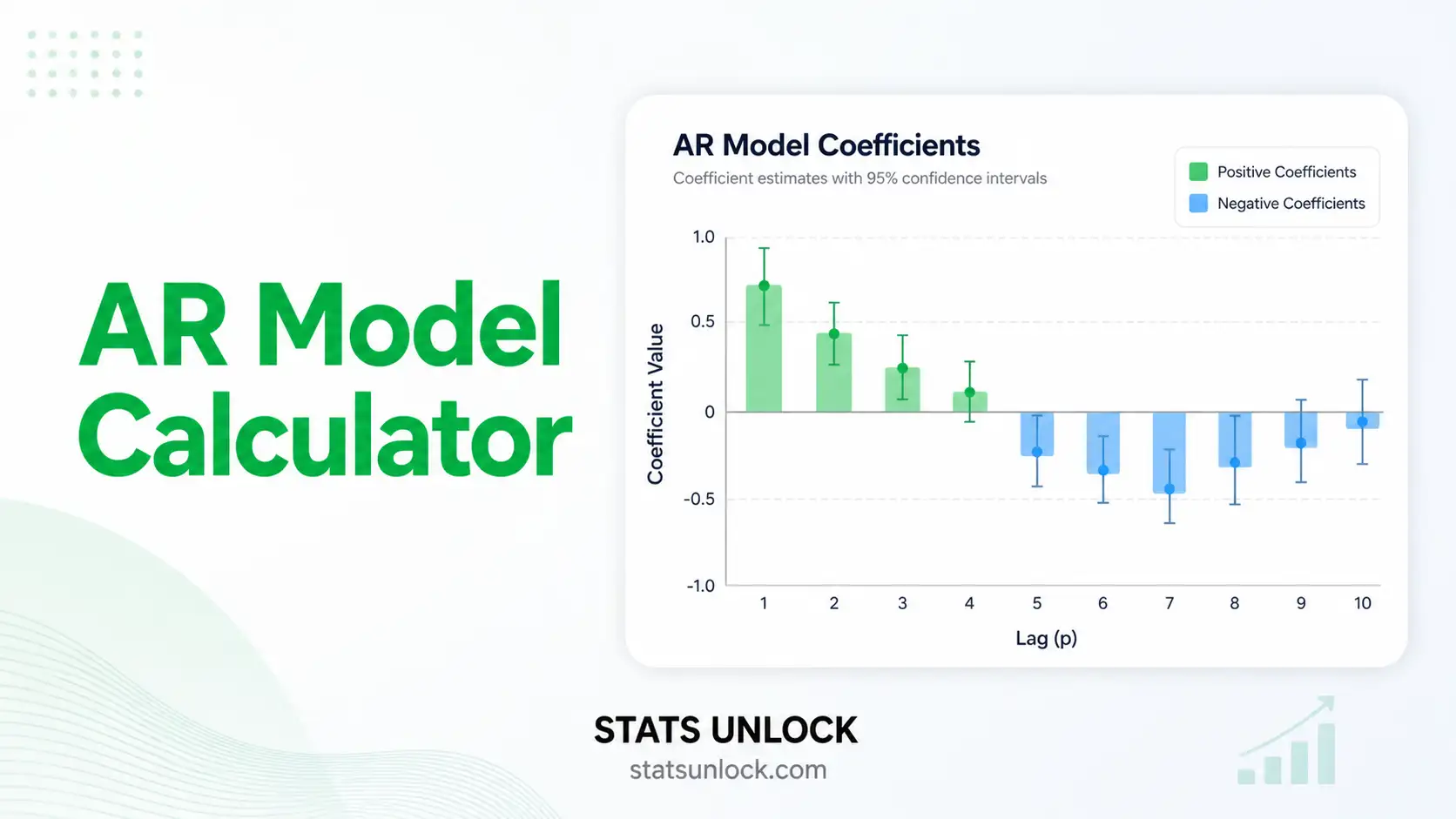

📈 AR Model Calculator
Fit AutoRegressive AR(p) models to time series data — estimate coefficients, test stationarity, view ACF/PACF plots, and generate publication-ready results instantly.
Step 1 — Enter Your Time Series Data
Paste comma-separated numbers in time order (oldest first). Supports commas, spaces, or one value per line.
| # | Value |
|---|
Step 2 — Model Configuration
Start with p = 1 or 2. Use PACF cutoff or AIC/BIC to choose.
OLS is more flexible; Yule-Walker always yields a stationary solution.
Apply if ADF test rejects stationarity.
How to Use This AR Model Calculator
When to Use an AR Model
- Your data is a single variable measured repeatedly over time at equal intervals
- You expect the current value to depend on one or more previous values (temporal autocorrelation)
- You want to forecast future values based on past patterns
- You need to model persistence or momentum in a time series (e.g., weather, population dynamics)
- You have confirmed or suspect stationarity (or are willing to difference the series first)
- The PACF of your series cuts off sharply after lag p (suggesting an AR(p) structure)
Technical Notes — Formulas Used
Show / Hide Formula Cards
Conclusion
Why AutoRegressive Models Are Essential in Research
The AutoRegressive (AR) model is one of the most fundamental tools in time series analysis. It captures a simple but powerful idea: the past predicts the future. By expressing each observation as a weighted linear combination of its own previous values, AR models quantify temporal persistence — how strongly the recent history of a variable influences where it goes next.
AR models are used across every scientific discipline. In ecology and wildlife biology, they describe how animal population levels fluctuate over seasons — today's prey density depends partly on last month's prey density, which depends on the month before that. In climate science, AR models are foundational to understanding how temperature anomalies and rainfall indices carry information forward in time. In public health, patient vital sign trajectories between clinic visits follow autoregressive patterns. In economics, AR models were among the first tools used to model GDP and inflation — their simplicity and interpretability remain unmatched for many applications.
Selecting the right AR order (p) is a critical step. The PACF is the primary diagnostic: in a true AR(p) process, the PACF cuts off sharply after lag p, while the ACF decays gradually. Comparing AIC and BIC values across candidate orders provides a formal, data-driven way to choose p. Researchers should always prefer the model with the lowest AIC or BIC, while ensuring residuals are white noise (verified by the Ljung-Box test).
Stationarity is the most important assumption. A non-stationary series — one whose mean or variance changes over time — will produce AR coefficient estimates that are biased and forecasts that diverge to infinity. The ADF test provides a formal check: if it rejects the null hypothesis (unit root), the series is stationary and you can proceed. If not, first differencing (d=1) usually resolves the problem, converting a trending or random-walk series into a stationary one.
Key practical recommendations when using AR models:
- Always test for stationarity with the ADF test before fitting any AR model.
- Use the PACF to identify the candidate order, then confirm with AIC/BIC comparison.
- Check residual ACF and the Ljung-Box test — if residuals show autocorrelation, your model order may be too low, or MA components may be needed (suggesting ARIMA).
- Report both AIC and BIC, as they may disagree — BIC is more conservative (prefers simpler models).
- Forecasts from AR models become less reliable as the horizon grows. Widen confidence intervals and communicate uncertainty clearly in your reports.
- For seasonal data, consider SARIMA instead of a plain AR model to capture seasonal autocorrelation at fixed lags.
This free AR model calculator implements correct OLS and Yule-Walker estimation, delivers the full suite of model diagnostics, and produces APA-formatted write-up templates to make your results immediately publication-ready. Whether you are a wildlife biologist analysing population trends, a public health researcher tracking weekly case counts, or an economist modelling quarterly growth rates, the AR model is a robust, transparent, and well-understood starting point for any time series analysis.
Frequently Asked Questions
What is an AR model in statistics?
What is the difference between AR(1) and AR(2)?
How do I choose the AR order (p)?
What is the ADF test and when do I need it?
What do the AR coefficients (phi values) mean?
What is the Yule-Walker method?
How do I interpret AIC and BIC?
What should the residuals look like in a well-fitted AR model?
Can I use an AR model for ecological or wildlife data?
How do I report AR model results in APA 7th edition format?
What is the difference between an AR model and ARIMA?
What sample size is needed for a reliable AR model?
What is the Ljung-Box test in AR model diagnostics?
How does the AR model relate to autocorrelation?
What is model stationarity in an AR context?
References
The AR model calculator on this page is grounded in peer-reviewed methodology for autoregressive model estimation, time series stationarity testing, and AR model selection criteria. Key sources include foundational texts on AR model identification, Yule-Walker estimation, and ADF testing used in ecology, environmental science, and statistical research.
- Box, G. E. P., Jenkins, G. M., Reinsel, G. C., & Ljung, G. M. (2015). Time series analysis: Forecasting and control (5th ed.). Wiley. https://doi.org/10.1002/9781118619193
- Shumway, R. H., & Stoffer, D. S. (2017). Time series analysis and its applications: With R examples (4th ed.). Springer. https://doi.org/10.1007/978-3-319-52452-8
- Dickey, D. A., & Fuller, W. A. (1979). Distribution of the estimators for autoregressive time series with a unit root. Journal of the American Statistical Association, 74(366), 427–431. https://doi.org/10.2307/2286348
- Akaike, H. (1974). A new look at the statistical model identification. IEEE Transactions on Automatic Control, 19(6), 716–723. https://doi.org/10.1109/TAC.1974.1100705
- Schwarz, G. (1978). Estimating the dimension of a model. The Annals of Statistics, 6(2), 461–464. https://doi.org/10.1214/aos/1176344136
- Ljung, G. M., & Box, G. E. P. (1978). On a measure of lack of fit in time series models. Biometrika, 65(2), 297–303. https://doi.org/10.1093/biomet/65.2.297
- Brockwell, P. J., & Davis, R. A. (2016). Introduction to time series and forecasting (3rd ed.). Springer. https://doi.org/10.1007/978-3-319-29854-2
- Said, S. E., & Dickey, D. A. (1984). Testing for unit roots in autoregressive-moving average models of unknown order. Biometrika, 71(3), 599–607. https://doi.org/10.1093/biomet/71.3.599
- Burg, J. P. (1968). A new analysis technique for time series data. NATO Advanced Study Institute on Signal Processing. (Foundational paper on maximum entropy AR estimation)
- Tong, H. (1990). Non-linear time series: A dynamical system approach. Oxford University Press. https://doi.org/10.1093/oso/9780198522249.001.0001
- Turchin, P. (2003). Complex population dynamics: A theoretical/empirical synthesis. Princeton University Press. https://doi.org/10.1515/9781400847280 (AR models in population ecology)
- Royama, T. (1992). Analytical population dynamics. Springer. https://doi.org/10.1007/978-94-011-2916-9 (AR modelling of wildlife populations)
- Zuur, A. F., Ieno, E. N., & Smith, G. M. (2007). Analysing ecological data. Springer. https://doi.org/10.1007/978-0-387-45972-1
- Hyndman, R. J., & Athanasopoulos, G. (2021). Forecasting: Principles and practice (3rd ed.). OTexts. https://otexts.com/fpp3/
- Venables, W. N., & Ripley, B. D. (2002). Modern applied statistics with S (4th ed.). Springer. https://doi.org/10.1007/978-0-387-21706-2