

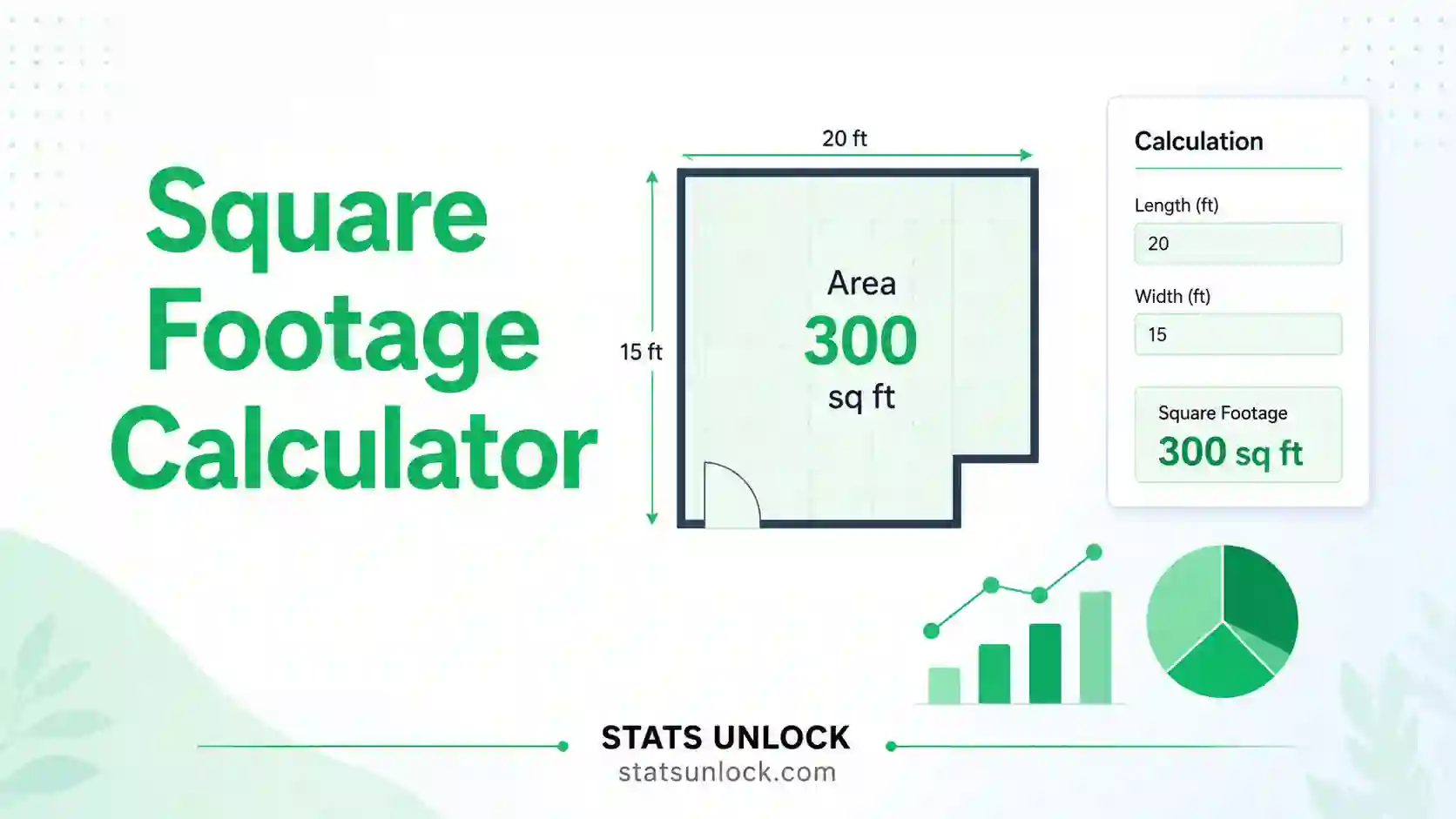

Square Footage Calculator
Enter your room in feet and inches and get the square footage instantly, across twenty shapes and nine units, from rectangles and triangles to circles, ellipses, hexagons, L-shapes and rooms with a cut out, with square yards, square metres, acres, waste allowance, flooring boxes, cubic yards and total cost.
Last updated: · Formulas checked against the worked example on this page · Free, no sign up
🧮 1. Calculator
Inputs
Advanced options: waste, boxes, cost and depth
Add more rooms for a total square footage
Each extra room is measured in plain feet, length times width. The totals below add them to the shape above.
Your Result
Floor area and waste appear here once you calculate.
___
Calculate first, then download your square footage as a plain text file.
📊 2. Your Results
⚡ Quick Answer
A square footage calculator multiplies the length of an area by its width, both measured in feet, to give the area in square feet.
To calculate square footage of a room, measure the length and the width in feet, turn any leftover inches into a decimal by dividing them by 12, then multiply the two numbers. A room 12 ft 6 in long and 10 ft 3 in wide is 12.5 × 10.25 = 128.13 square feet. For a shape that is not a rectangle, split it into rectangles, triangles and part circles, work out each piece, and add them up.
Rule of thumb: always add a waste allowance before you buy. Use 10% for a straight lay, 15% for diagonal or herringbone, and 20% for a patterned or heavily cut floor.
Key Takeaways
- A square footage calculator needs only two numbers for a normal room: length in feet and width in feet.
- Turn inches into feet by dividing by 12, so 6 inches is 0.5 ft and 3 inches is 0.25 ft.
- One square yard is 9 square feet, one square metre is 10.7639 square feet, and one acre is 43,560 square feet.
- Buy 10 to 15% more flooring than your measured area, because offcuts, pattern matching and breakages are normal.
- For concrete, mulch or soil, cubic yards = square feet × depth in inches ÷ 324.
- Measure at floor level, not at waist height, and measure each wall separately, because very few rooms are truly square.
📑 3. What Is Square Footage?
Square footage is the size of a flat surface measured in square feet. One square foot is the area of a square that is one foot long on every side. If you could tile a room with squares that each measure 12 inches by 12 inches, the number of tiles you would need is the square footage of that room.
It is a measure of area, not of length. Length answers "how far", area answers "how much surface". That is why square footage is written as ft² or sq ft, with the small two meaning the unit has been multiplied by itself.
3.1 A worked one-liner
A bedroom that is 12 feet 6 inches long and 10 feet 3 inches wide has 12.5 × 10.25 = 128.13 square feet of floor.
3.2 What a square foot actually looks like
3.3 Who uses square footage and why
- Home owners buying flooring, carpet, tile, laminate, turf or paint.
- Renters and buyers comparing two homes by size rather than by photos.
- Landscapers ordering mulch, topsoil, gravel or grass seed for a lawn or a yard.
- Builders and estimators pricing work per square foot.
- Landlords and agents quoting rent per square foot for offices and shops.
- Insurers and valuers estimating rebuild cost from floor area.
3.4 Square footage against the nearest alternatives
| Measure | What it tells you | Unit | Use it when |
|---|---|---|---|
| Square footage (area) | How much flat surface there is | sq ft | Flooring, paint, turf, rent, listings |
| Linear footage (length) | How far along one line | ft | Skirting, trim, fencing, gutters |
| Cubic footage (volume) | How much space is filled | cu ft | Storage, shipping, air conditioning |
| Cubic yards (volume) | How much loose material to order | cu yd | Concrete, mulch, soil, gravel |
| Acres (large area) | How big a plot of land is | acre | Lots, fields, farms, development sites |
| Square metres (area) | The same area in metric | m² | Most of the world outside the USA |
A common and expensive mistake is ordering skirting board by square footage. Skirting is bought by linear feet, which is the distance around the room, not the area of the floor.
🔎 4. What Does Your Square Footage Mean?
Your square footage tells you how much flat surface you have to cover, price, or fill. Under 100 sq ft is a small area, 100 to 200 sq ft is an average sized room, 200 to 400 sq ft is a large room, and anything over 1,000 sq ft is whole home scale. Compare your number against those bands, then add a waste allowance before you buy.
4.1 What your square footage means
4.2 Where your area sits against typical rooms
4.3 How much material you actually need to buy
4.4 The same area in other units
4.5 Why the number changes when you round
Rounding a measurement to the nearest foot changes the answer more than people expect, because the error is multiplied twice. Rounding 12 ft 6 in down to 12 ft and 10 ft 3 in down to 10 ft turns 128.13 sq ft into 120 sq ft. That is 6.3% less, which is most of a waste allowance thrown away. Always keep the inches.
4.6 What changes your square footage
- Alcoves, bays and chimney breasts. Measure them as separate small rectangles and add or subtract them, or use the L-shape, U-shape or cut out options.
- Fitted furniture. For flooring, most installers still run the floor under fitted units, so measure the full room.
- Doorways and thresholds. A door reveal adds a small rectangle of floor that still needs covering.
- Out of square walls. If two opposite walls differ by more than an inch, measure both and use the longer one.
- Sloping ceilings. Floor area does not change, but usable area and some legal definitions do.
4.7 What to do next
- Write down your square footage and the waste percentage you used.
- Check the coverage printed on the box of the product you want.
- Divide the total needed by the coverage and round up to a whole box.
- Buy one extra box for future repairs if the product is likely to be discontinued.
- Keep the offcuts until the job is signed off.
4.8 Common mistakes this calculator prevents
- Treating 12 ft 6 in as 12.6 ft. It is 12.5 ft, because inches are twelfths, not tenths.
- Multiplying feet by inches and getting a number with no meaning.
- Dividing square feet by 3 to get square yards. The correct divisor is 9.
- Forgetting the waste allowance and running out of flooring on the last row.
- Using a room's square footage to buy skirting board, which is sold by the linear foot.
- Adding up rooms measured in different units without converting first.
4.9 A sanity check you can do in your head
📋 5. How Do You Use Your Square Footage?
Use your square footage three ways: to order material, to price a job, and to compare spaces. Multiply the area including waste by the price per square foot to get a budget, divide it by the coverage on the box to get a box count, and quote the same figure in square metres when talking to a metric supplier. Never order trim or skirting from it.
Five ready to copy blocks. Each one fills in with your own numbers once you press Calculate.
1. A plain summary to save or share
2. What to ask your flooring supplier or contractor
3. Your shopping list and budget
4. A re-measure checklist before you order
5. A formal line for a quote, a listing or a document
🔢 6. What Is the Square Footage Formula?
The square footage formula for a normal room is the first card. The cards below it move outward to inches, other shapes, unit conversions, material and volume. Every one of the twenty shapes in the dropdown is listed with its own formula in Table 11.8.
Circle: A = π × (d ÷ 2)²
Trapezoid: A = ½ × (a + b) × h
L-shape: A = (L1 × W1) + (L2 × W2)
m² = A × 0.09290304
acre = A ÷ 43,560
in² = A × 144
Boxes: B = T ÷ c, rounded up
Cost: C = T × p
🛠 7. How to Use This Calculator
Ten steps, carried through one worked example: a bedroom 12 ft 6 in by 10 ft 3 in that is getting laminate flooring at $3.50 per square foot.
- Choose your measurement unit. Nine are offered, from feet and inches through to millimetres and kilometres. Leave it on "Feet and inches" if you measured with a tape. Our bedroom was measured that way.
- Choose the shape. The dropdown holds twenty shapes in five groups. A normal four walled room is "Rectangle or room", which is what our bedroom is.
- Type the length. Enter 12 in the feet box and 6 in the inches box. The calculator turns that into 12.5 ft.
- Type the width. Enter 10 in the feet box and 3 in the inches box, which becomes 10.25 ft.
- Set how many identical areas. Leave it at 1 for a single bedroom. Set it to 3 if you have three bedrooms of the same size.
- Open Advanced options. Set the waste allowance to 10% for a straight lay laminate.
- Enter the coverage and the price. Our laminate covers 20 sq ft per box and costs 3.50 per square foot.
- Add more rooms if you want a whole home total. Open "Add more rooms" and enter each extra room's length and width in plain feet.
- Press Calculate Square Footage. The panel on the right shows 128.13 sq ft and its size band straight away.
- Read Section 2 and download. You get 14.24 square yards, 11.90 square metres, 0.0029 acres, 140.94 sq ft to buy, 8 boxes and a cost of about $493.28. Use Download TXT or Download PDF to keep it.
📈 8. How to Calculate Square Footage in Excel
This section shows how to calculate square footage in Excel or Google Sheets, using the same bedroom as everywhere else on this page: 12 ft 6 in by 10 ft 3 in, which is 128.13 sq ft.
8.1 The functions you need
| Function | What it does | Example | Result |
|---|---|---|---|
=B2*C2 | Multiplies length by width | =12.5*10.25 | 128.125 |
ROUND | Rounds to a set number of decimals | =ROUND(128.125,2) | 128.13 |
ROUNDUP | Always rounds up, needed for boxes | =ROUNDUP(7.047,0) | 8 |
SUM | Totals the square footage of many rooms | =SUM(H2:H4) | 273.82 |
PI() | Gives pi for circular areas | =PI()*(10/2)^2 | 78.54 |
SQRT | Square root, needed for Heron's formula | =SQRT(1600) | 40 |
CONVERT | Converts units directly | =CONVERT(128.125,"ft2","m2") | 11.9032 |
CEILING | Rounds up to a multiple, an alternative to ROUNDUP | =CEILING(140.94,20) | 160 |
CONVERT needs the Analysis ToolPak in very old versions of Excel. In Excel 2010 and later, and in Google Sheets, it is built in.
8.2 Step by step
8.1 Step 1: put the raw tape measurements in a sheet
Keep feet and inches in separate columns. Do not try to type 12.6 for 12 ft 6 in, because that is a different length. Columns B and C are the length, columns D and E are the width.
8.2 Step 2: turn feet and inches into decimal feet
Columns F and G hold the decimal feet. Type these two formulas into row 2, then drag the fill handle down to copy them to every room. Excel divides the inches by 12 and adds them to the feet.
F2: =B2+C2/12G2: =D2+E2/128.3 Step 3: calculate the square footage
Column H is the square footage. This is the square footage formula in Excel: length times width, rounded to two decimal places for display. The second formula totals every room, which gives 273.82 sq ft here.
H2: =ROUND(F2*G2,2)Total: =SUM(H2:H4)8.4 Step 4: add waste and count the boxes
On a fresh sheet, put the square footage in A2 and the waste percentage in B2. These two formulas give the total to buy and the box count, where 20 is the coverage printed on the carton. Always use ROUNDUP and never ROUND: you cannot buy 7.05 boxes, and 7 boxes leaves you short.
C2: =A2*(1+B2/100)D2: =ROUNDUP(C2/20,0)8.5 Step 5: convert to other units and to volume
With the square footage in A2, these four formulas fill the rest of the row. Format the acres cell with more decimal places or it will display as 0.00.
B2: =A2/9 (square yards)C2: =A2*0.09290304 (square metres)D2: =A2/43560 (acres)E2: =A2*4/324 (cubic yards at 4 in)=ROUNDUP(C2/$B$8,0), so the formula still points at the right cell when you drag it down a list of rooms.8.3 The awkward cases
- Fractions of an inch. Type
=12+6.5/12for 12 ft 6½ in. Typing 6 1/2 into a plain cell may be read as a date. - A whole measurement typed as text.
12' 6"is text, not a number, and multiplying it gives#VALUE!. Keep feet and inches in separate numeric columns. - Circles. Use
=PI()*(A2/2)^2with the diameter in A2. Squaring the diameter instead of the radius gives an answer four times too large. - Three sided plots. Heron's formula in one cell:
=SQRT(((A2+B2+C2)/2)*(((A2+B2+C2)/2)-A2)*(((A2+B2+C2)/2)-B2)*(((A2+B2+C2)/2)-C2)). - Acres. 0.0029 acres displays as 0.00 with the default two decimal places. Increase the decimals on that cell.
ROUND if the stored number must match the printed one.8.4 Why answers differ across software
- Display rounding versus stored value. This tool rounds only for display and calculates at full precision, which is what Excel does too. A calculator that rounds each room to two decimals before adding will drift by a few hundredths across a whole house.
- The square metre constant. This tool and Excel's
CONVERTboth use 0.09290304 exactly. Some websites use 0.0929, which is 0.003% low, about 0.004 m² on our bedroom. - Rounding boxes. Excel's
ROUND(7.047,0)gives 7.ROUNDUPgives 8. This tool always rounds boxes up, because 7 boxes does not finish the floor. - Pi.
PI()carries 15 digits. A page using 3.14 is 0.05% low on a circular area.
8.5 Charting it in Excel
Select the room names and the square footage column, then Insert, Charts, Pie for the share each room contributes, or Insert, Charts, Bar for a straight comparison. Add data labels and set them to show the value, so the square footage is printed on the chart itself. To show your room against typical sizes, add a second series holding the typical values and choose a clustered bar chart.
8.6 Error messages and what they mean
| Error | Cause | Fix |
|---|---|---|
#VALUE! | One of the cells holds text, such as 12'6" or 12 ft | Retype it as a plain number, keeping inches in their own column |
#DIV/0! | Coverage per box is empty or zero | Enter the real coverage from the carton, or leave the box count out |
#NUM! | Heron's formula got three sides that cannot form a triangle | Re-measure. Any two sides must add up to more than the third |
##### | The column is too narrow to show the number | Widen the column. The value is fine |
#NAME? | CONVERT is unavailable in a very old Excel | Enable the Analysis ToolPak, or multiply by 0.09290304 by hand |
Google Sheets: every formula above works unchanged. The one difference is that Sheets has no Analysis ToolPak, because CONVERT is always available.
📊 9. How to Calculate Square Footage in R
One script, complete and runnable from top to bottom. It uses the same three rooms as Section 8, so the bedroom comes out at 128.13 sq ft.
9.1 The complete script
# ============================================================
# Square Footage Calculator in R
# Stats Unlock - statsunlock.com
# Change only the MEASUREMENTS block below, then run the whole file.
# ============================================================

# ---- 1. MEASUREMENTS (change these) -------------------------
rooms <- data.frame(
  room       = c("Bedroom", "Hall", "Kitchen"),
  length_ft  = c(12, 8, 11),      # whole feet
  length_in  = c(6,  0, 3),       # leftover inches
  width_ft   = c(10, 4, 9),
  width_in   = c(3,  6, 9),
  stringsAsFactors = FALSE
)

waste_pct     <- 10      # 10 straight lay, 15 diagonal, 20 patterned
coverage_sqft <- 20      # square feet per box, from the carton
price_per_sqft<- 3.50    # your currency per square foot
depth_inches  <- 4       # depth for cubic yards, 0 to skip

# Reading from a file instead:
# rooms <- read.csv("rooms.csv", stringsAsFactors = FALSE)
# rooms <- rooms[complete.cases(rooms), ]   # drop rows with missing values

# ---- 2. CONVERT FEET AND INCHES TO DECIMAL FEET -------------
to_feet <- function(ft, inches) ft + inches / 12

rooms$L <- to_feet(rooms$length_ft, rooms$length_in)
rooms$W <- to_feet(rooms$width_ft,  rooms$width_in)

# ---- 3. SQUARE FOOTAGE --------------------------------------
rooms$sqft <- rooms$L * rooms$W

total_sqft <- sum(rooms$sqft)

# ---- 4. CONVERSIONS AND MATERIALS ---------------------------
sq_yards  <- total_sqft / 9
sq_metres <- total_sqft * 0.09290304
acres     <- total_sqft / 43560
sq_inches <- total_sqft * 144

to_buy <- total_sqft * (1 + waste_pct / 100)
boxes  <- if (coverage_sqft > 0) ceiling(to_buy / coverage_sqft) else NA
cost   <- to_buy * price_per_sqft
cu_yd  <- if (depth_inches > 0) total_sqft * depth_inches / 324 else NA

# ---- 5. PLAIN ENGLISH VERDICT -------------------------------
band <- as.character(cut(total_sqft,
  breaks = c(-Inf, 100, 200, 400, 1000, Inf),
  labels = c("a small area", "an average sized room", "a large room",
             "a very large space", "whole home scale"),
  right  = FALSE))

cat("\n=== SQUARE FOOTAGE RESULT ===\n")
print(round(rooms[, c("room", "L", "W", "sqft")], 2))
cat(sprintf("\nTotal square footage : %.2f sq ft\n", total_sqft))
cat(sprintf("That is %s.\n", band))
cat(sprintf("Square yards         : %.2f\n", sq_yards))
cat(sprintf("Square metres        : %.2f\n", sq_metres))
cat(sprintf("Acres                : %.4f\n", acres))
cat(sprintf("Square inches        : %.0f\n", sq_inches))
cat(sprintf("Buy with %g%% waste   : %.2f sq ft\n", waste_pct, to_buy))
if (!is.na(boxes)) cat(sprintf("Boxes needed         : %d\n", boxes))
cat(sprintf("Estimated cost       : %.2f\n", cost))
if (!is.na(cu_yd)) cat(sprintf("Cubic yards at %g in : %.2f\n", depth_inches, cu_yd))

# ---- 6. FIGURE AT 300 DPI -----------------------------------
png("square_footage.png", width = 2400, height = 1500, res = 300)
op <- par(mar = c(5, 7, 4, 2))
bp <- barplot(rooms$sqft,
              names.arg = rooms$room,
              horiz = TRUE, las = 1,
              col = "#1d4ed8", border = NA,
              xlab = "Square feet",
              main = sprintf("Square footage by room (total %.2f sq ft)", total_sqft),
              xlim = c(0, max(rooms$sqft) * 1.25))
text(rooms$sqft, bp, labels = sprintf("%.2f", rooms$sqft), pos = 4, cex = 0.8)
par(op)
dev.off()
cat("\nSaved square_footage.png at 300 dpi\n")
cat("Generated by STATS UNLOCK - statsunlock.com\n")
There is no install.packages() step. This script runs in any R installation.
9.2 What each part of the script does
| Block | What it does |
|---|---|
| 1. MEASUREMENTS | The only block you edit. Feet and inches stay in separate columns so nothing is misread |
to_feet() | Turns feet and inches into decimal feet by dividing the inches by 12 |
| 3. SQUARE FOOTAGE | Multiplies length by width for each room, then sums them for the total |
| 4. CONVERSIONS | Square yards, square metres, acres, square inches, waste, boxes, cost and cubic yards |
ceiling() | Rounds the box count up. R has no half box, and neither does the shop |
cut() | Puts the total into a size band and returns a plain English label |
| 5. VERDICT | Prints every number with cat() and sprintf() so the output is readable |
| 6. FIGURE | Saves square_footage.png at 300 dpi, a horizontal bar of square footage by room |
9.3 What the figure shows
A horizontal bar chart, one bar per room, with the square footage printed at the end of each bar and the total in the title. The x axis is stretched 25% past the longest bar so the labels are never clipped. At 300 dpi and 2400 pixels wide the file is print quality, which is what a report or a quote needs.
9.4 Problems and fixes
| Problem | Cause | Fix |
|---|---|---|
argument of length 0 | A column name was mistyped, so R got an empty vector | Run names(rooms) and check the spelling |
| Every area is far too small | Inches were entered in the feet column | 12 ft 6 in is length_ft = 12, length_in = 6 |
could not find function "ceiling" | A typo. It is not ceil() in R | Use ceiling() |
| The png file is empty | dev.off() was never reached because of an error above it | Run dev.off() once by hand, then run the script again |
| Acres print as 0.0000 | Small numbers with too few digits | The script already uses %.4f. Increase it to %.6f for tiny plots |
| The read.csv line fails | The file is not in the working directory | Run getwd() and either move the file or give a full path |
9.5 One-liners
| Task | R |
|---|---|
| Square footage of one room | (12 + 6/12) * (10 + 3/12) |
| Square feet to square metres | 128.125 * 0.09290304 |
| Square feet to acres | 128.125 / 43560 |
| Circle from a diameter | pi * (10/2)^2 |
| Triangle from three sides | s <- (a+b+c)/2; sqrt(s*(s-a)*(s-b)*(s-c)) |
| Boxes needed | ceiling(140.9375 / 20) |
🐍 10. How to Calculate Square Footage in Python
The same three rooms again, so the bedroom is 128.13 sq ft and the three room total is 273.81 sq ft.
10.1 The complete script
# ============================================================
# Square Footage Calculator in Python
# Stats Unlock - statsunlock.com
# Change only the MEASUREMENTS block below, then run the whole file.
# pip install pandas matplotlib
# ============================================================

import math
from decimal import Decimal, ROUND_HALF_UP

import pandas as pd
import matplotlib
matplotlib.use("Agg")
import matplotlib.pyplot as plt

# ---- 1. MEASUREMENTS (change these) -------------------------
rooms = pd.DataFrame({
    "room":      ["Bedroom", "Hall", "Kitchen"],
    "length_ft": [12, 8, 11],     # whole feet
    "length_in": [6,  0, 3],      # leftover inches
    "width_ft":  [10, 4, 9],
    "width_in":  [3,  6, 9],
})

waste_pct      = 10      # 10 straight lay, 15 diagonal, 20 patterned
coverage_sqft  = 20      # square feet per box, from the carton
price_per_sqft = 3.50    # your currency per square foot
depth_inches   = 4       # depth for cubic yards, 0 to skip

# Reading from a file instead:
# rooms = pd.read_csv("rooms.csv")
# rooms = rooms.dropna()          # drop rows with missing values

# ---- 2. CONVERT FEET AND INCHES TO DECIMAL FEET -------------
def to_feet(ft, inches):
    return ft + inches / 12

rooms["L"] = to_feet(rooms["length_ft"], rooms["length_in"])
rooms["W"] = to_feet(rooms["width_ft"],  rooms["width_in"])

# ---- 3. SQUARE FOOTAGE --------------------------------------
rooms["sqft"] = rooms["L"] * rooms["W"]
total_sqft = rooms["sqft"].sum()

# Python's built-in round() uses banker's rounding, so round(128.125, 2)
# gives 128.12 while Excel gives 128.13. Use this helper to match Excel.
def round_half_up(x, places=2):
    q = Decimal(10) ** -places
    return float(Decimal(str(x)).quantize(q, rounding=ROUND_HALF_UP))

# ---- 4. CONVERSIONS AND MATERIALS ---------------------------
sq_yards  = total_sqft / 9
sq_metres = total_sqft * 0.09290304
acres     = total_sqft / 43560
sq_inches = total_sqft * 144

to_buy = total_sqft * (1 + waste_pct / 100)
boxes  = math.ceil(to_buy / coverage_sqft) if coverage_sqft > 0 else None
cost   = to_buy * price_per_sqft
cu_yd  = total_sqft * depth_inches / 324 if depth_inches > 0 else None

# ---- 5. PLAIN ENGLISH VERDICT -------------------------------
if total_sqft < 100:
    band = "a small area"
elif total_sqft < 200:
    band = "an average sized room"
elif total_sqft < 400:
    band = "a large room"
elif total_sqft < 1000:
    band = "a very large space"
else:
    band = "whole home scale"

print("\n=== SQUARE FOOTAGE RESULT ===")
print(rooms[["room", "L", "W", "sqft"]].round(2).to_string(index=False))
print(f"\nTotal square footage : {round_half_up(total_sqft):.2f} sq ft")
print(f"That is {band}.")
print(f"Square yards         : {round_half_up(sq_yards):.2f}")
print(f"Square metres        : {round_half_up(sq_metres):.2f}")
print(f"Acres                : {round_half_up(acres, 4):.4f}")
print(f"Square inches        : {sq_inches:.0f}")
print(f"Buy with {waste_pct}% waste   : {round_half_up(to_buy):.2f} sq ft")
if boxes is not None:
    print(f"Boxes needed         : {boxes}")
print(f"Estimated cost       : {round_half_up(cost):.2f}")
if cu_yd is not None:
    print(f"Cubic yards at {depth_inches} in : {round_half_up(cu_yd):.2f}")

# ---- 6. FIGURE AT 300 DPI -----------------------------------
fig, ax = plt.subplots(figsize=(8, 5), dpi=300)
ax.barh(rooms["room"], rooms["sqft"], color="#1d4ed8")
for y, v in enumerate(rooms["sqft"]):
    ax.text(v * 1.01, y, f"{round_half_up(v):.2f}", va="center", fontsize=8)
ax.set_xlabel("Square feet")
ax.set_xlim(0, rooms["sqft"].max() * 1.25)
ax.set_title(f"Square footage by room (total {round_half_up(total_sqft):.2f} sq ft)")
ax.invert_yaxis()
fig.tight_layout()
fig.savefig("square_footage.png", dpi=300)
plt.close(fig)

print("\nSaved square_footage.png at 300 dpi")
print("Generated by STATS UNLOCK - statsunlock.com")
Install the two third-party packages with pip install pandas matplotlib.
10.2 What each part of the script does
| Block | What it does |
|---|---|
| 1. MEASUREMENTS | The only block you edit. A small DataFrame of rooms, with feet and inches kept apart |
to_feet() | Divides the inches by 12 and adds them to the feet |
| 3. SQUARE FOOTAGE | Length times width per room, then .sum() for the total |
round_half_up() | Uses decimal so the printed numbers match Excel instead of banker's rounding |
math.ceil() | Rounds the box count up to a whole box |
| 5. VERDICT | An if chain that turns the total into a size band, then prints every result |
matplotlib.use("Agg") | Draws without a screen, so the script runs on a server or in a notebook |
| 6. FIGURE | Saves square_footage.png at 300 dpi with the value printed on each bar |
10.3 What the figure shows
The same horizontal bar chart as the R script, one bar per room, values printed at the end of each bar, the total in the title, and the y axis inverted so the first room in your table appears at the top. It is saved at 300 dpi, which is print quality.
10.4 Problems and fixes
| Problem | Cause | Fix |
|---|---|---|
ModuleNotFoundError: pandas | The package is not installed in this environment | Run pip install pandas matplotlib |
| The bedroom prints as 128.12, not 128.13 | Python's built-in round() uses banker's rounding, so an exact .125 goes to the even digit | Use the round_half_up() helper in the script, which matches Excel and this calculator |
| The three room total is 273.81 here but 273.82 in Excel | Excel rounded each room to two decimals first, then added. Python added at full precision | Neither is wrong. Round once, at the end, unless a contract says otherwise |
| Every area is far too small | Inches went into the feet column | 12 ft 6 in is length_ft = 12, length_in = 6 |
| A blank window opens and nothing saves | plt.show() was used instead of savefig | Keep matplotlib.use("Agg") and fig.savefig() |
ZeroDivisionError | Coverage per box was set to 0 | The script already guards this. Keep the if coverage_sqft > 0 check |
10.5 One-liners
| Task | Python |
|---|---|
| Square footage of one room | (12 + 6/12) * (10 + 3/12) |
| Square feet to square metres | 128.125 * 0.09290304 |
| Square feet to acres | 128.125 / 43560 |
| Circle from a diameter | import math; math.pi * (10/2)**2 |
| Triangle from three sides | s = (a+b+c)/2; math.sqrt(s*(s-a)*(s-b)*(s-c)) |
| Boxes needed | math.ceil(140.9375 / 20) |
📋 11. Reference Tables
Nine lookup tables. This is the square footage chart section: use it to check an answer, to convert a unit, or to sanity check a room size without typing anything.
Table 11.1 Inches to decimal feet
| Inches | Decimal feet | Inches | Decimal feet |
|---|---|---|---|
| 1 in | 0.0833 | 7 in | 0.5833 |
| 2 in | 0.1667 | 8 in | 0.6667 |
| 3 in | 0.2500 | 9 in | 0.7500 |
| 4 in | 0.3333 | 10 in | 0.8333 |
| 5 in | 0.4167 | 11 in | 0.9167 |
| 6 in | 0.5000 | 12 in | 1.0000 |
What to conclude: inches are twelfths, not tenths. 6 inches is 0.5 ft and 3 inches is 0.25 ft. If you ever write 12.6 ft for 12 ft 6 in, your area will be about 1% too large.
Table 11.2 Square footage chart for common room sizes
| Room size (ft) | Square feet | Square metres | Square yards | Typical use |
|---|---|---|---|---|
| 8 × 8 | 64 | 5.95 | 7.11 | Small box bedroom, home office |
| 10 × 10 | 100 | 9.29 | 11.11 | Small bedroom, storage unit |
| 10 × 12 | 120 | 11.15 | 13.33 | Standard second bedroom |
| 12 × 12 | 144 | 13.38 | 16.00 | Average bedroom, small dining room |
| 12 × 14 | 168 | 15.61 | 18.67 | Large bedroom |
| 12 × 16 | 192 | 17.84 | 21.33 | Master bedroom, small living room |
| 14 × 20 | 280 | 26.01 | 31.11 | Living room |
| 20 × 20 | 400 | 37.16 | 44.44 | Two car garage, open plan area |
| 20 × 30 | 600 | 55.74 | 66.67 | Large open plan floor, small apartment |
What to conclude: most bedrooms land between 100 and 200 sq ft. If your answer is far outside that, check whether you measured in inches by mistake, or missed a foot on the tape.
Table 11.3 Square feet to other area units
| Square feet | Square inches | Square yards | Square metres | Acres |
|---|---|---|---|---|
| 1 | 144 | 0.1111 | 0.0929 | 0.000023 |
| 10 | 1,440 | 1.111 | 0.929 | 0.00023 |
| 100 | 14,400 | 11.11 | 9.290 | 0.0023 |
| 500 | 72,000 | 55.56 | 46.45 | 0.0115 |
| 1,000 | 144,000 | 111.1 | 92.90 | 0.0230 |
| 2,000 | 288,000 | 222.2 | 185.8 | 0.0459 |
| 5,000 | 720,000 | 555.6 | 464.5 | 0.1148 |
| 10,000 | 1,440,000 | 1,111 | 929.0 | 0.2296 |
| 43,560 | 6,272,640 | 4,840 | 4,046.86 | 1.0000 |
What to conclude: one acre is exactly 43,560 sq ft and exactly 4,840 sq yd. To convert square footage to acres, divide by 43,560. To convert acres to square footage, multiply by 43,560.
Table 11.4 Waste allowance by installation type
| Installation | Waste to add | Buy for a 128.13 sq ft room | Why |
|---|---|---|---|
| Straight lay plank or tile, square room | 10% | 140.94 sq ft | Normal end cuts and a few damaged pieces |
| Straight lay, room with alcoves | 12% | 143.50 sq ft | Extra cuts around each obstruction |
| Diagonal or herringbone | 15% | 147.34 sq ft | Every edge piece is cut at an angle |
| Large format tile | 15% | 147.34 sq ft | An offcut is too big to use elsewhere |
| Patterned carpet or vinyl | 20% | 153.75 sq ft | Pattern repeats must line up across seams |
| Sheet vinyl, one piece | Buy the roll width | Roll width × room length | You buy a rectangle, not an area |
What to conclude: waste is not optional. The most common flooring complaint is running short on the final row, and a part box costs far more per square foot than the original order.
Table 11.5 Coverage per box and boxes needed
| Product | Typical coverage per box | Boxes for 140.94 sq ft | Leftover |
|---|---|---|---|
| Laminate plank | 20 sq ft | 8 | 19.06 sq ft |
| Engineered wood | 24 sq ft | 6 | 3.06 sq ft |
| Luxury vinyl plank | 30 sq ft | 5 | 9.06 sq ft |
| Ceramic tile, 12 in | 15 sq ft | 10 | 9.06 sq ft |
| Large format tile, 24 in | 16 sq ft | 9 | 3.06 sq ft |
| Interior paint, one coat | 350 sq ft per gallon | 1 gallon | 209 sq ft of coverage |
What to conclude: always round the box count up. Coverage figures are the manufacturer's, so check the carton, because they vary by range and by country.
Table 11.6 Square feet to cubic yards by depth
| Area | 2 in deep | 3 in deep | 4 in deep | 6 in deep |
|---|---|---|---|---|
| 100 sq ft | 0.62 cu yd | 0.93 cu yd | 1.23 cu yd | 1.85 cu yd |
| 128.13 sq ft | 0.79 cu yd | 1.19 cu yd | 1.58 cu yd | 2.37 cu yd |
| 250 sq ft | 1.54 cu yd | 2.31 cu yd | 3.09 cu yd | 4.63 cu yd |
| 500 sq ft | 3.09 cu yd | 4.63 cu yd | 6.17 cu yd | 9.26 cu yd |
| 1,000 sq ft | 6.17 cu yd | 9.26 cu yd | 12.35 cu yd | 18.52 cu yd |
What to conclude: the whole table comes from one line, cubic yards = square feet times depth in inches divided by 324. Concrete suppliers usually sell in quarter yard steps, so round up to the next quarter.
Table 11.7 Which unit each trade sells in
| Item | Sold by | What to measure | Common mistake |
|---|---|---|---|
| Laminate, vinyl, tile, carpet tile | Square feet or square metres | Floor area | Forgetting waste |
| Broadloom carpet | Square yards, or by roll width | Floor area and room width | Dividing sq ft by 3 instead of 9 |
| Skirting, trim, coving | Linear feet | Perimeter of the room | Ordering by floor area |
| Paint | Gallons or litres | Wall area minus doors and windows | Forgetting the second coat |
| Concrete, mulch, topsoil, gravel | Cubic yards | Area and depth | Ordering by square feet |
| Turf and sod | Square feet or by the roll | Lawn area | Not subtracting beds and paths |
| Land | Acres or square feet | Plot area | Mixing frontage with area |
What to conclude: square footage is the right measure for surfaces. It is the wrong measure for anything sold by length or by volume, and that is where most over ordering and under ordering happens.
Table 11.8 Every shape and its square footage formula
| Shape | What to measure | Formula | Worked example (sq ft) |
|---|---|---|---|
| Rectangle or room | Length, Width | A = L × W | 12 × 10 = 120.00 |
| Square | Side | A = s² | 9 × 9 = 81.00 |
| Parallelogram | Base, Perpendicular height | A = b × h | 14 × 6 = 84.00 |
| Trapezoid | Both parallel sides, Height | A = ½(a + b)h | ½(10+14)×8 = 96.00 |
| Rhombus or kite | Both diagonals | A = ½ d₁ d₂ | ½×12×8 = 48.00 |
| Triangle | Base, Perpendicular height | A = ½ b h | ½×18×12 = 108.00 |
| Right angled triangle | The two short sides | A = ½ a b | ½×6×8 = 24.00 |
| Triangle, three sides | All three sides | Heron: A = √(s(s−a)(s−b)(s−c)) | sides 3, 4, 5 = 6.00 |
| Circle | Diameter | A = π(d ÷ 2)² | π×7² = 153.94 |
| Semicircle | Diameter | A = ½π(d ÷ 2)² | ½π×7² = 76.97 |
| Ellipse or oval | Long and short diameter | A = (π ÷ 4) d₁ d₂ | (π/4)×14×9 = 98.96 |
| Circular ring | Outer and inner diameter | A = (π ÷ 4)(D² − d²) | (π/4)(400−100) = 235.62 |
| Sector or pie slice | Diameter, Angle in degrees | A = (θ ÷ 360)π(d ÷ 2)² | 90° of a 20 ft circle = 78.54 |
| Regular pentagon | One side | A = 1.720477 × s² | 1.720477×10² = 172.05 |
| Regular hexagon | One side | A = 2.598076 × s² | 2.598076×8² = 166.28 |
| Regular octagon | One side | A = 4.828427 × s² | 4.828427×6² = 173.82 |
| L-shape | Two rectangles | A = L₁W₁ + L₂W₂ | (20×15)+(12×8) = 396.00 |
| U-shape or T-shape | Three rectangles | A = L₁W₁ + L₂W₂ + L₃W₃ | 300+96+24 = 420.00 |
| Room with a cut out | Room, then the cut out | A = LW − lw | (16×12)−(6×3) = 174.00 |
| Rectangular border | Outer sides, Border width | A = LW − (L−2t)(W−2t) | (24×16)−(20×12) = 144.00 |
What to conclude: every one of these is in the shape dropdown at the top of the page, grouped into straight sided, triangles, curved, regular polygons, and combined or cut out. If your area is not on this list, split it into pieces that are, work out each one, and add them together.
Table 11.9 The nine measurement units and how each converts to feet
| Unit | A 12 ft 6 in wall reads as | Use it for | How the calculator converts it |
|---|---|---|---|
| Feet and inches | 12 ft 6 in | Tape measure readings, the default | Inches are divided by 12 first |
| Feet, decimal | 12.5 ft | Plans and quotes already in decimal feet | Multiply straight through |
| Inches | 150 in | Small areas, tile and worktop offcuts | Divide by 12 to get feet |
| Yards | 4.1667 yd | Carpet and some landscaping | Multiply by 3 to get feet |
| Miles | 0.00237 mi | Large land parcels and corridors | Multiply by 5,280 to get feet |
| Metres | 3.81 m | Most of the world outside the USA | Multiply by 3.280839895 to get feet |
| Centimetres | 381 cm | Room plans drawn in centimetres | Multiply by 0.0328084 to get feet |
| Millimetres | 3,810 mm | Joinery, worktops and shop drawings | Multiply by 0.00328084 to get feet |
| Kilometres | 0.00381 km | Land, routes and site boundaries | Multiply by 3,280.84 to get feet |
What to conclude: the calculator converts everything to decimal feet first, then multiplies. Switching the unit converts the numbers you have already typed at full precision, so you can measure in millimetres and still read the answer in square feet.
📑 12. Example Results
Eight worked examples that cover the whole range: a textbook room, a whole home, a tiny closet, a borderline case, an extreme size, a case where the obvious reading is wrong, an invalid input, and one real world job.
| Item | Value |
|---|---|
| Shape | Rectangle |
| Length | 12 ft 6 in = 12.5 ft |
| Width | 10 ft 3 in = 10.25 ft |
| Square footage | 128.13 sq ft |
| Square metres | 11.90 m² |
| Square yards | 14.24 yd² |
| With 10% waste | 140.94 sq ft |
| Boxes at 20 sq ft | 8 |
What it means: This is an average sized bedroom. The inches matter: dropping them would give 120 sq ft, which is 6.3% short and would cost you a box of flooring on the last row.
How to use it: Order 8 boxes of laminate and keep the offcuts until the job is finished and signed off.
| Item | Value |
|---|---|
| Rooms | Living 280, Kitchen 180, Bed 1 192 |
| More rooms | Bed 2 144, Bed 3 120, Hall and bath 164 |
| Total square footage | 1,080 sq ft |
| Square metres | 100.34 m² |
| Acres | 0.0248 |
| With 10% waste | 1,188 sq ft |
| Cost at $3.50 | $4,158.00 |
| Band | Whole home scale |
What it means: Above 1,000 sq ft you are looking at a whole floor rather than a room. Adding rooms one at a time is far more reliable than measuring the outside of the building.
How to use it: Use this total for a flooring quote, then measure each room again individually before ordering, because a 1% error here is 11 sq ft.
| Item | Value |
|---|---|
| Shape | Rectangle |
| Length | 4 ft 0 in = 4.0 ft |
| Width | 2 ft 6 in = 2.5 ft |
| Square footage | 10.00 sq ft |
| Square inches | 1,440 |
| With 10% waste | 11.00 sq ft |
| Boxes at 20 sq ft | 1 |
| Band | Small area |
What it means: A very small area still needs a whole box. The waste percentage is almost meaningless here, because the minimum purchase is one box.
How to use it: Buy one box, or better, use offcuts left over from the room next door.
| Item | Value |
|---|---|
| Shape | Square |
| Length | 10 ft 0 in |
| Width | 10 ft 0 in |
| Square footage | 100.00 sq ft |
| Square metres | 9.29 m² |
| Band | Average sized room, just |
| Below the edge | 99.9 sq ft would read Small area |
| With 10% waste | 110.00 sq ft |
What it means: 100 sq ft sits exactly on the line between a small area and an average sized room. Bands are guides, not rules, so do not read anything into a result that is one square foot either side of an edge.
How to use it: Ignore the label and use the number. What matters for a purchase is 110 sq ft with waste, not which word the calculator prints.
| Item | Value |
|---|---|
| Shape | Rectangle |
| Length | 120 ft |
| Width | 90 ft |
| Square footage | 10,800 sq ft |
| Acres | 0.2479 |
| Square metres | 1,003.35 m² |
| Topsoil at 3 in | 100.00 cu yd |
| Band | Whole home scale |
What it means: The formula does not change with size, but the useful unit does. Nobody quotes a lawn in square inches, and above about 20,000 sq ft most people switch to acres.
How to use it: Use the acre figure when talking to a landscaper or a land agent, and the square footage when ordering turf or seed.
| Item | Value |
|---|---|
| Assumed shape | One 20 ft × 15 ft rectangle |
| Assumed area | 300.00 sq ft |
| Actual shape | L-shape with an 8 ft × 6 ft notch |
| Notch area | 48.00 sq ft |
| Actual square footage | 252.00 sq ft |
| Overestimate | 48 sq ft, or 19% |
| Cost of the error at $3.50 | $168.00 of unused flooring |
| Correct approach | Split into two rectangles and add |
What it means: The number looks fine and is completely wrong. Measuring the widest length and the widest width of an L-shaped room always overstates the area, sometimes by a fifth.
How to use it: Split any non rectangular room into rectangles that do not overlap, calculate each one, and add them. The L-shape option in this calculator does that for you.
| Item | Value |
|---|---|
| Length | 12 ft 6 in |
| Width | 0 |
| Result | No result |
| Message | Width must be greater than 0 |
| What is shown | An inline note under the field |
| What is not shown | NaN, Infinity or a blank number |
| Boxes | Not calculated |
| Cost | Not calculated |
What it means: A missing or zero measurement stops the calculation instead of producing a meaningless number. Zero times anything is zero, and a floor of 0 sq ft helps nobody.
How to use it: Go back to the field the message names, enter a real measurement, and press Calculate again.
| Item | Value |
|---|---|
| Shape | Circle |
| Diameter | 14 ft |
| Radius | 7 ft |
| Square footage | 153.94 sq ft |
| Square metres | 14.30 m² |
| Depth | 4 in |
| Concrete needed | 1.90 cu yd |
| Order | 2.00 cu yd, rounded to the next quarter yard |
What it means: The area comes from the radius, not the diameter. Squaring 14 instead of 7 would give 615.75 sq ft, four times too much, and four times too much concrete.
How to use it: Order 2 cubic yards. Concrete suppliers sell in quarter yard steps and a part load still carries a delivery charge, so rounding up is normal.
📏 13. How Do You Measure a Room for Square Footage?
Measure a room for square footage with a metal tape, at floor level, wall to wall. Take the length along one wall and the width along the wall next to it, then measure both of each pair of opposite walls, because few rooms are truly square. Write feet and inches separately, add alcoves and bays as their own rectangles, and measure everything twice.
Almost every wrong answer comes from a wrong measurement, not from wrong arithmetic. These twelve steps take about ten minutes for a normal room.
- Use a metal tape, not a cloth one. A cloth tape stretches, and a 25 ft metal tape locks so you can read it alone.
- Clear the edges. Push furniture back from at least one long wall and one short wall so the tape lies flat.
- Measure at floor level. Skirting boards, radiators and window sills all sit above the floor, and measuring at waist height gives a bigger room than the one you are covering.
- Hook the tape into the corner. Push the hook hard against the wall, keep the tape straight, and read it where it meets the far wall.
- Read to the nearest half inch, then round up. Rounding up gives you a small safety margin, which is the right direction to be wrong in.
- Measure both opposite walls. Very few rooms are truly square. If the two lengths differ, use the longer one.
- Measure alcoves and bays separately. Each one is a small rectangle. Write it down as its own room in the extra rooms list.
- Include the door reveal. The strip of floor inside the door frame still needs covering, usually about 5 inches deep by the door width.
- Subtract only permanent fixtures. Take off a kitchen island or a built in hearth. Do not take off a bed or a sofa.
- Write feet and inches separately. Write "12 ft 6 in", never "12.6", and never mix the two on one page.
- Sketch the room and label it. A rough plan with the numbers on it catches mistakes that a list of numbers hides.
- Measure it all again. A second pass takes two minutes and catches the misread foot that would have cost you a box of flooring.
13.1 The inputs, their units and their typical ranges
| Input | Unit | Typical range | Where you get it |
|---|---|---|---|
| Length | any of the nine units | 3 ft to 60 ft for rooms | Tape measure, wall to wall at floor level |
| Width | feet and inches | 2 ft to 40 ft for rooms | Tape measure, the shorter wall |
| Diameter | any of the nine units | 2 ft to 40 ft | Widest straight line across a circle or an oval |
| Angle (sector only) | degrees | 1 to 360 | Protractor or the plan. A quarter circle is 90 |
| Base and height (triangle) | feet | 2 ft to 60 ft | Height at a right angle to the base, not the slope |
| Border width | feet | 0.5 ft to 6 ft | Path or edging width, measured twice |
| Waste allowance | percent | 10 to 20 | Installer, or Table 11.4 above |
| Coverage per box | sq ft | 15 to 30 | Printed on the carton |
| Price per square foot | currency | 1 to 25 | Product page or written quote |
| Depth | inches | 2 to 8 for slabs and mulch | Specification or supplier guidance |
13.2 Common measuring mistakes
- Writing 12.6 for 12 ft 6 in. The correct decimal is 12.5.
- Measuring over the skirting board rather than at the floor.
- Measuring only one of each pair of walls in an out of square room.
- Letting the tape sag across a long room, which shortens the reading.
- Forgetting the bay window, which is often 8 to 12 sq ft on its own.
- Adding rooms measured in metres to rooms measured in feet.
- Measuring the ceiling instead of the floor in a room with a sloping roof.
✅ 14. When Should You Use a Square Footage Calculator?
Use a square footage calculator whenever you are buying something sold by area: flooring, carpet, tile, turf, paint or concrete. It is also the right tool for comparing room sizes and for converting between square feet, square metres and acres. Do not use it for a legal floor area on a sale or mortgage, or for anything sold by the linear foot.
- You are buying flooring, carpet, tile, laminate, vinyl or turf.
- You want to calculate square footage of a room in feet and inches, metres, or any of the other seven units.
- You need a total square footage across several rooms.
- You are pricing painting, tiling or decorating by the square foot.
- You need square feet converted to square yards, square metres or acres.
- You are ordering concrete, mulch, topsoil or gravel and need cubic yards.
- You want a quick size comparison between two homes or two offices.
- You need a legal floor area for a sale, a mortgage or a planning application. Those follow a published measurement standard and usually need a surveyor.
- You are ordering skirting, trim, guttering or fencing. Those are sold by the linear foot.
- You need the volume of a room for heating or air conditioning sizing. That is cubic feet, which needs the ceiling height too.
- The surface is genuinely curved or sloped, such as a domed roof. Flat area understates a curved surface.
- The plot has curved or irregular boundaries. A land survey handles those properly.
14.1 Four quick examples
- Laminate for one bedroom. Rectangle, feet and inches, 10% waste, coverage 20 sq ft. This calculator is exactly right.
- Turf for a back lawn. Rectangle or L-shape in plain feet, then subtract beds as extra rooms with a minus. Right tool.
- Skirting for the same bedroom. Wrong tool. You need the perimeter, which is 2 × (12.5 + 10.25) = 45.5 linear feet.
- Listing a house for sale. Wrong tool for the legal figure, but useful for a rough check before the surveyor arrives.
14.2 Which tool you actually need
| If you need | Use | Because |
|---|---|---|
| Floor or wall area | This square footage calculator | Area is length times width |
| Distance around a room | A perimeter calculator | Perimeter is 2 × (length + width) |
| Room volume | A cubic feet calculator | Volume needs a third measurement, the height |
| Loose material to order | The cubic yards line in Section 2 | Suppliers sell by volume, not by area |
| Land size | The acres line in Section 2 | Land is traded in acres or hectares |
| A legal floor area | A measured survey | National standards define what counts as floor area |
🔧 15. Troubleshooting and Common Errors
My answer looks about 1% too big
Why does another website give a different answer?
The area is 12 times too small or 12 times too big
My square yards look wrong
The acres figure shows as 0.00
I ran out of flooring on the last row
My room does not fit any of the shape options
The triangle option says the sides do not form a triangle
My circle area is four times too big
The border option refuses my numbers
The total does not match adding my rooms by hand
The Download TXT button is greyed out
⚠ 16. Assumptions and Limitations
16.1 Assumptions
- The area is flat. If the surface slopes or curves, the true surface area is larger than this figure, so you will under order.
- The corners are square. If the room is out of square, using the longer of each pair of walls slightly over estimates, which is the safe direction.
- Your measurements are accurate to about half an inch. A one inch error on a 12 ft wall changes the area by roughly 0.7%, so you under or over order by that much.
- The shape you picked matches the real one. Treating an L-shape as a rectangle over estimates, sometimes by 20%, as Example 6 shows.
- The waste percentage suits your installation. Too low and you run short. Too high and you pay for boxes you return or store.
- The coverage on the box is right. Manufacturers state nominal coverage. Real coverage can be a fraction lower, so a very tight box count can fail.
- The price per square foot is the delivered price. If it excludes underlay, adhesive, delivery or fitting, the total will be low.
- Depth is uniform. For concrete or mulch, an uneven base means more material than the cubic yards figure suggests.
16.2 Limitations, and what to use instead
| Limitation | Why it matters | Better tool |
|---|---|---|
| No legal definition of floor area | Countries differ on whether stairs, balconies and sloping ceilings count | A measured survey to your national or international standard |
| Cannot see the room | Alcoves, pillars and bays must be entered by hand | Add each one as a separate area, or use a laser measure with a floor plan app |
| No perimeter output | Trim, skirting and edging are sold by the linear foot | A perimeter calculator, or 2 × (length + width) |
| No volume for rooms | Heating and ventilation sizing needs cubic feet | A cubic feet calculator that also takes ceiling height |
| Irregular land boundaries | Real plots are rarely rectangles or triangles | A land survey, or splitting the plot into triangles from a scaled plan |
| Prices are yours, not live | Material prices move and vary by region | A written quote from your supplier |
🏁 17. Conclusion
A square footage calculator turns two tape measure readings into the one number every flooring shop, landscaper and contractor asks for. Measure the length, measure the width, turn the inches into decimal feet by dividing by 12, and multiply.
___ Run the calculator above to fill in your own numbers here.
Whatever the shape, the method is the same: break it into rectangles, triangles and part circles, work out each piece, and add them up. Then add a waste allowance before you buy, because offcuts are not a mistake, they are how flooring works. That is all there is to a square footage calculator.
❓ 18. Frequently Asked Questions
How do I calculate square footage?
How do I calculate square footage of a room?
How many square feet is a 10x12 room?
How do I calculate square footage with feet and inches?
How do you calculate square footage price?
How do I calculate square footage for flooring?
How do I convert square footage to square yards?
How do I calculate acreage from square footage?
How is square footage calculated for a house?
How do I calculate the square footage of a triangle?
How do I calculate the square footage of a circle?
What is a lawn or yard square footage calculator used for?
How many square feet are in a square metre?
How do I calculate total square footage for several rooms?
How much waste should I add to my square footage?
How do I convert square feet to cubic yards?
Is square footage the same as linear footage?
How do I calculate square footage in Excel?
How do I calculate square footage in R?
How do I calculate square footage in Python?
🔖 19. Cite This Tool
If you used this square footage calculator in a report, a quote, a dissertation or a listing, cite it like this.
19.1 APA 7th edition
19.2 BibTeX
19.3 A plain reference for a document
19.4 How this calculator was built and checked
Trust in a calculator comes from being able to see how it works, so here is the method in full.
- Formula sources. Every area formula on this page is standard plane geometry, not a proprietary variant. Rectangle, triangle, trapezoid, circle, ellipse, annulus and sector use their textbook forms. Triangles from three sides use Heron's formula. Regular polygons use the standard side-squared constants: 1.720477 for a pentagon, 2.598076 for a hexagon, 4.828427 for an octagon.
- Conversion constants. Exact values only. 1 square yard is 9 square feet, 1 square foot is 0.09290304 square metres, 1 acre is 43,560 square feet, and 1 square foot is 144 square inches. The cubic yards divisor of 324 comes from 12 inches per foot multiplied by 27 cubic feet per cubic yard. Rounded constants such as 0.0929 are not used, because they drift by about 0.003 per cent.
- How the arithmetic is handled. Every calculation runs at full floating point precision and is rounded only for display. Rounding each room before adding it, which some calculators do, makes a whole home total drift by a few hundredths of a square foot.
- Verification. All twenty shape formulas and all nine unit conversions were checked against independent hand calculations before release. The worked example of 12 ft 6 in by 10 ft 3 in resolves to 128.13 square feet in this tool, in the Excel formulas in Section 8, in the R script in Section 9 and in the Python script in Section 10. Where the three genuinely disagree, such as Python's banker's rounding turning 128.125 into 128.12, the disagreement is named in Sections 8.4 and 10.4 rather than hidden.
- Rounding rules that are deliberate. Box counts always round up, never to nearest, because a part box does not finish a floor. Cost is calculated on the waste-included area, not the bare room area, because you pay for the offcuts.
- What it will not do. This tool reports a measured area from the numbers you type. It is not a measured survey and carries no legal standing for a sale, a mortgage valuation or a building permit. Section 16 lists every assumption and the direction of the error when each one fails.
- Evidence base. The accuracy and measurement-standard claims on this page are supported by the twenty peer-reviewed studies in Section 22, covering quantity-takeoff accuracy, floor-area measurement standards and the real-world discrepancies between them.
Maintained by Stats Unlock. Last reviewed 26 August 2026. Found an error? The formulas and the worked numbers are all on this page, so any result can be checked by hand.
🔗 20. Related Tools
More calculators from Stats Unlock.
📖 21. Glossary of Terms
| Term | Plain English meaning |
|---|---|
| Acre | A land area of exactly 43,560 square feet, or 4,840 square yards. |
| Area | How much flat surface something has. Measured in square units such as square feet. |
| Base | The side of a triangle you measure the height from. |
| Border | A strip of a fixed width running around the edge of a larger area, such as a path around a patio. |
| Coverage | How much surface one box, roll or tin will cover, printed by the manufacturer. |
| Cubic yard | A volume of 27 cubic feet, the usual unit for ordering concrete, mulch and soil. |
| Decimal feet | Feet written with a decimal part instead of inches. 12 ft 6 in is 12.5 decimal feet. |
| Diameter | The widest straight line across a circle, passing through its centre. Twice the radius. |
| Floor area | The area of the floor of a room or a building. What flooring is bought by. |
| Heron's formula | A way to get the area of a triangle from its three side lengths, with no height needed. |
| Linear foot | A plain foot of length, used for anything sold by the run such as skirting or fencing. |
| L-shape | A room or plot shaped like the letter L. Handled by splitting it into two rectangles. |
| Perimeter | The distance all the way round the outside of a shape. |
| Perpendicular height | The height measured at a right angle to the base, not along a slope. |
| Pi | The number 3.14159, used to work out the area of circles. |
| Radius | The distance from the centre of a circle to its edge. Half the diameter. |
| Square foot | The area of a square measuring one foot on every side. Written ft² or sq ft. |
| Square metre | The metric equivalent, a square one metre on every side. Equal to 10.7639 square feet. |
| Square yard | A square three feet on every side, so 9 square feet. Used for carpet. |
| Straight lay | Flooring laid parallel to the walls, which produces the least waste. |
| Trapezoid | A four sided shape with exactly one pair of parallel sides. |
| Usable area | The floor you can actually walk on and furnish, which can be smaller than the measured area. |
| Waste allowance | The extra percentage you buy to cover offcuts, breakages and pattern matching. |
📚 22. References
Twenty peer-reviewed studies on area measurement, quantity takeoff and floor area accuracy, in APA 7th style. They are the evidence behind the accuracy and standards points made on this page.
- Akanbi, T., Zhang, J., & Lee, Y.-C. (2023). IFC-based algorithms for automated quantity takeoff from architectural model: Case study on residential development project. Journal of Architectural Engineering, 29(4). View paper
- Valinejadshoubi, M., Moselhi, O., Iordanova, I., Valdivieso, F., & Bagchi, A. (2024). Automated system for high-accuracy quantity takeoff using BIM. Automation in Construction, 157. View paper
- Khosakitchalert, C., Yabuki, N., & Fukuda, T. (2019). Improving the accuracy of BIM-based quantity takeoff for compound elements. Automation in Construction, 106. View paper
- Chen, B., Jiang, S., Qi, L., Su, Y., & Mao, Y. (2022). Design and implementation of quantity calculation method based on BIM data. Sustainability, 14(13). View paper
- Sadeh, H., et al. (2026). Testing AI accuracy in quantity takeoff: A methodological case study in commercial construction. EPiC Series in Built Environment. View paper
- Yang, F., et al. (2024). Introducing computing to construction management undergraduate students through automated quantity takeoff from IFC-based BIM. Computing in Civil Engineering 2023. View paper
- Deewong, W. (2025). Estimating the ratios of masonry wall and wall finishing work to the building area. ASEAN Journal of Scientific and Technological Reports. View paper
- Li, H., et al. (2025). Automatic quantity takeoff for irregular areas of architectural, engineering, and construction objects from 2D drawings. CIB Conferences. View paper
- Saenpaeng, W., et al. (2025). Development of an automated workflow for reinforced concrete structural quantity takeoff and cost estimation using visual programming in a BIM environment. Engineering and Technology Horizons. View paper
- Alder, M. A. (2006). Comparing time and accuracy of building information modeling to on-screen takeoff for a quantity takeoff of a conceptual estimate. Brigham Young University. View paper
- Kara, A., van Oosterom, P., Cagdas, V., Isikdag, U., & Lemmen, C. (2018). Towards harmonizing property measurement standards. Journal of Spatial Information Science. View paper
- Orford, S. (2010). Towards a data-rich infrastructure for housing-market research: Deriving floor-area estimates for individual properties from secondary data sources. Environment and Planning B: Planning and Design, 37(2). View paper
- Dawid, L., et al. (2025). Comparing the performance of regression and machine learning models in predicting the usable area of houses with multi-pitched roofs. Applied Sciences, 15. View paper
- Ma, S. Y. T., & Chau, K. W. (2018). Evolving institutions to tackle asymmetrical information problems in the housing market: A case study on shrinkage of flat sizes in Hong Kong. Habitat International, 75. View paper
- Benduch, P., et al. (2018). The concept of estimating usable floor area of buildings based on cadastral data. Reports on Geodesy and Geoinformatics, 106. View paper
- Cienciala, A., et al. (2023). Unreliability of cadastral data on parcel area and its effect on sustainable real estate valuation. Reports on Geodesy and Geoinformatics, 115. View paper
- Bieda, A., et al. (2014). Accuracy of determination of real estate area. Geomatics and Environmental Engineering. View paper
- Özer, S., & Jacoby, S. (2022). Dwelling size and usability in London: A study of floor plan data using machine learning. Building Research & Information, 50(6). View paper
- Kippes, S. (2005). Comparison of the calculation of habitable dwelling surfaces. Proceedings of the 11th Annual Conference of the Pacific Rim Real Estate Society. View paper
- Harefa, K. (2025). Application of multiple linear regression algorithm for house price estimation based on building location and area. Riau Jurnal Teknik Informatika. View paper