

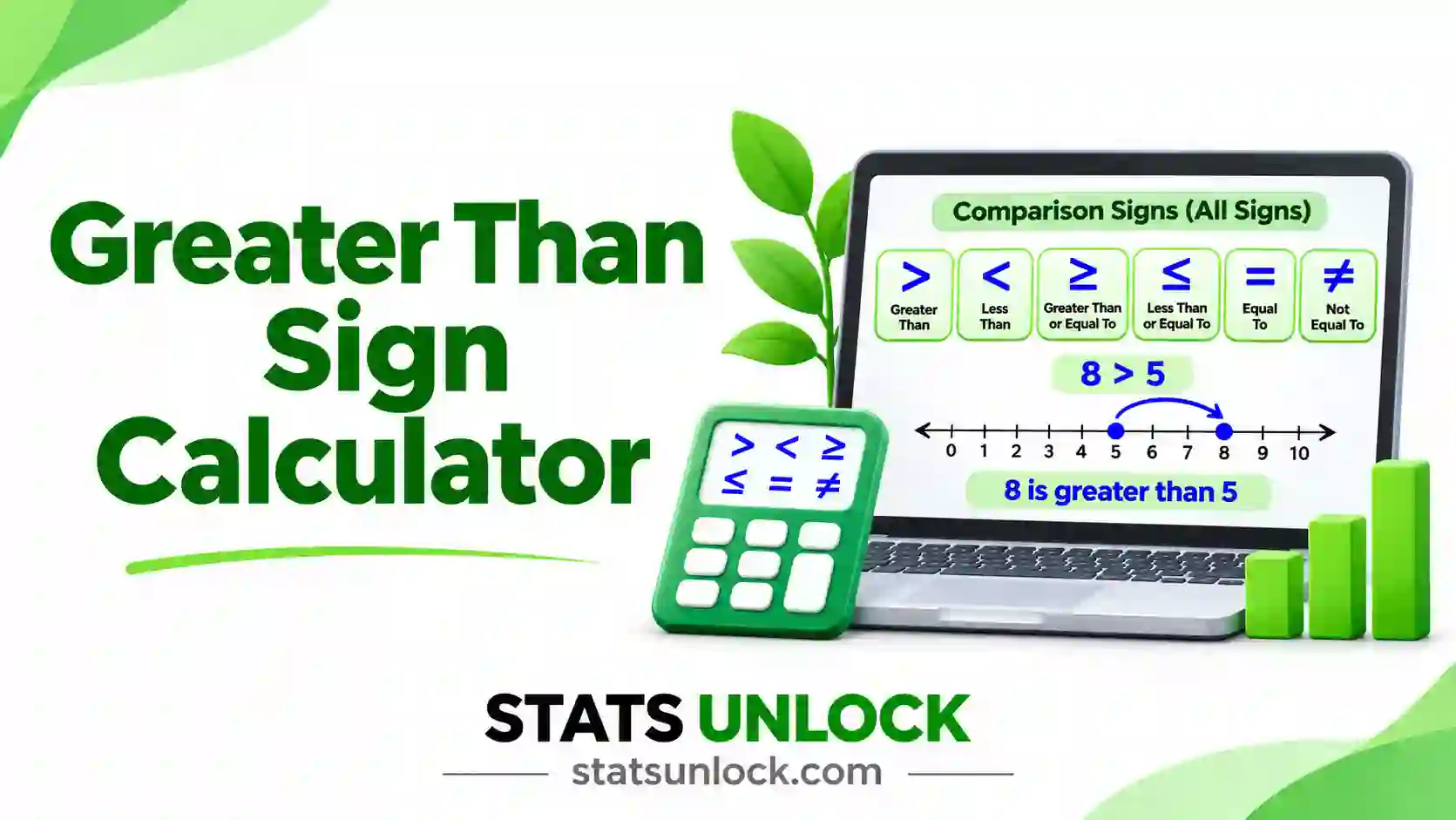

Greater Than Sign Calculator
Type any two numbers and this greater than less than sign calculator puts the correct sign between them: >, < or =. It works with fractions, decimals, percents, negative numbers and square roots, and it shows every step.
⚡ 0. Quick Answer
The greater than sign is >. It means the number on its left is bigger than the number on its right, so 3/4 > 0.7 reads "three quarters is greater than 0.7".
Worked example: 3/4 = 0.75 and 0.7 = 0.70. Since 75 hundredths is more than 70 hundredths, the correct sign is >. The exact difference is 3/4 − 0.7 = 1/20, which is positive.
Rule of thumb: the open side faces the bigger number and the point faces the smaller one. Turn it round and you have the less than sign (<). Add a line under either one for "or equal to": ≥ and ≤. Use = when the two values match and ≠ when they do not. A stroke through a sign means "not" (≯, ≮), a doubled sign means "much" (≫, ≪), and ≈ means "about equal". The operation signs sit beside them: + adds, − subtracts, × multiplies (typed as * in spreadsheets and code), and ÷ divides (typed as /).
>Greater than<Less than≥Greater than or equal to≤Less than or equal to=Equal to≠Not equal to≫Much greater than≪Much less than≯Not greater than≮Not less than≈Approximately equal to≧Greater than over equal to≦Less than over equal to⩾Greater than or slanted equal to⩽Less than or slanted equal to≷Greater than or less than≡Identical to±Plus or minus+Plus (add)−Minus (subtract)*Asterisk (times, in code)×Times (multiply)÷Divided byGreater than or equal to sign copy and paste: press Copy under ≥, then paste it into Word, Google Docs, an email or a chat. All 23 signs copy the same way. Type >, < or = straight from the keyboard.
Key Takeaways
- The greater than sign is > and the less than sign is <. The wide, open side always faces the bigger number.
- a > b exactly when a − b is positive. Subtract, look at the sign of the answer, and you have the right symbol.
- To compare fractions, use one denominator: 3/4 = 15/20 and 0.7 = 14/20, and 15 is more than 14.
- With two negative numbers the order flips: −3 > −8, because −3 is closer to zero.
- On a keyboard, type ≥ with Alt + 242 on Windows or Option + . on a Mac. In a spreadsheet or code, write >=.
📚 1. What Is the Greater Than Sign?
The greater than sign (>) is the math sign for greater than. It is written between two values to say that the first one is larger than the second. 8 > 3 is read "eight is greater than three". The sign looks like an arrowhead pointing to the right: two short lines that meet at a point on the right and open wide on the left.
What does the greater than sign look like next to its partner? The less than sign (<) is the same shape turned round. It points to the left and opens to the right, so 3 < 8 reads "three is less than eight". These two are the greater than and less than signs, sometimes called the bigger than and smaller than signs. Both statements above describe the same fact.
A worked one-liner: which sign goes between 3/4 and 0.7? Write both as hundredths: 3/4 = 0.75 and 0.7 = 0.70. Since 0.75 is more than 0.70, the answer is 3/4 > 0.7.
1.1 Greater than or equal to sign, and the rest of the family
The greater than or equal to sign (≥) is a greater than sign with a line underneath. It means "bigger than or the same as". x ≥ 18 is true for 18, 19, 20 and every larger number. The less than or equal to symbol (≤) works the same way in the other direction. Together with = and ≠ these are the greater than less than equal to signs used in all of school mathematics.
| Sign | Name | Read as | Example | True when |
|---|---|---|---|---|
| > | Greater than sign | is greater than | 3/4 > 0.7 | the left number is bigger |
| < | Less than sign | is less than | 0.7 < 3/4 | the left number is smaller |
| ≥ | Greater than or equal to sign | is at least | 5 ≥ 5 | the left number is bigger or the same |
| ≤ | Less than or equal to sign | is at most | 4 ≤ 5 | the left number is smaller or the same |
| = | Equals sign | is equal to | 0.5 = 1/2 | both sides have the same value |
| ≠ | Not equal to sign | is not equal to | 0.5 ≠ 0.45 | the two values differ |
1.2 Three ways to decide which sign is right
This calculator checks every answer three ways. The table shows when each method is the quickest one by hand.
| Method | What you do | Best for | Watch out for |
|---|---|---|---|
| Common denominator | Rewrite both numbers over the same denominator, then compare the tops | Two fractions, or a fraction and a decimal | Finding the lowest common denominator takes a moment |
| Cross-multiplication | Multiply each top by the other bottom and compare the two products | Two fractions in an exam, when speed matters | Only valid when both denominators are positive |
| Decimals and place value | Line up the decimal points and compare digit by digit from the left | Decimals, percents and money | Rounding can hide a small difference such as 1/3 and 0.333 |
| Subtraction | Work out a − b and look at whether it is positive, negative or zero | Negative numbers and checking any answer | Subtracting a negative means adding |
Who uses it: pupils meet the greater than sign in the first years of school and use it through algebra, where it becomes the language of inequalities. Programmers write it in every if statement. Spreadsheet users type it in filters and IF formulas. Scientists use it to state limits such as p < 0.05. The symbols > and < first appeared in print in 1631, in a book by the English mathematician Thomas Harriot. The forms with a line underneath, ≥ and ≤, were used by the French scientist Pierre Bouguer in 1734.
🧮 2. Enter Your Problem
Type each number the way you would write it: 3/4, 0.7, -5, 15%, 2 1/3 (a mixed number), 3x10^8, 0.(3) for a repeating decimal, sqrt(2) or pi. The tool decides whether >, < or = belongs between them.
Write a full statement and the tool says whether it is true or false, and gives the correct sign if it is false. Use >, <, >=, <=, = or != between the numbers. Chains work too, for example -5 < -3 < 0.
Mix any forms you like. You get the list from least to greatest with less than signs, and from greatest to least with greater than signs. Equal values are joined with an equals sign.
Teachers use this to build an answer key: paste or upload many pairs, then Download Doc gives every answer with its working. A header row is skipped.
Nothing is worked out until you press Solve. Pressing Enter in a number box does the same.
📊 3. Results and Step-by-Step Solution
🧠 4. Understanding Your Answer, In Detail
4.1 What the sign in your answer means
___ Solve a problem above to fill this paragraph with your own numbers.
A comparison sign makes a claim that is either true or false. "3/4 > 0.7" claims that 3/4 is the larger number, and it is true. The sign you choose has to match where the two numbers sit on the number line. The number further to the right is the greater one, every time, for whole numbers, fractions, decimals and negative numbers alike.
4.2 What the difference tells you
___ Solve a problem above to fill this paragraph with your own numbers.
Mathematicians define "greater than" with subtraction: a > b means that a − b is a positive number. That is why the calculator reports the difference. A positive difference gives >, a negative difference gives <, and a difference of exactly zero gives =. The size of the difference also tells you how far apart the numbers are, which the sign alone cannot.
4.3 Exact fractions against decimals
___ Solve a problem above to fill this paragraph with your own numbers.
A decimal check is fast, but rounding can mislead. 1/3 and 0.333 look equal to three places, yet 1/3 is greater, because 1/3 = 0.3333... goes on for ever. The exact method never rounds: 1/3 = 1000/3000 and 0.333 = 999/3000, and 1000 is more than 999. When two numbers are very close, trust the common denominator, not the rounded decimal.
4.4 What the charts show
___ Solve a problem above to fill this paragraph with your own numbers.
Chart 1 is the number line picture. Chart 2 shows each number as a bar, which makes "bigger" visible at a glance. Chart 3 shows the numerators once both numbers share a denominator. Chart 4 tests all six signs at once, so you can see that when A > B is true, A ≥ B and A ≠ B are true as well.
4.5 Greater than or less than sign with negative numbers
Negative numbers are where most mistakes happen. −8 looks bigger than −3 because 8 is bigger than 3, but −8 is the smaller number: it is further to the left, colder as a temperature and deeper as a debt. For two negative numbers, the one closer to zero is greater, so −3 > −8. Any positive number is greater than any negative number, and zero sits between them.
4.6 How the answer changes when you change a number
The sign only changes when the numbers cross each other. Raise 0.7 to 0.74 and 3/4 is still greater. Raise it to 0.75 and the two are equal. Raise it to 0.76 and the sign turns round to <. So a comparison is sensitive only near the point where the two values meet, and that is exactly where an exact method matters most.
4.7 When both signs are true, and when none is
If the numbers are equal, three statements are true at once: a = b, a ≥ b and a ≤ b. That is not a contradiction, because "or equal to" covers the equal case. At the other extreme, no sign can be written when one of the numbers does not exist. A fraction with 0 underneath, such as 5/0, is undefined, so 5/0 ? 2 has no answer at all.
4.8 Where this leads next
Once numbers can be compared, letters can be too. An inequality such as x > 3 uses the same sign to describe every number to the right of 3 on the number line. Solving inequalities follows the rules of equations, with one extra rule: multiplying or dividing both sides by a negative number turns the sign round.
✍ 5. How to Write the Answer
▶ Solve a problem above to fill all five cards with your own answer.
Conventions for this style
- Show the conversion to a common form. That line earns the method mark.
- Write the final statement with the numbers in the order the question gave them.
- Leave fractions exact. Do not round unless the question asks for decimals.
Conventions for this style
- One line: first number, sign, second number.
- Use the real signs ≥ and ≤ in print. Use >= only in code and spreadsheets.
- Put a space on each side of the sign so it is easy to read.
Conventions for this style
- Give the sign and the decimal values, so a marker can check at a glance.
- For a whole worksheet, use the Batch tab and Download Doc.
Conventions for this style
- In running text, write the words "greater than" or "less than" in full.
- Keep symbols for tables, equations and limits such as p < 0.05.
- State the difference when its size matters, not only its direction.
Conventions for this style
- Plain keyboard characters only, so it pastes cleanly anywhere.
- Type >= for ≥, type <= for ≤, and != for ≠.
- Write fractions with a slash: 3/4.
∑ 6. Formulas Used
🔀 7. Greater Than Sign Flowchart, Step by Step
This flowchart shows how to choose the greater than or less than sign, step by step, from two raw numbers to a finished statement. Every box uses the same worked example as the Excel, R and Python sections: which sign goes between 3/4 and 0.7?
Check any box yourself: the Excel sheet in Section 9, the R script in Section 10, the Python script in Section 11 and the written method in Section 14 all give 15/20 against 14/20 and a difference of 1/20 for this problem.
📝 8. How to Use This Calculator
- Choose a tab. Use Compare Two Numbers for one pair, Check a Statement to test something like 3/4 >= 0.7, Order a List to sort many numbers, or Batch to solve a whole worksheet.
- Type the first number. Enter it the way you would write it: 3/4, 0.7, -5, 15%, 2 1/3, 3x10^8, sqrt(2) or pi. The keypad under the boxes has the keys a phone keyboard hides.
- Type the second number. It can be in a different form from the first. Mixing a fraction with a decimal or a percent is exactly what the tool is for.
- Or pick a sample problem. Ten built-in problems cover fractions, decimals, negative numbers, a percent, large numbers, a square root, equal values and an undefined case.
- Set the decimal places and answer form. Choose 2, 4, 6 or 10 decimal places, and whether the answer box shows exact fractions or decimals only.
- Press Solve. Nothing is worked out until you do. Changing any number clears the old result, so you never read a stale answer.
- Read the answer box. It shows the two numbers with the correct sign between them, how to read it aloud, and a Verified badge once three methods agree.
- Follow the step-by-step solution. Each step is one move: convert, find a common denominator, compare, cross-multiply, check with decimals, subtract, write the statement.
- Check the table and the four charts. The table lists every value, including the difference and all six comparison signs. The charts show the numbers on a number line and as bars.
- Download the working. Download Doc saves a text file with the answer and every step. Download PDF opens the print dialog with a clean one-page report.
📈 9. How to Use the Greater Than Sign in Excel
Excel uses the greater than sign as a comparison operator. Put it between two cells and Excel answers TRUE or FALSE. With one IF formula you can also make Excel print the correct sign itself, which turns a sheet into a greater than less than sign calculator for a whole column of pairs. This section uses the same problem as the rest of the page: 3/4 in A2 and 0.7 in B2.
=IF(A2>B2,">",IF(A2=B2,"=","<")) and press Enter. For 0.75 and 0.7 it returns >.9.1 The functions you need
| You want | Excel formula | Note |
|---|---|---|
| Is A greater than B? | =A2>B2 | Returns TRUE or FALSE |
| Is A greater than or equal to B? | =A2>=B2 | Excel has no ≥ key. Type > then = |
| Is A less than B? | =B2>A2 | The same test read from the other side |
| Is A not equal to B? | =A2<>B2 | Less than followed by greater than means "not equal" |
| Print the correct sign | =IF(A2>B2,">",IF(A2=B2,"=","<")) | Gives >, = or < as text |
| Direction as a number | =SIGN(A2-B2) | 1 means A is greater, −1 means A is less, 0 means equal |
| The larger of the two | =MAX(A2,B2) | MIN gives the smaller |
| Count the cells above 0.7 | =COUNTIF(A2:A20,">0.7") | The sign and the number go inside quotation marks |
| Show the ≥ symbol in a cell | =UNICHAR(8805) | 8804 gives ≤ and 8800 gives ≠ |
| Equal within a tiny tolerance | =ABS(A2-B2)<=0.000000001 | Safe for numbers that came out of long calculations |
=3/4 instead, or type 0 3/4 with a zero and a space in front.9.2 Step by step
1 Enter the two numbers
Put the first number in A2 and the second in B2. Type =3/4 in A2 so Excel stores 0.75, and 0.7 in B2.
A2 holds 0.75 (typed as =3/4) and B2 holds 0.7.
2 Ask the greater than question
In C2 type the two cells with the greater than sign between them. Excel answers TRUE because 0.75 is more than 0.7.
=A2>B2C2 shows TRUE: A2 is greater than B2.
3 Make Excel print the sign
A nested IF tests "greater" first, then "equal". Anything left over must be "less".
=IF(A2>B2,">",IF(A2=B2,"=","<"))D2 shows the greater than sign, >, so the statement is 0.75 > 0.7.
4 Add the difference and fill down
The difference confirms the sign: positive for >, negative for <, zero for =. Select C2 to E2 and drag the fill handle down to compare a whole list of pairs.
=A2-B2Four pairs at once. Row 2 gives a difference of 0.05 (that is 1/20), row 4 shows −8 < −3, and row 5 shows two equal values.
5 Build the full statement
Join the three parts with & to write the comparison as a sentence you can copy.
=A2&" "&D2&" "&B2For row 2 this returns the text 0.75 > 0.7.
9.3 The awkward cases
- Numbers stored as text. In Excel any text counts as greater than any number, so
="10">9is TRUE for the wrong reason. Look for green triangles in the cell corners and convert the cells to numbers. - Fifteen significant digits. Excel keeps about 15 digits. Two numbers that differ only at the 16th digit compare as equal. This calculator uses exact fractions, so it has no such limit.
- Typing the ≥ sign. In a formula always type
>=. The single character ≥ is for display only. To show it in a cell use=UNICHAR(8805), or Insert, Symbol, then choose the Mathematical Operators subset. - Greater than or equal sign in Word. Type 2265 and press Alt + X to get ≥. Type 2264 and press Alt + X to get ≤. The same works in Outlook.
- Comparing dates and times. Dates are stored as numbers, so
=A2>B2is TRUE when A2 is the later date.
9.4 Why Excel might disagree with R or Python
| Situation | What happens | Fix |
|---|---|---|
=0.1+0.2=0.3 | Excel says TRUE because it compares 15 digits. R and Python say FALSE, because the stored binary values differ at the 17th digit | In R use all.equal(). In Python use math.isclose() or Fraction |
Chained comparison =1 < 2 < 3 | Excel works left to right: 1 < 2 is TRUE, then TRUE < 3 is FALSE. Python reads the chain as a whole and says True | In Excel write =AND(1 < 2, 2 < 3) |
Chain 3 > 2 > 1 in R | R also works left to right: 3 > 2 is TRUE, and TRUE > 1 is FALSE | In R write 3 > 2 & 2 > 1 |
| Text against a number | Excel: text is always greater. R compares them as text. Python raises a TypeError | Convert text to numbers before comparing |
| Upper and lower case | ="a"="A" is TRUE in Excel. R and Python treat them as different | Use EXACT() in Excel for a case-sensitive test |
=-3^2>0 | TRUE in Excel, where −3^2 is 9. In R, Python and on paper −3^2 is −9, so the test is false | Write =-(3^2) in Excel |
=ROUND(2.5,0)>2 | TRUE in Excel, which rounds halves up to 3. R and Python round 2.5 to the even number 2, so the test is false | Compare before rounding, not after |
| Tool | Greater than | Greater than or equal to | Not equal to |
|---|---|---|---|
| Excel and Google Sheets | =A2>B2 | =A2>=B2 | =A2<>B2 |
| R | a > b | a >= b | a != b |
| Python | a > b | a >= b | a != b |
| SQL | a > b | a >= b | a <> b |
9.5 Charting it in Excel
- Select the two numbers and their labels.
- Choose Insert, Charts, Clustered Column. The taller column is the greater number.
- For a number line picture, use Insert, Scatter with the numbers as x values and 0 as every y value. Do not use a Line chart, which spaces the points evenly and hides the real gap.
- Set the vertical axis to start at 0, or small differences will look larger than they are.
9.6 Excel errors you will probably hit
| Excel shows | Why | Fix |
|---|---|---|
#DIV/0! | A cell divides by zero, for example =5/0 | The number is undefined, so it cannot be compared. Correct the denominator |
#VALUE! in the difference | One cell holds text, so =A2-B2 cannot subtract | Convert the text to a number, or retype it |
| A date such as 04-Mar | You typed 3/4 without an equals sign | Type =3/4 and format the cell as Number |
| "There is a problem with this formula" | You typed the ≥ character inside a formula | Use >= |
#SPILL! | A range comparison such as =A2:A9>B2:B9 has no empty cells to fill | Clear the cells below the formula |
| TRUE when you expected FALSE | One of the numbers is stored as text | Check for green triangles, then use Convert to Number |
📈 10. How to Use the Greater Than Sign in R
In R the greater than sign is the operator >, and 3/4 > 0.7 returns TRUE. The script below goes further. It compares the two numbers exactly with whole-number arithmetic, prints the correct sign with the working, checks the answer and saves one figure at 300 dpi. It uses base R only.
Rscript. Change only the four lines that set the numerators and denominators.10.1 The complete script
R, base only, saves greater_than_sign.png
# ============================================================
# Greater than sign: which sign goes between two numbers?
# StatsUnlock - https://statsunlock.com/greater-than-sign/
# Base R only. No packages to install.
# ============================================================

# ---- 1. Your two numbers, each as numerator / denominator --
# 3/4 is 3 over 4. The decimal 0.7 is 7 over 10.
a_num <- 3;  a_den <- 4      # A = 3/4
b_num <- 7;  b_den <- 10     # B = 0.7 = 7/10
a_text <- "3/4"
b_text <- "0.7"

# ---- 2. Exact comparison with whole numbers only -----------
# Cross-multiply. Both denominators must be positive.
stopifnot(a_den > 0, b_den > 0)
cross_a <- a_num * b_den     # 3 * 10 = 30
cross_b <- b_num * a_den     # 7 * 4  = 28

if (cross_a > cross_b) {
  sign_chr <- ">"
} else if (cross_a == cross_b) {
  sign_chr <- "="
} else {
  sign_chr <- "<"
}
words <- c(">" = "is greater than", "=" = "is equal to", "<" = "is less than")

# ---- 3. Show the working -----------------------------------
gcd <- function(x, y) if (y == 0) abs(x) else gcd(y, x %% y)
lcd   <- a_den * b_den / gcd(a_den, b_den)
top_a <- a_num * lcd / a_den
top_b <- b_num * lcd / b_den
d_num <- cross_a - cross_b
d_den <- a_den * b_den
g     <- gcd(d_num, d_den)
A <- a_num / a_den
B <- b_num / b_den

cat(sprintf("A = %s = %d/%d = %.4f\n", a_text, a_num, a_den, A))
cat(sprintf("B = %s = %d/%d = %.4f\n", b_text, b_num, b_den, B))
cat(sprintf("Common denominator %d: %d/%d and %d/%d\n", lcd, top_a, lcd, top_b, lcd))
cat(sprintf("Cross products: %d and %d\n", cross_a, cross_b))
cat(sprintf("Difference A - B = %d/%d = %.4f\n", d_num / g, d_den / g, A - B))
cat(sprintf("Answer: %s %s %s   (%s %s %s)\n",
            a_text, sign_chr, b_text, a_text, words[[sign_chr]], b_text))

# ---- 4. Check the answer -----------------------------------
# sign() gives 1, 0 or -1. The exact and the decimal route must agree.
stopifnot(sign(cross_a - cross_b) == sign(top_a - top_b))
stopifnot(isTRUE(all.equal(A - B, d_num / d_den)))
cat("Check passed: tops, cross products and difference all agree.\n")

# ---- 5. One figure: both numbers on a number line ----------
png("greater_than_sign.png", width = 2400, height = 900, res = 300)
par(mar = c(4.2, 1, 2.6, 1), family = "sans")
lo <- min(A, B, 0); hi <- max(A, B, 1); pad <- (hi - lo) * 0.08
plot(NA, xlim = c(lo - pad, hi + pad), ylim = c(-1, 1), yaxt = "n", ylab = "",
     xlab = "Number line (further right is greater)", bty = "n")
segments(lo - pad, 0, hi + pad, 0, col = "#475569", lwd = 2)
points(c(A, B), c(0, 0), pch = 19, cex = 2.2, col = c("#2563eb", "#ea580c"))
text(A, 0.45, a_text, col = "#2563eb", font = 2)
text(B, -0.45, b_text, col = "#ea580c", font = 2)
title(main = paste(a_text, sign_chr, b_text), adj = 0, font.main = 2)
dev.off()
cat("Saved greater_than_sign.png\n")
Expected output: common denominator 20 with 15/20 and 14/20, cross products 30 and 28, difference 1/20 = 0.0500, and the answer 3/4 > 0.7.
10.2 What each part does
| Line or function | What it does, and why it is there |
|---|---|
| a_num, a_den | The first number as a fraction. Keeping the top and bottom as whole numbers means nothing is rounded. |
| stopifnot(a_den > 0, ...) | Cross-multiplication is only valid for positive denominators. This line stops the script if that is not true. |
| cross_a, cross_b | The two cross products, 30 and 28. Comparing them is the same as comparing the fractions. |
| if ... else if ... else | Picks the sign as text. The three branches match the three possible answers: greater, equal, less. |
| gcd() | Euclid's method for the greatest common divisor, needed to find the least common denominator and to reduce the difference. |
| %% | The remainder operator. 10 %% 4 is 2. |
| sprintf() | Formats the output. %d prints a whole number, %.4f prints four decimal places, %s prints text. |
| all.equal() | Compares two decimals with a small tolerance. Never test decimals with ==, because 0.1 + 0.2 == 0.3 is FALSE in R. |
| png(..., res = 300) | Opens a 300 dpi image file. dev.off() closes it. Forgetting dev.off() leaves an empty file. |
x <-3 does not ask "is x less than −3?". It assigns the value 3 to x, because <- is the assignment arrow. Put spaces round the sign: x < -3.10.3 What the figure shows
A number line from 0 to 1 with two dots: blue for A (3/4) and orange for B (0.7). The blue dot is further to the right, which is the picture behind the statement 3/4 > 0.7. The title of the figure is the finished statement.
10.4 Common R problems and fixes
| Symptom | Cause | Fix |
|---|---|---|
0.1 + 0.2 == 0.3 is FALSE | Decimals are stored in binary and are slightly off | Use isTRUE(all.equal(0.1 + 0.2, 0.3)) |
| x suddenly equals 3 | You typed x<-3, which assigns | Write x < -3 with spaces |
"10" > "9" is FALSE | Both are text, and text is compared letter by letter | Convert with as.numeric() first |
Result is NA | One of the values is missing | Any comparison with NA gives NA. Remove or fill the missing value |
| A warning about "the condition has length > 1" | if was given a whole vector | Use ifelse() for vectors, or any() and all() |
3 > 2 > 1 is FALSE | R compares left to right, so it tests TRUE > 1 | Write 3 > 2 & 2 > 1 |
10.5 Useful one-liners
| You want | R code |
|---|---|
| Is 3/4 greater than 0.7? | 3/4 > 0.7 |
| Direction as 1, 0 or −1 | sign(3/4 - 0.7) |
| The larger of two numbers | max(3/4, 0.7) |
| Compare two columns, row by row | ifelse(a > b, ">", ifelse(a == b, "=", "<")) |
| Order a list from least to greatest | sort(c(3/4, 0.7, 2/3, -1/2)) |
| Show a decimal as a fraction | MASS::fractions(0.75) |
| Print the ≥ symbol | cat("≥") |
📈 11. How to Use the Greater Than Sign in Python
Python writes greater than as > and greater than or equal to as >=. The script below uses the built-in fractions module, so 3/4 and 0.7 are held as exact fractions and the comparison can never be upset by rounding. It prints the sign with the working, checks the answer three ways and saves one 300 dpi figure.
a_text and b_text. Fractions such as "5/8" and decimals such as "0.45" both work.Install the one outside package with pip install matplotlib. math.lcm needs Python 3.9 or newer.
11.1 The complete script
Python 3.9+, saves greater_than_sign.png
# ============================================================
# Greater than sign: which sign goes between two numbers?
# StatsUnlock - https://statsunlock.com/greater-than-sign/
# Exact arithmetic with fractions.Fraction, one 300 dpi figure.
# ============================================================
import math
from fractions import Fraction

import matplotlib
matplotlib.use("Agg")              # remove this line in Jupyter
import matplotlib.pyplot as plt

# ---- 1. Your two numbers -----------------------------------
# Give each number as text so nothing is rounded on the way in.
a_text = "3/4"
b_text = "0.7"

A = Fraction(a_text)               # 3/4
B = Fraction(b_text)               # 7/10, exact

# ---- 2. Choose the sign ------------------------------------
if A > B:
    sign, words = ">", "is greater than"
elif A == B:
    sign, words = "=", "is equal to"
else:
    sign, words = "<", "is less than"

# ---- 3. Show the working -----------------------------------
lcd = math.lcm(A.denominator, B.denominator)
top_a = A.numerator * (lcd // A.denominator)
top_b = B.numerator * (lcd // B.denominator)
cross_a = A.numerator * B.denominator
cross_b = B.numerator * A.denominator
diff = A - B

print(f"A = {a_text} = {A} = {float(A):.4f}")
print(f"B = {b_text} = {B} = {float(B):.4f}")
print(f"Common denominator {lcd}: {top_a}/{lcd} and {top_b}/{lcd}")
print(f"Cross products: {cross_a} and {cross_b}")
print(f"Difference A - B = {diff} = {float(diff):.4f}")
print(f"Answer: {a_text} {sign} {b_text}   ({a_text} {words} {b_text})")

# ---- 4. Check the answer three ways ------------------------
by_tops = (top_a > top_b) - (top_a < top_b)
by_cross = (cross_a > cross_b) - (cross_a < cross_b)
by_diff = (diff > 0) - (diff < 0)
assert by_tops == by_cross == by_diff, "the three methods disagree"
print("Check passed: tops, cross products and difference all agree.")

# ---- 5. One figure: both numbers on a number line ----------
fig, ax = plt.subplots(figsize=(8, 2.6))
lo = min(float(A), float(B), 0.0)
hi = max(float(A), float(B), 1.0)
pad = (hi - lo) * 0.08
ax.hlines(0, lo - pad, hi + pad, color="#475569", linewidth=2, zorder=1)
ax.scatter([float(A)], [0], s=180, color="#2563eb", zorder=3, label=f"A = {a_text}")
ax.scatter([float(B)], [0], s=180, color="#ea580c", zorder=3, label=f"B = {b_text}")
ax.annotate(a_text, (float(A), 0), xytext=(0, 16), textcoords="offset points",
            ha="center", color="#2563eb", fontweight="bold")
ax.annotate(b_text, (float(B), 0), xytext=(0, -24), textcoords="offset points",
            ha="center", color="#ea580c", fontweight="bold")
ax.set_ylim(-1, 1)
ax.set_yticks([])
ax.set_xlabel("Number line (further right is greater)")
ax.set_title(f"{a_text} {sign} {b_text}", fontweight="bold", loc="left")
ax.spines[["top", "right", "left"]].set_visible(False)
ax.legend(frameon=False, loc="upper left", ncol=2)
fig.savefig("greater_than_sign.png", dpi=300, bbox_inches="tight")
print("Saved greater_than_sign.png")
Run it with python greater_than_sign.py. It prints 15/20 and 14/20, cross products 30 and 28, a difference of 1/20 = 0.0500 and the answer 3/4 > 0.7. In Jupyter or Google Colab, delete the matplotlib.use("Agg") line and add plt.show() at the end.
11.2 What each part does
| Line or function | What it does, and why it is there |
|---|---|
| Fraction("0.7") | Reads the text 0.7 as exactly 7/10. Pass text, not a float. Fraction(0.7) without quotation marks gives 3152519739159347/4503599627370496, the binary value the computer really stores. |
| A > B, A == B | Comparisons between two Fraction objects are exact, with no tolerance needed. |
| math.lcm() | The lowest common multiple of the two denominators, here 20. |
| // | Whole-number division. 20 // 4 is 5, with no decimal point. |
| (x > y) - (x < y) | A short way to get 1, 0 or −1 for greater, equal or less. Python treats True as 1 and False as 0. |
| assert | Stops the script with a message if the three methods ever disagree. |
| f"{float(A):.4f}" | An f-string. .4f prints four decimal places. |
| savefig(dpi=300, bbox_inches="tight") | Saves the figure at print quality and trims the empty border. |
11.3 What the figure shows
The same number line as the R script: a blue dot at 3/4 and an orange dot at 0.7, with the statement 3/4 > 0.7 as the title. The number further to the right is the greater one.
11.4 Common Python problems and fixes
| Symptom | Cause | Fix |
|---|---|---|
0.1 + 0.2 == 0.3 is False | Floats are binary approximations | Use math.isclose(0.1 + 0.2, 0.3) or Fraction |
TypeError: '>' not supported between 'str' and 'int' | One value is text, often from input() or a CSV file | Convert with float() or Fraction() first |
"10" > "9" is False | Text is compared character by character | Convert both to numbers |
SyntaxError at => | The equals sign is in the wrong place | Greater than or equal to is >=, sign first |
| A strange huge fraction | Fraction(0.7) was given a float | Write Fraction("0.7") or Fraction(7, 10) |
nan > 1 is False, and so is nan < 1 | NaN (not a number) is not comparable to anything | Test with math.isnan() first |
11.5 Useful one-liners
| You want | Python code |
|---|---|
| Is 3/4 greater than 0.7? | Fraction(3, 4) > Fraction("0.7") |
| Check a chain in one go | -5 < -3 < 0 |
| The larger of two numbers | max(0.75, 0.7) |
| Order a list from least to greatest | sorted([0.75, 0.7, 2/3, -0.5]) |
| Greatest to least | sorted(values, reverse=True) |
| Compare two NumPy arrays | numpy.greater(a, b) |
| Print the ≥ symbol | print("≥") |
📋 12. Reference Tables
12.1 Greater than and less than symbols, with their codes
| Sign | Name | Unicode | HTML code | LaTeX | In code and spreadsheets |
|---|---|---|---|---|---|
| > | Greater than sign | U+003E | & | > | > |
| < | Less than sign | U+003C | & | < | < |
| ≥ | Greater than or equal to sign | U+2265 | & | \geq | >= |
| ≤ | Less than or equal to symbol | U+2264 | & | \leq | <= |
| = | Equals sign | U+003D | = | = | = in Excel, == in R and Python |
| ≠ | Not equal to sign | U+2260 | & | \neq | <> in Excel and SQL, != in R and Python |
| ≫ | Much greater than | U+226B | & | \gg | none |
| ≪ | Much less than | U+226A | & | \ll | none |
| ≯ | Not greater than | U+226F | & | \ngtr | <= |
How to use this table: copy a sign from the first column, or type the code from the column that matches where you are writing. "Not greater than" means the same as "less than or equal to".
12.2 Greater than sign on keyboard: how to type each sign
| Sign | Windows | Mac | Microsoft Word | Chromebook | Linux |
|---|---|---|---|---|---|
| > | Shift + . (full stop key) | Shift + . | Shift + . | Shift + . | Shift + . |
| < | Shift + , (comma key) | Shift + , | Shift + , | Shift + , | Shift + , |
| ≥ | Hold Alt, type 242 on the number pad | Option + . | Type 2265, then Alt + X | Ctrl + Shift + U, type 2265, Enter | Compose, then >, then = |
| ≤ | Hold Alt, type 243 on the number pad | Option + , | Type 2264, then Alt + X | Ctrl + Shift + U, type 2264, Enter | Compose, then <, then = |
| ≠ | Use the Word method, or copy it from this page | Option + = | Type 2260, then Alt + X | Ctrl + Shift + U, type 2260, Enter | Compose, then /, then = |
The key positions are for a US or UK keyboard layout. Alt codes need the number pad with Num Lock on. On a phone, press and hold the > or = key on the symbols page to see more signs, or copy the sign from Section 0. In Google Docs, use Insert, Special characters and search for "greater".
12.3 Benchmark fractions, decimals and percents
| Fraction | Decimal | Percent | Fraction | Decimal | Percent |
|---|---|---|---|---|---|
| 1/10 | 0.1 | 10% | 3/5 | 0.6 | 60% |
| 1/8 | 0.125 | 12.5% | 5/8 | 0.625 | 62.5% |
| 1/6 | 0.1666... | 16.67% | 2/3 | 0.6666... | 66.67% |
| 1/5 | 0.2 | 20% | 7/10 | 0.7 | 70% |
| 1/4 | 0.25 | 25% | 3/4 | 0.75 | 75% |
| 1/3 | 0.3333... | 33.33% | 4/5 | 0.8 | 80% |
| 3/8 | 0.375 | 37.5% | 5/6 | 0.8333... | 83.33% |
| 2/5 | 0.4 | 40% | 7/8 | 0.875 | 87.5% |
| 1/2 | 0.5 | 50% | 9/10 | 0.9 | 90% |
How to use this table: the rows run from smallest to largest down each half. To compare two benchmark values, find both and see which is lower in the table.
12.4 How to compare each type of number
| You are comparing | Do this | Example |
|---|---|---|
| Two whole numbers | More digits is bigger. With the same number of digits, compare from the left | 1,000,000 > 999,999 |
| Two decimals | Line up the decimal points, add zeros to the shorter one, compare from the left | 0.5 = 0.50, and 0.50 > 0.45 |
| Two fractions, same denominator | Compare the numerators | 5/8 > 3/8 |
| Two fractions, same numerator | The smaller denominator gives the bigger fraction | 1/3 > 1/4 |
| Two fractions, nothing in common | Cross-multiply, or use a common denominator | 5/8 > 7/12 because 60 > 56 |
| A fraction and a decimal | Turn the decimal into a fraction, or divide the fraction out | 3/4 = 0.75 > 0.7 |
| A percent and anything else | Divide the percent by 100 first | 15% = 0.15 > 0.125 |
| A positive and a negative | The positive number is always greater | 0.01 > −500 |
| Two negatives | Compare without the minus signs, then turn the sign round | 3 < 8, so −3 > −8 |
| A square root and a number | Square both (for positive numbers) and compare | √2 > 1.414 because 2 > 1.999396 |
12.5 Rules that keep or turn the sign
| If a > b and you... | Then | Sign | Example from 8 > 3 |
|---|---|---|---|
| add the same number to both sides | a + c > b + c | stays | 10 > 5 |
| subtract the same number from both sides | a − c > b − c | stays | 6 > 1 |
| multiply both sides by a positive number | a × c > b × c | stays | 16 > 6 |
| multiply both sides by a negative number | a × c < b × c | turns | −16 < −6 |
| divide both sides by a negative number | a ÷ c < b ÷ c | turns | −4 < −1.5 |
| swap the two sides | b < a | turns | 3 < 8 |
| take reciprocals (both positive) | 1/a < 1/b | turns | 1/8 < 1/3 |
12.6 The signs on a number line and in interval notation
| Statement | In words | Circle at 3 | Shading | Interval notation |
|---|---|---|---|---|
| x > 3 | x is greater than 3 | open (3 not included) | to the right | (3, ∞) |
| x ≥ 3 | x is at least 3 | filled (3 included) | to the right | [3, ∞) |
| x < 3 | x is less than 3 | open | to the left | (−∞, 3) |
| x ≤ 3 | x is at most 3 | filled | to the left | (−∞, 3] |
| 1 < x ≤ 3 | x is more than 1 and at most 3 | open at 1, filled at 3 | between them | (1, 3] |
The line under the greater than sign and the filled circle mean the same thing: the end value itself is allowed.
📈 13. Example Results
Eight greater than sign examples, from the first one a child meets to the traps that catch older students. Each shows the working, a number line and how to write the answer.
Twelve apples and nine apples
Two whole numbers, the first greater than less than sign example in any textbook.
One basket holds 12 apples and another holds 9. Which sign goes between 12 and 9?
| Step | Working | Note |
|---|---|---|
| Count the digits | 2 digits and 1 digit | More digits means a bigger whole number |
| Subtract | 12 − 9 = 3 | Positive, so the first number is greater |
| Sign | > | Open side faces 12 |
What it means: the basket with 12 apples has more. The sign opens toward 12 and points at 9.
How to write it: 12 > 9, read "twelve is greater than nine".
Which is bigger, 2/3 or 3/5?
Different numerators and different denominators, so nothing can be read off directly.
A test question asks for the correct sign between 2/3 and 3/5.
| Step | Working | Note |
|---|---|---|
| Common denominator | LCM(3, 5) = 15 | The lowest number both 3 and 5 divide into |
| Rewrite | 2/3 = 10/15, 3/5 = 9/15 | Multiply top and bottom by the same number |
| Compare tops | 10 is more than 9 | Same denominator, so the tops decide |
| Difference | 1/15 | About 0.0667 |
What it means: two thirds is the larger share, by one fifteenth. Cross-multiplying gives the same answer faster: 2 × 5 = 10 and 3 × 3 = 9.
How to write it: 2/3 = 10/15 and 3/5 = 9/15, so 2/3 > 3/5.
0.09 against 0.1
The longer decimal is not the bigger number.
A pupil says 0.09 is greater than 0.1 "because 9 is greater than 1". Is that right?
| Step | Working | Note |
|---|---|---|
| Equal length | 0.09 and 0.10 | Add a zero so both have two decimal places |
| Tenths digit | 0 and 1 | The first place that differs decides it |
| Sign | < | 0 tenths is less than 1 tenth |
What it means: the pupil compared 9 with 1 and ignored place value. 0.1 is ten hundredths, which beats nine hundredths.
How to write it: 0.09 < 0.10, so 0.09 < 0.1.
Phone battery: 5/8 full or 60%?
A fraction against a percent, the mix people meet outside school.
One phone shows a battery bar that is 5/8 full. Another shows 60%. Which phone has more charge?
| Step | Working | Note |
|---|---|---|
| Percent to fraction | 60% = 60/100 = 3/5 | Percent means "out of 100" |
| Common denominator | 5/8 = 25/40, 3/5 = 24/40 | LCM(8, 5) = 40 |
| Difference | 1/40 = 2.5% | A small but real gap |
What it means: the phone at 5/8 has slightly more charge, 62.5% against 60%.
How to write it: 5/8 = 62.5% > 60%.
4/6 and 2/3
Two fractions that look different and are the same number.
Which sign belongs between 4/6 and 2/3?
| Step | Working | Note |
|---|---|---|
| Simplify | 4/6 = 2/3 | Divide top and bottom by 2 |
| Cross-multiply | 4 × 3 = 12, 2 × 6 = 12 | Equal products mean equal fractions |
| Sign | = | ≥ and ≤ are also true |
What it means: neither is greater. They are equivalent fractions, so the equals sign is the answer.
How to write it: 4/6 = 2/3.
7/0 and 3
One of the "numbers" is not a number.
A worksheet has a misprint: compare 7/0 with 3.
| Step | Working | Note |
|---|---|---|
| Check the denominator | 0 | Division by zero is not defined |
| Place on the number line | none | No number times 0 gives 7 |
| Sign | cannot be written | Not greater, not less, not equal |
What it means: the question has no answer. It is not "infinity is greater". An undefined expression cannot take part in a comparison.
How to write it: 7/0 is undefined, so no comparison is possible.
6.02 × 10²³ and 6 × 10²³
Scientific notation, where the power of ten is compared first.
A chemistry student rounds a constant to 6 × 10²³. Is the fuller value 6.02 × 10²³ greater or less?
| Step | Working | Note |
|---|---|---|
| Compare the powers | 23 and 23 | A higher power of ten would win outright |
| Compare the front numbers | 6.02 is more than 6 | Only needed because the powers match |
| Difference | 0.02 × 10²³ = 2 × 10²¹ | Exact, with no rounding |
What it means: the fuller value is greater. The gap looks tiny, 0.02, but it stands for 2,000,000,000,000,000,000,000.
How to write it: 6.02 × 10²³ > 6 × 10²³.
−2 and −5
The obvious method, "5 is bigger than 2", gives the wrong sign.
The temperature is −2 °C in one town and −5 °C in another. Which temperature is greater?
| Step | Working | Note |
|---|---|---|
| Without the minus signs | 2 is less than 5 | This is the comparison that tempts people |
| Turn the sign round | −2 is greater than −5 | Both are negative, so the order flips |
| Check by subtracting | −2 − (−5) = 3 | Positive, so the first number is greater |
What it means: −2 °C is the warmer, greater temperature. A bigger digit after a minus sign means a smaller number.
How to write it: −2 > −5, or the same fact flipped, −5 < −2.
✏️ 14. How to Choose the Greater Than or Less Than Sign by Hand, Step by Step
This is the pen and paper method a teacher expects to see, worked on the same example as Sections 7, 9, 10 and 11: which sign goes between 3/4 and 0.7?
14.1 The written method
- Write the two numbers with a gap between them. 3/4 ___ 0.7.
- Check both numbers exist. Neither has 0 underneath a fraction line, so both are real numbers.
- Put them in one form. Turn the decimal into a fraction: 0.7 has one decimal place, so 0.7 = 7/10.
- Look at the signs. Both are positive, so their sizes must be compared.
- Find a common denominator. The lowest number that 4 and 10 both divide into is 20.
- Rewrite both fractions. 3/4 = 15/20 (multiply top and bottom by 5). 7/10 = 14/20 (multiply top and bottom by 2).
- Compare the numerators. 15 is more than 14, so 15/20 is the greater fraction.
- Write the sign with its open side toward the greater number. 3/4 > 0.7.
- Check. As decimals, 0.75 and 0.70: the hundredths agree with the answer. As a subtraction, 15/20 − 14/20 = 1/20, which is positive.
14.2 On a scientific calculator
No school calculator has a key that prints the greater than sign for you. Subtract instead, and read the sign of the answer.
| Calculator | Keys | What you see |
|---|---|---|
| Casio fx-991EX (ClassWiz) | Fraction key, 3 ▼ 4 ▶ − 0.7 = | 1/20. Positive, so 3/4 > 0.7. Press S⇔D to see 0.05 |
| Casio fx-570MS / fx-991MS / fx-82MS | 3 a b/c 4 − 0.7 = | 0.05. Positive, so 3/4 > 0.7 |
| TI-84 Plus CE | 3 ÷ 4 2nd MATH (the TEST menu) 3 (for >) 0.7 ENTER | 1, which means true. A 0 would mean false |
On the TI-84 TEST menu the six signs are listed in this order: =, ≠, >, ≥, <, ≤. The Casio models have an Inequality mode, but it solves inequalities with x in them and does not compare two plain numbers. Keystrokes differ a little between models and software versions, so confirm them against the maker's manual.
14.3 Practice problems with answers
Put >, < or = between each pair. Open a card to see the answer and the reason.
1. 9 ___ 6
9 > 6. 9 − 6 = 3, positive.
2. 0.3 ___ 0.30
0.3 = 0.30. A zero on the end of a decimal changes nothing. Both are 3/10.
3. −4 ___ −9
−4 > −9. −4 is closer to zero. Difference: −4 − (−9) = 5.
4. 2/5 ___ 3/8
2/5 > 3/8. Over 40: 16/40 and 15/40. Difference 1/40.
5. 1.02 ___ 1.2
1.02 < 1.2. Write 1.20. Tenths: 0 against 2. Difference −9/50.
6. 7/9 ___ 0.77
7/9 > 0.77. Over 900: 700/900 and 693/900. Difference 7/900. Note 7/9 = 0.777...
7. 45% ___ 4/9
45% > 4/9. 45% = 9/20. Over 180: 81/180 and 80/180. Difference 1/180.
8. −3/4 ___ −0.8
−3/4 > −0.8. Over 20: −15/20 and −16/20. −15 is closer to zero. Difference 1/20.
9. √10 ___ 3.2
√10 < 3.2. Square both: 10 and 10.24. Since 10 is less than 10.24, the root is less.
10. 6/0 ___ 1
No sign. 6/0 is undefined, so it cannot be compared with anything.
14.4 Mistakes that lose marks
- Judging a decimal by its length: 0.45 has more digits than 0.5, but 0.5 is greater.
- Comparing two negative numbers by their digits: −8 is less than −3, not greater.
- Comparing only numerators or only denominators of two fractions. 3/8 is less than 2/5 even though 3 is more than 2 and 8 is more than 5.
- Rounding too early: 1/3 and 0.333 are not equal. 1/3 is greater.
- Writing the sign backwards. Read your answer aloud: "three quarters is greater than 0.7" must sound true.
- Forgetting to turn the sign when multiplying or dividing both sides by a negative number.
- Using > when the question says "at least". "At least 18" means ≥ 18, which includes 18 itself.
🎯 15. When to Use This Method
Choosing between the greater than sign and the less than sign is the right tool whenever a question asks "which is bigger?" about two definite numbers.
Use it when:
- ✓ You have two numbers in different forms, such as a fraction and a decimal, or a percent and a fraction.
- ✓ The numbers are close together and you need to be certain, not roughly right.
- ✓ Negative numbers are involved and you want to avoid the usual slip.
- ✓ You need to put a list in order from least to greatest.
- ✓ You want to check whether a written statement such as 5/8 ≥ 0.6 is true.
Use something else when:
- ✗ The statement has a letter in it, such as 2x + 1 > 7. That is an inequality to solve, not two numbers to compare.
- ✗ You want to know how many times bigger one number is. That is a ratio or a percentage change.
- ✗ The values are measurements with error, and you want to know if the gap is real. That needs a statistical test.
- ✗ You are comparing words or dates. Those follow alphabetical or calendar order.
Four everyday examples:
- Shopping: is 15% off better than 1/8 off? 15% = 0.15 and 1/8 = 0.125, so 15% > 1/8.
- Cooking: is a 2/3 cup measure bigger than a 3/5 cup measure? Yes, 2/3 > 3/5.
- Weather: is −2 °C warmer than −5 °C? Yes, −2 > −5.
- Rules and limits: "you must be at least 120 cm tall" is written height ≥ 120.
Decision tree for the quickest method:
| Ask in this order | If yes, use |
|---|---|
| Is one number negative and the other positive? | The sign rule. The positive number is greater. Finished |
| Are both whole numbers? | Count digits, then compare from the left |
| Are both decimals or percents? | Place value, with the decimal points lined up |
| Are both fractions? | Cross-multiplication |
| Is it a fraction against a decimal? | A common denominator, or divide the fraction out |
| Is there a square root? | Square both numbers, if both are positive |
| Still unsure? | Subtract. The sign of the difference is the answer |
🔧 16. Common Mistakes and Troubleshooting
I always mix up the greater than and less than signs
Cause: the two signs are mirror images. Fix: the open side always faces the bigger number. Or use the letter trick: the less than sign looks like a tilted L, and L stands for "less".
My answer is the wrong way round for negative numbers
Cause: you compared the digits and ignored the minus signs. Fix: for two negatives, compare without the minus signs and then turn the sign round. −8 < −3.
I thought 0.45 was bigger than 0.5
Cause: 45 is bigger than 5, but those are not the values. Fix: write 0.50 and compare the tenths first. 5 tenths beats 4 tenths.
The tool says equal but the numbers look different
Cause: they are two names for one value, such as 0.5 and 1/2, or 4/6 and 2/3. Fix: nothing is wrong. Use the equals sign.
The tool and my calculator disagree about 1/3 and 0.3333
Cause: the calculator rounded 1/3 to 0.3333. Fix: trust the exact answer. 1/3 is greater, by 1/30000.
The tool says "undefined"
Cause: a fraction has 0 underneath, or a square root has a negative number inside. Fix: correct the number. An undefined expression cannot be compared.
The tool cannot read my number
Cause: it contains a letter, a unit, a currency sign or a power other than a power of ten. Fix: type the number alone: 3/4, 0.7, -5, 15%, 2 1/3, 3x10^8, sqrt(2) or pi.
My list is in the wrong order
Cause: a number with a thousands comma, such as 1,000, was read as two numbers. Fix: in the list and batch tabs, type large numbers without commas.
Excel says TRUE when it should say FALSE
Cause: one of the cells holds text, and Excel treats any text as greater than any number. Fix: convert the cell to a number. See Section 9.3.
I cannot find the greater than or equal to sign on my keyboard
Cause: there is no key for it. Fix: Alt + 242 on Windows, Option + . on a Mac, 2265 then Alt + X in Word, or copy it from Section 0. See table 12.2.
⚖ 17. Assumptions and Limitations
Assumptions
- The numbers are real numbers. The signs > and < have no meaning for complex numbers such as 2 + 3i. If you type something that is not a real number, the tool says so.
- What you type is exact. 0.333 is treated as 333/1000, not as 1/3. To mean one third, type 1/3 or the repeating decimal 0.(3).
- Decimals use a full stop. 0.7 is read correctly. A decimal comma, as in 0,7, is read as a separator in list mode.
- A percent means "out of 100". 15% is read as 0.15. It is not 15% of the other number.
- The slash means division. 3/4 is three divided by four. A date such as 3/4 is not understood as a date.
Limitations
- Irrational numbers are compared with bounds. Square roots are compared exactly by squaring. π and e are compared with bounds that are correct to 40 decimal places, which is far more than any practical problem needs.
- No general expressions. The tool reads single numbers, not sums such as 1/2 + 1/3. Work the expression out first, or use the Algebra Calculator.
- No inequalities with letters. It will not solve 2x + 1 > 7. It compares numbers only.
- Powers of ten only. 3x10^8 is read, but 2^10 is not.
- Size limits. Lists hold up to 200 numbers and batches up to 500 lines.
🏁 18. Conclusion
The greater than sign is one of the smallest marks in mathematics, and it carries a precise claim: the number on the open side is the bigger one. Getting it right is never about the shape of the sign. It is about knowing, with certainty, which of two numbers is further to the right on the number line.
What the answer is
___ Solve a problem above to see the sign for your numbers.
For the worked example on this page the answer is 3/4 > 0.7. Over a common denominator the numbers are 15/20 and 14/20, the cross products are 30 and 28, and the difference is 1/20. Three methods, one sign.
What it tells you
___
A comparison answers "which is bigger?" and nothing more. To know how much bigger, look at the difference or the ratio, both of which are in the results table.
Watch out for
___
Three situations cause nearly every wrong sign: two negative numbers, decimals of different lengths, and fractions compared by their tops alone. In each case the cure is the same. Put both numbers in one form, then compare.
Next steps
___
Practise with the ten problems in Section 14.3, then move on to inequalities with a letter in them, where the same signs describe whole ranges of numbers. For arithmetic on the numbers themselves, the 4 Function Calculator and the Factor Calculator are the natural companions. Come back to this page whenever you need to be sure which way round to write the greater than sign.
❓ 19. Frequently Asked Questions
Q1. What is the greater than sign?
The greater than sign is >, a math symbol that shows the number on its left is larger than the number on its right. For example, 8 > 3 is read "eight is greater than three". The wide, open side of the sign faces the bigger number and the point faces the smaller number.
Q2. What does the greater than sign look like?
The greater than sign looks like an arrowhead pointing to the right: >. It is made of two short lines that meet at a point on the right and open wide on the left. On a keyboard it is on the same key as the full stop, and you type it with Shift.
Q3. Which way does the greater than sign go?
The greater than sign opens to the left and points to the right, like this: >. The open side always faces the bigger number, so the bigger number is written first: 9 > 4. If the smaller number comes first, you need the less than sign instead: 4 < 9.
Q4. What are the greater than and less than signs?
The greater than sign is > and the less than sign is <. They are the same shape facing opposite ways. 7 > 2 means 7 is bigger than 2, and 2 < 7 means 2 is smaller than 7. Both statements say the same thing, read from different sides.
Q5. What is the greater than or equal to sign?
The greater than or equal to sign is ≥, a greater than sign with a line underneath. It means the left value is bigger than the right value or the same as it. x ≥ 18 is true for 18, 19, 20 and every larger number. In code and spreadsheets it is typed as >=.
Q6. What is the greater than sign with a line under it?
A greater than sign with a line under it is the greater than or equal to sign, ≥. The line stands for "or equal to". 5 ≥ 5 is true and 6 ≥ 5 is true, but 4 ≥ 5 is false. The matching less than sign with a line underneath is ≤.
Q7. How do you type the greater than sign on a keyboard?
Hold Shift and press the full stop key to type the greater than sign, >. Hold Shift and press the comma key for the less than sign. These positions are the same on US and UK keyboards, on Windows, Mac, Chromebook and Linux.
Q8. How do you type a greater than or equal to sign on a keyboard?
On Windows, hold Alt and type 242 on the number pad to make the greater than or equal to sign. On a Mac, press Option and the full stop key. In Word, type 2265 and press Alt + X. On a Chromebook, press Ctrl + Shift + U, type 2265 and press Enter.
Q9. How do you insert the greater than or equal sign in Word?
In Word, type 2265 and then press Alt + X, and the code turns into the greater than or equal sign. You can also use Insert, Symbol, More Symbols and choose the Mathematical Operators subset. For less than or equal to, the code is 2264.
Q10. How can I copy and paste the greater than or equal to sign?
Press the Copy button under the sign in Section 0 of this page, then paste it wherever you need it. The greater than or equal to sign is the single character with Unicode number U+2265, so it pastes correctly into Word, Google Docs, email and chat apps.
Q11. How do you remember which sign is greater than and which is less than?
Remember that the open side always faces the bigger number. Many children picture an alligator's mouth that opens toward the larger meal. Another trick: the less than sign looks like a tilted letter L, and L is for "less".
Q12. How do you use the greater than sign with negative numbers?
With negative numbers, the number closer to zero is the greater one, so −3 > −8. This is the opposite of how the digits look. Any positive number is greater than any negative number, and zero is greater than every negative number.
Q13. How do you tell which fraction is greater?
Cross-multiply to tell which fraction is greater. For 5/8 and 7/12, work out 5 × 12 = 60 and 7 × 8 = 56. The fraction whose numerator gave the bigger product is greater, so 5/8 > 7/12. A common denominator gives the same answer: 15/24 and 14/24.
Q14. How do you compare decimals with the greater than sign?
Line up the decimal points and compare the digits from left to right. The first place where the digits differ decides the sign. For 0.5 and 0.45, the tenths are 5 and 4, so 0.5 > 0.45. A longer decimal is not automatically a bigger number.
Q15. How do you write greater than or equal to in Excel?
In Excel, type the greater than sign followed by an equals sign: >=. For example, =A2>=B2 returns TRUE when A2 is at least as big as B2. Excel does not accept the single ≥ character inside a formula. To display it in a cell, use =UNICHAR(8805).
Q16. How do you write greater than in R?
In R, greater than is written > and greater than or equal to is written >=. The line 3/4 > 0.7 returns TRUE. Put spaces round the less than sign when a negative number follows, because R reads the two characters of its assignment arrow as "assign", not "less than".
Q17. How do you write greater than or equal to in Python?
In Python, greater than or equal to is written >=, with the greater than sign first. For example, 5 >= 5 is True. Python can also check a chain in one line, such as 1 < 2 < 3. For exact results with fractions, use the Fraction class from the fractions module.
Q18. How do you check greater than or less than on a scientific calculator?
Subtract the second number from the first and look at the sign of the answer. A positive answer means the first number is greater, a negative answer means it is less, and zero means they are equal. On a TI-84, the TEST menu also has the greater than sign and returns 1 for true or 0 for false.
Q19. Who invented the greater than and less than signs?
The greater than and less than signs first appeared in print in 1631, in a book by the English mathematician Thomas Harriot that was published after his death. The versions with a line underneath, for "or equal to", were used by the French scientist Pierre Bouguer in 1734.
Q20. Is the bigger than sign the same as the greater than sign?
Yes, the bigger than sign and the greater than sign are the same symbol, >. In the same way, the smaller than sign is the less than sign, <. "Greater than" and "less than" are the names used in mathematics, and "more than" and "fewer than" are everyday ways of saying the same thing.
📑 20. Cite This Tool
Pushbanathan, R. (2026). Greater than sign calculator [Interactive math tool]. StatsUnlock. https://statsunlock.com/greater-than-sign/ (accessed 10 November 2026)@misc{statsunlock_greater_than_sign_2026, title={Greater Than Sign Calculator}, author={Pushbanathan, Reegan}, year={2026}, note={Interactive math tool, StatsUnlock}, url={https://statsunlock.com/greater-than-sign/}}The values ___ and ___ were compared exactly using the StatsUnlock Greater Than Sign Calculator (2026). Result: ___.🔗 21. Related Tools
Work out an expression first, then bring the answer back here to compare it.
Open the tool →Add, subtract, multiply and divide with steps. Subtracting is the quickest check of any comparison.
Open the tool →Find factors, the GCF and the LCM you need for a common denominator.
Open the tool →Find the average of a list, then see which values are greater than it.
Open the tool →Measure how spread out a list of numbers is, with every step shown.
Open the tool →Intervals are written with less than or equal to signs: lower ≤ value ≤ upper.
Open the tool →Check whether a gap between two survey results is greater than the margin of error.
Open the tool →See a whole list in order at a glance, from the least value to the greatest.
Open the tool →📖 22. Glossary of Terms
| Term | Plain-English meaning |
|---|---|
| Ascending order | From least to greatest. Written with less than signs: 1 < 2 < 3. |
| Common denominator | A shared bottom number for two fractions. With it, the numerators alone show which fraction is greater. |
| Comparison sign | Any of >, <, ≥, ≤, = or ≠. Also called a relational symbol. |
| Cross-multiplication | Multiplying each numerator by the other fraction's denominator to compare two fractions quickly. |
| Denominator | The bottom number of a fraction. It says how many equal parts the whole is cut into. It can never be 0. |
| Descending order | From greatest to least. Written with greater than signs: 3 > 2 > 1. |
| Difference | The result of subtracting. Here it is a − b, and its sign decides which comparison sign is correct. |
| Equivalent fractions | Fractions with the same value, such as 4/6 and 2/3. |
| Greater than or equal to sign (≥) | The greater than sign with a line under it. It allows the two values to be equal. |
| Greater than sign (>) | The sign that says the left value is bigger than the right value. |
| Inequality | A statement that uses >, <, ≥, ≤ or ≠ instead of an equals sign. |
| Irrational number | A number whose decimal never ends and never repeats, such as √2 or π. |
| Least common denominator (LCD) | The smallest common denominator of two fractions. It is the lowest common multiple of the two denominators. |
| Less than sign (<) | The sign that says the left value is smaller than the right value. |
| Number line | A line with numbers in order. Further to the right always means greater. |
| Numerator | The top number of a fraction. It says how many parts are taken. |
| Place value | The worth of a digit from its position: tens, ones, tenths, hundredths and so on. |
| Strict inequality | One that does not allow equality: > or <. The forms ≥ and ≤ are called non-strict. |
| Trichotomy | The rule that for any two real numbers exactly one of a < b, a = b or a > b is true. |
| Undefined | Having no value at all, like 5/0. An undefined expression cannot be compared. |
📚 23. References
These peer-reviewed journal articles support the methods and teaching points on this page: how people compare numbers, why fractions, decimals and negative numbers cause mistakes, how students read relational symbols, and why computers need care with decimal comparisons.
- Bofferding, L. (2014). Negative integer understanding: Characterizing first graders' mental models. Journal for Research in Mathematics Education, 45(2), 194–245. https://doi.org/10.5951/jresematheduc.45.2.0194
- Bonato, M., Fabbri, S., Umiltà, C., & Zorzi, M. (2007). The mental representation of numerical fractions: Real or integer? Journal of Experimental Psychology: Human Perception and Performance, 33(6), 1410–1419. https://doi.org/10.1037/0096-1523.33.6.1410
- Dehaene, S., Dupoux, E., & Mehler, J. (1990). Is numerical comparison digital? Analogical and symbolic effects in two-digit number comparison. Journal of Experimental Psychology: Human Perception and Performance, 16(3), 626–641. https://doi.org/10.1037/0096-1523.16.3.626
- De Smedt, B., Verschaffel, L., & Ghesquière, P. (2009). The predictive value of numerical magnitude comparison for individual differences in mathematics achievement. Journal of Experimental Child Psychology, 103(4), 469–479. https://doi.org/10.1016/j.jecp.2009.01.010
- DeWolf, M., Grounds, M. A., Bassok, M., & Holyoak, K. J. (2014). Magnitude comparison with different types of rational numbers. Journal of Experimental Psychology: Human Perception and Performance, 40(1), 71–82. https://doi.org/10.1037/a0032916
- Durkin, K., & Rittle-Johnson, B. (2015). Diagnosing misconceptions: Revealing changing decimal fraction knowledge. Learning and Instruction, 37, 21–29. https://doi.org/10.1016/j.learninstruc.2014.08.003
- Goldberg, D. (1991). What every computer scientist should know about floating-point arithmetic. ACM Computing Surveys, 23(1), 5–48. https://doi.org/10.1145/103162.103163
- Holloway, I. D., & Ansari, D. (2009). Mapping numerical magnitudes onto symbols: The numerical distance effect and individual differences in children's mathematics achievement. Journal of Experimental Child Psychology, 103(1), 17–29. https://doi.org/10.1016/j.jecp.2008.04.001
- Kieran, C. (1981). Concepts associated with the equality symbol. Educational Studies in Mathematics, 12(3), 317–326. https://doi.org/10.1007/BF00311062
- Lyons, I. M., Price, G. R., Vaessen, A., Blomert, L., & Ansari, D. (2014). Numerical predictors of arithmetic success in grades 1–6. Developmental Science, 17(5), 714–726. https://doi.org/10.1111/desc.12152
- McNeil, N. M., & Alibali, M. W. (2005). Why won't you change your mind? Knowledge of operational patterns hinders learning and performance on equations. Child Development, 76(4), 883–899. https://doi.org/10.1111/j.1467-8624.2005.00884.x
- Moyer, R. S., & Landauer, T. K. (1967). Time required for judgements of numerical inequality. Nature, 215(5109), 1519–1520. https://doi.org/10.1038/2151519a0
- Ni, Y., & Zhou, Y.-D. (2005). Teaching and learning fraction and rational numbers: The origins and implications of whole number bias. Educational Psychologist, 40(1), 27–52. https://doi.org/10.1207/s15326985ep4001_3
- Rittle-Johnson, B., Siegler, R. S., & Alibali, M. W. (2001). Developing conceptual understanding and procedural skill in mathematics: An iterative process. Journal of Educational Psychology, 93(2), 346–362. https://doi.org/10.1037/0022-0663.93.2.346
- Schneider, M., & Siegler, R. S. (2010). Representations of the magnitudes of fractions. Journal of Experimental Psychology: Human Perception and Performance, 36(5), 1227–1238. https://doi.org/10.1037/a0018170
- Schneider, M., Beeres, K., Coban, L., Merz, S., Schmidt, S. S., Stricker, J., & De Smedt, B. (2017). Associations of non-symbolic and symbolic numerical magnitude processing with mathematical competence: A meta-analysis. Developmental Science, 20(3), e12372. https://doi.org/10.1111/desc.12372
- Siegler, R. S., Thompson, C. A., & Schneider, M. (2011). An integrated theory of whole number and fractions development. Cognitive Psychology, 62(4), 273–296. https://doi.org/10.1016/j.cogpsych.2011.03.001
- Tsamir, P., & Almog, N. (2001). Students' strategies and difficulties: The case of algebraic inequalities. International Journal of Mathematical Education in Science and Technology, 32(4), 513–524. https://doi.org/10.1080/00207390110038277
- Vaiyavutjamai, P., & Clements, M. A. (2006). Effects of classroom instruction on student performance on, and understanding of, linear equations and linear inequalities. Mathematical Thinking and Learning, 8(2), 113–147. https://doi.org/10.1207/s15327833mtl0802_2
- Vamvakoussi, X., & Vosniadou, S. (2004). Understanding the structure of the set of rational numbers: A conceptual change approach. Learning and Instruction, 14(5), 453–467. https://doi.org/10.1016/j.learninstruc.2004.06.013