

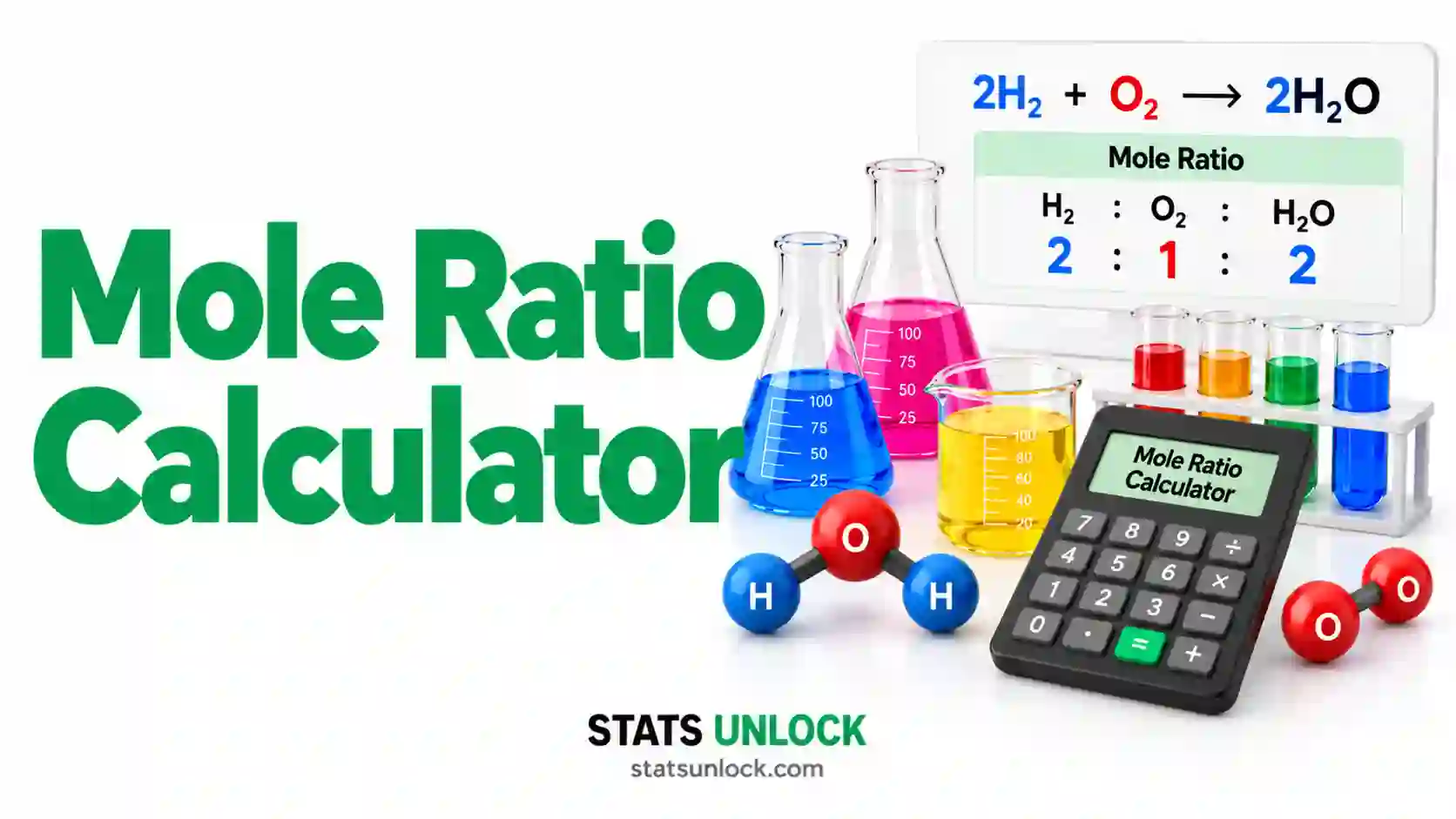

Mole Ratio Calculator
Find every mole ratio in a chemical equation and convert moles of one substance to moles or grams of another, calculate an experimental mole ratio from lab masses, the molar ratio of two compounds from their molecular weights, or the insert : vector molar ratio for DNA cloning. Every step shown, with a figure and four charts.
⚡ 0. Quick Answer
To calculate a mole ratio, balance the equation and read the coefficients: in N2 + 3H2 → 2NH3 the mole ratio of N2 : H2 : NH3 is 1 : 3 : 2. To convert, multiply the moles you have by (coefficient wanted ÷ coefficient given):
Rule of thumb: mole ratios come from coefficients, never from subscripts or masses. For an experimental mole ratio, convert each mass to moles and divide by the smallest: 1.27 g Cu and 4.32 g Ag give 0.01999 : 0.04005 = 1 : 2.00. For DNA cloning, insert ng = vector ng × (insert bp ÷ vector bp) × ratio, so 50 ng of a 3000 bp vector needs 50.0 ng of a 1000 bp insert at 3 : 1.
🔑 Key Takeaways
- A mole ratio is the ratio of the coefficients of two substances in a balanced equation; it is a conversion factor between their moles.
- An equation with n substances has n(n − 1) ÷ 2 mole ratios: propane combustion, C3H8 + 5O2 → 3CO2 + 4H2O, has 6.
- Mole ratios work in moles: convert grams with the molar mass first. 44.1 g of propane is 1.000 mol, which needs 5.00 mol O2.
- An experimental mole ratio divides measured moles by the smallest and rounds; values near .5 or .33 are multiplied by 2 or 3 (Fe : O = 1 : 1.50 becomes 2 : 3).
- A DNA molar ratio counts molecules, not nanograms: a 3 : 1 insert : vector ratio with a 1000 bp insert and 50 ng of a 3000 bp vector is 50.0 ng of insert.
📚 1. What Is a Mole Ratio, and How Does a Mole Ratio Calculator Work?
A mole ratio (also called a molar ratio or mole-to-mole ratio) is the ratio between the amounts, in moles, of two substances in a reaction. It comes from the coefficients of the balanced chemical equation: N2 + 3H2 → 2NH3 says that 1 mol of nitrogen reacts with 3 mol of hydrogen to give 2 mol of ammonia, whatever the scale. That is why mole ratios are central to every stoichiometric calculation: they are the only bridge between one substance and another.
A mole ratio calculator balances the equation for you, lists all possible mole ratios, and converts an amount of one substance (in moles, grams, mL of solution, litres of gas or particles) into the moles and grams of every other substance. It can also work backwards from the lab: from measured masses to an experimental mole ratio, or from two masses and molecular weights to the molar ratio of two compounds. For molecular biology it gives the insert : vector molar ratio used in ligation, In-Fusion and Gibson or NEBuilder assembly.
A worked one-liner: how many moles of oxygen react with 5.0 mol of hydrogen? 2H2 + O2 → 2H2O gives O2 : H2 = 1 : 2, so 5.0 × 1/2 = 2.5 mol O2.
Who uses it: mole ratios are taught in NCERT Class 11 (“Some Basic Concepts of Chemistry”), GCSE, A level, AP Chemistry and IB, and asked in JEE, NEET and the MCAT. Lab students use experimental mole ratios to identify a reaction or a hydrate; molecular biologists set up ligations with an insert : vector molar ratio every week.
| Balanced equation | Mole ratio | Example conversion |
|---|---|---|
| N2 + 3H2 → 2NH3 | 1 : 3 : 2 | 6.00 mol H2 → 4.00 mol NH3 |
| 2H2 + O2 → 2H2O | 2 : 1 : 2 | 5.0 mol H2 → 2.5 mol O2 |
| C3H8 + 5O2 → 3CO2 + 4H2O | 1 : 5 : 3 : 4 | 1.000 mol C3H8 → 3.00 mol CO2 |
| Fe2O3 + 3CO → 2Fe + 3CO2 | 1 : 3 : 2 : 3 | 2.50 mol Fe2O3 → 5.00 mol Fe |
| HCl + NaOH → NaCl + H2O | 1 : 1 : 1 : 1 | 25.0 mL of 0.100 M NaOH → 0.00250 mol HCl |
What this free mole ratio calculator solves
One tool covers every mole ratio calculation in a chemistry course and a cloning lab: a mole to mole ratio calculator, an all possible mole ratios calculator, a stoichiometry mole ratio calculator, a molar ratio calculator for two compounds from molecular weight, an experimental mole ratio calculator, and a DNA molar ratio calculator for ligation and In-Fusion cloning. Press Try it to load an example, then press the button to see the working.
| Problem | What it works out | Example | |
|---|---|---|---|
| Mole-to-mole conversion | Moles and grams of the substance you want | 6.00 mol H2 → 4.00 mol NH3 | |
| All possible mole ratios | Every pair from the balanced equation | Propane: 6 ratios | |
| From grams | Mass ÷ molar mass, then every ratio | 44.1 g C3H8 → 5.00 mol O2 | |
| Experimental mole ratio | Moles, ratio ÷ smallest, whole numbers, % difference | Cu : Ag = 1 : 2.00 | |
| Hydrate formula | Water to salt mole ratio | CuSO4 · 5H2O | |
| Molar ratio of two compounds | From masses and molar masses | 10.0 g NaCl : 10.0 g KCl = 1.28 : 1 | |
| From molecular weight | Mass needed for a target molar ratio | 1 : 2 glucose : sucrose | |
| DNA ligation molar ratio | Insert ng and fmol for 3 : 1 | 50 ng vector → 50.0 ng insert | |
| In-Fusion molar ratio | 2 : 1 for each insert, with volumes | Two inserts: 60.0 and 32.0 ng |
Free, with no sign-up. Everything runs in your browser: nothing you type is sent to a server or stored.
En español: ¿cómo se calcula la relación molar? Balancea la ecuación y usa los coeficientes: en N2 + 3H2 → 2NH3, 6,00 mol de H2 × 2/3 = 4,00 mol de NH3.
How accurate is this mole ratio calculator?
Equations are balanced exactly with whole-number coefficients, and molar masses use the CIAAW 2024 standard atomic weights (Prohaska et al., 2022). Answers are given to the number of significant figures in your data. Every answer is checked before it gets the Verified badge: the equation must conserve mass, and every amount divided by its coefficient must give the same extent of reaction. For DNA, molecular weights use 617.96 g/mol per base pair plus 36.04 g/mol, the average for double-stranded DNA used by vendor calculators. The R and Python scripts in Sections 10 and 11 return the same 4.00 mol NH3 and 1 : 2 Cu : Ag ratio as the headline problems.
Research on stoichiometry finds that most student errors come from using the mole ratio the wrong way up or from using masses in place of moles, not from the arithmetic (Schmidt & Jignéus, 2003; Gulacar et al., 2013). That is why the steps always show the ratio as a fraction with its units.
🧮 2. Enter Your Problem in the Mole Ratio Calculator
1. What do you have?
2. Equation (balanced or not)
Use -> for the arrow; the equation is balanced for you. Leave the amount empty to see only the mole ratios.
Press Enter in any box to calculate. Nothing is calculated until you press the button.
📊 3. Your Results: Mole Ratio Calculator with Steps
🧠 4. What Does Your Mole Ratio Mean?
4.1 Why are mole ratios central to stoichiometric calculations?
A balanced equation describes the reaction in particles: one N2 molecule with three H2 molecules gives two NH3. A mole is a fixed number of particles (6.022 × 10²³), so the same 1 : 3 : 2 ratio holds for moles. That makes the mole ratio the only link between two substances: grams, litres, molarity and particles must all be turned into moles, passed through the mole ratio, and turned back. Explaining the significance of the mole ratio in stoichiometric calculations comes down to this: without it you cannot get from what you have to what you want. A mole ratio calculator simply makes that bridge visible for every pair of substances at once.
4.2 How are mole ratios used in chemical calculations?
Write the ratio as a fraction with the substance you want on top and the one you have on the bottom, so the units cancel: 6.00 mol H2 × (2 mol NH3 ÷ 3 mol H2) = 4.00 mol NH3. The full road map is grams → moles (÷ M) → moles of the other substance (× mole ratio) → grams (× M). The mole ratio is also how you find the limiting reagent: divide the moles of each reactant by its coefficient, and the smallest runs out first.
4.3 Is a mole ratio the same as a mass ratio?
Mole ratios are not mass ratios. In N2 + 3H2 → 2NH3, the mole ratio N2 : H2 is 1 : 3, but the mass ratio is 28.014 : 6.048, about 4.6 : 1. Equal masses of NaCl and KCl contain different numbers of moles (0.171 and 0.134 mol in 10.0 g), so their molar ratio is 1.28 : 1, not 1 : 1. The mole ratio calculator always shows both, so the difference is clear.
4.4 What is an experimental mole ratio?
An experimental mole ratio is measured, not read from an equation. Divide each amount of moles by the smallest, then round. A value close to .5, .33 or .25 is a signal to multiply all the numbers by 2, 3 or 4 before rounding. In the mole ratio calculator, type the expected ratio to get the percent difference; comparing the two tells you how well the experiment went:
| Difference from the expected ratio | Typical description | Common reason |
|---|---|---|
| Within 5% | Good agreement | Careful weighing, complete reaction |
| 5 to 15% | Fair | Product lost in transfer, not fully dry |
| Above 15% | Poor | Incomplete reaction, side reaction, wet product, wrong equation |
4.5 Hydrates and formulas
The same arithmetic gives the water of crystallisation of a hydrate: 1.60 g of anhydrous CuSO4 and 0.90 g of water driven off give 0.01002 : 0.0500 = 1 : 4.98, so the formula is CuSO4·5H2O. The experimental mode of the mole ratio calculator does this rounding for you. An empirical formula is an experimental mole ratio of atoms: 2.00 g Fe and 0.860 g O give 1 : 1.50 = 2 : 3, so Fe2O3.
4.6 What molar ratio should you use for DNA cloning?
In ligation and assembly reactions, what matters is the number of DNA molecules, so the ratio is a molar ratio. Because a 1000 bp insert has a third of the mass per molecule of a 3000 bp vector, a 3 : 1 insert : vector molar ratio needs equal masses: 50 ng of each. Common starting points are 3 : 1 for T4 DNA ligase, 2 : 1 for In-Fusion (Takara) and NEBuilder HiFi assembly, and 3–5 : 1 or more for fragments under about 350 bp; vendors stress that these are starting points to optimise. The DNA mode of the mole ratio calculator has buttons for each of these presets.
4.7 Whole-number and fractional ratios
Mole ratios from an equation are usually given as the smallest whole numbers, but fractions are just as correct for calculations: H2 : O2 = 2 : 1 is the same as 1 : 0.5. The mole ratio calculator gives each ratio both ways, so you can use whichever fraction makes the units cancel.
4.8 A field note on where mole ratio problems go wrong
Marking stoichiometry, the same slips come up: using an unbalanced equation, reading the ratio from subscripts (the 2 in H2) instead of coefficients, putting the ratio upside down, multiplying grams by the mole ratio, and rounding an experimental 1 : 1.5 to 1 : 2 instead of doubling it to 2 : 3. Writing units on every number stops most of them (Dori & Hameiri, 2003).
✍ 5. How to Write a Mole Ratio Answer
📌 Conventions examiners look for
- Write the balanced equation first.
- Show the mole ratio as a fraction with units, so the units visibly cancel.
- Convert grams to moles before using the ratio.
📌 Conventions
- Give the unit and the substance: 4.00 mol NH3.
- Round to the least number of significant figures in the data.
📌 Conventions
- Report the experimental ratio to two decimals and the whole-number ratio beside it.
- Give the percent difference from the expected ratio.
📌 Conventions
- Accept answers within rounding of the atomic weights used.
- Use the Batch tab to make a whole worksheet answer key.
📌 Conventions
- Write subscripts as plain digits: NH3.
∑ 6. Mole Ratio Formula and Related Equations
The mole ratio formula is nB = nA × (b ÷ a), where a and b are the coefficients of A and B in the balanced equation. The other cards feed into it or use it.
🔀 7. How to Calculate Mole Ratio: Flowchart, Step by Step
This flowchart shows how to calculate mole ratios and use them, exactly as the mole ratio calculator does, on the same problem used in the Excel, R, Python and by-hand sections: nitrogen and hydrogen make ammonia. How many moles and grams of NH3 form from 6.00 mol of H2?
Check any box yourself: the Excel sheet in Section 9, the R script in Section 10 and the Python script in Section 11 all return 4.00 mol and 68.1 g of NH3 for this problem.
📝 8. How to Use This Mole Ratio Calculator
- Choose what you have. A chemical equation, measured amounts for an experimental ratio, two compounds, or a DNA vector and insert.
- Type the equation. Write N2 + H2 -> NH3; it is balanced for you and the balanced form appears under the box.
- Pick the substance you have and the one you want. Choose “every other substance” to convert to all of them at once.
- Enter the amount and unit. Use mol, mmol, g, mg, kg, mL of solution with molarity, litres of gas at STP or particles; leave it empty to see only the ratios.
- For an experimental ratio, enter each substance and its amount. Formulas, names or a molar mass in g/mol all work; add the expected ratio to get the percent difference.
- For two compounds, choose ratio or mass. Enter both masses for the molar ratio, or a target ratio to get the mass of B to weigh.
- For DNA, enter the vector length and mass and each insert’s length and ratio. Presets give 3 : 1, 2 : 1, 5 : 1 and 1 : 1; add ng/µL to get volumes.
- Press the button. Nothing is calculated before you press it, and changing any input clears the old answer.
- Read the ratios, the steps and the charts. The Verified badge means mass is conserved and every amount matches the ratio.
- Copy, share or batch. Copy the answer, share a link, download a report, or solve a whole worksheet on the Batch tab.
📈 9. How to Calculate Mole Ratio in Excel
Excel handles mole ratio calculations in a few small tables: the coefficients of the balanced equation, a ratio column, a conversion row, an experimental-ratio table with MIN, and a DNA insert row. The sheets use the headline problems, so they must return 4.00 mol NH3, Cu : Ag = 1 : 2 and 50.0 ng of insert, the same as the mole ratio calculator above.
=B6*C4/C3 gives the moles you want.9.1 The functions you need
| You want | Excel formula | Note |
|---|---|---|
| Moles from grams | =B2/C2 | Mass ÷ molar mass |
| Mole ratio B per A | =C4/C2 | Coefficient ÷ coefficient |
| Ratio in lowest terms | =C2/GCD(C2,C4)&" : "&C4/GCD(C2,C4) | Text such as 1 : 2 |
| Mole-to-mole | =B6*C4/C3 | Have × wanted ÷ given |
| Grams of product | =B7*D4 | Moles × molar mass |
| Experimental ratio | =D2/MIN(D$2:D$3) | Divide by the smallest |
| DNA insert (ng) | =B2*(B4/B3)*B5 | Vector ng × length ratio × molar ratio |
9.2 Step by step
1 Coefficients and mole ratios
Type each substance with its coefficient from the balanced equation; divide to get each ratio per mole of N2.
N2 : H2 : NH3 = 1 : 3 : 2.
2 Mole-to-mole conversion
Multiply the moles you have by the coefficient you want over the coefficient you have.
=B6*C4/C3 =B7*D4
6.00 mol H2 gives 4.00 mol NH3, 68.1 g.
3 Experimental mole ratio
Moles from each mass, then divide by the smallest with an absolute reference.
=B2/C2 =D2/MIN(D$2:D$3)
Cu : Ag = 1 : 2.004, so 1 : 2.
4 DNA insert : vector molar ratio
Vector mass and length, insert length and the molar ratio give the insert mass.
50 ng of a 3000 bp vector at 3 : 1 needs 50.0 ng of a 1000 bp insert.
9.3 Awkward cases
- Fractional coefficients (H2 + ½O2): the ratios are the same; multiply all coefficients by 2 if you want whole numbers.
- Ratios near .5 or .33: add a column
=E2*2or=E2*3before rounding withROUND. - Several inserts: one row per insert with the same vector cells, referenced with
$.
9.4 Why your Excel answer might differ
| Situation | What happens | Fix |
|---|---|---|
| Answer 2.25 times too big or small | Ratio upside down | Wanted on top, given on the bottom |
| Ratio from an unbalanced equation | Wrong coefficients | Balance first |
| Third decimal differs | Rounded molar masses (N 14, H 1) | Use 14.007 and 1.008 |
| DNA mass slightly different from a vendor tool | Average bp weight 617.96, 650 or 660 g/mol | The ratio formula cancels it; only fmol differ |
| Tool | Mole-to-mole |
|---|---|
| Excel / Google Sheets | =B6*C4/C3 |
| R | 6.00 * coef["NH3"] / coef["H2"] |
| Python | amount * coef[wanted] / coef[given] |
| Casio fx-991EX | 6.00 × 2 ÷ 3 = |
9.5 Charting in Excel
- Next to each substance, compute its moles for your amount:
=$B$6*C2/$C$3. - Insert → Clustered Column; the bar heights follow the 1 : 3 : 2 ratio, as in chart 2 above.
9.6 Excel errors you will probably hit
| Excel shows | Why | Fix |
|---|---|---|
#DIV/0! | A coefficient or molar mass cell is empty | Fill columns C and D |
#NUM! | GCD was given a decimal coefficient | Use whole-number coefficients |
#VALUE! | A unit typed in a number cell (“6.00 mol”) | Numbers only; put units in the header |
📈 10. How to Calculate Mole Ratio in R
This base R script stores the coefficients as a named vector, prints every mole ratio with combn, converts 6.00 mol of H2 to ammonia, calculates an experimental Cu : Ag ratio from masses, checks the answers and saves a 300 dpi chart. For the headline problem it prints 4.00 mol and 68.1 g of NH3, matching the mole ratio calculator on this page.
Rscript mole_ratio.R. Change only the coef, M and mass lines.10.1 The complete script
R, base only, saves mole_ratio.png
# ============================================================
# Mole ratio calculator in R (base R only):
# all mole ratios from a balanced equation, a mole-to-mole conversion,
# and an experimental mole ratio from measured masses
# StatsUnlock - https://statsunlock.com/mole-ratio-calculator/
# ============================================================

# ---- 1. Balanced equation: N2 + 3 H2 -> 2 NH3 -------------------------------
coef <- c(N2 = 1, H2 = 3, NH3 = 2)
M    <- c(N2 = 28.014, H2 = 2.016, NH3 = 17.031)    # g/mol
gcd  <- function(a, b) if (b == 0) a else gcd(b, a %% b)

# ---- 2. Every mole ratio (all possible pairs) ------------------------------
pairs <- combn(names(coef), 2)
for (k in seq_len(ncol(pairs))) {
  a <- pairs[1, k]; b <- pairs[2, k]; g <- gcd(coef[a], coef[b])
  cat(sprintf("%s : %s = %d : %d\n", a, b, coef[a] / g, coef[b] / g))
}

# ---- 3. Mole-to-mole conversion: 6.00 mol H2 -> NH3 ------------------------
n_wanted <- 6.00 * coef["NH3"] / coef["H2"]          # mol x (2 / 3)
mass_wanted <- n_wanted * M["NH3"]
cat(sprintf("6.00 mol H2 x 2/3 = %.2f mol NH3 = %.1f g\n", n_wanted, mass_wanted))

# ---- 4. Experimental mole ratio: 1.27 g Cu gives 4.32 g Ag -----------------
moles <- c(Cu = 1.27 / 63.546, Ag = 4.32 / 107.870)
ratio <- moles / min(moles)
print(round(ratio, 3))
cat("Whole-number ratio Cu : Ag =", paste(round(ratio), collapse = " : "), "\n")

# ---- 5. Checks -------------------------------------------------------------
stopifnot(round(n_wanted, 2) == 4.00, round(mass_wanted, 1) == 68.1,
          all(round(ratio) == c(1, 2)), abs(ratio["Ag"] - 2.004) < 0.001)
cat("Verdict: Verified (all checks pass)\n")

# ---- 6. Figure: moles of every substance for 6.00 mol H2 -------------------
mol <- 6.00 * coef / coef["H2"]
png("mole_ratio.png", width = 2100, height = 1350, res = 300)
par(mar = c(4, 4.5, 3, 1))
bp <- barplot(mol, col = c("#2563eb", "#ea580c", "#16a34a"), ylab = "mol", ylim = c(0, 7),
              main = "N2 + 3 H2 -> 2 NH3: moles follow the 1 : 3 : 2 ratio")
text(bp, mol + 0.3, sprintf("%.2f mol", mol))
invisible(dev.off())
cat("Saved mole_ratio.png\n")
Output: N2 : H2 = 1 : 3, N2 : NH3 = 1 : 2, H2 : NH3 = 3 : 2, 6.00 mol H2 x 2/3 = 4.00 mol NH3 = 68.1 g, Whole-number ratio Cu : Ag = 1 : 2, Verdict: Verified.
10.2 R traps
- Index named vectors by name (
coef["H2"]) so the ratio cannot be taken from the wrong substance. %%is the remainder operator, used in thegcdfunction; insidesprintf, a percent sign must also be written%%.- Round only when printing; keep full precision for the ratio.
10.3 What each part does
| Part | What it does |
|---|---|
combn(names(coef), 2) | Every pair: all possible mole ratios |
coef[a] / g | Ratio in lowest terms |
6.00 * coef["NH3"] / coef["H2"] | Mole-to-mole conversion |
moles / min(moles) | Experimental mole ratio |
stopifnot(...) | The checks |
10.4 The figure
The script saves mole_ratio.png at 2100 × 1350 pixels and 300 dpi: the moles of N2, H2 and NH3 for 6.00 mol of H2, following the 1 : 3 : 2 ratio.
🐍 11. How to Calculate Mole Ratio in Python
This script does the same in plain Python: a dictionary of coefficients, every mole ratio with itertools.combinations, the mole-to-mole conversion, the experimental ratio, exact checks with fractions.Fraction and a 300 dpi chart. It is the same method the mole ratio calculator runs in your browser.
Install once: pip install matplotlib
11.1 The complete script
Python, saves mole_ratio.png
# ============================================================
# Mole ratio calculator in Python:
# all mole ratios from a balanced equation, a mole-to-mole conversion,
# and an experimental mole ratio from measured masses
# StatsUnlock - https://statsunlock.com/mole-ratio-calculator/
# pip install matplotlib
# ============================================================
from fractions import Fraction
from itertools import combinations
from math import gcd
import matplotlib
matplotlib.use("Agg")
import matplotlib.pyplot as plt

# ---- 1. Balanced equation: N2 + 3 H2 -> 2 NH3 -------------------------------
coef = {"N2": 1, "H2": 3, "NH3": 2}
M = {"N2": 28.014, "H2": 2.016, "NH3": 17.031}          # g/mol

# ---- 2. Every mole ratio (all possible pairs) ------------------------------
for a, b in combinations(coef, 2):
    g = gcd(coef[a], coef[b])
    print(f"{a} : {b} = {coef[a] // g} : {coef[b] // g}")

# ---- 3. Mole-to-mole conversion: 6.00 mol H2 -> NH3 ------------------------
given, amount, wanted = "H2", 6.00, "NH3"
n_wanted = amount * coef[wanted] / coef[given]             # mol x (2 / 3)
mass_wanted = n_wanted * M[wanted]
print(f"{amount:.2f} mol {given} x {coef[wanted]}/{coef[given]} = {n_wanted:.2f} mol {wanted} = {mass_wanted:.1f} g")

# ---- 4. Experimental mole ratio: 1.27 g Cu gives 4.32 g Ag -----------------
masses = {"Cu": 1.27, "Ag": 4.32}
molar = {"Cu": 63.546, "Ag": 107.870}
moles = {k: masses[k] / molar[k] for k in masses}
smallest = min(moles.values())
ratio = {k: v / smallest for k, v in moles.items()}
whole = {k: round(v) for k, v in ratio.items()}
print("Experimental:", {k: round(v, 3) for k, v in ratio.items()}, "->", whole)

# ---- 5. Checks ------------------------------------------------------------
assert Fraction(coef["NH3"], coef["H2"]) == Fraction(2, 3)
assert round(n_wanted, 2) == 4.00 and round(mass_wanted, 1) == 68.1
assert whole == {"Cu": 1, "Ag": 2} and abs(ratio["Ag"] - 2.004) < 0.001
print("Verdict: Verified (all checks pass)")

# ---- 6. Figure: moles of every substance for 6.00 mol H2 -------------------
names = list(coef)
mol = [amount * coef[s] / coef[given] for s in names]
fig, ax = plt.subplots(figsize=(7, 4.5))
ax.bar(names, mol, color=["#2563eb", "#ea580c", "#16a34a"])
for i, v in enumerate(mol):
    ax.text(i, v + 0.1, f"{v:.2f} mol", ha="center")
ax.set_ylabel("mol"); ax.set_title("N2 + 3 H2 -> 2 NH3: moles follow the 1 : 3 : 2 ratio")
fig.tight_layout(); fig.savefig("mole_ratio.png", dpi=300)
print("Saved mole_ratio.png")
Output: N2 : H2 = 1 : 3, 6.00 mol H2 x 2/3 = 4.00 mol NH3 = 68.1 g, Experimental: {'Cu': 1.0, 'Ag': 2.004} -> {'Cu': 1, 'Ag': 2}, Verdict: Verified.
11.2 Python traps
Fraction(2, 3)keeps the ratio exact;2 / 3is a rounded float.round(1.5)gives 2 andround(2.5)gives 2 (round half to even): check values near .5 by multiplying instead.- Use the same molar masses as your textbook if you want to match its third decimal.
11.3 Packages
pip install chempy balances equations with balance_stoichiometry, so the coefficients (and mole ratios) can come from formulas; molmass gives molar masses.
11.4 What each part does
| Part | What it does |
|---|---|
combinations(coef, 2) | All possible mole ratios |
amount * coef[wanted] / coef[given] | Mole-to-mole conversion |
v / smallest | Experimental ratio |
assert ... | The checks |
11.5 The figure
The script saves mole_ratio.png at 300 dpi: the moles of each substance for 6.00 mol of H2.
📋 12. Mole Ratio Tables and Worksheet
12.1 Mole ratios of common reactions
Every equation was balanced, and every ratio read off, by the same engine as the mole ratio calculator above.
| Balanced equation | All mole ratios | Ratios |
|---|---|---|
| N2 + 3 H2 → 2 NH3 | N2 : H2 = 1 : 3; N2 : NH3 = 1 : 2; H2 : NH3 = 3 : 2 | 3 |
| 2 H2 + O2 → 2 H2O | H2 : O2 = 2 : 1; H2 : H2O = 1 : 1; O2 : H2O = 1 : 2 | 3 |
| CH4 + 2 O2 → CO2 + 2 H2O | CH4 : O2 = 1 : 2; CH4 : CO2 = 1 : 1; CH4 : H2O = 1 : 2; O2 : CO2 = 2 : 1; O2 : H2O = 1 : 1; CO2 : H2O = 1 : 2 | 6 |
| C3H8 + 5 O2 → 3 CO2 + 4 H2O | C3H8 : O2 = 1 : 5; C3H8 : CO2 = 1 : 3; C3H8 : H2O = 1 : 4; O2 : CO2 = 5 : 3; O2 : H2O = 5 : 4; CO2 : H2O = 3 : 4 | 6 |
| C6H12O6 + 6 O2 → 6 CO2 + 6 H2O | C6H12O6 : O2 = 1 : 6; C6H12O6 : CO2 = 1 : 6; C6H12O6 : H2O = 1 : 6; O2 : CO2 = 1 : 1; O2 : H2O = 1 : 1; CO2 : H2O = 1 : 1 | 6 |
| Fe2O3 + 3 CO → 2 Fe + 3 CO2 | Fe2O3 : CO = 1 : 3; Fe2O3 : Fe = 1 : 2; Fe2O3 : CO2 = 1 : 3; CO : Fe = 3 : 2; CO : CO2 = 1 : 1; Fe : CO2 = 2 : 3 | 6 |
| 4 Al + 3 O2 → 2 Al2O3 | Al : O2 = 4 : 3; Al : Al2O3 = 2 : 1; O2 : Al2O3 = 3 : 2 | 3 |
| 2 KClO3 → 2 KCl + 3 O2 | KClO3 : KCl = 1 : 1; KClO3 : O2 = 2 : 3; KCl : O2 = 2 : 3 | 3 |
| Mg + 2 HCl → MgCl2 + H2 | Mg : HCl = 1 : 2; Mg : MgCl2 = 1 : 1; Mg : H2 = 1 : 1; HCl : MgCl2 = 2 : 1; HCl : H2 = 2 : 1; MgCl2 : H2 = 1 : 1 | 6 |
| CaCO3 → CaO + CO2 | CaCO3 : CaO = 1 : 1; CaCO3 : CO2 = 1 : 1; CaO : CO2 = 1 : 1 | 3 |
| 2 Na + Cl2 → 2 NaCl | Na : Cl2 = 2 : 1; Na : NaCl = 1 : 1; Cl2 : NaCl = 1 : 2 | 3 |
| Zn + 2 HCl → ZnCl2 + H2 | Zn : HCl = 1 : 2; Zn : ZnCl2 = 1 : 1; Zn : H2 = 1 : 1; HCl : ZnCl2 = 2 : 1; HCl : H2 = 2 : 1; ZnCl2 : H2 = 1 : 1 | 6 |
| 2 C2H6 + 7 O2 → 4 CO2 + 6 H2O | C2H6 : O2 = 2 : 7; C2H6 : CO2 = 1 : 2; C2H6 : H2O = 1 : 3; O2 : CO2 = 7 : 4; O2 : H2O = 7 : 6; CO2 : H2O = 2 : 3 | 6 |
| 2 N2O5 → 4 NO2 + O2 | N2O5 : NO2 = 1 : 2; N2O5 : O2 = 2 : 1; NO2 : O2 = 4 : 1 | 3 |
| 2 Al + 3 CuSO4 → Al2(SO4)3 + 3 Cu | Al : CuSO4 = 2 : 3; Al : Al2(SO4)3 = 2 : 1; Al : Cu = 2 : 3; CuSO4 : Al2(SO4)3 = 3 : 1; CuSO4 : Cu = 1 : 1; Al2(SO4)3 : Cu = 1 : 3 | 6 |
| H2SO4 + 2 NaOH → Na2SO4 + 2 H2O | H2SO4 : NaOH = 1 : 2; H2SO4 : Na2SO4 = 1 : 1; H2SO4 : H2O = 1 : 2; NaOH : Na2SO4 = 2 : 1; NaOH : H2O = 1 : 1; Na2SO4 : H2O = 1 : 2 | 6 |
12.2 Insert mass for common cloning setups
Insert mass = vector mass × (insert bp ÷ vector bp) × insert : vector molar ratio, with 50 ng of vector unless stated.
| Vector | Insert | Molar ratio | Insert mass | Insert moles |
|---|---|---|---|---|
| 3000 bp, 50 ng (27.0 fmol) | 1000 bp | 3 : 1 | 50.0 ng | 80.9 fmol |
| 3000 bp, 50 ng (27.0 fmol) | 1000 bp | 1 : 1 | 16.7 ng | 27.0 fmol |
| 3000 bp, 50 ng (27.0 fmol) | 500 bp | 3 : 1 | 25.0 ng | 80.9 fmol |
| 5000 bp, 50 ng (16.2 fmol) | 1500 bp | 3 : 1 | 45.0 ng | 48.5 fmol |
| 5000 bp, 100 ng (32.4 fmol) | 1500 bp | 2 : 1 | 60.0 ng | 64.7 fmol |
| 2700 bp, 50 ng (30.0 fmol) | 750 bp | 3 : 1 | 41.7 ng | 89.9 fmol |
| 6000 bp, 100 ng (27.0 fmol) | 2000 bp | 2 : 1 | 66.7 ng | 53.9 fmol |
| 5400 bp, 100 ng (30.0 fmol) | 150 bp | 5 : 1 | 13.9 ng | 149.8 fmol |
| 4000 bp, 50 ng (20.2 fmol) | 4000 bp | 1 : 1 | 50.0 ng | 20.2 fmol |
| 10000 bp, 100 ng (16.2 fmol) | 3000 bp | 2 : 1 | 60.0 ng | 32.4 fmol |
12.3 Mole ratio worksheet with answers
Twenty-five questions in three groups: mole ratios from equations, mole-to-mole and gram conversions, and experimental and DNA molar ratios. Every answer was checked by the mole ratio calculator engine. Cover the last column and try them first.
Free printable mole ratio worksheet with answers.
| # | Question | Working | Answer |
|---|---|---|---|
| A. Read the mole ratio from the equation | |||
| 1 | From N2 + 3 H2 → 2 NH3, what is the mole ratio of N2 to NH3? | Coefficients 1 and 2 | 1 : 2 |
| 2 | From 2 H2 + O2 → 2 H2O, what is the mole ratio of H2 to O2? | Coefficients 2 and 1 | 2 : 1 |
| 3 | From CH4 + 2 O2 → CO2 + 2 H2O, what is the mole ratio of CH4 to O2? | Coefficients 1 and 2 | 1 : 2 |
| 4 | From C6H12O6 + 6 O2 → 6 CO2 + 6 H2O, what is the mole ratio of C6H12O6 to CO2? | Coefficients 1 and 6 | 1 : 6 |
| 5 | From 4 Al + 3 O2 → 2 Al2O3, what is the mole ratio of Al to Al2O3? | Coefficients 4 and 2 | 2 : 1 |
| 6 | From 2 KClO3 → 2 KCl + 3 O2, what is the mole ratio of KClO3 to O2? | Coefficients 2 and 3 | 2 : 3 |
| 7 | From 2 Al + 3 CuSO4 → Al2(SO4)3 + 3 Cu, what is the mole ratio of Al to Cu? | Coefficients 2 and 3 | 2 : 3 |
| 8 | From H2SO4 + 2 NaOH → Na2SO4 + 2 H2O, what is the mole ratio of H2SO4 to NaOH? | Coefficients 1 and 2 | 1 : 2 |
| B. Mole-to-mole and gram conversions | |||
| 9 | N2 + 3 H2 → 2 NH3: how many moles of NH3 form from 2.50 mol N2? | n(NH3) = 2.500 mol N2 × 2 mol NH3 / 1 mol N2 = 5.00 mol NH3; m = 5.000 mol × 17.031 g/mol = 85.2 g | 5.00 mol NH3 (85.2 g) |
| 10 | 2 H2 + O2 → 2 H2O: how many moles of H2 react with 3.0 mol O2? | n(H2) = 3.00 mol O2 × 2 mol H2 / 1 mol O2 = 6.0 mol H2; m = 6.00 mol × 2.016 g/mol = 12 g | 6.0 mol H2 (12 g) |
| 11 | C3H8 + 5 O2 → 3 CO2 + 4 H2O: how many moles of O2 react with 0.500 mol C3H8? | n(O2) = 0.5000 mol C3H8 × 5 mol O2 / 1 mol C3H8 = 2.50 mol O2; m = 2.500 mol × 31.998 g/mol = 80.0 g | 2.50 mol O2 (80.0 g) |
| 12 | 4 Al + 3 O2 → 2 Al2O3: how many moles of Al2O3 form from 4.00 mol Al? | n(Al2O3) = 4.000 mol Al × 2 mol Al2O3 / 4 mol Al = 2.00 mol Al2O3; m = 2.000 mol × 101.961 g/mol = 204 g | 2.00 mol Al2O3 (204 g) |
| 13 | 2 KClO3 → 2 KCl + 3 O2: how many moles of O2 form from 2.00 mol KClO3? | n(O2) = 2.000 mol KClO3 × 3 mol O2 / 2 mol KClO3 = 3.00 mol O2; m = 3.000 mol × 31.998 g/mol = 96.0 g | 3.00 mol O2 (96.0 g) |
| 14 | Fe2O3 + 3 CO → 2 Fe + 3 CO2: how many moles and grams of Fe form from 80.0 g Fe2O3? | n = 80.00 g ÷ 159.687 g/mol = 0.5010 mol; n(Fe) = 0.5010 mol Fe2O3 × 2 mol Fe / 1 mol Fe2O3 = 1.00 mol Fe; m = 1.002 mol × 55.845 g/mol = 56.0 g | 1.00 mol Fe (56.0 g) |
| 15 | CH4 + 2 O2 → CO2 + 2 H2O: how many moles and grams of H2O form from 8.02 g CH4? | n = 8.020 g ÷ 16.043 g/mol = 0.4999 mol; n(H2O) = 0.4999 mol CH4 × 2 mol H2O / 1 mol CH4 = 1.00 mol H2O; m = 0.9998 mol × 18.015 g/mol = 18.0 g | 1.00 mol H2O (18.0 g) |
| 16 | Mg + 2 HCl → MgCl2 + H2: how many moles and grams of H2 form from 4.86 g Mg? | n = 4.860 g ÷ 24.305 g/mol = 0.2000 mol; n(H2) = 0.2000 mol Mg × 1 mol H2 / 1 mol Mg = 0.200 mol H2; m = 0.2000 mol × 2.016 g/mol = 0.403 g | 0.200 mol H2 (0.403 g) |
| 17 | HCl + NaOH → NaCl + H2O: how many moles of HCl react with 20.0 mL of 0.150 M NaOH? | n = 0.150 mol/L × 20.0 mL ÷ 1000 = 0.003000 mol; n(HCl) = 0.003000 mol NaOH × 1 mol HCl / 1 mol NaOH = 0.00300 mol HCl; m = 0.003000 mol × 36.458 g/mol = 0.109 g | 0.00300 mol HCl (0.109 g) |
| C. Experimental, two-compound and DNA molar ratios | |||
| 18 | A sample contains 0.635 g of Cu and 2.16 g of Ag. Find the experimental mole ratio. | 0.00999 mol Cu : 0.0200 mol Ag = 1.00 : 2.00 | Cu : Ag = 1 : 2 |
| 19 | A sample contains 0.243 g of Mg and 0.160 g of O. Find the experimental mole ratio. | 0.0100 mol Mg : 0.0100 mol O = 1.00 : 1.00 | Mg : O = 1 : 1 |
| 20 | A sample contains 1.12 g of Fe and 0.480 g of O. Find the experimental mole ratio. | 0.0201 mol Fe : 0.0300 mol O = 1.00 : 1.50 | Fe : O = 2 : 3 |
| 21 | A sample contains 2.08 g of BaCl2 and 0.360 g of H2O. Find the experimental mole ratio. | 0.00999 mol BaCl2 : 0.0200 mol H2O = 1.00 : 2.00 | BaCl2 : H2O = 1 : 2 |
| 22 | A sample contains 0.600 g of C and 0.151 g of H. Find the experimental mole ratio. | 0.0500 mol C : 0.150 mol H = 1.00 : 3.00 | C : H = 1 : 3 |
| 23 | What is the molar ratio of 4.00 g NaOH to 3.65 g HCl? | 0.100 mol : 0.100 mol | NaOH : HCl = 1 : 1.00 |
| 24 | Ligation: 50 ng of a 4000 bp vector and a 1200 bp insert at 3 : 1. How much insert? | 50 × (1200 ÷ 4000) × 3 | 45.0 ng insert |
| 25 | In-Fusion at 2 : 1 with 100 ng of a 6000 bp vector and a 900 bp insert. How much insert? | 100 × (900 ÷ 6000) × 2 | 30.0 ng insert |
📈 13. Mole Ratio Calculation Examples
Eight examples run through the mole ratio calculator, from ammonia to an In-Fusion cloning reaction. Each figure is drawn from the computed numbers: one bar per substance (or DNA fragment) in moles, so the bar heights are the mole ratio.
Ammonia from hydrogen
Wanted over given: 2/3.
6.00 mol of hydrogen reacts with nitrogen in excess: N2 + 3H2 → 2NH3.
| Quantity | Value | Note |
|---|---|---|
| Balanced equation | N2 + 3 H2 → 2 NH3 | Coefficients = mole ratios |
| Mole ratio N2 : H2 | 1 : 3 | 1 mol N2 ↔ 3.000 mol H2 |
| Mole ratio N2 : NH3 | 1 : 2 | 1 mol N2 ↔ 2.000 mol NH3 |
| Mole ratio H2 : NH3 | 3 : 2 | 1 mol H2 ↔ 0.6667 mol NH3 |
| Reactant N2 | 2.00 mol (56.0 g) | needed: × 1/3 |
| Given H2 | 6.00 mol (12.1 g) | 6.00 mol |
| Product NH3 | 4.00 mol (68.1 g) | formed: × 2/3 |
What it means: The coefficients 3 and 2 give the ratio 2 mol NH3 per 3 mol H2, so 6.00 × 2/3 = 4.00 mol of ammonia. The same extent, 2.00 mol, uses 2.00 mol of N2.
How to write it: 6.00 mol H2 × (2 mol NH3 / 3 mol H2) = 4.00 mol NH3
Burning propane
Four substances, six mole ratios.
44.1 g of propane burns completely: C3H8 + 5O2 → 3CO2 + 4H2O.
| Quantity | Value | Note |
|---|---|---|
| Balanced equation | C3H8 + 5 O2 → 3 CO2 + 4 H2O | Coefficients = mole ratios |
| Mole ratio C3H8 : O2 | 1 : 5 | 1 mol C3H8 ↔ 5.000 mol O2 |
| Mole ratio C3H8 : CO2 | 1 : 3 | 1 mol C3H8 ↔ 3.000 mol CO2 |
| Mole ratio C3H8 : H2O | 1 : 4 | 1 mol C3H8 ↔ 4.000 mol H2O |
| Mole ratio O2 : CO2 | 5 : 3 | 1 mol O2 ↔ 0.6000 mol CO2 |
| Mole ratio O2 : H2O | 5 : 4 | 1 mol O2 ↔ 0.8000 mol H2O |
| Mole ratio CO2 : H2O | 3 : 4 | 1 mol CO2 ↔ 1.333 mol H2O |
What it means: 44.1 g ÷ 44.097 g/mol = 1.000 mol of propane. Each other substance follows its own ratio: 5.00 mol O2 used, 3.00 mol CO2 and 4.00 mol H2O formed.
How to write it: C3H8 : O2 : CO2 : H2O = 1 : 5 : 3 : 4
Iron from iron(III) oxide
Two moles of iron per mole of oxide.
2.50 mol of iron(III) oxide is reduced by carbon monoxide: Fe2O3 + 3CO → 2Fe + 3CO2.
| Quantity | Value | Note |
|---|---|---|
| Balanced equation | Fe2O3 + 3 CO → 2 Fe + 3 CO2 | Coefficients = mole ratios |
| Mole ratio Fe2O3 : CO | 1 : 3 | 1 mol Fe2O3 ↔ 3.000 mol CO |
| Mole ratio Fe2O3 : Fe | 1 : 2 | 1 mol Fe2O3 ↔ 2.000 mol Fe |
| Mole ratio Fe2O3 : CO2 | 1 : 3 | 1 mol Fe2O3 ↔ 3.000 mol CO2 |
| Mole ratio CO : Fe | 3 : 2 | 1 mol CO ↔ 0.6667 mol Fe |
| Mole ratio CO : CO2 | 1 : 1 | 1 mol CO ↔ 1.000 mol CO2 |
| Mole ratio Fe : CO2 | 2 : 3 | 1 mol Fe ↔ 1.500 mol CO2 |
What it means: Each Fe2O3 gives two Fe, so 2.50 × 2 = 5.00 mol of iron (279 g); it needs 2.50 × 3 = 7.50 mol of CO.
How to write it: 2.50 mol Fe2O3 × (2 mol Fe / 1 mol Fe2O3) = 5.00 mol Fe
Copper and silver nitrate
Measured masses, whole-number ratio.
1.27 g of copper wire dissolves in silver nitrate solution and 4.32 g of silver forms.
| Quantity | Value | Note |
|---|---|---|
| Moles of Cu | 0.0200 mol | 1.27 g ÷ 63.546 g/mol |
| Moles of Ag | 0.0400 mol | 4.32 g ÷ 107.870 g/mol |
| Ratio ÷ smallest | 1.000 : 2.004 | Experimental mole ratio |
| Simplest whole-number ratio | 1 : 2 | rounded |
| Difference for Ag | +0.2% | found 2.004 vs expected 2.000 |
What it means: Moles of Cu and Ag are in the ratio 1 : 2.004, which rounds to 1 : 2, the ratio in Cu + 2Ag+ → Cu2+ + 2Ag. A 0.2% difference is excellent agreement.
How to write it: Cu : Ag = 0.01999 : 0.04005 = 1 : 2.00
Water in copper sulfate crystals
The water to salt mole ratio is the x in CuSO4·xH2O.
Heating blue copper sulfate leaves 1.60 g of white anhydrous CuSO4 and drives off 0.90 g of water.
| Quantity | Value | Note |
|---|---|---|
| Moles of CuSO4 | 0.010 mol | 1.60 g ÷ 159.602 g/mol |
| Moles of H2O | 0.050 mol | 0.90 g ÷ 18.015 g/mol |
| Ratio ÷ smallest | 1.000 : 4.983 | Experimental mole ratio |
| Simplest whole-number ratio | 1 : 5 | rounded |
What it means: 0.0500 ÷ 0.01002 = 4.98, which rounds to 5: the hydrate is CuSO4·5H2O.
How to write it: CuSO4 : H2O = 1 : 4.98 ≈ 1 : 5, so CuSO4·5H2O
An iron oxide formula
1 : 1.5 means double, not round.
2.00 g of iron combines with 0.860 g of oxygen.
| Quantity | Value | Note |
|---|---|---|
| Moles of Fe | 0.0358 mol | 2.00 g ÷ 55.845 g/mol |
| Moles of O | 0.0538 mol | 0.860 g ÷ 15.999 g/mol |
| Ratio ÷ smallest | 1.000 : 1.501 | Experimental mole ratio |
| Simplest whole-number ratio | 2 : 3 | after × 2 |
What it means: O ÷ Fe = 1.501, halfway between whole numbers, so multiply both by 2: 2 : 3, the formula Fe2O3.
How to write it: Fe : O = 1 : 1.50 = 2 : 3, so Fe2O3
Equal masses, different moles
10 g each is not 1 : 1.
A mixture contains 10.0 g of NaCl and 10.0 g of KCl.
| Quantity | Value | Note |
|---|---|---|
| Moles of NaCl | 0.171 mol | 10.0 g ÷ 58.440 g/mol |
| Moles of KCl | 0.134 mol | 10.0 g ÷ 74.548 g/mol |
| Molar ratio NaCl : KCl | 1.28 : 1 | = 1 : 0.784 |
| Nearest whole-number ratio | 5 : 4 | within 0.1 |
| Mass ratio NaCl : KCl | 1.00 : 1 | Compare: the molar mass ratio is 0.7839 |
| Mole fraction of NaCl | 0.561 | n(A) ÷ (n(A) + n(B)) |
What it means: KCl has the larger molar mass (74.548 vs 58.440 g/mol), so the same mass holds fewer moles: the molar ratio NaCl : KCl is 1.28 : 1.
How to write it: NaCl : KCl = 0.1711 : 0.1341 = 1.28 : 1
In-Fusion with two inserts
2 : 1 for each insert.
100 ng of a 5000 bp linearised vector (50 ng/µL) with a 1500 bp insert (20 ng/µL) and an 800 bp insert, each at 2 : 1.
| Quantity | Value | Note |
|---|---|---|
| Vector | 100 ng (32.36 fmol) | 5000 bp, MW 3.090 × 10⁶ g/mol; 2.00 µL |
| Insert 1 (1500 bp, 2 : 1) | 60.00 ng (64.73 fmol) | exact 60.00 ng; 3.00 µL at 20 ng/µL |
| Insert 2 (800 bp, 2 : 1) | 32.00 ng (64.73 fmol) | exact 32.00 ng |
| Total DNA | 192.0 ng | vector + inserts |
What it means: Each insert must hold twice as many molecules as the vector, 64.7 fmol. The shorter insert needs less mass for the same number of molecules.
How to write it: Insert 1 = 100 ng × (1500/5000) × 2 = 60.0 ng; insert 2 = 100 × (800/5000) × 2 = 32.0 ng
✏️ 14. How to Calculate Mole Ratio by Hand
This is the written method examiners expect, on the same problem as Sections 7, 9, 10 and 11: how many moles and grams of NH3 form from 6.00 mol of H2?
14.1 How to calculate mole ratio step by step
- Balance the equation. N2 + 3H2 → 2NH3.
- Read the coefficients of the two substances: H2 3, NH3 2.
- Write the mole ratio as a fraction, wanted over given: 2 mol NH3 ÷ 3 mol H2.
- Multiply the moles you have: 6.00 mol H2 × 2/3 = 4.00 mol NH3.
- Convert to grams if asked: 4.00 mol × 17.031 g/mol = 68.1 g.
- Check: 6.00 ÷ 3 = 4.00 ÷ 2 = 2.00, the same extent of reaction.
14.2 How to calculate mole to mole ratio for every substance
For C3H8 + 5O2 → 3CO2 + 4H2O there are six mole ratios: C3H8 : O2 = 1 : 5, C3H8 : CO2 = 1 : 3, C3H8 : H2O = 1 : 4, O2 : CO2 = 5 : 3, O2 : H2O = 5 : 4 and CO2 : H2O = 3 : 4. With 1.000 mol of propane, multiply by each: 5.00 mol O2, 3.00 mol CO2, 4.00 mol H2O.
14.3 How to calculate molar ratio from molecular weight (grams)
Divide each mass by its molecular weight first. 44.1 g of propane ÷ 44.097 g/mol = 1.000 mol, and 44.1 g of CO2 would be 44.1 ÷ 44.009 = 1.002 mol: equal masses, almost equal moles here only because the molar masses happen to be close.
14.4 How to calculate experimental mole ratio
In the classic copper and silver nitrate experiment, 1.27 g of copper wire gives 4.32 g of silver. Moles: Cu 1.27 ÷ 63.546 = 0.01999 mol; Ag 4.32 ÷ 107.870 = 0.04005 mol. Divide by the smaller: 1 : 2.004, so Cu : Ag = 1 : 2, matching Cu + 2Ag+ → Cu2+ + 2Ag (a 0.2% difference). Load sample 6 in the mole ratio calculator to see every step.
14.5 How to calculate the molar ratio of two compounds
10.0 g of NaCl is 10.0 ÷ 58.440 = 0.1711 mol and 10.0 g of KCl is 10.0 ÷ 74.548 = 0.1341 mol, so NaCl : KCl = 1.28 : 1. To make a 1 : 2 mole ratio of glucose to sucrose with 5.00 g of glucose (180.156 g/mol): 0.02775 mol × 2 = 0.05551 mol of sucrose × 342.30 g/mol = 19.0 g.
14.6 How to calculate molar ratio for DNA cloning
For a ligation with T4 DNA ligase at 3 : 1 insert : vector, 50 ng of a 3000 bp vector and a 1000 bp insert: insert = 50 × (1000 ÷ 3000) × 3 = 50.0 ng. In moles, 50 ng ÷ (3000 × 617.96 + 36.04) g/mol = 26.97 fmol of vector and 80.9 fmol of insert. For In-Fusion (Takara recommends 2 : 1 for each insert) with 100 ng of a 5000 bp vector, a 1500 bp insert needs 100 × (1500 ÷ 5000) × 2 = 60.0 ng. The mole ratio calculator gives the same numbers, plus the volumes to pipette.
14.7 On a scientific calculator
On a Casio fx-991EX or fx-82MS, type the chain at once: 6.00 × 2 ÷ 3 = gives 4; then × 17.031 = gives 68.124.
Keep the unrounded answer (Ans) for the next step. Key names differ between models; check your manual.
14.8 Do it in the lab: the mole ratio of copper to silver
Copper wire in silver nitrate solution
- Weigh a clean coil of copper wire (about 1.3 g).
- Place it in about 50 mL of 0.5 mol/L silver nitrate solution in a beaker; leave it overnight, covered, away from light.
- Shake the silver crystals off the wire, rinse the wire with water then acetone, dry and reweigh it to get the copper used.
- Collect the silver by filtration, wash with water and acetone, dry to constant mass and weigh.
Hazards: silver nitrate stains skin and is corrosive to eyes; acetone is highly flammable. Wear eye protection and gloves, keep flames away and follow your school’s risk assessment.
Main errors: silver lost in filtration or washing (ratio too low), silver not fully dry (ratio too high), and copper oxide on the wire.
| Measurement | Value | Working |
|---|---|---|
| Copper wire before | 2.416 g | |
| Copper wire after | 1.142 g | Copper used 1.274 g = 0.02005 mol |
| Filter paper | 0.952 g | |
| Filter paper + dry silver | 5.270 g | Silver 4.318 g = 0.04003 mol |
| Mole ratio Ag : Cu | 1.997 : 1 | 0.04003 ÷ 0.02005 |
| Whole-number ratio | Cu : Ag = 1 : 2 | Cu + 2Ag+ → Cu2+ + 2Ag |
| Difference from 2 : 1 | −0.2% | (1.997 − 2) ÷ 2 × 100 |
Example data. A ratio of 1 : 1 would point to copper(I), Cu + Ag+ → Cu+ + Ag; the measured 1 : 2.00 shows copper is oxidised to Cu2+.
14.9 How to calculate mole ratios: practice problems with answers
Ten practice problems, easy to hard. Open each one to see the answer.
1. In 2SO2 + O2 → 2SO3, what is the mole ratio of SO2 to O2?
2 SO2 + O2 → 2 SO3; SO2 : O2 = 2 : 1; SO2 : SO3 = 1 : 1; O2 : SO3 = 1 : 2. Answer: SO2 : O2 = 2 : 1
2. How many moles of O2 are needed to burn 3.00 mol of CH4?
n = 3.00 mol; n(O2) = 3.000 mol CH4 × 2 mol O2 / 1 mol CH4 = 6.00 mol O2; m = 6.000 mol × 31.998 g/mol = 192 g. Answer: 6.00 mol O2 (192 g)
3. How many moles of NH3 form from 1.40 mol of N2?
n = 1.40 mol; n(NH3) = 1.400 mol N2 × 2 mol NH3 / 1 mol N2 = 2.80 mol NH3; m = 2.800 mol × 17.031 g/mol = 47.7 g. Answer: 2.80 mol NH3 (47.7 g)
4. What mass of O2 forms when 24.5 g of KClO3 decomposes?
n = 24.50 g ÷ 122.545 g/mol = 0.1999 mol; n(O2) = 0.1999 mol KClO3 × 3 mol O2 / 2 mol KClO3 = 0.300 mol O2; m = 0.2999 mol × 31.998 g/mol = 9.60 g. Answer: 0.300 mol O2 (9.60 g)
5. How many moles of H2 form when 13.08 g of zinc reacts with HCl?
n = 13.080 g ÷ 65.380 g/mol = 0.20006 mol; n(H2) = 0.20006 mol Zn × 1 mol H2 / 1 mol Zn = 0.2001 mol H2; m = 0.20006 mol × 2.016 g/mol = 0.4033 g. Answer: 0.2001 mol H2 (0.4033 g)
6. 0.486 g Mg burns to give MgO containing 0.320 g O. Find the mole ratio Mg : O.
n = 0.4860 g ÷ 24.305 g/mol = 0.02000 mol; n = 0.3200 g ÷ 15.999 g/mol = 0.02000 mol; Mg: 0.019996 ÷ 0.019996 = 1.000; O: 0.020001 ÷ 0.019996 = 1.000; Mg : O = 1 : 1. Answer: Mg : O = 1 : 1
7. A hydrate of MgSO4 loses 6.30 g of water from 6.00 g of anhydrous salt. Find x in MgSO4·xH2O.
n = 6.000 g ÷ 120.361 g/mol = 0.04985 mol; n = 6.300 g ÷ 18.015 g/mol = 0.3497 mol; MgSO4: 0.049850 ÷ 0.049850 = 1.000; H2O: 0.34971 ÷ 0.049850 = 7.015; MgSO4 : H2O = 1 : 7. Answer: MgSO4 : H2O = 1 : 7
8. What is the molar ratio of 5.00 g CaCO3 to 5.00 g MgCO3?
n = 5.000 g ÷ 100.086 g/mol = 0.04996 mol; n = 5.000 g ÷ 84.313 g/mol = 0.05930 mol; n(CaCO3) : n(MgCO3) = 0.04996 : 0.05930 = 0.8424 : 1 = 1 : 1.187; CaCO3 : MgCO3 ≈ 5 : 6. Answer: CaCO3 : MgCO3 = 1 : 1.19
9. How much 500 bp insert is needed with 50 ng of a 3000 bp vector at 3 : 1?
MW = 3000 bp × 617.96 + 36.04 = 1853916 g/mol; n = 50 ng ÷ MW = 26.97 fmol; m = 50 ng × (500 bp ÷ 3000 bp) × 3 = 25.00 ng. Answer: 25.0 ng insert
10. How many fmol is 100 ng of a 5000 bp plasmid?
MW = 5000 bp × 617.96 + 36.04 = 3089836 g/mol; n = 100 ng ÷ MW = 32.36 fmol; m = 100 ng × (1000 bp ÷ 5000 bp) × 1 = 20.00 ng. Answer: 32.4 fmol
Want more practice on paper? Print the worksheet and check your answers.
14.10 Mistakes that lose marks
Research on stoichiometry finds that most errors come from the mole ratio and the conversion to moles, not the arithmetic (Gulacar et al., 2013; Mulford & Robinson, 2002).
- Using an unbalanced equation.
- Taking the ratio from subscripts instead of coefficients.
- Putting the ratio upside down (given over wanted).
- Multiplying grams by the mole ratio instead of moles.
- Rounding an experimental 1 : 1.5 to 1 : 2 instead of doubling it to 2 : 3.
- Using equal nanograms of insert and vector instead of a molar ratio.
- Rounding intermediate answers too early.
✅ 15. When Should You Use a Mole Ratio Calculator?
- You need to convert moles (or grams) of one substance to another through a balanced equation.
- You want every mole ratio in an equation at once, for example to set up a stoichiometry table.
- You measured masses in a lab and need the experimental mole ratio or a hydrate formula.
- You are setting up a ligation, In-Fusion or HiFi assembly and need the insert mass for a molar ratio; the mole ratio calculator works as a DNA molar ratio calculator too.
- What the products of a reaction are: you must supply the equation.
- How much product you will actually get (use the theoretical yield calculator for the limiting reagent and percent yield).
- The best molar ratio for your cloning reaction: vendor ratios are starting points to optimise.
- Whether a measured ratio is wrong because of a side reaction.
Four real examples
| Situation | Data | Result |
|---|---|---|
| Haber process homework | 6.00 mol H2 with N2 in excess | 4.00 mol NH3, 68.1 g |
| Copper and silver nitrate practical | 1.27 g Cu, 4.32 g Ag | Cu : Ag = 1 : 2.00 |
| Hydrate analysis | 1.60 g CuSO4, 0.90 g water lost | CuSO4·5H2O |
| Plasmid cloning | 50 ng 3000 bp vector, 1000 bp insert, 3 : 1 | 50.0 ng insert |
Decision tree
- Do you have a chemical equation? Yes: equation mode, with or without an amount.
- Did you measure masses of substances that reacted or formed? Yes: experimental mode.
- Do you want the molar ratio of two compounds, or how much of one to weigh for a target ratio? Yes: two-compound mode.
- Is it DNA? Yes: DNA mode with the vector and insert lengths.
🔧 16. Mole Ratio Calculator Troubleshooting
“More than one independent way to balance it”
Cause: the equation is really two reactions, or a product is missing. Fix: split it, or type the coefficients yourself as written in your textbook.
The “I have” list is empty
Cause: the arrow is missing or a formula has a typo. Fix: write -> between the sides; the balanced equation appears under the box when it is read.
My mole ratio is upside down
Cause: the given and wanted substances are swapped. Fix: pick the substance you know in “I have” and the one you want in “Find”.
The experimental ratio will not round to whole numbers
Cause: a mass is off, the product is wet, or the reaction was incomplete. Fix: check the masses; the chart shows how far each value is from a whole number.
A name is not recognised
Cause: the name is not in the built-in list. Fix: type the formula, pick one of the suggestions, or type the molar mass in g/mol.
My textbook answer is slightly different
Cause: rounded atomic weights (N 14, H 1). Fix: the ratio itself is exact; only the grams change in the third figure.
The DNA mass differs from NEB or Takara’s calculator
Cause: rounding, or the end correction. Fix: both use mass × length ratio × molar ratio; the exact column includes the 36.04 g/mol end correction.
The insert is longer than the vector
Cause: a large insert in a small backbone. Fix: many protocols then use 1 : 1, or swap the roles so the larger piece is the “vector”.
The solution option asks for molarity
Cause: moles of a solution = molarity × volume. Fix: type the volume in mL and the molarity in mol/L.
⚖️ 17. Assumptions and Limitations of the Mole Ratio Calculator
| Assumption | What it requires | How to check | If it fails |
|---|---|---|---|
| Correct equation | The real reactants and products | Your textbook or the question | Correct ratios for the wrong reaction |
| Complete reaction | For conversions, the reaction goes as written | Limiting reagent, yield | Real amounts are lower |
| Pure substances | The masses entered are pure compounds | Label purity, hydrates | Correct the mass for purity |
| Ideal gas at STP | 0 °C and 1 atm, 22.414 L/mol | Use moles for other conditions | Gas moles off by a few percent |
| Average DNA composition | 617.96 g/mol per bp, linear double-stranded DNA | Sequence-specific weight | fmol off by well under 1% |
Limitations. A mole ratio calculator gives stoichiometric ratios; it does not decide which reactant runs out first (use the limiting reagent) or how much product you will isolate (percent yield). Experimental ratios are rounded to whole numbers when every value is within 0.1 of one; a ratio that will not round is a sign of a measurement problem, not a new law of chemistry. DNA molar ratios recommended by vendors are starting points for optimisation, not guarantees.
🎯 18. Conclusion
What the answer is
A mole ratio is the ratio of coefficients in a balanced equation. For N2 + 3H2 → 2NH3 it is 1 : 3 : 2, so 6.00 mol of H2 gives 4.00 mol (68.1 g) of NH3.
What it means chemically
It is the particle ratio of the reaction scaled up to moles, and the bridge between any two substances in every stoichiometric calculation.
Watch out for
Balance first, use coefficients not subscripts, convert grams to moles, put the wanted substance on top, and double an experimental 1 : 1.5 rather than rounding it.
Next steps
Practise with the worksheet in Section 12.3 and the ten problems in Section 14.9, then use the mole ratio calculator for your next stoichiometry problem or cloning reaction.
❓ 19. Frequently Asked Questions
What is a mole ratio calculator?
A mole ratio calculator finds the mole ratios between substances in a balanced chemical equation and uses them to convert moles or grams of one substance into another. This one also calculates experimental mole ratios from lab masses, the molar ratio of two compounds, and DNA insert : vector molar ratios for cloning.
How do you calculate mole ratio?
Balance the equation and take the coefficients of the two substances. In N2 + 3H2 → 2NH3, the mole ratio of H2 to NH3 is 3 : 2. Write it as a fraction to convert between them.
How do you calculate mole to mole ratio?
Multiply the moles you have by the coefficient of the substance you want divided by the coefficient of the substance you have: 6.00 mol H2 × 2/3 = 4.00 mol NH3.
How do you calculate molar ratio from molecular weight?
Divide each mass by its molecular weight to get moles, then divide the moles. 10.0 g of NaCl (58.440 g/mol) is 0.1711 mol and 10.0 g of KCl (74.548 g/mol) is 0.1341 mol, so the molar ratio is 1.28 : 1.
How do you calculate the molar ratio of two compounds?
Convert both amounts to moles and divide one by the other. To make a target ratio instead, multiply the moles of A by the ratio to get the moles of B, then by B’s molar mass to get the mass to weigh.
How do you calculate experimental mole ratio?
Convert each measured mass to moles, divide by the smallest, and round to whole numbers (multiplying first if a value ends near .5 or .33). 1.27 g Cu and 4.32 g Ag give 0.01999 : 0.04005 = 1 : 2.00.
How do you calculate molar ratio from moles?
Divide the moles of one substance by the moles of the other: 0.0500 mol of water and 0.0100 mol of CuSO4 give a 5 : 1 ratio of water to salt.
What are all the possible mole ratios in an equation?
One for each pair of substances: n(n − 1) ÷ 2 for n substances. C3H8 + 5O2 → 3CO2 + 4H2O has six: 1 : 5, 1 : 3, 1 : 4, 5 : 3, 5 : 4 and 3 : 4 (twelve if each is also written the other way round).
Why are mole ratios central to stoichiometric calculations?
Because a balanced equation counts particles, and moles count particles. The mole ratio is the only link between the amount of one substance and another, so every stoichiometry calculation passes through it: grams to moles, mole ratio, moles to grams.
Explain the significance of the mole ratio in stoichiometric calculations.
The mole ratio converts moles of a known substance into moles of an unknown one. It is fixed by the balanced equation and works at any scale, so it lets you predict how much reactant is needed, how much product forms, and which reactant is limiting.
How are mole ratios used in chemical calculations?
As conversion factors: in mole-to-mole and mass-to-mass stoichiometry, limiting reagent problems, theoretical yield, titration calculations (moles of acid per mole of base) and in deriving empirical and hydrate formulas from experimental data.
Is the mole ratio the same as the mass ratio?
No. The mole ratio N2 : H2 is 1 : 3, but the mass ratio is 28.014 : 6.048, about 4.6 : 1. They are equal only when the molar masses are equal.
How do you calculate molar ratio for DNA cloning?
Insert mass (ng) = vector mass (ng) × (insert length ÷ vector length) × the insert : vector molar ratio. 50 ng of a 3000 bp vector with a 1000 bp insert at 3 : 1 needs 50.0 ng of insert.
What molar ratio should I use for ligation (NEB)?
A 3 : 1 insert : vector molar ratio is the usual starting point for T4 DNA ligase cloning, with 1 : 1 to 7 : 1 worth testing. For NEBuilder HiFi assembly, NEB’s guidelines suggest 2 : 1 for a single insert, more for small fragments, and 1 : 1 for multi-fragment assemblies of similar size.
What is the In-Fusion molar ratio (Takara)?
Takara recommends a 2 : 1 insert : vector molar ratio for In-Fusion cloning, including 2 : 1 for each insert in multiple-insert reactions (2 : 2 : 1 for two inserts), 3–5 : 1 for 150–350 bp fragments, and 5–15 : 1 for short oligos.
How do you convert ng of DNA to pmol or fmol?
Divide the mass by the molecular weight, bp × 617.96 + 36.04 g/mol for double-stranded DNA. 50 ng of a 3000 bp plasmid is 50 × 10−9 g ÷ 1.854 × 10⁶ g/mol = 26.97 fmol.
How do you calculate mole ratios with grams?
Convert the grams to moles first (grams ÷ molar mass), apply the mole ratio, and convert back with the other molar mass if you need grams: 44.1 g propane ÷ 44.097 = 1.000 mol × 3 = 3.00 mol CO2 × 44.009 = 132 g.
Can a mole ratio be a fraction or a decimal?
Yes. 2 : 1 and 1 : 0.5 are the same ratio. Equations are written with whole numbers by convention, but experimental mole ratios are measured as decimals and then rounded.
How do you calculate mole ratios in Excel, Python or R?
Put the coefficients in cells and divide: =B6*C4/C3 in Excel, amount * coef[wanted] / coef[given] in Python, 6.00 * coef["NH3"] / coef["H2"] in R. Sections 9 to 11 give complete sheets and scripts.
Where can I find mole ratio practice problems with answers?
Section 12.3 has a 25-question mole ratio worksheet with answers, from reading ratios off equations to experimental and DNA molar ratios, and Section 14.9 has ten practice problems with worked answers.
📑 20. Cite This Tool
StatsUnlock Team. (2026). Mole ratio calculator [Interactive chemistry tool]. StatsUnlock. https://statsunlock.com/mole-ratio-calculator/@misc{statsunlock_moleratio_2026, title={Mole Ratio Calculator}, author={{StatsUnlock Team}}, year={2026}, note={Interactive chemistry tool}, url={https://statsunlock.com/mole-ratio-calculator/}}Mole ratios were calculated with the StatsUnlock Mole Ratio Calculator (2026) from balanced equations and measured amounts, using CIAAW 2024 standard atomic weights.🔗 21. Related Tools
Grams to grams through the mole ratio.
Open tool →Limiting reagent and yield from the mole ratio.
Open tool →Balance the equation the ratios come from.
Open tool →Convert masses before using the ratio.
Open tool →Molar mass of any formula.
Open tool →Empirical formulas from mole ratios of atoms.
Open tool →Mole ratios for redox titrations.
Open tool →Solve a ratio for the unknown.
Open tool →Mole ratios connect balancing, molar mass, stoichiometry and yield; these tools cover each step.
📖 22. Glossary of Mole Ratio Terms
| Term | Plain-English meaning |
|---|---|
| Avogadro constant | 6.022 140 76 × 1023 particles per mole. |
| Balanced equation | An equation with the same number of each atom on both sides. |
| Coefficient | The number in front of a formula; it gives the mole ratio. |
| Empirical formula | The simplest whole-number mole ratio of atoms in a compound. |
| Experimental mole ratio | A mole ratio worked out from measured amounts. |
| Extent of reaction | Moles of any substance ÷ its coefficient; the same for every substance. |
| fmol | Femtomole, 10−15 mol, the usual unit for DNA in cloning. |
| Hydrate | A salt with water molecules in its crystals, such as CuSO4·5H2O. |
| Insert | The DNA fragment being cloned into a vector. |
| Limiting reagent | The reactant that runs out first; found with mole ratios. |
| Mass ratio | The ratio of masses; not the same as the mole ratio. |
| Molar mass | Mass of one mole of a substance, in g/mol (molecular weight). |
| Molar ratio | Another name for the mole ratio. |
| Mole | The SI unit of amount of substance. |
| Mole fraction | Moles of one component ÷ total moles. |
| Mole ratio | The ratio of the amounts in moles of two substances in a reaction. |
| Mole-to-mole conversion | Moles of one substance × mole ratio = moles of another. |
| Stoichiometry | The arithmetic of amounts in chemical reactions. |
| Subscript | The small number in a formula; never used for the mole ratio between substances. |
| Vector | The plasmid or other DNA that carries the insert. |
📚 23. References
Peer-reviewed sources for the methods and data used in this mole ratio calculator: standard atomic weights, the definition of the mole, and research on how students learn stoichiometry and mole ratios. Cloning ratios follow the vendors’ published guidelines (New England Biolabs and Takara Bio).
- Chandrasegaran, A. L., Treagust, D. F., Waldrip, B. G., & Chandrasegaran, A. (2009). Students’ dilemmas in reaction stoichiometry problem solving: Deducing the limiting reagent in chemical reactions. Chemistry Education Research and Practice, 10(1), 14–23. https://doi.org/10.1039/B901456J
- Dori, Y. J., & Hameiri, M. (2003). Multidimensional analysis system for quantitative chemistry problems: Symbol, macro, micro, and process aspects. Journal of Research in Science Teaching, 40(3), 278–302. https://doi.org/10.1002/tea.10077
- Furió, C., Azcona, R., & Guisasola, J. (2002). The learning and teaching of the concepts ‘amount of substance’ and ‘mole’: A review of the literature. Chemistry Education Research and Practice, 3(3), 277–292. https://doi.org/10.1039/B2RP90023H
- Gabel, D. L., & Sherwood, R. D. (1984). Analyzing difficulties with mole-concept tasks by using familiar analog tasks. Journal of Research in Science Teaching, 21(8), 843–851. https://doi.org/10.1002/tea.3660210806
- Güttler, B., Bettin, H., Brown, R. J. C., Davis, R. S., Mester, Z., Milton, M. J. T., ... Stock, M. (2019). Amount of substance – the Avogadro constant and the SI unit “mole”. Metrologia, 56(4), 044002. https://doi.org/10.1088/1681-7575/ab1fae
- Gulacar, O., Overton, T. L., Bowman, C. R., & Fynewever, H. (2013). A novel code system for revealing sources of students’ difficulties with stoichiometry. Chemistry Education Research and Practice, 14(4), 507–515. https://doi.org/10.1039/C3RP00029J
- Krishnan, S. R., & Howe, A. C. (1994). The mole concept: Developing an instrument to assess conceptual understanding. Journal of Chemical Education, 71(8), 653–655. https://doi.org/10.1021/ed071p653
- Marquardt, R., Meija, J., Mester, Z., Towns, M., Weir, R., Davis, R., & Stohner, J. (2018). Definition of the mole (IUPAC Recommendation 2017). Pure and Applied Chemistry, 90(1), 175–180. https://doi.org/10.1515/pac-2017-0106
- Meija, J., Coplen, T. B., Berglund, M., Brand, W. A., De Bièvre, P., Gröning, M., ... Prohaska, T. (2016). Atomic weights of the elements 2013 (IUPAC Technical Report). Pure and Applied Chemistry, 88(3), 265–291. https://doi.org/10.1515/pac-2015-0305
- Mulford, D. R., & Robinson, W. R. (2002). An inventory for alternate conceptions among first-semester general chemistry students. Journal of Chemical Education, 79(6), 739. https://doi.org/10.1021/ed079p739
- Nakhleh, M. B. (1992). Why some students don’t learn chemistry: Chemical misconceptions. Journal of Chemical Education, 69(3), 191–196. https://doi.org/10.1021/ed069p191
- Nurrenbern, S. C., & Pickering, M. (1987). Concept learning versus problem solving: Is there a difference? Journal of Chemical Education, 64(6), 508–510. https://doi.org/10.1021/ed064p508
- Olmsted, J. (1999). Amounts tables as a diagnostic tool for flawed stoichiometric reasoning. Journal of Chemical Education, 76(1), 52. https://doi.org/10.1021/ed076p52
- Pekdağ, B., & Azizoğlu, N. (2013). Semantic mistakes and didactic difficulties in teaching the “amount of substance” concept: A useful model. Chemistry Education Research and Practice, 14(1), 117–129. https://doi.org/10.1039/C2RP20132A
- Prohaska, T., Irrgeher, J., Benefield, J., Böhlke, J. K., Chesson, L. A., Coplen, T. B., ... Zhu, X. (2022). Standard atomic weights of the elements 2021 (IUPAC Technical Report). Pure and Applied Chemistry, 94(5), 573–600. https://doi.org/10.1515/pac-2019-0603
- Sanger, M. J. (2005). Evaluating students’ conceptual understanding of balanced equations and stoichiometric ratios using a particulate drawing. Journal of Chemical Education, 82(1), 131–134. https://doi.org/10.1021/ed082p131
- Schmidt, H.-J., & Jignéus, C. (2003). Students’ strategies in solving algorithmic stoichiometry problems. Chemistry Education Research and Practice, 4(3), 305–317. https://doi.org/10.1039/B3RP90018E
- Staver, J. R., & Lumpe, A. T. (1995). Two investigations of students’ understanding of the mole concept and its use in problem solving. Journal of Research in Science Teaching, 32(2), 177–193. https://doi.org/10.1002/tea.3660320206
- Tiesinga, E., Mohr, P. J., Newell, D. B., & Taylor, B. N. (2021). CODATA recommended values of the fundamental physical constants: 2018. Reviews of Modern Physics, 93(2), 025010. https://doi.org/10.1103/RevModPhys.93.025010
- Yarroch, W. L. (1985). Student understanding of chemical equation balancing. Journal of Research in Science Teaching, 22(5), 449–459. https://doi.org/10.1002/tea.3660220507