
Tension Force Calculator
Calculate tension force with steps: a hanging mass or a lift cable, two ropes at angles, two blocks joined by a string, an Atwood machine or table pulley, a ball on a string in a circle, and spring tension at rest. Any units, a units check and a free-body diagram drawn from your numbers.
⚡ 0. Quick Answer
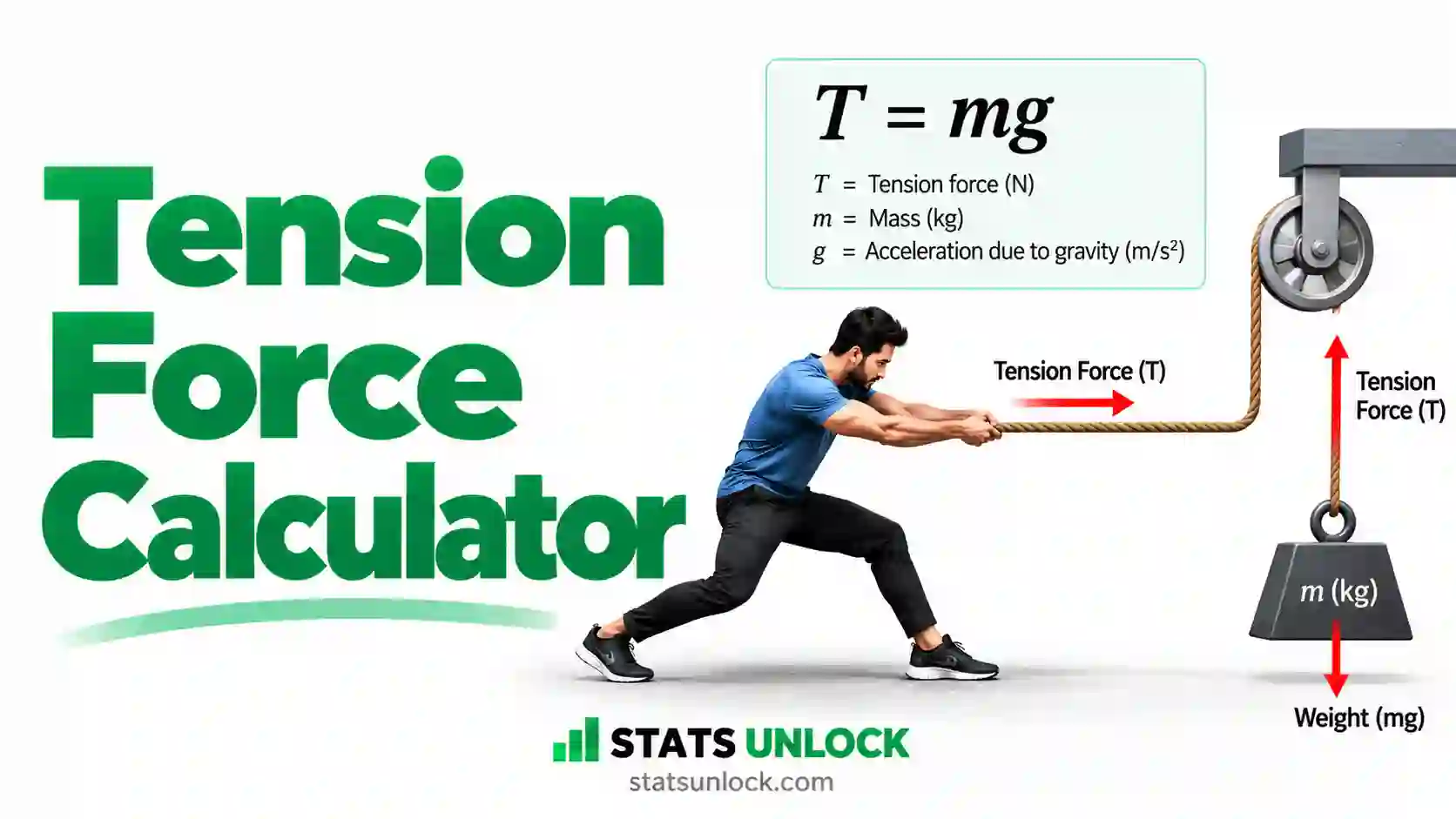
A tension force calculator finds the pull in a rope, string or cable using Newton’s second law. For a mass hanging on a rope, T = m(g + a); at rest, T = mg, so a 5.00 kg mass gives 5.00 × 9.81 = 49.1 N.
Rule of thumb: a rope holding a still weight carries exactly that weight. Accelerating upward adds m a; two ropes at a shallow angle can each carry far more than the whole weight.
Key Takeaways
- A tension force calculator uses T = m(g + a): a 5.00 kg mass hanging at rest pulls its rope with 49.1 N.
- In a lift accelerating up at 2.0 m/s², the cable holding a 60 kg person carries 708 N, about 20% more than their weight.
- Two wires at 30° holding a 4.0 kg picture each carry about 39 N, the full weight of the picture, not half of it.
- In an Atwood machine with 3.0 kg and 5.0 kg, the string tension is 36.8 N, between the two weights of 29.4 N and 49.1 N.
- A 0.50 kg ball whirled at 4.0 m/s on a 0.80 m string pulls with 14.9 N at the bottom of a vertical circle, three times its weight.
📚 1. What Is a Tension Force Calculator?
A tension force calculator works out how hard a rope, string, cable or chain is pulling. Tension (T) is the pulling force transmitted along a stretched rope, measured in newtons (N). A rope can only pull, never push, and it always pulls along its own length, away from the object it is attached to.
To calculate tension force, draw a free-body diagram of the object on the end of the rope, then use Newton’s second law, ΣF = ma. For a single vertical rope, T − mg = ma, so T = m(g + a). When the object is at rest or moves at a steady speed, a = 0 and the tension equals the weight. For ropes at angles, balance the horizontal and vertical parts separately. For connected objects, write F = ma for each one.
A worked one-liner: a 10.0 kg sign hangs from two ropes at 30° and 60° to the horizontal. Balancing the forces gives T₁ = mg cos 60° ÷ sin 90° = 49.1 N in the shallow rope and T₂ = mg cos 30° = 85.0 N in the steep rope. Together their vertical parts hold up the 98.1 N weight.
Who uses it: students in CBSE and ICSE Class 9 to 12, IGCSE, GCSE and A level, AP Physics 1, JEE and NEET, and first-year engineering. Engineers use tension to size lift cables, crane slings, bridge hangers, guitar strings and climbing ropes. George Atwood built his pulley machine in 1784 to slow down free fall so that steady acceleration could be timed by hand.
| Situation | Tension formula | Key idea |
|---|---|---|
| Hanging at rest | T = mg | The rope holds the full weight |
| Accelerating up or down | T = m(g + a) | Up is positive; T > mg when accelerating upward |
| Two ropes at angles | T₁ = mg cos θ₂ ÷ sin(θ₁ + θ₂) | Balance horizontal and vertical parts |
| Two blocks pulled by F | T = F m₁ ÷ (m₁ + m₂) | The string only accelerates the block behind it |
| Atwood machine | T = 2m₁m₂g ÷ (m₁ + m₂) | One string, one tension, one acceleration |
| Ball on a string, circle | T = mv² ÷ r (± mg) | Largest at the bottom of a vertical circle |
| Spring | T = kx | Hooke’s law; at rest, kx = mg |
🧮 2. Enter Your Values
Pick a situation, choose what to solve for, then type your values in any units.
Solve for:
Formula: T = m (g + a)
Scientific notation works: type 6.2e-3. Angles are in degrees unless you pick rad. In the hanging mode, a negative acceleration means speeding up downward or slowing down on the way up.
📊 3. Results and Step-by-Step Working
🧠 4. Understanding Your Answer, In Detail
4.1 What tension means
Tension is the force a stretched rope exerts on whatever is attached to each end. Pull a rope with 49.1 N and it pulls back on your hand with 49.1 N and on the object with 49.1 N. For a light (massless) rope, the tension is the same all along its length, even around a smooth pulley. That is why one value of T describes the whole string in an Atwood machine.
4.2 Tension is not always the weight
This is the most common mistake. T = mg only when the object is at rest or moving at a steady speed. If a lift accelerates upward, the cable must hold the weight and also provide the extra m a, so T is larger. If it accelerates downward, T is smaller. In free fall (a = −g) the cable carries nothing. In a circle, the string must also supply the centripetal force, mv² ÷ r.
4.3 Is it a sensible size?
Use 10 N per kilogram as a quick check: a rope holding a still 5 kg bag carries about 50 N. Climbing ropes are rated to about 20 kN, and a car tow rope to 20 to 50 kN. Two ropes at a small angle can carry several times the weight, so a tight washing line or a slackline can see thousands of newtons from a modest load.
4.4 How it scales
Tension is proportional to the mass. Double the load, double the tension. For ropes at angles, tension depends on 1 ÷ sin θ: halving a small angle roughly doubles the tension. In a circle it grows with v², so doubling the speed makes the centripetal part four times larger.
4.5 Angles: from the horizontal or the vertical?
This calculator measures rope angles from the horizontal. If your question measures them from the vertical, use 90° minus that angle, or swap sin and cos in the formula. With angles α from the vertical and equal ropes, T = mg ÷ (2 cos α).
4.6 What the charts show
For ropes at angles, chart 1 shows tension shooting up as the ropes flatten; the dashed line marks the weight, and the curves cross it at 30°. For connected bodies, the charts show tension rising in a straight line with the pull, and tension sitting between the two weights in an Atwood machine. The point marked on each chart is your problem.
4.7 Where the simple model breaks down
The formulas assume a light, unstretchable rope and a light, frictionless pulley. A heavy rope or chain has more tension at the top than at the bottom, and it sags into a catenary curve. A massive pulley needs some force to spin, so the tension differs on its two sides. Friction between a rope and a post grows exponentially with the wrap angle (the capstan equation), which is how a sailor holds a heavy load with a few turns round a bollard.
4.8 Where this leads next
Tension appears everywhere in mechanics: pendulums, conical pendulums, bridges, cranes, elevators and musical strings, where the wave speed is √(T ÷ μ). The same method, a free-body diagram for each object and F = ma for each, solves them all.
✍ 5. How to Write the Answer
📌 Conventions
- Draw a free-body diagram for each object and label every force.
- State which direction you take as positive.
- Write F = ma for each object before you combine equations.
- Round to the smallest number of significant figures in the data.
📌 Conventions
- Tension is a force: give it in newtons, with a space before the unit (49.1 N).
- Give the direction: "along the rope, away from the object".
- For two ropes, name each tension (T₁, T₂).
📌 Conventions
- Name the method: force meter, Atwood timing or rope angles.
- Report the mean of at least three repeats.
- The uncertainty here assumes ±1 in the last digit of each value, combined in quadrature. Replace it with the spread of your repeat readings when you have them.
📌 Conventions
- State which g the key expects, because 9.8, 9.81 and 10 give different last digits.
- Give a mark for a correct free-body diagram.
- Award a separate mark for the unit.
📌 Conventions
- Write m/s^2 for m/s², theta for θ and e5 for powers of ten.
- Use * for multiply and / for divide so the line pastes anywhere.
∑ 6. Formulas Used
🔀 7. Tension Force Calculation Flowchart, Step by Step
This flowchart shows how to calculate tension force step by step, from a word problem to a checked answer. Every box uses the same worked example as the Excel, R and Python sections: a 5.00 kg mass hangs at rest from a rope. Find the tension in the rope.
Check any box yourself: the Excel sheet in Section 9, the R script in Section 10 and the Python script in Section 11 all return 49.1 N for this mass. Section 14 shows the method written out by hand.
📝 8. How to Use This Calculator
- Choose the situation. Pick a hanging mass, two ropes at angles, two blocks joined by a string, a pulley, a ball on a string in a circle, or a spring.
- Choose what to solve for. Click a Solve for chip, for example tension, mass, acceleration, or the largest pull before a string breaks. That field turns into a dashed answer box.
- Type the known values. Plain numbers, decimals and scientific notation all work: 5.00, 0.80 or 6.2e-3.
- Pick the unit beside each value. Grams, pounds, kN, lbf, kgf, km/h, cm and degrees or radians are converted for you.
- Get the signs and angles right. Up is positive for acceleration. Rope angles are measured from the horizontal.
- Set g for your syllabus. Use 9.81 for IGCSE, A level and most US courses, 9.8 for CBSE and AP, or 10 for quick estimates.
- Press Calculate. Nothing is worked out until you do, and changing any input clears the old answer so you never read stale numbers.
- Read the answer box and the badges. They show the tension with its units, the acceleration or the second tension, Units check ✓ and Verified.
- Follow the working, the free-body diagram and the charts. The GRESS table, numbered steps, results table, diagram and four charts explain the answer.
- Copy or download the working. Section 5 gives five ready-to-paste write-ups, and Download Doc or Download PDF saves the whole solution.
📈 9. How to Calculate Tension Force in Excel
Excel has no tension function, and it does not need one. T = m(g + a) is one line, so a sheet with one problem per row can handle a whole class set of lift, crane and rope questions. The two habits that matter are keeping g in a single cell so you can switch between 9.81, 9.8 and 10, and wrapping every angle in RADIANS().
=B2*($H$1+C2). For the 5.00 kg mass at rest, Excel returns 49.05, in newtons.9.1 The functions you need
| You want | Excel formula | Note |
|---|---|---|
| Tension in a vertical rope | =B2*($H$1+C2) | T = m(g + a); the $ signs keep g fixed when you fill down |
| Mass a rope can lift | =D2/($H$1+C2) | m = T ÷ (g + a) |
| Acceleration from a tension | =D2/B2-$H$1 | a = T ÷ m − g |
| Rope 1 of two at angles | =B2*$H$1*COS(RADIANS(D2))/SIN(RADIANS(C2+D2)) | Angles from horizontal in C2 and D2 |
| Two equal ropes at θ | =B2*$H$1/(2*SIN(RADIANS(E2))) | T = mg ÷ (2 sin θ) |
| Atwood machine | =2*B2*C2*$H$1/(B2+C2) | Masses in B2 and C2 |
| Bottom of a vertical circle | =B2*C2^2/D2+B2*$H$1 | Speed in C2, radius in D2 |
| Is the string slack at the top? | =IF(C2^2/D2<$H$1,"slack","taut") | Taut only if v² ÷ r ≥ g |
| Newtons to pound-force | =CONVERT(D2,"N","lbf") | Force strings: "N", "dyn", "lbf" |
| Pounds to kilograms | =CONVERT(200,"lbm","kg") | Mass in pounds is "lbm", not "lb" |
9.2 Step by step
1 Set up the columns and the g cell
One problem per row, units in every header, g typed once in H1.
Three loads in rows 2 to 4. H1 = 9.81 is the only place g appears.
2 Work out the tension
=B2*($H$1+C2)This is T = m(g + a). Fill the formula down to row 4.
The 5.00 kg mass at rest gives 49.05 N, which rounds to 49.1 N to 3 significant figures.
3 Add two ropes at angles
=B2*$H$1*COS(RADIANS(D2))/SIN(RADIANS(C2+D2))On a second sheet, put the mass in B and the two rope angles in C and D. For the second rope in F2, use COS(RADIANS(C2)) instead.
The 10.0 kg sign at 30° and 60° gives 49.05 N and 84.96 N.
4 Find the acceleration from a measured tension
=D2/B2-$H$1A force sensor reads the tension and you want the acceleration. Put the reading in D and rearrange.
708 N in the cable of a 60 kg load with g = 9.8 gives a = 2.0 m/s², upward.
9.3 The awkward cases
=SIN(30) returns −0.988, not 0.5, because Excel reads 30 as radians. Always wrap the angle: =SIN(RADIANS(30)). On a two-rope problem this one slip can even give a negative tension.- Signs for acceleration. Up is positive. A lift slowing down on the way up has a negative a, so the cable tension is less than the weight.
- CONVERT strings are case-sensitive. Force uses
"N"and"lbf"; mass in pounds is"lbm". A wrong string returns#N/A. - Breaking strain. To find the largest mass a rope rated at 500 N can lift at 1.5 m/s², use
=500/($H$1+1.5). - Precision: Excel keeps about 15 significant digits. Round only in the final display with
=ROUND(D2,1)or the number format.
9.4 Why Excel might disagree with R, Python or this page
| Value of g | Tension for 5.00 kg at rest | Who uses it |
|---|---|---|
| 9.80665 m/s² | 49.033 N → 49.0 N | Standard gravity; scipy.constants.g in Python |
| 9.81 m/s² | 49.05 N → 49.1 N | IGCSE, A level, most US textbooks, this page’s worked example |
| 9.8 m/s² | 49.0 N | CBSE, NCERT, AP Physics |
| 10 m/s² | 50.0 N | Quick estimates and some exam boards |
So a different last digit is usually a different g. Note 49.05 itself: Excel and most calculators round it half away from zero to 49.1, while R’s round() and Python’s round() round half to even and can give 49.0. Formatting with sprintf("%.3g") or f"{x:.3g}" avoids the surprise in most cases.
9.5 Charting it
- Put the rope angle (5 to 90 degrees) in one column and
=$B$2*$H$1/(2*SIN(RADIANS(A2)))in the next. - Insert → Charts → Scatter with smooth lines. Do not use the Line chart type, which spaces x values evenly.
- Add the weight as a second series, a flat line at mg.
- The curves cross at 30°. Below that, each rope carries more than the whole weight.
- Label the axes with units: Rope angle from horizontal (°) and Tension in each rope (N).
9.6 Errors you will hit
| Excel shows | Why | Fix |
|---|---|---|
#VALUE! | A unit typed in a cell, such as "5 kg" | Keep units in the header; cells hold numbers only |
#DIV/0! | An angle of 0 (a perfectly flat rope), or g + a = 0 | A flat rope cannot hold a weight; check the angle |
#N/A | A CONVERT unit string Excel does not know, such as "lb" or "kgf" | Use "lbm" for mass and "lbf" for force; multiply kgf by 9.80665 yourself |
| Negative or huge tension | Angle passed to SIN or COS in degrees | Wrap with RADIANS() |
| Answer 1000 times too big | Mass typed in grams | Divide by 1000, or =CONVERT(B2,"g","kg") |
| Every row gives the same answer | Relative reference to g changed when you filled down | Use $H$1, not H1 |
📈 10. How to Calculate Tension Force in R
R works out tension in one line, T <- m * (g + a). The script below does more: it rearranges for mass and acceleration, solves two ropes at angles, an Atwood machine, a ball on a string and a lift cable, prints every answer with its unit, runs a substitution check, and saves one 300 dpi figure of tension against rope angle. It uses base R only.
Rscript tn.R. Change only the lines under "Your values" to solve your own problem.10.1 The complete script
R, base only, saves tension_force_plot.png
# ============================================================
# Tension force calculator in R, with one 300 dpi figure
# StatsUnlock - https://statsunlock.com/tension-force-calculator/
# Base R only. No packages to install.
# ============================================================

# ---- 1. Your values (SI units) -----------------------------
m <- 5.00      # hanging mass in kg
a <- 0         # acceleration in m/s^2, up is positive (0 = at rest)
g <- 9.81      # m/s^2; use 9.80665, 9.8 or 10 to match your book

# ---- 2. Tension in a vertical rope -------------------------
T <- m * (g + a)                 # newtons; at rest T = m g

# ---- 3. Solve for any variable -----------------------------
m_back <- T / (g + a)            # mass from tension
a_back <- T / m - g              # acceleration from tension

# ---- 4. Ropes at angles, Atwood machine, circle, lift ------
deg <- pi / 180                                  # degrees to radians
W   <- 10.0 * g                                  # 10.0 kg sign
T1  <- W * cos(60 * deg) / sin(90 * deg)         # rope at 30 degrees
T2  <- W * cos(30 * deg) / sin(90 * deg)         # rope at 60 degrees
T_atwood <- 2 * 3.0 * 5.0 * g / (3.0 + 5.0)      # 3.0 kg and 5.0 kg
T_bottom <- 0.50 * 4.0^2 / 0.80 + 0.50 * g       # ball at the bottom of a circle
T_lift   <- 60 * (9.8 + 2.0)                     # 60 kg, lift accelerating up

# ---- 5. Print the answers with units -----------------------
cat(sprintf("Hanging tension T = %.3g N\n", T))
cat(sprintf("check m = %.3g kg, check a = %.3g m/s^2\n", m_back, a_back))
cat(sprintf("Sign: T1 = %.3g N, T2 = %.3g N\n", T1, T2))
cat(sprintf("Atwood tension    = %.3g N\n", T_atwood))
cat(sprintf("Circle (bottom)   = %.3g N\n", T_bottom))
cat(sprintf("Lift cable        = %.0f N\n", T_lift))
stopifnot(abs(T - m * g - m * a) < 1e-12)       # substitution check
cat("Units: kg x m/s^2 = kg m/s^2 = N\n")

# ---- 6. One figure: tension against rope angle -------------
theta <- seq(5, 90, length.out = 200)           # angle from horizontal, degrees
T_rope <- m * g / (2 * sin(theta * deg))        # two equal ropes holding m
png("tension_force_plot.png", width = 7, height = 4.5, units = "in", res = 300)
plot(theta, T_rope, type = "l", lwd = 3, col = "#9333ea", ylim = c(0, 6 * m * g),
     xlab = "Rope angle from horizontal (degrees)", ylab = "Tension in each rope (N)",
     main = "5.00 kg held by two equal ropes")
abline(h = m * g, lty = 2, col = "#2563eb")
legend("topright", c("Tension in each rope", "Weight mg"), col = c("#9333ea", "#2563eb"),
       lwd = c(3, 1), lty = c(1, 2), bty = "n")
invisible(dev.off())
Output when run: Hanging tension T = 49.1 N, Sign: T1 = 49.1 N, T2 = 85 N, Atwood tension = 36.8 N, Circle (bottom) = 14.9 N, Lift cable = 708 N. These match Sections 3, 7, 9 and 11.
10.2 What each part does
| Line | What it does |
|---|---|
| T <- m * (g + a) | Tension in a vertical rope, in newtons. |
| T / m - g | The acceleration that a measured tension implies. |
| deg <- pi / 180 | Converts degrees to radians, because sin() and cos() use radians. |
| W * cos(60 * deg) / sin(90 * deg) | Tension in the 30° rope of the sign: the cosine of the other rope’s angle. |
| 2 * 3.0 * 5.0 * g / (3.0 + 5.0) | Atwood machine tension, 2m₁m₂g ÷ (m₁ + m₂). |
| 0.50 * 4.0^2 / 0.80 + 0.50 * g | Ball at the bottom of a vertical circle: centripetal force plus weight. |
| stopifnot(...) | Substitution check: stops with an error if T − mg ≠ ma. |
| png(..., res = 300) | Saves a print-quality figure; dev.off() closes the file. |
R traps: trig functions take radians; T is R’s shortcut for TRUE, so the script overwrites it on purpose, and you should write TRUE in full afterwards; round(49.05, 1) may give 49 because of half-to-even rounding; -2^2 is −4 in R.
10.3 What the figure shows
The purple curve is the tension in each of two equal ropes holding the 5.00 kg mass. At 90° (straight up) each rope carries half the weight, 24.5 N. The curve crosses the dashed weight line at 30°, and below about 10° each rope carries several times the weight. That is why a washing line or a slackline can never be pulled perfectly straight.
10.4 Common problems and fixes
| Problem | Fix |
|---|---|
| Rope tension negative or huge | The angle was in degrees inside sin(). Multiply by pi / 180. |
| Error: object 'm' not found | Run the script from the top, so the inputs are defined first. |
| The PNG is blank | dev.off() did not run; run the last line again. |
| Later code using T as TRUE breaks | Rename the tension to Tn, or write TRUE in full. |
10.5 Useful one-liners
# tension for several masses at rest
c(1, 2, 5, 10) * 9.81
# lift cable for 60 kg accelerating up at 2.0, then down at 2.0 (g = 9.8)
60 * (9.8 + c(2.0, -2.0))
# two equal ropes at 30 degrees holding 4.0 kg
4.0 * 9.81 / (2 * sin(30 * pi / 180))
# slowest speed at the top of a 0.80 m vertical circle
sqrt(9.81 * 0.80)
📈 11. How to Calculate Tension Force in Python
Python does the same job with NumPy and Matplotlib. The script solves the hanging mass, the sign on two ropes, an Atwood machine, a ball on a string and a lift cable, prints each answer with its unit, and saves one 300 dpi figure of tension against rope angle.
Install once with pip install numpy matplotlib. Google Colab already has both.
11.1 The complete script
Python 3 with NumPy, saves tension_force_plot.png
# ============================================================
# Tension force calculator in Python, with one 300 dpi figure
# StatsUnlock - https://statsunlock.com/tension-force-calculator/
# pip install numpy matplotlib
# ============================================================
import numpy as np
import matplotlib.pyplot as plt

# ---- 1. Your values (SI units) -----------------------------
m = 5.00        # hanging mass, kg
a = 0.0         # acceleration, m/s^2, up is positive
g = 9.81        # m/s^2 (scipy.constants.g would give 9.80665)

# ---- 2. Tension in a vertical rope -------------------------
T = m * (g + a)                  # N

# ---- 3. Solve for any variable -----------------------------
m_back = T / (g + a)
a_back = T / m - g

# ---- 4. Ropes at angles, Atwood machine, circle, lift ------
W = 10.0 * g                                          # 10.0 kg sign
t1, t2 = np.radians(30), np.radians(60)
T1 = W * np.cos(t2) / np.sin(t1 + t2)
T2 = W * np.cos(t1) / np.sin(t1 + t2)
T_atwood = 2 * 3.0 * 5.0 * g / (3.0 + 5.0)
T_bottom = 0.50 * 4.0**2 / 0.80 + 0.50 * g
T_lift = 60 * (9.8 + 2.0)

# ---- 5. Print the answers with units -----------------------
print(f"Hanging tension T = {T:.3g} N")
print(f"check m = {m_back:.3g} kg, check a = {a_back:.3g} m/s^2")
print(f"Sign: T1 = {T1:.3g} N, T2 = {T2:.3g} N")
print(f"Atwood tension    = {T_atwood:.3g} N")
print(f"Circle (bottom)   = {T_bottom:.3g} N")
print(f"Lift cable        = {T_lift:.0f} N")
assert abs(T - m * g - m * a) < 1e-12          # substitution check

# ---- 6. One figure: tension against rope angle -------------
theta = np.linspace(5, 90, 200)
T_rope = m * g / (2 * np.sin(np.radians(theta)))
fig, ax = plt.subplots(figsize=(7, 4.5))
ax.plot(theta, T_rope, lw=3, color="#9333ea", label="Tension in each rope")
ax.axhline(m * g, ls="--", color="#2563eb", label="Weight mg")
ax.set_ylim(0, 6 * m * g)
ax.set_xlabel("Rope angle from horizontal (degrees)")
ax.set_ylabel("Tension in each rope (N)")
ax.set_title("5.00 kg held by two equal ropes")
ax.legend(frameon=False)
fig.savefig("tension_force_plot.png", dpi=300, bbox_inches="tight")
Output when run: Hanging tension T = 49.1 N, Sign: T1 = 49.1 N, T2 = 85 N, Atwood tension = 36.8 N, Circle (bottom) = 14.9 N, Lift cable = 708 N.
11.2 What each part does
| Line | What it does |
|---|---|
| T = m * (g + a) | Tension in a vertical rope, N. |
| np.radians(30) | Degrees to radians for np.sin and np.cos. |
| W * np.cos(t2) / np.sin(t1 + t2) | Tension in rope 1 of two ropes at angles. |
| 4.0**2 | Powers use **; ^ is bitwise XOR in Python. |
| assert abs(...) < 1e-12 | Substitution check: T − mg must equal ma. |
| f"{T:.3g}" | Formats to 3 significant figures. |
| fig.savefig(..., dpi=300) | Saves a print-quality PNG. |
Python traps: math.sin(30) uses radians; ^ is not a power; round(2.5) gives 2 (half to even); scipy.constants.g is 9.80665, which changes the last digit compared with 9.81.
11.3 What the figure shows
The same curve as in R: tension in each of two equal ropes against their angle from the horizontal. It falls to half the weight when the ropes hang straight down and rises without limit as they flatten. Change m at the top of the script and the whole curve scales with it.
11.4 Common problems and fixes
| Problem | Fix |
|---|---|
| ModuleNotFoundError: numpy | Run pip install numpy matplotlib, or use Google Colab. |
| Wrong rope tensions | Wrap angles in np.radians(). |
| No PNG appears | Look in the folder you ran the script from, or print os.getcwd(). |
| Last digit differs from your textbook | Set g to the value your course uses. |
11.5 Useful one-liners
# tension for several masses at rest
import numpy as np; np.array([1, 2, 5, 10]) * 9.81
# lift cable for 60 kg accelerating up, then down, at 2.0 m/s^2 (g = 9.8)
60 * (9.8 + np.array([2.0, -2.0]))
# two equal ropes at 30 degrees holding 4.0 kg
4.0 * 9.81 / (2 * np.sin(np.radians(30)))
# Atwood machine acceleration for 3.0 kg and 5.0 kg
(5.0 - 3.0) * 9.81 / (3.0 + 5.0)
Run it in a terminal with python tn.py, in a Jupyter notebook cell, or in Google Colab without installing anything.
📋 12. Reference Tables
12.1 Tension formulas at a glance
| Situation | Tension | Acceleration |
|---|---|---|
| Hanging, at rest or steady speed | m g | 0 |
| Lift or crane accelerating at a (up +) | m (g + a) | given |
| Free fall | 0 | −g |
| Two ropes at θ₁, θ₂ from horizontal | m g cos θ₂ ÷ sin(θ₁ + θ₂) | 0 |
| Two equal ropes at θ | m g ÷ (2 sin θ) | 0 |
| Two blocks, pull F on m₂ | F m₁ ÷ (m₁ + m₂) | F ÷ (m₁ + m₂) − μg |
| Atwood machine | 2 m₁ m₂ g ÷ (m₁ + m₂) | (m₂ − m₁) g ÷ (m₁ + m₂) |
| Block on a table, mass m₂ hanging | m₂ (g − a) | (m₂ − μm₁) g ÷ (m₁ + m₂) |
| Vertical circle, bottom / top | m v² ÷ r ± m g | v² ÷ r toward the centre |
| Conical pendulum, string at α to vertical | m g ÷ cos α | g tan α |
| Simple pendulum at the lowest point | m g + m v² ÷ L | v² ÷ L |
12.2 How tension in two equal ropes grows as they flatten
| Angle from horizontal | Tension in each rope | For 10.0 kg (g = 9.81) |
|---|---|---|
| 90° (straight up) | 0.50 × mg | 49.1 N |
| 60° | 0.58 × mg | 56.6 N |
| 45° | 0.71 × mg | 69.4 N |
| 30° | 1.00 × mg | 98.1 N |
| 15° | 1.93 × mg | 190 N |
| 10° | 2.88 × mg | 282 N |
| 5° | 5.74 × mg | 563 N |
12.3 Typical working loads of ropes and cables
| Rope or cable | Typical breaking strength | Note |
|---|---|---|
| Cotton string, 2 mm | about 100 to 200 N | School lab string |
| Fishing line, 10 lb test | about 44 N | Rated by test weight |
| Paracord 550 | about 2.4 kN | 550 lbf rating |
| Dynamic climbing rope | above 20 kN | Designed to stretch and absorb a fall |
| Steel wire rope, 10 mm | about 60 kN | Working load usually 1/5 of this |
Typical published ranges; check the manufacturer’s rating. Engineers apply a safety factor of 5 or more, so the working load is a fraction of the breaking strength.
12.4 Force unit conversions
| Unit | In newtons | Where you meet it |
|---|---|---|
| 1 kN | 1000 N | Engineering, cables and cranes |
| 1 lbf (pound-force) | 4.448 222 N | US engineering, rope ratings |
| 1 kgf (kilogram-force) | 9.806 65 N (exact) | Spring balances, older textbooks |
| 1 dyn (dyne) | 10⁻⁵ N | CGS units |
| 1 mN | 0.001 N | Small lab forces |
12.5 Constants
| Constant | Value | Status |
|---|---|---|
| Standard acceleration of gravity g₀ | 9.806 65 m/s² | exact (defined) |
| Typical surface g on Earth | 9.78 (equator) to 9.83 (poles) m/s² | measured |
| Moon surface g | 1.62 m/s² | NASA fact sheet |
| Mars surface g | 3.71 m/s² | NASA fact sheet |
Source: NIST, CODATA 2022 recommended values (Mohr et al., 2025, reference 1); NASA Planetary Fact Sheets.
📈 13. Example Results
Lifting a 200 lb engine with a chain hoist
Pounds, pound-force and newtons.
A mechanic lifts a 200 lb engine out of a car with a chain hoist at a slow, steady speed. Find the tension in the chain in pound-force and in newtons.
| Quantity | Value | Note |
|---|---|---|
| Steady speed | a = 0 | So T = weight |
| T = m g | 200 lbf | On Earth, 1 lb of mass weighs 1 lbf |
| In newtons | 889.6 N → 890 N | × 4.448 N/lbf |
What it means: With standard gravity, 200 lb of mass weighs 200 lbf. In SI, m = 90.72 kg and T = 90.72 × 9.807 = 889.6 N. 200 lbf × 4.448 = 889.6 N, the same answer.
How to write it: "At steady speed T = W = 200 lbf = 890 N, upward along the chain."
A crane lifting a 2.5 t steel beam
Extra tension while the load speeds up.
A crane lifts a 2500 kg steel beam, accelerating it upward at 0.80 m/s². Find the cable tension, and compare it with the beam’s weight. Take g = 9.81 m/s².
| Quantity | Value | Note |
|---|---|---|
| Weight m g | 24525 N | |
| Extra m a | 2000 N | Needed to speed up |
| T = m(g + a) | 26525 N → 27 kN | 2 s.f., from a = 0.80 |
What it means: T = 2500 × (9.81 + 0.80) = 26525 N, about 27 kN. Once the beam reaches a steady speed the tension drops back to the weight, 24.5 kN. Riggers size slings for the peak, not the static weight.
How to write it: "T = m(g + a) = 2500 kg × (9.81 + 0.80) m/s² = 2.7 × 10⁴ N."
What is the lift doing?
Finding acceleration from a cable tension.
A 1000 kg lift hangs from a cable with a tension of 9000 N. Take g = 9.8 m/s² (CBSE style). Find the acceleration and describe the motion.
| Quantity | Value | Note |
|---|---|---|
| Weight m g | 9800 N | More than T |
| a = T ÷ m − g | -0.80 m/s² | Negative means downward |
| Motion | speeding up going down | or slowing down going up |
What it means: a = 9000 ÷ 1000 − 9.8 = −0.80 m/s². The minus sign means the acceleration is downward. The lift is either speeding up on the way down or slowing down on the way up; the tension alone cannot tell which.
How to write it: "a = T/m − g = 9000 N ÷ 1000 kg − 9.8 m/s² = −0.80 m/s² (0.80 m/s² downward)."
A traffic light on two cables
Unequal angles, unequal tensions.
A 25 kg traffic light hangs from two cables at 37° and 53° to the horizontal. Take g = 9.8 m/s². Find the tension in each cable.
| Quantity | Value | Note |
|---|---|---|
| Weight m g | 245 N | |
| T₁ = mg cos 53° ÷ sin 90° | 147.4 N → 150 N | 2 s.f. |
| T₂ = mg cos 37° ÷ sin 90° | 195.7 N → 200 N | 2 s.f. |
| Horizontal check | 117.8 N = 117.8 N | T₁ cos 37° = T₂ cos 53° |
What it means: T₁ = 245 × cos 53° = 147.4 N and T₂ = 245 × cos 37° = 195.7 N. The steeper cable takes more of the load. Check: the horizontal parts are both 118 N, and the vertical parts add to 245 N.
How to write it: "T₁ = mg cos θ₂ / sin(θ₁ + θ₂) = 150 N; T₂ = mg cos θ₁ / sin(θ₁ + θ₂) = 200 N."
A spider hanging on its silk
Millinewtons and scientific notation.
A 0.20 g garden spider hangs still from a single thread of silk. Find the tension in the thread.
| Quantity | Value | Note |
|---|---|---|
| Convert | 2.0 × 10⁻⁴ kg | 0.20 g ÷ 1000 |
| T = m g | 1.962 mN → 2.0 × 10⁻³ N | 2 s.f. |
What it means: T = 2.0 × 10⁻⁴ × 9.81 = 1.96e-03 N, which is 2.0 mN. Typed as 0.20 kg by mistake, the answer would be 2.0 N, a thousand times too big.
How to write it: "T = mg = 2.0 × 10⁻⁴ kg × 9.81 m/s² = 2.0 × 10⁻³ N."
Towing a trailer
Tension between two objects.
A car tows a 900 kg trailer along a level road, speeding up at 1.2 m/s². Ignore rolling resistance. Find the tension in the tow bar.
| Quantity | Value | Note |
|---|---|---|
| Forces on the trailer | T only (horizontally) | Draw the trailer alone |
| T = m a | 1080 N → 1.1 kN | 2 s.f. |
What it means: Drawing the trailer on its own, the only horizontal force on it is the tension, so T = ma = 900 × 1.2 = 1080 N, about 1.1 kN. With rolling resistance of, say, 150 N, the tension would rise to about 1.2 kN.
How to write it: "T = m_trailer × a = 900 kg × 1.2 m/s² = 1.1 × 10³ N."
Standing in the middle of a slackline
Why a nearly flat rope carries huge tension.
A 75 kg person stands at the middle of a slackline, which sags to 5° below the horizontal on each side. Find the tension in the line.
| Quantity | Value | Note |
|---|---|---|
| Weight m g | 736 N | |
| T = mg ÷ (2 sin 5°) | 4221 N → 4.2 kN | 2 s.f. |
| T ÷ mg | 5.74 | Each side |
What it means: T = 75 × 9.81 ÷ (2 × sin 5°) = 735.8 ÷ 0.1743 = 4221 N, about 4.2 kN. That is why slacklines are anchored to trees with tree protectors and rated in kN. Pulling the line perfectly flat would need infinite tension.
How to write it: "T = mg / (2 sin θ) = 75 kg × 9.81 m/s² / (2 sin 5°) = 4.2 × 10³ N."
A negative tension in a picture wire
The calculator mode that ruins angle answers.
A 2.0 kg picture hangs from a wire with both halves at 30° to the horizontal. One student gets T = −9.9 N. Find the correct tension.
| Quantity | Value | Note |
|---|---|---|
| T = mg ÷ (2 sin 30°) | 19.62 N → 20 N | sin 30° = 0.5 |
| Radian mode: sin(30 rad) | -0.9880 | Gives −9.9 N |
| A rope cannot push | T ≥ 0 | A negative answer is a red flag |
What it means: T = 2.0 × 9.81 ÷ (2 × sin 30°) = 19.62 ÷ 1.0 = 19.6 N, so 20 N in each half: at 30° each half carries the full weight. In radian mode sin 30 = −0.988, which gives −9.9 N, a negative tension that a wire cannot have.
How to write it: "T = mg / (2 sin 30°) = 19.6 N ÷ 1.0 = 20 N in each half of the wire."
✏️ 14. How to Calculate Tension Force by Hand, Step by Step
This is the written method examiners expect, worked on the same example as Sections 7, 9, 10 and 11, extended to an accelerating rope: a 5.00 kg mass hangs from a rope. Take g = 9.81 m/s². Find the tension when the mass is at rest, then when it is pulled upward with an acceleration of 2.00 m/s².
14.1 The written method (GRESS)
- Given. m = 5.00 kg, g = 9.81 m/s², a = 0 then a = +2.00 m/s². Draw the free-body diagram: tension up, weight down.
- Required. Tension T (N) in each case.
- Equation. Take up as positive. ΣF = ma gives T − mg = ma, so T = m(g + a).
- Substitute, with units. At rest: T = (5.00 kg)(9.81 + 0) m/s². Accelerating: T = (5.00 kg)(9.81 + 2.00) m/s².
- Solve. T = 49.05 N → 49.1 N at rest. T = 59.05 N → 59.1 N while accelerating.
- Check the units and the size. kg × m/s² = N. The tension is larger when accelerating upward, as it must be.
- Write the answer with units and direction. T = 49.1 N at rest and 59.1 N while accelerating, both upward along the rope.
14.2 On a scientific calculator
| Task | Keys | What you see |
|---|---|---|
| Hanging mass, accelerating up | 5 × ( 9.81 + 2 ) = | 59.05 |
| Two equal ropes at 30° (DEG mode) | 4 × 9.81 ÷ ( 2 sin 30 ) ) = | 39.24 |
| Atwood machine | 2 × 3 × 5 × 9.81 ÷ 8 = | 36.7875 |
| Ball at the bottom of a circle | 0.5 × 4 x² ÷ 0.8 + 0.5 × 9.81 = | 14.905 |
| Casio fx-991EX (ClassWiz) | Store g in a memory letter with STO, then reuse that letter in every expression | 49.05 |
Check the screen shows D (degrees) before any rope-angle problem. In R (radian) mode, sin 30 gives −0.988 and the tension comes out negative. The brackets around 2 sin 30 matter: without them, the calculator works out 4 × 9.81 ÷ 2 × sin 30 = 9.81, which is wrong.
14.3 Measure it yourself: a school lab practical
Measuring tension with force meters (spring balances)
- Hang a known mass, for example 500 g, from a newton meter. Read the tension and compare it with mg = 0.500 × 9.81 = 4.91 N.
- Tie the same mass at the middle of a string. Hook each end to a newton meter and hold the meters level, so the strings make equal angles with the horizontal.
- Measure each angle with a protractor or a phone clinometer app such as phyphox. Read both meters.
- Move the meters further apart to make the angle smaller. Take readings at about 60°, 45°, 30° and 15°.
- Compare each reading with T = mg ÷ (2 sin θ). Plot T against 1 ÷ sin θ: it should be a straight line through the origin with gradient mg ÷ 2.
- For a dynamic test, hang the mass from a phone or wireless force sensor and lift it with a quick upward jerk. The reading rises above mg while the mass speeds up, then falls back.
Main errors: meters not zeroed in the position you use them, the angle read from the bent string near the knot, friction inside the meter, and parallax on the scale. Zero each meter horizontally, read the angle a few centimetres from the knot, and tap the meter before reading.
| Angle θ from horizontal | 1 ÷ sin θ | Left meter (N) | Right meter (N) | Mean T (N) | Predicted (N) |
|---|---|---|---|---|---|
| 60° | 1.15 | 2.9 | 2.8 | 2.85 | 2.83 |
| 45° | 1.41 | 3.5 | 3.4 | 3.45 | 3.47 |
| 30° | 2.00 | 5.0 | 4.8 | 4.90 | 4.91 |
| 15° | 3.86 | 9.6 | 9.3 | 9.45 | 9.48 |
Sample class data for a 0.500 kg mass with g = 9.81 m/s². The predictions use T = mg ÷ (2 sin θ). To check a row, open the "Two ropes at angles" tab, choose equal angles, and enter 0.500 kg and the angle.
14.4 Practice problems with answers
1. A 12 kg bucket hangs at rest from a rope. Find the tension (g = 9.8 m/s²).
At rest, T = mg = 12 × 9.8 = 117.6 N, so 120 N to 2 s.f.
2. A crane lifts an 800 kg load with an upward acceleration of 0.50 m/s². Find the cable tension (g = 9.81).
T = 800 × (9.81 + 0.50) = 8248 N, so 8.2 kN.
3. A 500 kg lift car is moving up but slowing down at 1.5 m/s². Find the cable tension (g = 9.81).
Slowing on the way up means a = −1.5 m/s². T = 500 × (9.81 − 1.5) = 4155 N, so 4.2 kN, less than the weight of 4.9 kN.
4. A rope breaks at 600 N. What is the largest mass it can lift with an upward acceleration of 2.0 m/s²? (g = 9.81)
m = T ÷ (g + a) = 600 ÷ 11.81 = 50.8 kg, so 51 kg.
5. A 2.0 kg picture hangs from a wire with both halves at 20° to the horizontal. Find the tension (g = 9.81).
T = mg ÷ (2 sin 20°) = 19.62 ÷ 0.684 = 28.7 N, so 29 N, more than the picture’s weight.
6. A 15 kg lamp hangs from two cables at 40° and 70° to the horizontal. Find both tensions (g = 9.8).
mg = 147 N, sin 110° = 0.940. T₁ = 147 × cos 70° ÷ 0.940 = 53.5 N. T₂ = 147 × cos 40° ÷ 0.940 = 119.8 N. So 54 N and 120 N.
7. Masses of 2.0 kg and 6.0 kg hang over a light frictionless pulley. Find the acceleration and the tension (g = 9.81).
a = (6.0 − 2.0) × 9.81 ÷ 8.0 = 4.9 m/s². T = 2 × 2.0 × 6.0 × 9.81 ÷ 8.0 = 29.4 N, so 29 N.
8. A 3.0 kg block and a 2.0 kg block on a smooth floor are joined by a string. A 25 N force pulls the 2.0 kg block. Find the tension in the string.
a = 25 ÷ 5.0 = 5.0 m/s². The string pulls only the 3.0 kg block: T = 3.0 × 5.0 = 15 N.
9. A 0.20 kg ball on a 0.50 m string is whirled in a horizontal circle at 3.0 m/s on a smooth table. Find the tension.
T = mv² ÷ r = 0.20 × 9.0 ÷ 0.50 = 3.6 N.
10. A student says the tension in an Atwood machine with 3.0 kg and 5.0 kg masses is 5.0 × 9.81 = 49 N. What went wrong?
That would only be true if nothing moved. The heavier mass accelerates downward, so the string pulls it with less than its weight. The correct tension is 2 × 3.0 × 5.0 × 9.81 ÷ 8.0 = 36.8 N, between the two weights of 29.4 N and 49.1 N.
14.5 Mistakes that lose marks
- Writing T = mg when the object is accelerating. It is only true at rest or at a steady speed.
- Getting the sign of a wrong. Choose a positive direction and stick to it; slowing down on the way up is a negative acceleration.
- Splitting the weight in half between two ropes at an angle. Each rope carries mg ÷ (2 sin θ), which can be more than mg.
- Mixing up angles from the horizontal and from the vertical.
- Using the whole system mass when finding the tension in one string. Use the mass the string actually pulls.
- Calculator in radian mode for an angle in degrees.
- Drawing tension as a push. A rope only pulls, along the rope and away from the object.
🎯 15. When to Use These Equations
The tension formulas on this page come from Newton’s second law applied to an ideal rope. They work very well inside a clear range.
Use them when:
- ✓ The rope, string or cable is light compared with the masses it holds.
- ✓ The rope does not stretch much, so everything it joins moves with the same acceleration.
- ✓ Any pulley is light and turns freely, so the tension is the same on both sides.
- ✓ You can draw a free-body diagram for each object and list every force on it.
Use something else when:
- ✗ The rope is heavy, like a chain or a long cable: tension grows toward the top, and a hanging cable sags into a catenary.
- ✗ The pulley is heavy: add its moment of inertia, because the two sides then carry different tensions.
- ✗ The rope wraps around a post or bollard with friction: use the capstan equation, T₂ = T₁eμφ.
- ✗ The load is jerked or dropped onto the rope: the peak tension depends on how the rope stretches, not just on m(g + a).
- ✗ The string is vibrating, as on a guitar: tension sets the wave speed, v = √(T ÷ μ), with μ the mass per metre.
Real-world examples:
- Lifts and cranes: the cable carries m(g + a), most while speeding up on the way up.
- Hanging signs, lamps and pictures: two wires at a shallow angle each carry more than the whole weight.
- Towing: a tow rope pulls the car behind with F × m₁ ÷ (m₁ + m₂), the share of the pull that car needs.
- Pulleys and counterweights: lift counterweights and Atwood machines share one tension in one string.
- Swings, slings and hammer throws: tension supplies the centripetal force, largest at the bottom of the swing.
- Climbing and rescue: belay ropes are rated in kN because a falling climber can load the rope with several times body weight.
🔧 16. Common Mistakes and Troubleshooting
My lift answer equals the weight, but the book says more
Cause: you left out the acceleration. Fix: T = m(g + a). For 60 kg accelerating up at 2.0 m/s² with g = 9.8, T = 60 × 11.8 = 708 N, not 588 N.
My lift answer is too small when it should be too big
Cause: a sign error. Fix: take up as positive. Speeding up going up, or slowing down going down, both mean a > 0 and T > mg.
My two-rope answer is half the weight
Cause: you shared the weight equally and ignored the angle. Fix: T = mg ÷ (2 sin θ). At 30° each rope carries the whole weight.
My two-rope answers are swapped
Cause: mixing up which cosine goes with which rope. Fix: the steeper rope carries more. T₁ uses cos θ₂, the other rope’s angle.
My angle answers are negative or huge
Cause: calculator or spreadsheet in radian mode with an angle in degrees. Fix: switch to DEG, or use RADIANS() in Excel and pi/180 in R.
"Not physical: the string would go slack"
Cause: at the top of a vertical circle, the speed is below √(g r), so gravity alone is more than enough to turn the ball. Fix: increase the speed or reduce the radius. The ball leaves the circle.
"Not physical: a rope cannot push"
Cause: the downward acceleration you entered is bigger than g, which would need a negative tension. Fix: check the sign and size of a. In free fall the tension is zero.
My Atwood tension equals the heavier weight
Cause: you assumed nothing accelerates. Fix: T = 2m₁m₂g ÷ (m₁ + m₂), which always lies between the two weights.
The last digit differs from my textbook
Cause: a different g. 9.8, 9.81 and 10 give 49.0 N, 49.1 N and 50.0 N for the 5.00 kg mass. Fix: set g to the value your question states.
The charts do not appear
Cause: the Chart.js library was blocked, or Calculate has not been pressed. Fix: press Calculate. The answer, steps, table and diagram work without the charts.
⚖ 17. Assumptions and Limitations
Assumptions
- Massless rope. Check: the rope is much lighter than the load. A heavy rope carries its own weight too, so the formulas underestimate the tension near the top.
- Inextensible rope. Check: the rope stretches only a little. A stretchy rope still gives the right steady tension, but sudden loads can raise the peak well above m(g + a).
- Light, frictionless pulley. Check: a small pulley on a good bearing. A heavy or stiff pulley makes the two tensions differ, and the single-tension answer is an average.
- Same μ for both blocks (two-block mode). Check: both blocks on the same floor. With different surfaces, write F = ma for each block separately.
- Steady speed at one point of the circle. The circle mode gives the tension at the top, the bottom or in a flat circle, at the speed you enter. In a vertical circle the speed changes around the loop.
- Ideal spring. T = kx holds within the elastic limit. Past it the spring stays stretched and k no longer applies.
- No air resistance. Check: speeds below a few m/s. Drag adds a force that the formulas leave out.
- Uniform g. g is taken as constant. Over the surface of the Earth it varies from 9.78 to 9.83 m/s², an effect of about 0.5%.
Limitations
- It does not model sagging cables (catenaries) or heavy chains.
- It does not include pulley inertia or bearing friction.
- It does not model rope friction around posts (the capstan effect).
- It handles two ropes at a time. Three or more ropes in a plane need simultaneous equations.
- Rope strengths in Section 12 are typical values only; always use the manufacturer’s rating with a safety factor for real lifting.
🏁 18. Conclusion
A tension force calculator rests on Newton’s second law, yet tension questions catch out students at every level. The arithmetic is short. The hard parts are drawing the right free-body diagram and remembering that tension is not always the weight.
Three habits fix nearly every error. First, draw one free-body diagram for each object and choose a positive direction. Second, write ΣF = ma for each object before you combine anything: T = m(g + a) for a hanging mass, horizontal and vertical balance for ropes at angles, one shared tension and acceleration in a pulley system. Third, check the size: a rope holding a still weight carries that weight; accelerating up carries more; two shallow ropes can each carry several times the weight.
For circles, tension provides the centripetal force, mv² ÷ r, plus or minus the weight. For springs, the tension is kx. And whenever the maths asks a rope to push, the rope has gone slack and the tension is zero.
Pick your situation, type your values in any units, and let this tension force calculator show every step, a units check and a free-body diagram drawn from your numbers.
❓ 19. Frequently Asked Questions
How do you calculate tension force?
Draw a free-body diagram and apply Newton’s second law. For a mass hanging on a rope, T − mg = ma, so T = m(g + a). A 5.00 kg mass at rest gives T = 5.00 × 9.81 = 49.1 N.
What is the tension force calculation formula?
The basic formula is T = m(g + a), with up as positive. At rest T = mg. For two ropes at angles, T₁ = mg cos θ₂ ÷ sin(θ₁ + θ₂). For an Atwood machine, T = 2m₁m₂g ÷ (m₁ + m₂). In a circle, T = mv² ÷ r plus or minus mg.
How do you calculate the tension force of a hanging mass?
If the mass is still or moving at a steady speed, the tension equals the weight, T = mg. If it accelerates, T = m(g + a). A 60 kg load in a lift accelerating upward at 2.0 m/s² with g = 9.8 gives T = 708 N.
How do you calculate tension force at an angle?
Split each tension into horizontal and vertical parts. The horizontal parts cancel and the vertical parts add up to the weight. With two equal ropes at θ to the horizontal, T = mg ÷ (2 sin θ). A 4.0 kg picture on wires at 30° gives 39 N in each wire.
How do you calculate horizontal tension force?
The horizontal tension is T cos θ, with θ measured from the horizontal. For a still object held by two ropes, both horizontal parts are equal. For the 10.0 kg sign on ropes at 30° and 60°, each horizontal part is 42.5 N.
How do you calculate the magnitude of tension force?
Find the components first, then combine them: |T| = √(Tx² + Ty²). For a rope at angle θ from the horizontal, T = Ty ÷ sin θ = Tx ÷ cos θ. The magnitude is always positive and is given in newtons.
How do you calculate tension force between two objects?
Find the acceleration of the whole system, then apply F = ma to the object the string pulls. For a 50 N pull on 4.0 kg and 6.0 kg blocks joined by a string, T = 50 × 4.0 ÷ 10.0 = 20 N. Equal friction on both blocks does not change this answer.
How do you calculate tension force in a rope?
For a light rope, the tension is the same along its whole length, so work it out at either end. Apply ΣF = ma to the object on the end: T = m(g + a) for a vertical rope. For a heavy rope, the tension grows toward the top by the weight of the rope below each point.
How do you calculate tension force in a string?
The method is the same as for a rope. In a pulley system with one string, there is one tension and one acceleration. For 3.0 kg and 5.0 kg over a pulley, T = 2 × 3.0 × 5.0 × 9.81 ÷ 8.0 = 36.8 N.
How do you calculate tension force in physics problems with pulleys?
Write F = ma for each mass along the direction of motion, using the same T and a. For an Atwood machine, a = (m₂ − m₁)g ÷ (m₁ + m₂) and T = 2m₁m₂g ÷ (m₁ + m₂). For a block on a table pulled by a hanging mass, T = m₂(g − a).
How do you calculate spring tension force at rest?
At rest the spring holds the weight, so T = kx = mg. A 250 g mass on a 40 N/m spring gives T = 0.250 × 9.81 = 2.45 N and a stretch of x = 2.45 ÷ 40 = 6.13 cm.
How do you calculate tension in circular motion?
The net force toward the centre is mv² ÷ r. At the bottom of a vertical circle, T = mv² ÷ r + mg; at the top, T = mv² ÷ r − mg. A 0.50 kg ball at 4.0 m/s on a 0.80 m string gives 14.9 N at the bottom.
Is tension equal to weight?
Only when a single vertical rope holds a mass at rest or at a steady speed. When the mass accelerates upward the tension is larger; when it accelerates downward the tension is smaller. With ropes at angles, each rope can carry more or less than the weight.
What is the SI unit of tension force?
The newton (N), because tension is a force. One newton is 1 kg·m/s². Large tensions are given in kilonewtons (kN), and in the US in pound-force (lbf), where 1 lbf = 4.448 N.
Can tension be negative?
No. A rope can only pull. If your working gives a negative tension, the rope has gone slack and T = 0, or a sign or angle was entered wrongly. A rod or strut can push, but that force is called compression, not tension.
Is tension the same throughout a rope?
Yes, for a light rope with no friction along it, including around a light frictionless pulley. A heavy rope, a massive pulley or friction with a post all make the tension change along the rope.
Why does tension increase as the rope angle gets smaller?
Only the vertical part of each tension, T sin θ, holds up the weight. As θ shrinks, sin θ shrinks, so T must grow to keep T sin θ the same. At 5°, each of two ropes carries about 5.7 times the weight.
How do you calculate tension force in Excel?
Put mass in B2, acceleration in C2 and g in H1, then type =B2*($H$1+C2). For 5.00 kg at rest, Excel returns 49.05 N. For ropes at angles, wrap every angle in RADIANS(), because Excel’s SIN and COS use radians.
How do you calculate tension force in Python?
Write T = m * (g + a) with SI values, then print(f"{T:.3g} N"). Use np.radians() inside np.sin and np.cos for rope angles. Section 11 has a full script that also saves a 300 dpi graph of tension against angle.
How do you calculate tension force in R?
Define m, a and g, then run T <- m * (g + a). For m = 5.00, a = 0 and g = 9.81, R prints 49.05. Convert angles with * pi / 180 before using sin() or cos(), and note that T is also R’s shortcut for TRUE.
📑 20. Cite This Tool
StatsUnlock Team. (2026). Tension force calculator [Interactive physics tool]. StatsUnlock. https://statsunlock.com/tension-force-calculator/@misc{statsunlock_tension_2026, title={Tension Force Calculator}, author={{StatsUnlock Team}}, year={2026}, note={Interactive physics tool}, url={https://statsunlock.com/tension-force-calculator/}}Tensions were calculated with the StatsUnlock Tension Force Calculator (2026) by applying Newton’s second law to each object, assuming light, inextensible strings and light, frictionless pulleys, with g = 9.81 m/s². Each result was checked by dimensional analysis and by substitution into the original equations.📖 22. Glossary of Terms
| Term | Plain-English meaning | SI unit |
|---|---|---|
| Acceleration (a) | How quickly velocity changes; up is taken as positive here. | m/s² |
| Atwood machine | Two masses hanging on one string over a pulley. | - |
| Capstan equation | How tension changes when a rope wraps round a post with friction, T₂ = T₁eμφ. | - |
| Catenary | The curve a heavy cable or chain makes when it hangs under its own weight. | - |
| Centripetal force | The net force toward the centre that keeps an object moving in a circle, mv² ÷ r. | newton (N) |
| Component | The part of a force along one direction, such as T cos θ horizontally. | newton (N) |
| Compression | A pushing force in a rod or strut; the opposite of tension. | newton (N) |
| Equilibrium | The state with zero net force, so the object is still or moves at a steady velocity. | - |
| Free-body diagram | A sketch of one object with every force on it drawn as an arrow. | - |
| Hooke’s law | The force of a spring is proportional to its stretch, T = kx. | - |
| Inextensible | Does not stretch, so everything joined by the string has the same acceleration. | - |
| Light (massless) string | A string whose mass is ignored, so its tension is the same everywhere. | - |
| Mass (m) | The amount of matter in an object; not the same as weight. | kilogram (kg) |
| Net force | The total force after adding all forces with their directions; equals ma. | newton (N) |
| Newton (N) | The SI unit of force, 1 kg·m/s². | N |
| Pound-force (lbf) | US unit of force, 4.448 N. | (N) |
| Slack | A rope with no tension, because the motion would need it to push. | - |
| Spring constant (k) | The force needed per metre of stretch. | N/m |
| Tension (T) | The pulling force carried along a stretched rope, string, cable or chain. | newton (N) |
| Weight (W) | The force of gravity on a mass, W = mg. | newton (N) |
📚 23. References
These peer-reviewed articles support the tension models, the pulley and rope physics, the lab methods and the common mistakes covered by this tension force calculator. Every DOI was checked in October 2026.
- Mohr, P. J., Newell, D. B., Taylor, B. N., & Tiesinga, E. (2025). CODATA recommended values of the fundamental physical constants: 2022. Reviews of Modern Physics, 97(2), 025002. https://doi.org/10.1103/RevModPhys.97.025002
- de Oliveira, T. R., & Lemos, N. A. (2018). Force and torque of a string on a pulley. American Journal of Physics, 86(4), 275–279. https://doi.org/10.1119/1.5016040
- Lemos, N. A. (2017). Atwood’s machine with a massive string. European Journal of Physics, 38(6), 065001. https://doi.org/10.1088/1361-6404/aa82fb
- de Sousa, C. A. (2012). Atwood’s machine as a tool to introduce variable mass systems. Physics Education, 47(2), 169–173. https://doi.org/10.1088/0031-9120/47/2/169
- Coelho, R. (2022). Experimental justification of the Poggendorff experiment. The Physics Teacher, 60(9), 762–764. https://doi.org/10.1119/5.0049112
- Behroozi, F. (2014). A fresh look at the catenary. European Journal of Physics, 35(5), 055007. https://doi.org/10.1088/0143-0807/35/5/055007
- Jung, J. H., Pan, N., & Kang, T. J. (2008). Capstan equation including bending rigidity and non-linear frictional behavior. Mechanism and Machine Theory, 43(6), 661–675. https://doi.org/10.1016/j.mechmachtheory.2007.06.002
- Galloni, E. E., & Kohen, M. (1979). Influence of the mass of the spring on its static and dynamic effects. American Journal of Physics, 47(12), 1076–1078. https://doi.org/10.1119/1.11978
- Gash, P. (2020). A Slinky’s elastic potential energy. The Physics Teacher, 58(3), 198–199. https://doi.org/10.1119/1.5145416
- Vogt, P., & Kuhn, J. (2012). Analyzing simple pendulum phenomena with a smartphone acceleration sensor. The Physics Teacher, 50(7), 439–440. https://doi.org/10.1119/1.4752056
- Rosengrant, D., Van Heuvelen, A., & Etkina, E. (2009). Do students use and understand free-body diagrams? Physical Review Special Topics: Physics Education Research, 5(1), 010108. https://doi.org/10.1103/PhysRevSTPER.5.010108
- Minstrell, J. (1982). Explaining the “at rest” condition of an object. The Physics Teacher, 20(1), 10–14. https://doi.org/10.1119/1.2340924
- Heller, J. I., & Reif, F. (1984). Prescribing effective human problem-solving processes: Problem description in physics. Cognition and Instruction, 1(2), 177–216. https://doi.org/10.1207/s1532690xci0102_2
- Brown, D. E., & Clement, J. (1989). Overcoming misconceptions via analogical reasoning: Abstract transfer versus explanatory model construction. Instructional Science, 18(4), 237–261. https://doi.org/10.1007/BF00118013
- Hestenes, D., Wells, M., & Swackhamer, G. (1992). Force concept inventory. The Physics Teacher, 30(3), 141–158. https://doi.org/10.1119/1.2343497
- Thornton, R. K., & Sokoloff, D. R. (1998). Assessing student learning of Newton’s laws: The Force and Motion Conceptual Evaluation and the evaluation of active learning laboratory and lecture curricula. American Journal of Physics, 66(4), 338–352. https://doi.org/10.1119/1.18863
- Hake, R. R. (1998). Interactive-engagement versus traditional methods: A six-thousand-student survey of mechanics test data for introductory physics courses. American Journal of Physics, 66(1), 64–74. https://doi.org/10.1119/1.18809
- Staacks, S., Hütz, S., Heinke, H., & Stampfer, C. (2018). Advanced tools for smartphone-based experiments: phyphox. Physics Education, 53(4), 045009. https://doi.org/10.1088/1361-6552/aac05e
- Besson, U., Borghi, L., De Ambrosis, A., & Mascheretti, P. (2007). How to teach friction: Experiments and models. American Journal of Physics, 75(12), 1106–1113. https://doi.org/10.1119/1.2779881
- Popova, E., & Popov, V. L. (2015). The research works of Coulomb and Amontons and generalized laws of friction. Friction, 3(2), 183–190. https://doi.org/10.1007/s40544-015-0074-6