

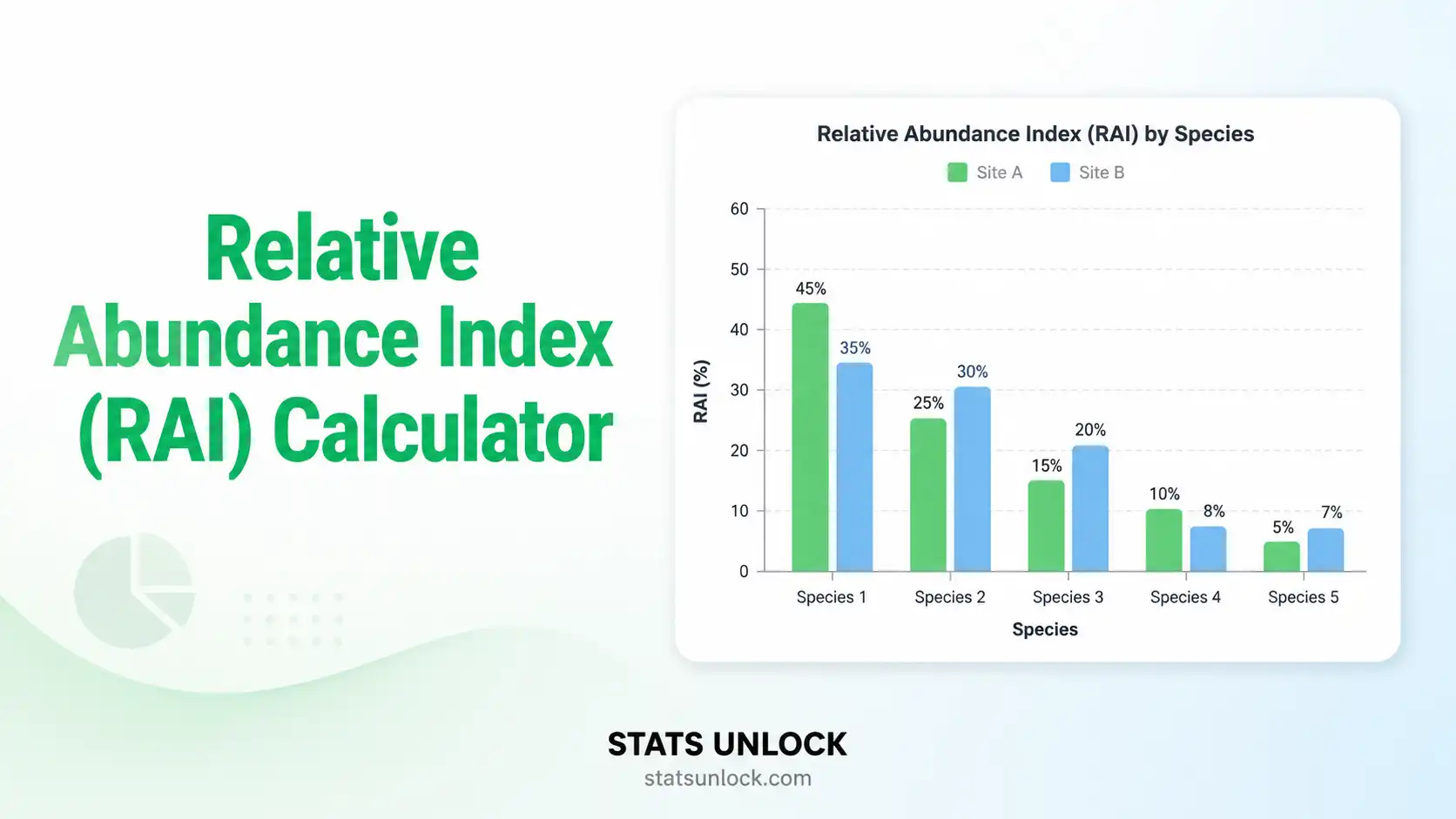

Relative Abundance Index (RAI) Calculator
Camera trap & wildlife detection analysis — compute RAI per 100 trap nights, rank species detection rates, and generate publication-ready output for ecology research.
📥 Data Input
Enter detections row by row. Use + Add Row to expand.
0 species entered
⚙️ Analysis Configuration
🧠 Plain Language Interpretation
📝 How to Write Your Results in Research
🪧 Research Poster Panel
🔬 Technical Notes — Formula Derivation, Assumptions, Limitations
Extended Formula Derivation
The Relative Abundance Index (RAI) is a naive, effort-standardised detection rate. For species i with ni independent detections across K camera stations operating for dk active days each:
RAIi = ( ni / Σk=1K dk ) × 100
Variant forms include: PR (Photographic Rate) using all photographs and a × 1000 scaling, and Detection Rate using camera-station as the denominator instead of trap nights.
Ecological & Statistical Assumptions
- Detection probability is equal across species (often violated — large/cooperative species detected more easily).
- All cameras have equal placement quality (trail vs random; height; angle).
- Active camera-days are correctly logged (no false-active periods).
- Independent events truly capture independent visits (≥30 min threshold is convention, not biology).
- Detection rate is monotonically related to true abundance — true only on average, not always.
Known Limitations
- RAI is an index, not an absolute density estimate. Use SECR or N-mixture models for density.
- RAI conflates abundance with detectability; for inference about true presence/absence use occupancy models.
- Heavily trafficked trails inflate detections for trail-following species (e.g., canids, ungulates).
- Camera failure during peak activity hours biases low RAI for crepuscular/nocturnal species.
- RAI cannot be compared across studies that use different independence thresholds or camera spacing.
📌 When to Use This Tool
Decision Checklist
- ✓ You have independent detection events per species filtered by a temporal threshold (e.g., 30 min).
- ✓ You know your total trap nights summed across all active stations.
- ✓ You want to compare detection rates across sites, seasons, or treatment regimes.
- ✓ Your camera array is reasonably standardised (similar placement protocol).
- ✗ Do NOT use if you only have raw photograph counts — filter for independence first.
- ✗ Do NOT use across studies with different independence thresholds.
- ✗ Do NOT use as an absolute density measure — RAI is a relative index only.
Real-World Examples
- Wildlife Monitoring — comparing mesocarnivore RAI across a urban-to-wild gradient in the Greater Yellowstone Ecosystem.
- Conservation Assessment — pre/post hunting closure RAI of white-tailed deer in eastern US national forests.
- Predator-Prey Studies — measuring coyote and lagomorph RAI together to test predator/prey co-detection on Mojave Desert camera grids.
- Invasive Species Tracking — RAI of feral hogs in southeastern US wildlife refuges over a 5-year monitoring window.
Sampling Design Guidance
- Minimum recommended effort: ≥ 1,000 trap nights for large-mammal communities; ≥ 2,000 for rare/cryptic species.
- Use ≥ 20 camera stations to capture spatial variability and avoid station-driven bias.
- Standardise camera height (40–50 cm for medium-large mammals), trail vs random placement, and bait/lure protocol.
- Pair RAI with naive occupancy and species accumulation curves to assess sampling adequacy.
Related Metrics — Decision Tree
- Need a single detection rate per species? → RAI (this tool).
- Need to correct for imperfect detection? → Naive / Modelled Occupancy (ψ).
- Need photographs/effort (no independence filter)? → Photographic Rate (PR).
- Need activity timing overlap between two species? → Activity Pattern Overlap (Δ).
- Need true density (individuals/km²)? → SECR or N-mixture models.
📖 How to Use This Tool — Step by Step
- Enter Your Data — Paste independent detection counts per species (e.g., 52, 48, 55, 61, 47) in the Type tab, upload a CSV / Excel file, or fill the Manual Table. Example: deer = 52, coyote = 48, raccoon = 55.
- Choose a Sample Dataset — Select one of five USA camera trap datasets (Yellowstone, Smokies, Olympic, Mojave, Adirondacks) to see RAI in action.
- Configure Analysis Settings — Enter Total Trap Nights (e.g., 1,200), Number of Camera Stations (e.g., 20), Independence Threshold (30 min standard), and RAI Standardization (per 100 trap nights default).
- Run the Analysis — Click "▶ Run RAI Analysis" to compute RAI per species, total RAI, dominance ranks, and naive occupancy estimates.
- Read the Summary Cards — Green = high detection rate species; amber = moderate; red = low. The Top Species card shows the dominant detected taxon.
- Read the Full Results Table — Every row shows species, raw detections, RAI per 100 trap nights, % share, and rank.
- Examine the Four Visualizations — (1) RAI bar chart sorted, (2) Detection share pie/donut, (3) Cumulative detection curve, (4) Rank-RAI dominance plot.
- Read the Ecological Interpretation — Five paragraphs explain what your RAI values mean for wildlife monitoring, park management, and journal reporting.
- Copy a Reporting Example — Choose from Ecology Journal, Thesis, Plain-Language, Conference Abstract, or Monitoring Report style. Each is auto-filled with your values.
- Export Your Results — Download .txt for sharing, PDF for printing, or copy the summary statement to your clipboard.
❓ Frequently Asked Questions
Q1. What is the Relative Abundance Index (RAI) and when should I use it?
RAI is a camera trap metric defined as the number of independent detections of a species divided by the total trap nights, multiplied by 100. It is the most widely used metric in wildlife camera trap studies because it produces a single, comparable detection rate per species per unit effort. Use RAI when you have standardised camera trap data and want to rank species, compare detection rates across sites, or document a community baseline.
Q2. What data do I need to calculate RAI?
You need (1) the number of independent detection events per species — events ≥30 minutes apart at the same camera station — and (2) the total trap nights, which equals the sum of active days across all cameras during the survey. The Paste tab accepts comma- or newline-separated detection counts; the Upload tab accepts CSV/Excel; the Manual table lets you enter species row-by-row.
Q3. What does a high vs low RAI value mean ecologically?
RAI is context-dependent — there are no universal "good" or "bad" thresholds. Within a study, higher RAI suggests a species is detected more frequently per unit effort, often reflecting higher local abundance or greater detectability. Low RAI may indicate rarity, evasive behaviour, low detection probability, or genuine local scarcity. Always compare RAI values within the same study and protocol, never across studies with different camera placement or independence thresholds.
Q4. How does RAI differ from Detection Probability?
RAI is a raw, naive index — it does not account for the fact that an animal could be present at a camera but not photographed. Detection probability (p) is a model-estimated parameter from occupancy or capture-recapture models that explicitly corrects for imperfect detection. RAI is faster, simpler, and useful for ranking, but detection probability is required when you need rigorous inference about presence, abundance, or density.
Q5. What are the assumptions and limitations of RAI?
RAI assumes equal detection probability across species, equal effort across cameras, and that detection rate scales linearly with true abundance. All three assumptions are routinely violated. Use rarefaction, occupancy models, or N-mixture models when these assumptions are critical to your inference. Also flag heavily-used trail cameras — they inflate RAI for trail-following species like canids and ungulates.
Q6. How many trap nights do I need for RAI to be reliable?
For large mammal communities, ≥1,000 trap nights is the commonly cited minimum. For rare or cryptic species (lynx, fisher, mountain lion in low-density populations), ≥2,000–3,000 trap nights is preferred. Always plot a species accumulation curve to confirm your survey has reached an asymptote before reporting RAI as community-representative.
Q7. Can I compare RAI values between sites or time periods?
Yes, but only when sampling effort, camera placement protocol, independence threshold, season, and target taxon are standardised. RAI per 100 trap nights makes raw counts comparable across unequal effort. For rigorous statistical comparison, use bootstrapping, permutation tests, or fit GLMs with trap nights as an offset. Do not compare across studies that used different independence thresholds (30 min vs 60 min produces different RAI values).
Q8. How do I report RAI in an ecology journal or conservation report?
Report: (1) total independent detections, (2) total trap nights, (3) number of camera stations, (4) independence threshold, (5) RAI per 100 trap nights per species, and (6) the camera trap protocol citation. See the five reporting templates in this tool — Ecology Journal, Thesis, Plain-Language, Conference Abstract, and Monitoring Report — for full publication-ready examples.
Q9. Can I use this calculator for published research or a university thesis?
This tool is designed for educational use, teaching, and exploratory analysis of camera trap data. For peer-reviewed publication, re-run your RAI computation in camtrapR (R) or your camera trap software of choice using the full raw event table. Cite as: StatsUnlock. (2025). Relative Abundance Index (RAI) Calculator. Retrieved from https://statsunlock.com.
Q10. My RAI seems unexpectedly high or low — what might have gone wrong?
Common causes: (1) failure to filter dependent detections (raw photo counts inflate RAI); (2) a single dominant camera station overrepresenting one trail; (3) miscounted trap nights — forgetting to subtract inactive days; (4) duplicate species labels; (5) including bait-station photos at the bait without applying a longer independence threshold. Verify each total against the raw event table and recompute.
🔍 Conclusion
📚 References
Foundational and methodological sources for RAI computation, camera-trap survey design, independence filtering, and comparison with occupancy and density estimators.
- O'Brien, T. G., Kinnaird, M. F., & Wibisono, H. T. (2003). Crouching tigers, hidden prey: Sumatran tiger and prey populations in a tropical forest landscape. Animal Conservation, 6(2), 131–139. https://doi.org/10.1017/S1367943003003172
- Rovero, F., & Zimmermann, F. (Eds.). (2016). Camera trapping for wildlife research. Pelagic Publishing. https://pelagicpublishing.com/products/camera-trapping-for-wildlife-research
- Burton, A. C., Neilson, E., Moreira, D., Ladle, A., Steenweg, R., Fisher, J. T., Bayne, E., & Boutin, S. (2015). Wildlife camera trapping: A review and recommendations for linking surveys to ecological processes. Journal of Applied Ecology, 52(3), 675–685. https://doi.org/10.1111/1365-2664.12432
- Niedballa, J., Sollmann, R., Courtiol, A., & Wilting, A. (2016). camtrapR: An R package for efficient camera trap data management. Methods in Ecology and Evolution, 7(12), 1457–1462. https://doi.org/10.1111/2041-210X.12600
- Sollmann, R. (2018). A gentle introduction to camera-trap data analysis. African Journal of Ecology, 56(4), 740–749. https://doi.org/10.1111/aje.12557
- Kays, R., Arbogast, B. S., Baker-Whatton, M., Beirne, C., Boone, H. M., Bowler, M., et al. (2020). An empirical evaluation of camera trap study design. Methods in Ecology and Evolution, 11(6), 700–713. https://doi.org/10.1111/2041-210X.13370
- Ahumada, J. A., Hurtado, J., & Lizcano, D. (2013). Monitoring the status and trends of tropical forest terrestrial vertebrate communities from camera trap data: A tool for conservation. PLoS ONE, 8(9), e73707. https://doi.org/10.1371/journal.pone.0073707
- MacKenzie, D. I., Nichols, J. D., Royle, J. A., Pollock, K. H., Bailey, L. L., & Hines, J. E. (2017). Occupancy estimation and modeling (2nd ed.). Academic Press. https://www.elsevier.com/books/occupancy-estimation-and-modeling/mackenzie/978-0-12-407197-1
- Karanth, K. U., & Nichols, J. D. (2002). Monitoring tigers and their prey. Centre for Wildlife Studies. https://www.wcs.org
- Wearn, O. R., & Glover-Kapfer, P. (2019). Snap happy: Camera traps are an effective sampling tool when compared with alternative methods. Royal Society Open Science, 6(3), 181748. https://doi.org/10.1098/rsos.181748
- Steenweg, R., Hebblewhite, M., Kays, R., Ahumada, J., Fisher, J. T., Burton, C., et al. (2017). Scaling-up camera traps: Monitoring the planet's biodiversity with networks of remote sensors. Frontiers in Ecology and the Environment, 15(1), 26–34. https://doi.org/10.1002/fee.1448
- Meek, P. D., Ballard, G., Claridge, A., Kays, R., Moseby, K., O'Brien, T., et al. (2014). Recommended guiding principles for reporting on camera trapping research. Biodiversity and Conservation, 23(9), 2321–2343. https://doi.org/10.1007/s10531-014-0712-8
- Sollmann, R., Mohamed, A., Samejima, H., & Wilting, A. (2013). Risky business or simple solution — Relative abundance indices from camera-trapping. Biological Conservation, 159, 405–412. https://doi.org/10.1016/j.biocon.2012.12.025
- Rowcliffe, J. M., Field, J., Turvey, S. T., & Carbone, C. (2008). Estimating animal density using camera traps without the need for individual recognition. Journal of Applied Ecology, 45(4), 1228–1236. https://doi.org/10.1111/j.1365-2664.2008.01473.x
- R Core Team. (2024). R: A language and environment for statistical computing. R Foundation for Statistical Computing. https://www.R-project.org/