


DNA vs RNA Calculator
Paste any DNA or RNA sequence to convert it both ways and compare the two molecules side by side: sugar, bases, chemical formula, molecular weight, extinction coefficient, A260 concentration, and how fast and how accurately DNA polymerase and RNA polymerase copy it. With labeled DNA vs RNA diagrams, a Venn diagram, a comparison chart and every difference explained in plain English.
⚡ 0. Quick Answer
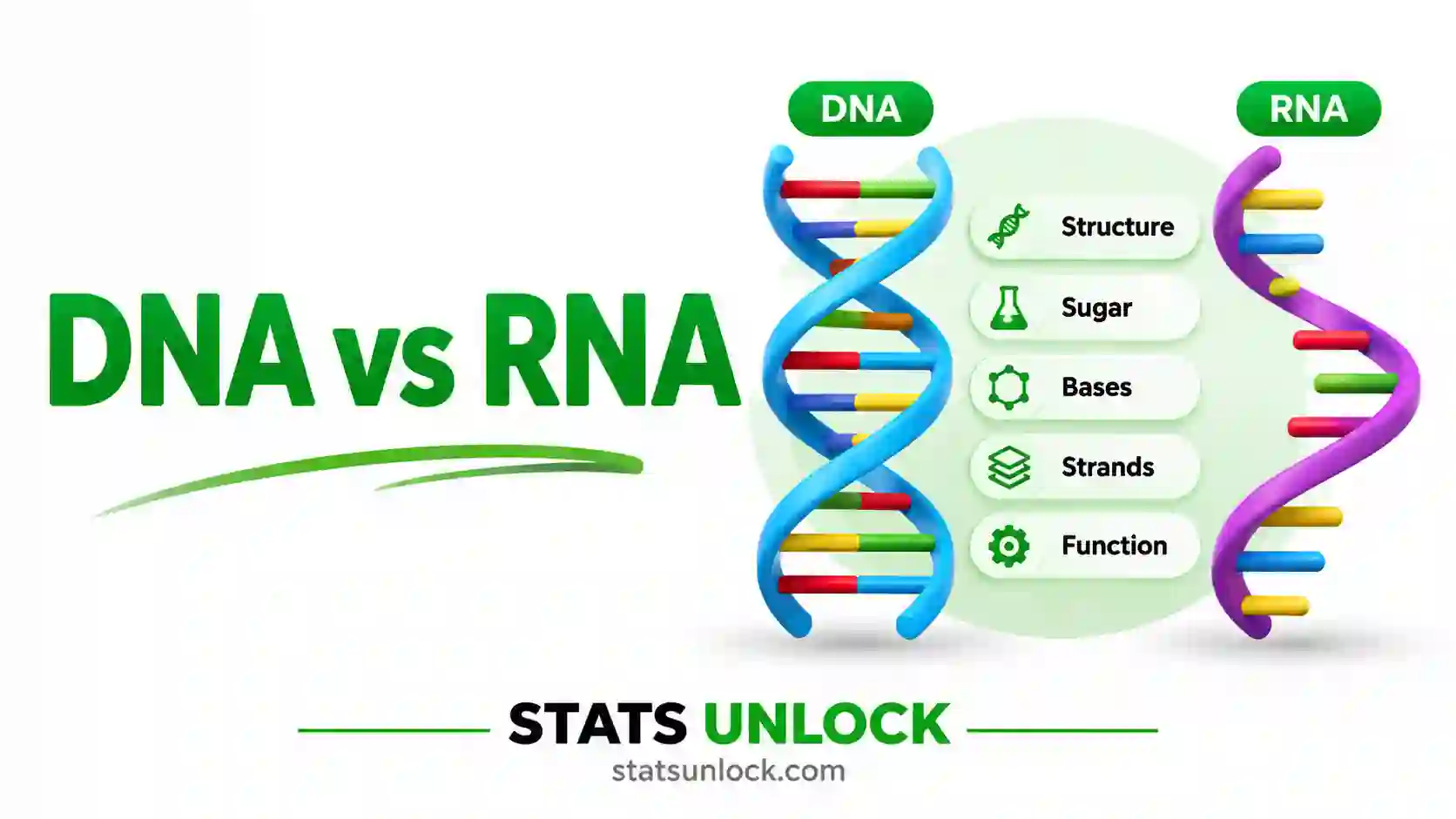
DNA vs RNA comes down to three differences: DNA has the sugar deoxyribose, RNA has ribose; DNA uses thymine (T), RNA uses uracil (U); DNA is usually a double helix, RNA usually a single strand.
Because of these differences, DNA is the stable, long-term store of genetic information, while RNA is a short-lived working copy that carries the message, builds proteins and regulates genes. Both are nucleic acids made of nucleotides with A, G and C, a phosphate backbone and the same five elements.
Rule of thumb: the same sequence weighs about 3 to 5% more as RNA than as single-stranded DNA, and RNA polymerase makes roughly 10,000 times more errors per base than DNA replication.
Key takeaways
- DNA vs RNA sugar: deoxyribose (H on carbon 2′) vs ribose (OH on carbon 2′).
- DNA vs RNA bases: both use A, G and C; DNA adds thymine, RNA adds uracil, so A pairs with T in DNA and with U in RNA.
- DNA vs RNA structure: DNA is a double-stranded B-form helix; RNA is usually single-stranded and folds into hairpins, and double-stranded RNA forms an A-form helix.
- DNA vs RNA function: DNA stores genetic information; RNA uses it (mRNA, tRNA, rRNA) and regulates genes.
- The worked gene ATGGCTTGGAAACGTGAATAA weighs 6,518.31 g/mol as DNA and 6,784.16 g/mol as RNA: a gap of 265.84 g/mol = 15.999 × 21 − 14.027 × 5.
📚 1. What Is the Difference Between DNA and RNA?
DNA vs RNA, explained: DNA (deoxyribonucleic acid) and RNA (ribonucleic acid) are the two kinds of nucleic acid. Both are chains of nucleotides, and each nucleotide has a phosphate, a five-carbon sugar and a nitrogenous base. The difference between DNA and RNA lies in which sugar, which bases and how many strands they use, and those small chemical differences give them very different jobs in the cell.
DNA vs RNA comparison chart
| Feature | DNA | RNA |
|---|---|---|
| Full name | Deoxyribonucleic acid | Ribonucleic acid |
| Sugar | Deoxyribose (no OH on C2′) | Ribose (OH on C2′) |
| Nitrogenous bases | Adenine, guanine, cytosine, thymine | Adenine, guanine, cytosine, uracil |
| Base pairing | A–T (2 H-bonds), G–C (3) | A–U (2), G–C (3), plus G–U wobble |
| Strands | Usually two, antiparallel | Usually one |
| Helix | B-form double helix, 10.5 bp per turn | Folds into hairpins; double strands form an A-form helix, about 11 bp per turn |
| Length | Very long: millions of base pairs per chromosome | Short: about 20 nt (microRNA) to tens of thousands of nt (mRNA) |
| Main function | Stores and passes on genetic information | Carries the message, builds proteins, regulates genes |
| Types | Nuclear, mitochondrial, chloroplast, plasmid DNA | mRNA, tRNA, rRNA, microRNA, siRNA, snRNA, long non-coding RNA |
| Made by | DNA polymerase (replication) | RNA polymerase (transcription) |
| Building blocks | dATP, dGTP, dCTP, dTTP | ATP, GTP, CTP, UTP |
| Location (eukaryotes) | Nucleus, mitochondria, chloroplasts | Made in the nucleus, works mostly in the cytoplasm |
| Lifetime | The life of the cell, repaired when damaged | Minutes to hours for most mRNAs |
| Stability | Very stable; resists alkali | Less stable; the 2′-OH lets the backbone cut itself (Li and Breaker, 1999) |
| Can act as an enzyme? | Not in nature | Yes: ribozymes, including the ribosome's peptidyl transferase (Cech, 2000) |
| Genetic material of | All cells, DNA viruses | RNA viruses |
| A260 conversion factor | 50 ng/µL (ds), 33 (ss) | 40 ng/µL |
| Average mass per nucleotide | about 309 g/mol | about 321 g/mol |
DNA vs RNA sugar: deoxyribose vs ribose
The sugar in DNA vs the sugar in RNA differs by a single oxygen atom. Both are five-carbon sugars (pentoses) in a ring. Ribose, the RNA sugar, carries a hydroxyl group (OH) on carbon 2′; deoxyribose, the DNA sugar, carries only a hydrogen there, which is what "deoxy" means. That one OH group makes RNA more reactive and less stable, and it is why the same sequence is heavier as RNA.
DNA vs RNA bases and base pairing
DNA and RNA share three nitrogenous bases: adenine (A), guanine (G) and cytosine (C). DNA's fourth base is thymine (T); RNA's is uracil (U). Thymine is uracil with an extra methyl group (CH₃) on carbon 5. Both pair with adenine using two hydrogen bonds, so the pairing rules are A–T and G–C in DNA, and A–U and G–C in RNA.
DNA vs RNA nucleotides
A DNA nucleotide is a deoxyribonucleotide: phosphate + deoxyribose + A, G, C or T. An RNA nucleotide is a ribonucleotide: phosphate + ribose + A, G, C or U. The cell builds DNA from deoxyribonucleoside triphosphates (dNTPs) and RNA from ribonucleoside triphosphates (NTPs), and the two polymerases are strict about which they use.
DNA vs RNA similarities
- Both are nucleic acids: polymers of nucleotides joined by phosphodiester bonds.
- Both have a sugar-phosphate backbone with a 5′ and a 3′ end, and both are made 5′ to 3′.
- Both use adenine, guanine and cytosine, and both follow complementary base pairing.
- Both contain the same five elements, C, H, O, N and P, and no sulfur.
- Both absorb UV light most strongly at 260 nm.
- Both can be the genetic material of a virus.
DNA vs RNA function
The function of DNA is to store the genetic instructions and pass them to new cells and offspring. The function of RNA is to use those instructions: messenger RNA (mRNA) carries a gene's code to the ribosome, transfer RNA (tRNA) brings amino acids, ribosomal RNA (rRNA) joins them into a protein, and small RNAs switch genes on and off. In the central dogma, DNA is copied by replication, transcribed into RNA, and RNA is translated into protein (Crick, 1970). Some viruses reverse the second step: reverse transcriptase copies RNA back into DNA (Baltimore, 1970; Temin and Mizutani, 1970).
A worked one-liner: the DNA coding strand ATGGCTTGGAAACGTGAATAA becomes the RNA AUGGCUUGGAAACGUGAAUAA. Its 5 T become 5 U and its 21 deoxyriboses become riboses, so the molecule gains 21 oxygen atoms, loses 5 CH₂ groups and gets 265.84 g/mol heavier.
Who uses this: students who need to compare and contrast DNA vs RNA (the same three differences taught in popular class videos such as the Amoeba Sisters' DNA vs RNA lesson), teachers making a DNA vs RNA chart or card sort, lab scientists converting between an RNA target and its cDNA or working out RNA vs DNA concentrations from one A260 reading, and anyone reading about DNA vs RNA viruses or RNA-seq.
🧮 2. Set Up Your Data
Only have a composition? Type how many of each base the molecule has. Masses, formulas, extinction and concentrations depend only on the counts.
What did you paste?
One A260 reading, read as DNA and as RNA
DNA polymerase vs RNA polymerase
📊 3. Results
🧠 4. Interpretation of Results, In Detail
4.1 The conversion: transcription vs reverse transcription
From the DNA coding strand, the RNA is the same sequence with every T changed to U, because RNA polymerase reads the other strand, the template, and builds a complementary copy. From the template strand, the RNA is its reverse complement. From RNA, the cDNA is the same sequence with U changed to T, which is what reverse transcriptase produces after its second strand. The strand view shows all four forms, with T and U highlighted.
4.2 The sugar difference in numbers
Every ribose has one more oxygen than a deoxyribose, so an RNA of n nucleotides has n more oxygen atoms than the same sequence as DNA. That alone adds 15.999 g/mol per nucleotide. The "+O" figure on the mass card is exactly the number of known nucleotides in your sequence.
4.3 The base difference in numbers
Each thymine in DNA becomes a uracil in RNA, which removes a methyl group: one carbon and two hydrogens, 14.027 g/mol. So an AT-rich sequence has a smaller DNA-to-RNA mass gap than a GC-rich one of the same length, and a sequence with no T at all gains the full 15.999 g/mol per nucleotide.
4.4 Single strand vs double helix
DNA usually exists as two antiparallel strands in a right-handed B-form helix, about 2 nm wide with 10.5 base pairs per turn (Watson and Crick, 1953; Franklin and Gosling, 1953). RNA is usually single-stranded but folds back on itself into hairpins and loops. When two RNA strands do pair, as in double-stranded RNA viruses or the first poly(A)·poly(U) duplex described by Rich and Davies (1956), the 2′-OH pushes the helix into the A-form: shorter, wider and about 11 base pairs per turn. RNA double helix vs DNA double helix is therefore a real structural difference, not just a strand count.
4.5 One A260, two concentrations
DNA and RNA both absorb at 260 nm, so a spectrophotometer cannot tell them apart. The same reading means 50 ng/µL per unit for double-stranded DNA, 40 for RNA and 33 for single-stranded DNA. Choose the right molecule in your instrument; reading RNA as dsDNA overestimates it by 25%. The sequence-specific values in the results use each molecule's own extinction coefficient.
4.6 Why RNA is less stable than DNA
The 2′-OH of ribose can attack the neighbouring phosphodiester bond and cut the RNA backbone, especially at high pH or with metal ions (Li and Breaker, 1999). DNA has no 2′-OH, so it survives alkali and lasts for years in a freezer, and even millennia in bones. RNA is also attacked by RNase enzymes, which are everywhere. That is why DNA is the long-term store and RNA a short-lived message.
4.7 DNA polymerase vs RNA polymerase
DNA polymerase copies DNA into DNA during replication; RNA polymerase copies DNA into RNA during transcription. DNA polymerase needs a primer, uses dNTPs, copies both strands of the whole genome once per cell cycle and checks its work with a 3′ to 5′ exonuclease. RNA polymerase needs no primer, uses NTPs, copies one strand of one gene at a time, as many times as the cell needs, and proofreads only by backing up and cutting (Sydow and Cramer, 2009). The copy-time card uses the speeds you set.
4.8 Error rates and why they differ
Replication must be nearly perfect because a mistake becomes a permanent mutation passed to every daughter cell. After proofreading and mismatch repair, about one error remains per billion to ten billion bases copied (Kunkel, 2004). A transcription error only spoils one of many RNA copies, so RNA polymerase can afford roughly one error per hundred thousand bases. The errors-per-copy card multiplies your length by each rate.
4.9 What this means for DNA vs RNA viruses
RNA viruses copy their genomes with RNA-dependent RNA polymerases or reverse transcriptases that lack proofreading, so their mutation rates are about 10⁻⁶ to 10⁻⁴ per nucleotide per cell infection, against roughly 10⁻⁸ to 10⁻⁶ for DNA viruses (Sanjuán et al., 2010; Drake, 1993). That is why influenza and SARS-CoV-2 change quickly. Whether a DNA virus or an RNA virus is more dangerous depends on the virus, not its nucleic acid: smallpox and some papillomaviruses are DNA viruses, while influenza, HIV and Ebola are RNA viruses.
4.10 What this comparison cannot tell you
It compares the same sequence as DNA and as RNA. It does not predict RNA folding, chemical modifications such as methylated bases or pseudouridine, splicing, or how long a particular RNA lasts in a cell. Copying times and error rates are averages; real polymerases pause, stall and vary along a gene. Use the numbers to understand the difference, then measure your own system.
✍ 5. How to Report Your DNA vs RNA Results
📌 Key conventions for this style
- Say whether you report DNA or RNA, and which strand.
- Give masses as free acid or name the salt.
- Name the A260 factor or extinction coefficient used.
- Write RNA sequences with U and DNA sequences with T.
📌 Key conventions for this style
- Explain the chemistry behind any DNA vs RNA difference you report.
- Show both sequences aligned in a figure.
- Name the software and version.
- Keep gene names italic and RNA names upright.
📌 Key conventions for this style
- Record which molecule type the spectrophotometer was set to.
- Note RNase precautions for RNA work.
- Record DNase treatment of RNA preps.
- Keep the raw A260, A280 and A230.
📌 Key conventions for this style
- Use the DNA vs RNA diagram or Venn diagram as the visual.
- Give one number per claim.
- Spell out DNA and RNA once.
- Keep the comparison to the differences that matter for your result.
📌 Key conventions for this style
- List both sequences in FASTA format.
- State the 5′ end chemistry.
- Give the extinction coefficients used.
- Deposit sequencing data (DNA-seq or RNA-seq) in a public archive.
∑ 6. Formulas Used
🔀 7. DNA vs RNA Calculation Flow Chart
This flow chart follows the worked example, the 21-base DNA coding strand ATGGCTTGGAAACGTGAATAA with a 5′-OH, read at A260 = 0.5. The Excel, R and Python sections use the same numbers.
Check any box yourself: the Excel sheet in Section 9, the R script in Section 10 and the Python script in Section 11 all return 6,518.31, 6,784.16 and 265.84 g/mol for this sequence.
📝 8. How to Use This DNA vs RNA Calculator
- Paste your DNA or RNA sequence. Paste the sequence 5 prime to 3 prime. FASTA headers, spaces, numbers and lowercase are cleaned automatically, and the live readout says whether it looks like DNA or RNA.
- Or load a sample. Ten built-in samples cover a short gene, its template strand, an siRNA, an mRNA, a 1,200-nt gene, GC-rich and AT-rich DNA, telomere DNA and its RNA (TERRA), and a messy read.
- Or upload a file, or type base counts. On the Upload tab choose a FASTA or TXT file, or a CSV or Excel file and the column that holds the sequence. On the Manual tab type how many of each base there are.
- Say what you pasted. Choose the DNA coding strand, the DNA template strand or RNA, or let the tool detect it: a U means RNA. The tool transcribes DNA to RNA or reverse-transcribes RNA to cDNA.
- Choose the 5 prime end. Pick 5 prime hydroxyl for synthetic oligos or 5 prime phosphate for natural and enzymatic molecules. The same end is used for both, so the mass gap does not change.
- Enter one A260 reading. Type the absorbance, dilution factor and path length. The tool shows what that one reading means if the sample is double-stranded DNA, single-stranded DNA or RNA.
- Set the polymerases. Pick E. coli or human cells for typical DNA polymerase and RNA polymerase speeds, or enter your own speeds and error rates.
- Press Compare DNA vs RNA. Nothing is calculated until you press the button. Changing any input clears the old results so you never read stale numbers.
- Read the comparison. Check the cards, the aligned DNA and RNA strands, the formula block, the side-by-side table, the element table and the four charts.
- Report and export. Copy the RNA or DNA sequence, copy one of the five ready-made report sentences, or download the full report as a text document or PDF.
📈 9. How to Compare DNA vs RNA in Excel
Excel can convert DNA to RNA with one SUBSTITUTE, count the bases with the LEN minus SUBSTITUTE trick, and add up both molecular weights with SUMPRODUCT. What trips people up is lowercase letters, forgetting the end correction, and using the DNA residue masses for RNA.
=SUBSTITUTE(UPPER(A2),"T","U") gives the RNA, and =15.999*LEN(A2)-14.027*(LEN(A2)-LEN(SUBSTITUTE(A2,"T",""))) gives the RNA-minus-DNA mass gap: 265.84 g/mol for the worked example.9.1 The functions you need
| You want | Excel function | Note |
|---|---|---|
| DNA to RNA (coding strand) | =SUBSTITUTE(UPPER(A2),"T","U") | UPPER first: SUBSTITUTE is case sensitive |
| RNA to cDNA | =SUBSTITUTE(UPPER(A2),"U","T") | Reverse transcription, same sense |
| Count one base | =LEN($A$2)-LEN(SUBSTITUTE($A$2,D2,"")) | D2 holds A, C, G or T; fill down |
| DNA molecular weight | =SUMPRODUCT(E2:E5,F2:F5)+18.015-79.979 | F holds DNA residue masses |
| RNA molecular weight | =SUMPRODUCT(E2:E5,G2:G5)+18.015-79.979 | G holds RNA residue masses; T count = U count |
| Mass gap rule | =15.999*LEN(A2)-14.027*E5 | E5 is the T count |
| Extinction coefficient | =SUMPRODUCT(E2:E5,H2:H5) | Use 8,700 for T in DNA, 9,900 for U in RNA |
| Concentration | =A260/epsilon*MW*1000 | ng/µL for a 1 cm path, undiluted |
| Copy time | =LEN(A2)/1000 | Seconds at 1,000 nt/s |
| Template strand to RNA | =SUBSTITUTE(revcomp,"T","U") | Reverse-complement first (see 9.3) |
9.2 Step by step
1 Paste the DNA and transcribe it
Put the DNA coding strand in A2. In B2, change every T to U.
=SUBSTITUTE(UPPER(A2),"T","U")A2 holds ATGGCTTGGAAACGTGAATAA; B2 returns the RNA AUGGCUUGGAAACGUGAAUAA.
2 Count the bases
Type A, C, G and T in D2 to D5 and count each one in the DNA. The T count is also the U count of the RNA.
=LEN($A$2)-LEN(SUBSTITUTE($A$2,D2,""))E2 to E5 give 8, 2, 6 and 5.
3 Molecular weight of the DNA
Put the DNA residue masses in F2 to F5, multiply by the counts, add water and remove one phosphate for a 5′-OH.
=SUMPRODUCT(E2:E5,F2:F5)+18.015-79.979F7 shows 6,518.31 g/mol.
4 Molecular weight of the RNA
Put the RNA residue masses in G2 to G5 (U on the T row) and repeat.
=SUMPRODUCT(E2:E5,G2:G5)+18.015-79.979G7 shows 6,784.16 g/mol.
5 Check the gap with the DNA vs RNA rule
On a Compare sheet, subtract the two masses, then check with 15.999 per nucleotide minus 14.027 per T.
=B3-B2 =15.999*Sheet1!B9-14.027*Sheet1!E5B4 and B5 both return 265.84 g/mol; B9 on Sheet1 holds the length, 21.
6 One A260, read as DNA and as RNA
Put each molecule's MW and extinction coefficient in its own column and convert the same A260.
=B4/B3*B2*1000B5 returns 13.01 ng/µL as DNA; C5 returns 13.22 ng/µL as RNA.
9.3 The awkward cases
Template strand. Reverse the text with =CONCAT(MID(A2,SEQUENCE(LEN(A2),,LEN(A2),-1),1)) in Excel 365, complement it with the lowercase-placeholder SUBSTITUTE chain, then change T to U.
RNA in, DNA out. Swap the roles: count U in the RNA, and the DNA has the same number of T.
Long sequences. A cell holds 32,767 characters. For whole transcriptomes or genomes, use R or Python.
9.4 Why your Excel answer might differ from R, Python or Biopython
| Situation | What happens | Fix |
|---|---|---|
| 5′ end assumed | Biopython assumes a 5′-phosphate: 6,598.23 (DNA) and 6,864.09 (RNA) for the worked example, 79.98 more each | The gap is the same either way: 265.84 to 265.86 |
| Rounded atomic weights | A few hundredths of a g/mol | Negligible; quote two decimals |
| Salt form | Sodium salts weigh about 22 g/mol more per phosphate | Say "free acid" |
| Nearest-neighbour ε | Supplier values for oligos are often a few percent different from summed ε | Use the supplier's value for their oligos |
| Lowercase input | SUBSTITUTE skips lowercase t | Wrap the input in UPPER |
| Modified RNA | Pseudouridine and methylated bases change the mass | Add the modifications by hand |
9.5 Charting the result in Excel
- Make a table of element counts with DNA and RNA columns.
- Select it and choose Insert → Clustered Column.
- Colour DNA blue and RNA fuchsia, the colours used on this page.
- Put the mass difference in the chart title so the figure stands on its own.
9.6 Excel errors you will probably hit
| Excel shows | Why | Fix |
|---|---|---|
| RNA still contains t | Lowercase input | Use SUBSTITUTE(UPPER(A2),"T","U") |
| Counts add up to less than the length | N bases or spaces | Clean the text; count N separately |
#NAME? | SEQUENCE or CONCAT in an old Excel | Use Excel 365, or R and Python |
| Gap is about 16 per base for every sequence | Forgot the −14.027 per T | Subtract 14.027 times the T count |
| Wrong counts after fill-down | A2 not locked | Use $A$2 |
| Sequence became a number or date | Autoformat | Format the column as Text before pasting |
📈 10. How to Compare DNA vs RNA in R
Biostrings converts between the two molecules for you: RNAString(dna) transcribes and DNAString(rna) reverse-transcribes. The script below then builds both chemical formulas atom by atom, so the masses, the mass gap, the extinction coefficients and the concentrations match this calculator.
Rscript. Change only the lines under "Your data".Biostrings is a Bioconductor package: install it with install.packages("BiocManager") then BiocManager::install("Biostrings").
10.1 The complete script
R with Biostrings, saves dna_vs_rna_plot.png
# DNA vs RNA calculator in R: convert, then compare formula, mass, extinction,
# A260 concentration, copy time and errors. Matches the StatsUnlock calculator.
library(Biostrings)

# ---- 1. Your data -------------------------------------------------------
seq_txt  <- "ATGGCTTGGAAACGTGAATAA"   # 5' to 3'
in_type  <- "dna_coding"              # dna_coding, dna_template or rna
five_p   <- FALSE                     # TRUE if the 5' end carries a phosphate
a260 <- 0.5; dilution <- 1; path_cm <- 1
v_dna <- 1000; v_rna <- 50            # polymerase speeds, nt per second
e_dna <- 1e-9; e_rna <- 1e-5          # errors per nucleotide

# ---- 2. Convert DNA <-> RNA ---------------------------------------------
s <- toupper(gsub("[^A-Za-z]", "", seq_txt))
if (in_type == "rna") {
  rna <- RNAString(chartr("T", "U", s)); dna <- DNAString(rna)        # reverse transcription: U -> T
} else if (in_type == "dna_template") {
  dna <- reverseComplement(DNAString(s)); rna <- RNAString(dna)       # template: reverse complement, then T -> U
} else {
  dna <- DNAString(s); rna <- RNAString(dna)                          # coding strand: T -> U
}
n  <- length(dna)
nT <- letterFrequency(dna, "T")

# ---- 3. Formulas and molecular weights ----------------------------------
aw <- c(C = 12.011, H = 1.008, N = 14.007, O = 15.999, P = 30.974)
res_dna <- list(A = c(10, 12, 5, 5, 1), C = c(9, 12, 3, 6, 1), G = c(10, 12, 5, 6, 1), T = c(10, 13, 2, 7, 1))
res_rna <- list(A = c(10, 12, 5, 6, 1), C = c(9, 12, 3, 7, 1), G = c(10, 12, 5, 7, 1), U = c(9, 11, 2, 8, 1))
formula_of <- function(x, res) {
  k <- letterFrequency(x, names(res))
  f <- Reduce(`+`, Map(function(b, m) res[[b]] * m, names(k), k)) + c(0, 2, 0, 1, 0)
  if (!five_p) f <- f - c(0, 1, 0, 3, 1)
  setNames(f, names(aw))
}
f_dna <- formula_of(dna, res_dna); f_rna <- formula_of(rna, res_rna)
mw_dna <- sum(f_dna * aw); mw_rna <- sum(f_rna * aw)
d_rule <- 15.999 * n - 14.027 * nT

# ---- 4. Extinction and concentration ------------------------------------
eps_nt  <- c(A = 15400, C = 7400, G = 11500, T = 8700, U = 9900)
eps_dna <- sum(letterFrequency(dna, c("A", "C", "G", "T")) * eps_nt[c("A", "C", "G", "T")])
eps_rna <- sum(letterFrequency(rna, c("A", "C", "G", "U")) * eps_nt[c("A", "C", "G", "U")])
conc_dna <- a260 / (eps_dna * path_cm) * dilution * mw_dna * 1000
conc_rna <- a260 / (eps_rna * path_cm) * dilution * mw_rna * 1000

# ---- 5. Report ----------------------------------------------------------
cat("DNA:", as.character(dna), "\nRNA:", as.character(rna), "\n")
cat("DNA formula:", paste0(names(f_dna), f_dna, collapse = " "), "| RNA formula:", paste0(names(f_rna), f_rna, collapse = " "), "\n")
cat(sprintf("MW DNA = %.2f | MW RNA = %.2f | difference = %.2f (rule %.2f) g/mol\n", mw_dna, mw_rna, mw_rna - mw_dna, d_rule))
cat(sprintf("eps260 DNA = %d | RNA = %d\n", eps_dna, eps_rna))
cat(sprintf("A260 %.2f: ssDNA %.2f ng/uL, RNA %.2f ng/uL | factors: dsDNA %.2f, ssDNA %.2f, RNA %.2f\n",
            a260, conc_dna, conc_rna, a260 * 50 * dilution, a260 * 33 * dilution, a260 * 40 * dilution))
cat(sprintf("Copy time: DNA pol %.3f s, RNA pol %.3f s | errors per copy: %.2e vs %.2e\n", n / v_dna, n / v_rna, n * e_dna, n * e_rna))

# ---- 6. Figure: atoms and mass, DNA vs RNA ------------------------------
png("dna_vs_rna_plot.png", width = 2400, height = 1100, res = 300)
par(mfrow = c(1, 2), mar = c(4, 4, 3, 1))
barplot(rbind(DNA = f_dna, RNA = f_rna), beside = TRUE, col = c("#2563eb", "#a21caf"),
        legend.text = TRUE, args.legend = list(x = "topright", bty = "n"), ylab = "Atoms", main = "Atoms: DNA vs RNA")
barplot(c(DNA = mw_dna, RNA = mw_rna), col = c("#2563eb", "#a21caf"), ylab = "g/mol",
        main = sprintf("RNA is %.2f g/mol heavier", mw_rna - mw_dna))
dev.off()
Run it with Rscript dna_vs_rna.R. For the worked example it prints MW DNA = 6518.31, MW RNA = 6784.16, difference = 265.84 (rule 265.84), eps260 250500 vs 256500, and 13.01 vs 13.22 ng/uL.
10.2 What each part does
| Line or function | What it does, and why it is there |
|---|---|
| RNAString(DNAString(s)) | Transcription of a coding strand: T becomes U. |
| DNAString(RNAString(...)) | Reverse transcription: U becomes T, giving the cDNA. |
| reverseComplement() | Turns a template strand into the coding strand first. |
| letterFrequency() | Counts each base; the T count of the DNA is the U count of the RNA. |
| res_dna, res_rna | Atoms in each residue; RNA has one more O, and U one C and two H fewer than T. |
| formula_of() | Sums the residues and corrects the chain ends. |
| d_rule | The DNA vs RNA mass rule, which must equal the direct difference. |
| eps_nt | Nucleotide extinction at 260 nm; U absorbs more than T. |
| png(..., res = 300) | A print-quality figure. dev.off() closes it. |
10.3 What the figure shows
The left panel compares the atoms in the DNA and RNA forms: the oxygen bars differ by one per nucleotide, the carbon and hydrogen bars slightly, and the nitrogen and phosphorus bars not at all. The right panel compares the two molecular weights, with the gap in the title.
10.4 Common R problems and fixes
| Problem | Cause | Fix |
|---|---|---|
| there is no package called Biostrings | Not installed with BiocManager | BiocManager::install("Biostrings") |
| invalid character in DNAString: U | RNA text passed to DNAString | Set in_type to "rna"; the script converts it |
| RNA is the reverse of what you expected | Template strand treated as coding | Set in_type to "dna_template" |
| MW off by 79.98 | Different 5′ end from the other tool | Set five_p to match |
| NA in the formula | A letter outside A, C, G, T or U | Remove N, or accept that it adds no mass |
| Empty PNG | dev.off() never ran | Run the last lines |
10.5 Useful one-liners
# Transcribe and reverse-transcribe
RNAString(DNAString("ATGGCTTGGAAACGTGAATAA"))
DNAString(RNAString("AUGGCUUGGAAACGUGAAUAA"))
# RNA from a template strand
RNAString(reverseComplement(DNAString("TTATTCACGTTTCCAAGCCAT")))
# Base counts of DNA and RNA side by side
rbind(DNA = letterFrequency(DNAString("ATGGCTTGGAAACGTGAATAA"), c("A","C","G","T")),
      RNA = letterFrequency(RNAString("AUGGCUUGGAAACGUGAAUAA"), c("A","C","G","U")))
📈 11. How to Compare DNA vs RNA in Python
Biopython's Seq object has transcribe() and back_transcribe(), and molecular_weight handles both DNA and RNA. The script below mirrors the R version step for step, then cross-checks both masses against Biopython.
Install once with pip install biopython matplotlib.
11.1 The complete script
Python 3 with Biopython, saves dna_vs_rna_plot.png
"""DNA vs RNA calculator in Python: convert, then compare formula, mass, extinction,
A260 concentration, copy time and errors. Matches the StatsUnlock calculator."""
import re
from collections import Counter
from Bio.Seq import Seq
from Bio.SeqUtils import molecular_weight
import matplotlib
matplotlib.use("Agg")
import matplotlib.pyplot as plt

# ---- 1. Your data -------------------------------------------------------
seq_txt = "ATGGCTTGGAAACGTGAATAA"   # 5' to 3'
in_type = "dna_coding"              # dna_coding, dna_template or rna
five_p = False                      # True if the 5' end carries a phosphate
a260, dilution, path_cm = 0.5, 1, 1
v_dna, v_rna = 1000, 50             # polymerase speeds, nt per second
e_dna, e_rna = 1e-9, 1e-5           # errors per nucleotide

# ---- 2. Convert DNA <-> RNA ---------------------------------------------
s = re.sub(r"[^A-Za-z]", "", seq_txt).upper()
if in_type == "rna":
    rna = Seq(s.replace("T", "U")); dna = rna.back_transcribe()        # U -> T (cDNA)
elif in_type == "dna_template":
    dna = Seq(s).reverse_complement(); rna = dna.transcribe()          # template -> coding -> RNA
else:
    dna = Seq(s); rna = dna.transcribe()                               # coding strand: T -> U
n, nT = len(dna), str(dna).count("T")

# ---- 3. Formulas and molecular weights ----------------------------------
AW = dict(C=12.011, H=1.008, N=14.007, O=15.999, P=30.974)
RES_DNA = dict(A=(10, 12, 5, 5, 1), C=(9, 12, 3, 6, 1), G=(10, 12, 5, 6, 1), T=(10, 13, 2, 7, 1))
RES_RNA = dict(A=(10, 12, 5, 6, 1), C=(9, 12, 3, 7, 1), G=(10, 12, 5, 7, 1), U=(9, 11, 2, 8, 1))

def formula_of(x, res):
    f = [0, 0, 0, 0, 0]
    for b, m in Counter(str(x)).items():
        if b in res:
            f = [a + m * r for a, r in zip(f, res[b])]
    f[1] += 2; f[3] += 1                     # + H2O for the chain ends
    if not five_p:
        f[1] -= 1; f[3] -= 3; f[4] -= 1      # 5'-OH: one phosphate fewer
    return dict(zip("CHNOP", f))

f_dna, f_rna = formula_of(dna, RES_DNA), formula_of(rna, RES_RNA)
mw_dna = sum(AW[e] * k for e, k in f_dna.items())
mw_rna = sum(AW[e] * k for e, k in f_rna.items())
d_rule = 15.999 * n - 14.027 * nT

# ---- 4. Extinction and concentration ------------------------------------
EPS = dict(A=15400, C=7400, G=11500, T=8700, U=9900)
eps_dna = sum(EPS[b] for b in str(dna) if b in EPS)
eps_rna = sum(EPS[b] for b in str(rna) if b in EPS)
conc_dna = a260 / (eps_dna * path_cm) * dilution * mw_dna * 1000
conc_rna = a260 / (eps_rna * path_cm) * dilution * mw_rna * 1000

# ---- 5. Report ----------------------------------------------------------
print("DNA:", dna, "\nRNA:", rna)
print("DNA formula:", " ".join(f"{e}{k}" for e, k in f_dna.items()), "| RNA formula:", " ".join(f"{e}{k}" for e, k in f_rna.items()))
print(f"MW DNA = {mw_dna:.2f} | MW RNA = {mw_rna:.2f} | difference = {mw_rna - mw_dna:.2f} (rule {d_rule:.2f}) g/mol")
print(f"eps260 DNA = {eps_dna} | RNA = {eps_rna}")
print(f"A260 {a260:.2f}: ssDNA {conc_dna:.2f} ng/uL, RNA {conc_rna:.2f} ng/uL | factors: dsDNA {a260 * 50 * dilution:.2f}, "
      f"ssDNA {a260 * 33 * dilution:.2f}, RNA {a260 * 40 * dilution:.2f}")
print(f"Copy time: DNA pol {n / v_dna:.3f} s, RNA pol {n / v_rna:.3f} s | errors per copy: {n * e_dna:.2e} vs {n * e_rna:.2e}")
# Cross-check with Biopython's own masses (Biopython assumes a 5'-phosphate)
print(f"Biopython 5'-phosphate MW: DNA {molecular_weight(dna, 'DNA'):.2f}, RNA {molecular_weight(rna, 'RNA'):.2f}")

# ---- 6. Figure: atoms and mass, DNA vs RNA ------------------------------
fig, ax = plt.subplots(1, 2, figsize=(8, 3.6))
x = range(5)
ax[0].bar([i - 0.2 for i in x], list(f_dna.values()), 0.4, color="#2563eb", label="DNA")
ax[0].bar([i + 0.2 for i in x], list(f_rna.values()), 0.4, color="#a21caf", label="RNA")
ax[0].set_xticks(list(x), list("CHNOP")); ax[0].set(ylabel="Atoms", title="Atoms: DNA vs RNA"); ax[0].legend(frameon=False)
ax[1].bar(["DNA", "RNA"], [mw_dna, mw_rna], color=["#2563eb", "#a21caf"])
ax[1].set(ylabel="g/mol", title=f"RNA is {mw_rna - mw_dna:.2f} g/mol heavier")
fig.tight_layout()
fig.savefig("dna_vs_rna_plot.png", dpi=300)
11.2 What each part does
| Line or function | What it does, and why it is there |
|---|---|
| dna.transcribe() | Coding strand to RNA: T becomes U. |
| rna.back_transcribe() | RNA to cDNA: U becomes T. |
| Seq(s).reverse_complement() | Template strand to coding strand. |
| formula_of() | Adds residue atoms for DNA or RNA, then corrects the ends. |
| d_rule | 15.999 per nucleotide minus 14.027 per T. |
| EPS | Nucleotide extinction coefficients at 260 nm. |
| molecular_weight(dna, "DNA") | Biopython's mass with a 5′-phosphate: 6,598.23 and 6,864.09 for the worked example, each 79.98 above the 5′-OH values. |
| fig.savefig(..., dpi=300) | A print-quality figure. In Jupyter, use plt.show(). |
11.3 What the figure shows
The same two panels as the R figure: atoms in DNA and RNA side by side, and the two molecular weights with the gap in the title.
11.4 Common Python problems and fixes
| Problem | Cause | Fix |
|---|---|---|
| ValueError: 'U' is not a valid unambiguous letter for DNA | RNA passed to molecular_weight as DNA | Pass "RNA" as the sequence type |
| transcribe() gives the wrong RNA | Template strand used as coding | reverse_complement() first, or set in_type |
| Mass 79.98 higher than this page | Biopython assumes a 5′-phosphate | Set five_p = True to compare |
| ModuleNotFoundError: Bio | Wrong package name | pip install biopython |
| Counts miss a base | Lowercase or spaces left in | Keep the re.sub and upper() line |
| Empty figure | plt.show() with the Agg backend | Use savefig, as the script does |
11.5 Useful one-liners
from Bio.Seq import Seq
Seq("ATGGCTTGGAAACGTGAATAA").transcribe()            # AUGGCUUGGAAACGUGAAUAA
Seq("AUGGCUUGGAAACGUGAAUAA").back_transcribe()       # ATGGCTTGGAAACGTGAATAA
Seq("TTATTCACGTTTCCAAGCCAT").reverse_complement().transcribe()   # template to RNA
from Bio.SeqUtils import molecular_weight
molecular_weight("AUGGCUUGGAAACGUGAAUAA", "RNA") - molecular_weight("ATGGCTTGGAAACGTGAATAA", "DNA")
Run it with python dna_vs_rna.py from a terminal. In Jupyter, drop the savefig line and add plt.show().
📋 12. Detailed Reference Tables
12.1 DNA nucleotides vs RNA nucleotides
| Base | DNA nucleotide | DNA residue | DNA mass | RNA nucleotide | RNA residue | RNA mass | RNA − DNA | ε260 DNA / RNA |
|---|---|---|---|---|---|---|---|---|
| A Adenine | dAMP | C10H12N5O5P1 | 313.210 | AMP | C10H12N5O6P1 | 329.209 | +15.999 | 15,400 / 15,400 |
| C Cytosine | dCMP | C9H12N3O6P1 | 289.184 | CMP | C9H12N3O7P1 | 305.183 | +15.999 | 7,400 / 7,400 |
| G Guanine | dGMP | C10H12N5O6P1 | 329.209 | GMP | C10H12N5O7P1 | 345.208 | +15.999 | 11,500 / 11,500 |
| T / U Thymine / Uracil | dTMP | C10H13N2O7P1 | 304.195 | UMP | C9H11N2O8P1 | 306.167 | +1.972 | 8,700 / 9,900 |
What to conclude: every RNA residue is 15.999 g/mol heavier than its DNA partner (one more oxygen), except U, which is only 1.972 g/mol heavier than T because uracil lacks thymine's CH₂. Masses from IUPAC atomic weights; extinction coefficients as used by Cavaluzzi and Borer (2004).
12.2 DNA polymerase vs RNA polymerase
| Feature | DNA polymerase | RNA polymerase |
|---|---|---|
| Process | Replication (DNA → DNA) | Transcription (DNA → RNA) |
| Building blocks | dATP, dGTP, dCTP, dTTP | ATP, GTP, CTP, UTP |
| Needs a primer? | Yes, a short RNA primer made by primase | No, starts from scratch at a promoter |
| Template | Both strands, whole genome | One strand, one gene at a time |
| Copies per cell cycle | Once | As many as needed |
| Unwinding | Needs helicase | Unwinds about 12 to 14 bp itself (transcription bubble) |
| Proofreading | 3′ to 5′ exonuclease in replicative polymerases | Backtracking and cleavage only (Sydow and Cramer, 2009) |
| Error rate | About 10⁻⁹ to 10⁻¹⁰ per base after repair (Kunkel, 2004) | About 10⁻⁴ to 10⁻⁶ per base |
| Speed | About 1,000 nt/s (E. coli Pol III); slower in human cells | About 20 to 80 nt/s (Jonkers and Lis, 2015) |
| Main types | Bacteria: Pol I to V; eukaryotes: Pol α, δ, ε and others | Bacteria: one; eukaryotes: Pol I (rRNA), Pol II (mRNA), Pol III (tRNA, 5S rRNA) (Cramer, 2019) |
| Product | Double-stranded DNA | Single-stranded RNA |
What to conclude: DNA polymerase is built for accuracy, RNA polymerase for flexibility and volume. The function of DNA polymerase vs RNA polymerase follows from what each product is for: a permanent copy of the genome versus a disposable message.
12.3 DNA viruses vs RNA viruses
| Feature | DNA viruses | RNA viruses |
|---|---|---|
| Genome | dsDNA or ssDNA | ssRNA (+ or − sense), dsRNA, or RNA copied through DNA (retroviruses) |
| Baltimore groups | I, II, VII (Baltimore, 1971) | III, IV, V, VI |
| Examples | Herpesviruses, adenoviruses, papillomaviruses, poxviruses (smallpox), hepatitis B virus | Influenza, SARS-CoV-2, HIV, measles, polio, Ebola, hepatitis C |
| Copying enzyme | Host or viral DNA polymerase, often with proofreading | RNA-dependent RNA polymerase or reverse transcriptase, usually without proofreading |
| Mutation rate | About 10⁻⁸ to 10⁻⁶ per nucleotide per cell infection | About 10⁻⁶ to 10⁻⁴ (Sanjuán et al., 2010) |
| Where it copies (eukaryotes) | Mostly the nucleus (poxviruses are an exception) | Mostly the cytoplasm (influenza and retroviruses also use the nucleus) |
| Genome size | Under 2 kb to over 2,000 kb | Mostly under about 32 kb |
| Typical behaviour | Can persist or hide (latent herpes); some cause cancer (HPV) | Evolve fast; drive many new outbreaks and vaccine updates |
What to conclude: an RNA virus vs a DNA virus is not automatically more or less dangerous. RNA viruses change faster; DNA viruses are more stable and can persist for life. Danger depends on the specific virus, the host and the treatment available.
12.4 Replication vs transcription vs translation
| Process | Template | Product | Enzyme or machine | Where (eukaryotes) |
|---|---|---|---|---|
| DNA replication | DNA | DNA | DNA polymerase | Nucleus |
| Transcription | DNA | RNA | RNA polymerase | Nucleus |
| Translation | mRNA | Protein | Ribosome, tRNA | Cytoplasm, rough ER |
| Reverse transcription | RNA | DNA | Reverse transcriptase | Cytoplasm (retroviruses), lab tubes (cDNA) |
| RNA replication | RNA | RNA | RNA-dependent RNA polymerase | Cytoplasm (RNA viruses) |
What to conclude: DNA replication vs RNA replication differ in who does it. Cells replicate only DNA; RNA replication is a virus trick.
12.5 DNA sequencing vs RNA sequencing (DNA-seq vs RNA-seq)
| Feature | DNA-seq | RNA-seq |
|---|---|---|
| What it reads | The genome: genes, mutations, structural changes | The transcriptome: which genes are on, and how strongly |
| Starting material | DNA | RNA, converted to cDNA by reverse transcriptase first |
| Changes between tissues? | Almost never: every cell has the same genome | Yes: each tissue and condition has its own profile |
| Main outputs | Variants, copy number, genome assembly | Expression levels, splicing, fusion transcripts (Wang et al., 2009) |
| Sample care | Robust | Needs RNase-free handling and fast freezing |
| First method | Chain-termination sequencing (Sanger et al., 1977) | High-throughput cDNA sequencing, 2008 onward |
What to conclude: a DNA sequence vs an RNA sequence of the same gene differ in T vs U and, in eukaryotes, in the introns spliced out of the RNA. DNA-seq tells you what could be made; RNA-seq tells you what is being made.
12.6 DNA vs RNA card sort answers
| Card | Answer |
|---|---|
| Contains the sugar deoxyribose | DNA |
| Contains the sugar ribose | RNA |
| Contains thymine | DNA |
| Contains uracil | RNA |
| Contains adenine, guanine and cytosine | Both |
| Usually double-stranded | DNA |
| Usually single-stranded | RNA |
| Made of nucleotides | Both |
| Has a sugar-phosphate backbone | Both |
| Contains phosphorus | Both |
| Stores genetic information long-term | DNA |
| Carries the code from the nucleus to the ribosome | RNA (mRNA) |
| Can leave the nucleus | RNA |
| Made during transcription | RNA |
| Copied during replication | DNA |
| Can act as an enzyme | RNA (ribozymes) |
| Is a nucleic acid | Both |
| Genetic material of some viruses | Both |
| Three types are mRNA, tRNA and rRNA | RNA |
| Shaped like a twisted ladder | DNA |
What to conclude: if a card names a sugar, a base other than A, G or C, the number of strands, or a job, it belongs to one molecule; if it describes what a nucleotide or a nucleic acid is, it is "Both".
📈 13. DNA vs RNA Examples: 8 Worked Results
Eight worked comparisons, from a 21-base gene to telomere RNA. Every number below came from this calculator, and each can be loaded from the sample list in Section 2.
A short gene as DNA and as RNA
The worked example used in Sections 7, 9, 10 and 11.
The 21-base DNA coding strand ATGGCTTGGAAACGTGAATAA (5′-OH) was transcribed and both forms compared at A260 = 0.5.
| Quantity | Value | Note |
|---|---|---|
| DNA | C208H258N86O121P20, 6,518.31 g/mol | Deoxyribose, thymine |
| RNA | C203H248N86O142P20, 6,784.16 g/mol | Ribose, uracil |
| Mass gap | 265.84 g/mol | 15.999 × 21 − 14.027 × 5 |
| Extinction | 250,500 vs 256,500 | +1,200 per T → U |
| Same A260 0.5 | 13.01 vs 13.22 ng/µL | ssDNA vs RNA |
What it means: Only two things change between the strands: the sugar, which gains an oxygen at every position, and the five thymines, which lose a methyl group as uracil. Together they add 265.84 g/mol.
How to write it: “The 21-nt sequence weighs 6,518.31 g/mol as single-stranded DNA and 6,784.16 g/mol as RNA (free acid, 5′-OH).”
The template strand gives the same RNA
Why the strand you paste matters.
The template strand 5′-TTATTCACGTTTCCAAGCCAT-3′ was entered with "DNA template strand" selected.
| Quantity | Value | Note |
|---|---|---|
| Template strand | TTATTCACGTTTCCAAGCCAT | What RNA polymerase reads |
| Reverse complement | ATGGCTTGGAAACGTGAATAA | The coding strand |
| RNA | AUGGCUUGGAAACGUGAAUAA | Identical to Example 1 |
| If entered as coding | UUAUUCACGUUUCCAAGCCAU | A different, wrong RNA |
| Rule | RNA = coding strand, T → U | Never the template itself |
What it means: RNA is complementary to the template strand and identical (T for U) to the coding strand. Pasting the template as if it were coding is the most common mistake in DNA vs RNA conversion questions.
How to write it: “The template strand was reverse-complemented before in silico transcription, giving AUGGCUUGGAAACGUGAAUAA.”
An siRNA strand and its cDNA
Reverse transcription: U becomes T.
A 21-nt siRNA strand, GCAAGCUGACCCUGAAGUUCA, was entered as RNA, diluted 1 in 20 and read at A260 = 0.8.
| Quantity | Value | Note |
|---|---|---|
| RNA | 6,695.10 g/mol | As synthesised |
| cDNA | GCAAGCTGACCCTGAAGTTCA | 6,415.22 g/mol |
| Mass gap | 279.87 g/mol | 15.999 × 21 − 14.027 × 4 |
| As RNA (ε) | 457.98 ng/µL | Factor 40 gives 640.00 |
| If read as dsDNA | 800.00 ng/µL | 75% too high: wrong setting |
What it means: For RNA, the instrument setting matters: the dsDNA factor would report 800 ng/µL for this sample, far above its real 458 ng/µL. Always tell the spectrophotometer you loaded RNA.
How to write it: “The siRNA strand (6,695.10 g/mol) was quantified at 457.98 ng/µL using its sequence-specific extinction coefficient.”
An mRNA with a poly-A tail
A tail with no U makes the gap bigger.
A 60-nt mRNA fragment (Kozak site, short ORF, 33-nt poly-A tail, 5′-phosphate) was compared with its cDNA.
| Quantity | Value | Note |
|---|---|---|
| RNA | 19,623.18 g/mol | 42 A, 6 C, 7 G, 5 U |
| cDNA | 18,733.38 g/mol | Same order with T |
| Mass gap | 889.81 g/mol | 15.999 × 60 − 14.027 × 5 |
| Gap per nt | 14.83 g/mol | Near the 16.00 maximum |
| Extinction | 815,200 vs 821,200 | A-rich sequences absorb strongly |
What it means: Sequences with few thymines or uracils have the largest DNA vs RNA mass gap, because almost every position gains an oxygen and almost none loses a methyl group.
How to write it: “The 60-nt mRNA fragment (19,623.18 g/mol) is 4.75% heavier than its cDNA.”
Copying a 1,200-nt gene
DNA polymerase vs RNA polymerase in numbers.
A typical protein-coding sequence of 1,200 nt was compared with E. coli speeds (1,000 vs 50 nt/s) and error rates of 10−9 vs 10−5.
| Quantity | Value | Note |
|---|---|---|
| DNA polymerase | 1.20 s | At 1,000 nt/s |
| RNA polymerase | 24.00 s | At 50 nt/s |
| Errors per DNA copy | 1.20 × 10⁻⁶ | 1 per 833,333 copies |
| Errors per RNA copy | 0.012 | 1 in about 83 transcripts |
| Mass | 369,900.76 vs 385,115.89 g/mol | Single strand, 5′-phosphate |
What it means: About 1 in 83 transcripts of this gene carries a mistake, but the cell makes many copies, so most protein is still correct. A replication error, at about 1 per 833,333 copies of the gene, is rarer but permanent.
How to write it: “At typical E. coli rates, the 1,200-nt gene is replicated in 1.2 s and transcribed in 24 s, with expected errors of 1.2 × 10⁻⁶ and 0.012 per copy.”
GC-rich vs AT-rich: different gaps
Same length, different DNA vs RNA mass gap.
Two 80-nt fragments, one 72.5% GC (9 T) and one 18.75% GC (30 T), were each compared as DNA and RNA.
| Quantity | Value | Note |
|---|---|---|
| GC-rich gap | 1,153.68 g/mol | 15.999 × 80 − 14.027 × 9 |
| AT-rich gap | 859.11 g/mol | 15.999 × 80 − 14.027 × 30 |
| Difference | 294.57 g/mol | 21 more T × 14.027 |
| Extinction gap | 10,800 vs 36,000 | 1,200 per T |
| DNA masses | 24,680.85 vs 24,644.10 | Almost equal |
What it means: Thymine-rich DNA gains less mass when it becomes RNA, because each T to U swap removes 14.027 g/mol. The rule predicts the 294.57 g/mol difference between the two gaps exactly.
How to write it: “The DNA-to-RNA mass gain was 1,153.68 g/mol for the GC-rich fragment and 859.11 g/mol for the AT-rich fragment.”
Telomere DNA and its RNA, TERRA
A real DNA repeat and the RNA made from it.
Eight copies of the human telomere repeat TTAGGG (48 nt) were compared with TERRA, the telomeric RNA carrying UUAGGG repeats (Azzalin et al., 2007).
| Quantity | Value | Note |
|---|---|---|
| Telomere DNA | 15,211.85 g/mol | (TTAGGG)8 |
| TERRA RNA | 15,755.37 g/mol | (UUAGGG)8 |
| Mass gap | 543.52 g/mol | 15.999 × 48 − 14.027 × 16 |
| Same A260 | 169.52 vs 169.53 ng/µL | Almost identical here |
| Biology | TERRA | Transcribed from telomeres; helps regulate them |
What it means: Telomeres were long thought silent, but they are transcribed into TERRA. Its sequence is the telomere repeat with U for T, so it can pair back with telomeric DNA.
How to write it: “The (TTAGGG)8 DNA repeat weighs 15,211.85 g/mol and the corresponding (UUAGGG)8 RNA 15,755.37 g/mol.”
A messy RNA read with N bases
What the tool does with real-world input.
A FASTA block with a header, line numbers, lowercase letters and two N bases was pasted with "Detect automatically", A260 = 0.05.
| Quantity | Value | Note |
|---|---|---|
| Detected | RNA (contains U) | Header and numbers removed |
| Unknown bases | 2 N | No mass, no absorbance |
| Mass gap | 331.81 g/mol | 15.999 × 26 − 14.027 × 6 |
| Concentration | 1.33 ng/µL | Below the reliable range |
| Verdict | CHECK | Re-sequence and use a dye assay |
What it means: The rule uses n − N because unknown bases add neither the sugar oxygen nor any mass. With A260 at 0.05, the concentration is noise; measure with a fluorescent RNA dye instead.
How to write it: “The read contained two unresolved bases and an A260 below 0.1, so it was not quantified spectrophotometrically.”
🧪 14. Bench Protocol: Telling DNA from RNA in a Sample
Study design: a spectrophotometer cannot tell DNA from RNA, because both absorb at 260 nm. Enzymes can. DNase I destroys DNA but not RNA; RNase A destroys RNA but not DNA. Treating three portions of the same sample and running them on a gel shows which molecule you have.
Prepare
- Work RNase-free. Wear gloves, use filter tips and RNase-free tubes and water, and clean the bench with an RNase decontamination spray.
- Measure the sample. Read A260 and enter it in Section 2 to see the concentration if it is DNA and if it is RNA.
- Plan three tubes with about 200 to 500 ng each: untreated, DNase I and RNase A.
Set up
- DNase tube. Add 1 unit of RNase-free DNase I and its buffer (with Mg²⁺) to 10 µL.
- RNase tube. Add RNase A to about 10 µg/mL in the same volume.
- Untreated tube. Add buffer and water only, as the control.
Run
- Incubate all three at 37 °C for 15 to 30 minutes.
- Stop the reactions by adding loading dye with EDTA (and, for RNA, heat at 65 °C for 5 minutes).
- Run a 1% agarose gel with a DNA ladder at about 100 V for 30 to 40 minutes and stain it.
Record
- Read the result. A band that disappears with DNase is DNA; a band that disappears with RNase is RNA; a band that survives both may be protected or not a nucleic acid.
- Photograph and label the gel with lanes, treatments and ladder sizes.
| Sample | Untreated | + DNase I | + RNase A | Verdict |
|---|---|---|---|---|
| Plasmid prep | Bands | Gone | Bands (smear at bottom gone) | DNA, with some RNA contamination removed |
| Total RNA prep | 28S and 18S bands | Bands | Gone | RNA, little DNA |
| Unknown | Band | Gone | Band | DNA |
Replicates: repeat with a known DNA and a known RNA as positive controls, so you know both enzymes worked.
Lab notebook: sample, A260, enzyme lot numbers and units, incubation time and temperature, gel percentage and voltage, and the gel photo.
Common mistakes when comparing DNA and RNA samples:
- Using DNase I that contains RNase, so RNA disappears in both tubes.
- Reading RNA with the dsDNA setting on the spectrophotometer (25% too high).
- Leaving RNA at room temperature without RNase inhibitors.
- Skipping DNase treatment before RT-qPCR, so genomic DNA gives false signal.
- Expecting RNA to run at the same size as DNA of the same length on a native gel; secondary structure changes its mobility.
🎯 15. When to Use This DNA vs RNA Calculator
Use it when:
- ✓ You need to compare DNA vs RNA structure and chemistry on a real sequence.
- ✓ You want the RNA made from a DNA strand, or the cDNA of an RNA.
- ✓ You need the molecular weight or extinction coefficient of the same sequence as DNA and as RNA.
- ✓ You have one A260 reading and are not sure whether the sample is DNA or RNA.
- ✓ You want to show how much faster and more accurate replication is than transcription.
Use something else when:
- ✗ You need the protein a gene makes: use a translation or protein synthesis tool.
- ✗ You need RNA folding or secondary structure: use an RNA folding program.
- ✗ Your RNA has modified bases: add the modifications to the mass yourself.
- ✗ You need to know whether a sample is DNA or RNA: do the nuclease test in Section 14.
Real-world examples:
- Biology class: filling in a DNA vs RNA Venn diagram, chart or card sort with real numbers.
- RT-qPCR: converting an RNA target into the cDNA sequence for primer design.
- siRNA work: getting the RNA mass and extinction coefficient right for dosing.
- Virology teaching: showing why RNA viruses mutate faster than DNA viruses.
Experimental design: decide early whether you will measure DNA or RNA, set the spectrophotometer to that molecule, and keep RNA cold and RNase-free from the first step.
Decision tree: Does the sequence contain U? Yes → it is RNA: choose "RNA" to get the cDNA. No → it is DNA: is it the strand RNA polymerase reads? Yes → choose "template strand". No → choose "coding strand" and use this DNA vs RNA calculator.
🔧 16. Troubleshooting and Common Errors
The tool says the sequence contains both T and U
Cause: DNA uses T and RNA uses U, so a mixture usually means two sequences were pasted together or there is a typo.
Fix: Use T for DNA or U for RNA, then choose the matching input type.
The RNA is not what I expected
Cause: A template strand was entered as the coding strand, or the other way round.
Fix: Choose DNA template strand if you pasted the strand RNA polymerase reads; its reverse complement becomes the RNA.
I chose template strand and got an error
Cause: The sequence contains U, which only RNA has.
Fix: Choose RNA or Detect automatically.
My masses are 79.98 g/mol off from another tool
Cause: The other tool assumes a different 5 prime end; Biopython assumes a 5 prime phosphate.
Fix: Set the 5 prime end to match. The DNA vs RNA gap is the same either way.
The mass gap is not 16 g/mol per nucleotide
Cause: Each thymine that becomes uracil loses a methyl group, 14.027 g/mol.
Fix: This is correct. The gap is 15.999 per nucleotide minus 14.027 per T.
The badge says A260 TOO HIGH or TOO LOW
Cause: Outside 0.1 to 1.0 the reading is not proportional to concentration.
Fix: Dilute or concentrate the sample, enter the new dilution factor and read again.
There is a warning about N bases
Cause: N means an unknown base; it adds no mass and no absorbance.
Fix: Replace N with the real base if you know it, or accept that both masses are slightly low.
The copy time or error numbers look extreme
Cause: Speeds and error rates differ by organism and conditions.
Fix: Choose the right cell type or type your own speeds and error rates.
The charts did not appear
Cause: Chart.js did not load, usually because of an ad blocker or no internet connection.
Fix: Every number in the cards and tables is still correct. Allow cdnjs.cloudflare.com or reload the page.
⚖ 17. Assumptions and Limitations
Assumptions
- Same sequence, two molecules. Requires comparing like with like. In cells, mRNA lacks introns that the gene contains, so a real gene and its mRNA differ in length too.
- Unmodified nucleotides. Requires plain A, C, G, T and U. Modified RNA bases (pseudouridine, m6A) and methylated DNA change the masses slightly.
- Same 5′ end on both. Requires matching ends. When they differ, the gap shifts by 79.98 g/mol.
- Free acid form. Salts weigh about 22 g/mol more per phosphate in both molecules, so the gap is unchanged.
- Summed extinction coefficients. Ignore base stacking, which lowers real absorbance by a few percent, more for double strands.
- Average copying speeds and error rates. Real polymerases pause and vary by organism, gene and conditions; the defaults are order-of-magnitude values.
Limitations
- No splicing. Paste the mature mRNA or cDNA if you need the processed RNA.
- No folding. RNA secondary structure is not predicted.
- No translation. Use a protein synthesis tool for the protein.
- Single strands for RNA. Double-stranded RNA mass is not shown separately; add the complementary RNA strand computed the same way.
- No purity check. Measure A260/A280 and A260/A230 separately.
- Average atomic weights. For mass spectrometry use monoisotopic masses.
🏁 18. Conclusion
DNA vs RNA is a difference of one oxygen on the sugar, one methyl group on one base, and the number of strands, and those small changes decide which molecule stores genes and which one uses them. This calculator puts numbers on every difference for your own sequence: the conversion, the formulas, the masses, the concentrations and the polymerases.
What was found
___
What it means at the bench
___
Cautions
___
Next steps
___
Whether you are comparing DNA and RNA for an exam or converting an RNA target into cDNA, the rule is the same: deoxyribose and thymine for DNA, ribose and uracil for RNA, and always say which one you mean.
❓ 19. Frequently Asked Questions About DNA vs RNA
Q1. What is the difference between DNA and RNA?
DNA has the sugar deoxyribose, the base thymine and is usually double-stranded; RNA has the sugar ribose, the base uracil and is usually single-stranded. DNA stores genetic information long-term, while RNA carries and uses it to make proteins.
Q2. What is the difference between DNA and RNA structure?
DNA is two antiparallel strands wound into a right-handed B-form double helix with A-T and G-C base pairs. RNA is usually one strand that folds back on itself into hairpins and loops; when RNA is double-stranded it forms a shorter, wider A-form helix.
Q3. What is the sugar in DNA vs RNA?
DNA contains deoxyribose and RNA contains ribose. Both are five-carbon sugars; ribose has a hydroxyl group (OH) on carbon 2 prime, while deoxyribose has only a hydrogen there.
Q4. What are the bases in DNA vs RNA?
Both use adenine, guanine and cytosine. DNA uses thymine as its fourth base and RNA uses uracil. Thymine is uracil with an extra methyl group.
Q5. How do DNA and RNA base pairs differ?
In DNA, adenine pairs with thymine (two hydrogen bonds) and guanine with cytosine (three). In RNA, adenine pairs with uracil, guanine with cytosine, and guanine can also pair with uracil in a wobble pair.
Q6. What is the difference between DNA nucleotides and RNA nucleotides?
A DNA nucleotide has deoxyribose and one of A, G, C or T; an RNA nucleotide has ribose and one of A, G, C or U. Both have a phosphate group. Each RNA nucleotide is heavier by one oxygen, except that U is lighter than T by a methyl group.
Q7. What is the function of DNA vs RNA?
DNA stores the genetic instructions and passes them to new cells. RNA uses them: messenger RNA carries the code to ribosomes, transfer RNA brings amino acids, ribosomal RNA builds proteins, and small RNAs regulate genes.
Q8. What is the difference between DNA polymerase and RNA polymerase?
DNA polymerase copies DNA into DNA during replication, needs a primer, uses dNTPs and proofreads, making about one error per billion bases. RNA polymerase copies DNA into RNA during transcription, needs no primer, uses NTPs and makes roughly one error per hundred thousand bases.
Q9. What is the difference between DNA viruses and RNA viruses?
DNA viruses have a DNA genome and usually copy it accurately; examples are herpesviruses and papillomaviruses. RNA viruses have an RNA genome copied by error-prone enzymes, so they mutate faster; examples are influenza, SARS-CoV-2 and HIV.
Q10. Which is more dangerous, a DNA virus or an RNA virus?
Neither type is always more dangerous. RNA viruses mutate faster, which helps them escape immunity and cause new outbreaks, while some DNA viruses persist for life or cause cancer. The danger depends on the specific virus.
Q11. Why is RNA less stable than DNA?
The 2 prime hydroxyl group on ribose can attack the RNA backbone and cut it, especially at high pH, and RNase enzymes are everywhere. DNA lacks this hydroxyl, so it is far more stable.
Q12. Why does DNA use thymine instead of uracil?
Cytosine can lose an amino group and turn into uracil, a common form of damage. Because DNA normally uses thymine, any uracil found in DNA is recognised as damage and repaired.
Q13. Can RNA form a double helix like DNA?
Yes. Double-stranded RNA forms a right-handed A-form helix, which is shorter and wider than DNA's B-form, with about 11 base pairs per turn. It occurs in some viruses, in RNA interference and in hairpins within single RNA strands.
Q14. What are the similarities between DNA and RNA?
Both are nucleic acids made of nucleotides joined by phosphodiester bonds, both have a sugar-phosphate backbone, both use adenine, guanine and cytosine, both contain C, H, O, N and P, and both absorb UV light at 260 nm.
Q15. How do you convert DNA to RNA?
For the coding strand, replace every T with U. For the template strand, take the reverse complement first, then replace T with U. This calculator does both and shows the strands aligned.
Q16. What is the difference between transcription and translation?
Transcription copies DNA into RNA using RNA polymerase in the nucleus. Translation reads mRNA on a ribosome to build a protein in the cytoplasm.
Q17. What is the difference between DNA sequencing and RNA sequencing?
DNA sequencing reads the genome, which is the same in every cell. RNA sequencing reads the RNA present in a sample after converting it to cDNA, showing which genes are switched on and how strongly.
Q18. How much heavier is RNA than DNA?
For the same sequence, RNA is heavier by 15.999 g/mol per nucleotide (one oxygen on ribose) minus 14.027 g/mol per thymine (the methyl group uracil lacks). That is usually 3 to 5 percent of the DNA mass.
Q19. Why are the A260 conversion factors different for DNA and RNA?
Different molecules absorb different amounts of light per gram. One A260 unit equals about 50 ng per microlitre of double-stranded DNA, 40 of RNA and 33 of single-stranded DNA, so always set the instrument to the right molecule.
Q20. How do you compare and contrast DNA vs RNA in a Venn diagram?
Put deoxyribose, thymine, double strand and long-term storage under DNA; ribose, uracil, single strand and protein-making under RNA; and nucleotides, phosphate backbone, adenine, guanine, cytosine and nucleic acid in the overlap.
📑 20. Cite This Tool
StatsUnlock Team. (2026). DNA vs RNA calculator: Structure, sugar, bases, mass and polymerase comparison [Interactive molecular biology tool]. StatsUnlock. https://statsunlock.com/dna-vs-rna-calculator/@misc{statsunlock_dna_vs_rna_2026, title={DNA vs RNA Calculator: Structure, Sugar, Bases, Mass and Polymerase Comparison}, author={{StatsUnlock Team}}, year={2026}, note={Interactive molecular biology tool}, url={https://statsunlock.com/dna-vs-rna-calculator/}}DNA and RNA forms of the ___-nt sequence were compared with the StatsUnlock DNA vs RNA Calculator (2026): DNA ___ g/mol, RNA ___ g/mol.🔗 21. Related Tools
Every genetics and lab calculator on StatsUnlock in one place.
Open tool →Punnett squares, genotype and phenotype ratios, and a chi-square test.
Open tool →Monomers, elements, molecular weight, A260 concentration and Tm of any DNA or RNA.
Coming soonTranscribe DNA to mRNA and translate it codon by codon into protein.
Coming soonWork out a formula from composition, the partner of the element table here.
Open tool →Molar mass of any formula, such as ribose or deoxyribose.
Open tool →Turn a mass and volume into a molar concentration.
Open tool →C1V1 = C2V2 for DNA and RNA working stocks.
Open tool →📖 22. Glossary of DNA and RNA Terms
| Term | Plain-English meaning |
|---|---|
| A-form helix | The double helix formed by double-stranded RNA: shorter and wider. |
| A260 | Absorbance at 260 nanometres, used to measure DNA and RNA concentration. |
| B-form helix | The usual DNA double helix: right-handed, about 10.5 base pairs per turn. |
| Coding strand | The DNA strand with the same sequence as the RNA, T in place of U. |
| DNA | Deoxyribonucleic acid: the usually double-stranded nucleic acid that stores genetic information. |
| DNA polymerase | The enzyme that copies DNA during replication; needs a primer and proofreads. |
| Deoxyribose | The five-carbon sugar in DNA, with H instead of OH on carbon 2 prime. |
| Nucleotide | The monomer of DNA and RNA: phosphate, sugar and base. |
| RNA | Ribonucleic acid: the usually single-stranded nucleic acid that carries and uses genetic information. |
| RNA polymerase | The enzyme that makes RNA from DNA during transcription; needs no primer. |
| RNA-seq | Sequencing the RNA in a sample, after converting it to cDNA. |
| Replication | Copying DNA into DNA, by DNA polymerase. |
| Retrovirus | An RNA virus that copies its genome into DNA with reverse transcriptase, such as HIV. |
| Reverse transcription | Making DNA from an RNA template, by reverse transcriptase. |
| Ribose | The five-carbon sugar in RNA, with OH on carbon 2 prime. |
| Ribozyme | An RNA molecule that acts as an enzyme. |
| Template strand | The DNA strand that RNA polymerase reads to make RNA. |
| Thymine | The base found in DNA but not RNA; uracil with a methyl group. |
| Transcription | Making RNA from a DNA template, by RNA polymerase. |
| Translation | Making a protein from mRNA on a ribosome. |
| Uracil | The base found in RNA in place of thymine. |
| Wobble pair | A G-U base pair, common in RNA. |
| cDNA | Complementary DNA: DNA made from an RNA template. |
| mRNA, tRNA, rRNA | Messenger, transfer and ribosomal RNA: the three main RNAs of protein synthesis. |
To see how alleles of a gene combine in offspring, try the genotype calculator.
📚 23. References
The structures of DNA and RNA, the polymerases that make them, the viruses that use them and the formulas for mass, extinction and concentration on this page rest on the peer-reviewed literature below. Every DOI was checked before publication.
- Azzalin, C. M., Reichenbach, P., Khoriauli, L., Giulotto, E., & Lingner, J. (2007). Telomeric repeat–containing RNA and RNA surveillance factors at mammalian chromosome ends. Science, 318(5851), 798–801. https://doi.org/10.1126/science.1147182
- Baltimore, D. (1970). RNA-dependent DNA polymerase in virions of RNA tumour viruses. Nature, 226(5252), 1209–1211. https://doi.org/10.1038/2261209a0
- Baltimore, D. (1971). Expression of animal virus genomes. Bacteriological Reviews, 35(3), 235–241. https://doi.org/10.1128/br.35.3.235-241.1971
- Cavaluzzi, M. J., & Borer, P. N. (2004). Revised UV extinction coefficients for nucleoside-5′-monophosphates and unpaired DNA and RNA. Nucleic Acids Research, 32(1), e13. https://doi.org/10.1093/nar/gnh015
- Cech, T. R. (2000). The ribosome is a ribozyme. Science, 289(5481), 878–879. https://doi.org/10.1126/science.289.5481.878
- Cramer, P. (2019). Organization and regulation of gene transcription. Nature, 573(7772), 45–54. https://doi.org/10.1038/s41586-019-1517-4
- Crick, F. (1970). Central dogma of molecular biology. Nature, 227(5258), 561–563. https://doi.org/10.1038/227561a0
- Drake, J. W. (1993). Rates of spontaneous mutation among RNA viruses. Proceedings of the National Academy of Sciences, 90(9), 4171–4175. https://doi.org/10.1073/pnas.90.9.4171
- Franklin, R. E., & Gosling, R. G. (1953). Molecular configuration in sodium thymonucleate. Nature, 171, 740–741. https://doi.org/10.1038/171740a0
- Jonkers, I., & Lis, J. T. (2015). Getting up to speed with transcription elongation by RNA polymerase II. Nature Reviews Molecular Cell Biology, 16(3), 167–177. https://doi.org/10.1038/nrm3953
- Kruger, K., Grabowski, P. J., Zaug, A. J., Sands, J., Gottschling, D. E., & Cech, T. R. (1982). Self-splicing RNA: Autoexcision and autocyclization of the ribosomal RNA intervening sequence of Tetrahymena. Cell, 31(1), 147–157. https://doi.org/10.1016/0092-8674(82)90414-7
- Kunkel, T. A. (2004). DNA replication fidelity. Journal of Biological Chemistry, 279(17), 16895–16898. https://doi.org/10.1074/jbc.R400006200
- Li, Y., & Breaker, R. R. (1999). Kinetics of RNA degradation by specific base catalysis of transesterification involving the 2′-hydroxyl group. Journal of the American Chemical Society, 121(23), 5364–5372. https://doi.org/10.1021/ja990592p
- Rich, A., & Davies, D. R. (1956). A new two stranded helical structure: Polyadenylic acid and polyuridylic acid. Journal of the American Chemical Society, 78(14), 3548–3549. https://doi.org/10.1021/ja01595a086
- Sanger, F., Nicklen, S., & Coulson, A. R. (1977). DNA sequencing with chain-terminating inhibitors. Proceedings of the National Academy of Sciences, 74(12), 5463–5467. https://doi.org/10.1073/pnas.74.12.5463
- Sanjuán, R., Nebot, M. R., Chirico, N., Mansky, L. M., & Belshaw, R. (2010). Viral mutation rates. Journal of Virology, 84(19), 9733–9748. https://doi.org/10.1128/JVI.00694-10
- Sydow, J. F., & Cramer, P. (2009). RNA polymerase fidelity and transcriptional proofreading. Current Opinion in Structural Biology, 19(6), 732–739. https://doi.org/10.1016/j.sbi.2009.10.009
- Temin, H. M., & Mizutani, S. (1970). RNA-dependent DNA polymerase in virions of Rous sarcoma virus. Nature, 226(5252), 1211–1213. https://doi.org/10.1038/2261211a0
- Wang, Z., Gerstein, M., & Snyder, M. (2009). RNA-Seq: A revolutionary tool for transcriptomics. Nature Reviews Genetics, 10(1), 57–63. https://doi.org/10.1038/nrg2484
- Watson, J. D., & Crick, F. H. C. (1953). Molecular structure of nucleic acids: A structure for deoxyribose nucleic acid. Nature, 171, 737–738. https://doi.org/10.1038/171737a0