

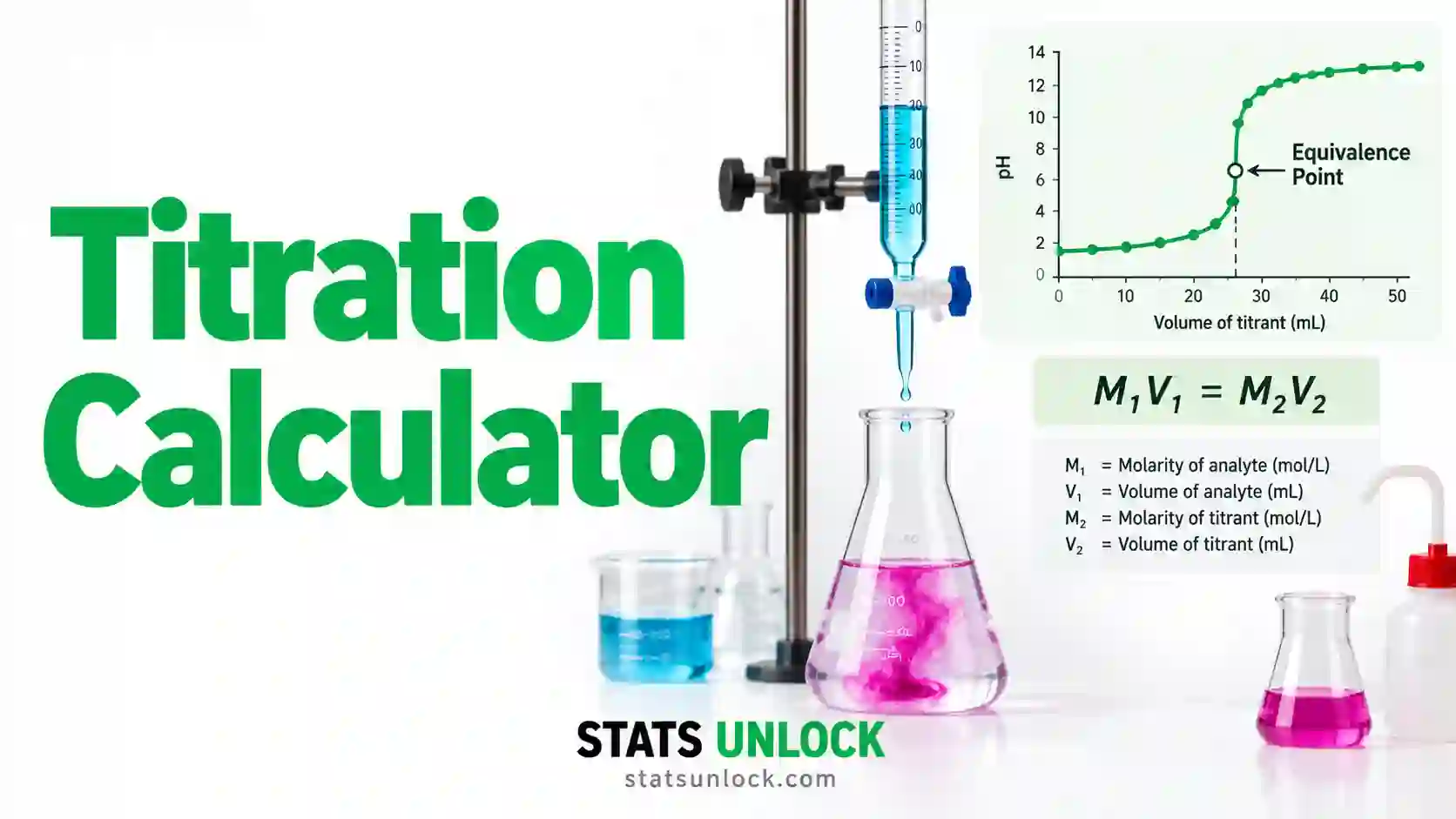

Titration Calculator
Calculate concentration from titration data with concordant titres and uncertainty, standardize a titrant, predict the endpoint, plot the full pH titration curve for strong, weak and polyprotic acids and bases with equivalence points and indicators, find the molar mass of an unknown acid, and solve back titrations, double titrations and titratable acidity, with every step, a figure and four charts.
By StatsUnlock Team · Exact charge-balance pH model and GUM uncertainty, checked against published titration theory and analytical chemistry · Last updated:
⚡ 0. Quick Answer
A titration calculator uses moles = concentration × volume and the mole ratio from the balanced equation: c(analyte) = c(titrant) × V(titrant) × a/b ÷ V(analyte). For 25.00 mL of HCl needing a mean concordant titre of 24.55 mL of 0.1000 M NaOH: 0.1000 × 24.55 ÷ 25.00 = 0.09820 mol/L HCl (± 0.00042, k = 2).
Rule of thumb: ignore the rough titre, average only concordant titres (within 0.10 mL), convert mL to L, and use the mole ratio: H2SO4 needs twice as much NaOH as HCl.
⭐ Key Takeaways
- A titration calculator turns titres of 24.80 (rough), 24.55, 24.60 and 24.50 mL into a mean of 24.55 mL and 0.09820 M HCl.
- For H2SO4 + 2NaOH, divide the moles of NaOH by 2: the ratio changes the answer by a factor of two.
- 0.1 M acetic acid with 0.1 M NaOH starts at pH 2.88, passes pH 4.76 (= pKa) at half-equivalence and reaches pH 8.73 at equivalence: use phenolphthalein.
- 0.1500 g of a diprotic acid needing 25.40 mL of 0.1000 M NaOH has a molar mass of 118.1 g/mol.
- Titratable acidity: 15.60 mL of 0.1 N NaOH for 10 mL of juice is 1.00% citric acid.
📚 1. What Is a Titration and How Do You Calculate It?
A titration measures an unknown amount of a substance (the analyte) by adding a solution of known concentration (the titrant) from a burette until the reaction is just complete: the equivalence point, seen as the endpoint by an indicator color change or a pH jump. Because moles = concentration × volume and the balanced equation fixes the mole ratio, one volume reading gives the unknown concentration. Students often find the mole ratio and the meaning of the equivalence point the hardest parts (Sheppard, 2006). A titration calculator handles the arithmetic, the concordant titres, the uncertainty and, for acid–base titrations, the full pH curve from an exact charge balance (de Levie, 1999).
A worked one-liner: n(NaOH) = 0.1000 × 24.55 ÷ 1000 = 2.455 × 10⁻³ mol = n(HCl); c(HCl) = 2.455 × 10⁻³ ÷ 0.02500 = 0.09820 mol/L.
Who uses it: GCSE, A level, IB and AP chemistry students writing up titration practicals; university analytical chemistry labs; quality control in food, pharmaceutical and water labs; and anyone checking an acid–base titration lab report, choosing an indicator or predicting the endpoint before running a titration.
Quick answers to the questions people ask most
How do you calculate concentration from titration?
Find the moles of titrant (concentration × titre in liters), use the balanced equation’s mole ratio to get moles of analyte, then divide by the analyte volume in liters. With 24.55 mL of 0.1000 M NaOH for 25.00 mL of HCl, n = 0.002455 mol and c(HCl) = 0.09820 mol/L.
How do you calculate the average titre?
Leave out the rough (first) titration, then average only concordant titres: those within 0.10 mL of each other. From 24.80 (rough), 24.55, 24.60 and 24.50 mL, the concordant titres are 24.50, 24.55 and 24.60, so the mean titre is 24.55 mL. Never average a titre that disagrees.
How do you calculate the equivalence point of a titration?
The equivalence point volume is the moles of analyte times the mole ratio, divided by the titrant concentration. For 25.0 mL of 0.0800 M HCl and 0.100 M NaOH, V = 0.00200 mol ÷ 0.100 M = 20.0 mL. Calculating it before titrating tells you where to slow down.
How do you calculate pH during a titration?
Before equivalence, a weak acid forms a buffer; at half-equivalence pH equals pKa. At equivalence, the pH depends on the salt formed. After equivalence, excess titrant sets the pH. This calculator solves the full charge balance at every volume, so one method covers all regions exactly.
How do you calculate molar mass from titration?
Moles of acid equal moles of NaOH divided by the number of acidic protons. Divide the mass of acid by those moles. For 0.1500 g of a diprotic acid neutralized by 25.40 mL of 0.1000 M NaOH, moles of acid = 0.001270 and the molar mass is 118.1 g/mol.
How do you calculate concentration of H2SO4 in titration?
Use the 1 : 2 ratio from H2SO4 + 2NaOH → Na2SO4 + 2H2O. Moles of acid are half the moles of NaOH. A mean titre of 22.13 mL of 0.100 M NaOH for 25.0 mL of acid gives 0.002213 mol NaOH, 0.001106 mol H2SO4 and 0.0443 mol/L.
| Titration | Balanced equation | Analyte : titrant | Indicator |
|---|---|---|---|
| HCl with NaOH | HCl + NaOH → NaCl + H2O | 1 : 1 | phenolphthalein or methyl orange |
| H2SO4 with NaOH | H2SO4 + 2NaOH → Na2SO4 + 2H2O | 1 : 2 | phenolphthalein |
| Acetic acid with NaOH | CH3COOH + NaOH → CH3COONa + H2O | 1 : 1 | phenolphthalein |
| NH3 with HCl | NH3 + HCl → NH4Cl | 1 : 1 | methyl red |
| Na2CO3 with HCl | Na2CO3 + 2HCl → 2NaCl + H2O + CO2 | 1 : 2 | methyl orange |
| Fe2+ with KMnO4 | MnO4− + 5Fe2+ + 8H+ → Mn2+ + 5Fe3+ + 4H2O | 5 : 1 | self-indicating |
🧮 2. Enter Your Titration Data
Optional: molar mass, equivalents and uncertainty
Mole ratio from the balanced equation: for H₂SO₄ + 2NaOH enter a = 1 (acid), b = 2 (NaOH).
25 °C, Kw = 1.0 × 10⁻¹⁴; typical literature pKa values; activity effects ignored.
Example: CaCO₃ + 2HCl, excess HCl back-titrated with NaOH: reagent per NaOH = 1, analyte per HCl = 0.5.
One titration per line: titrant mol/L, titre mL, aliquot mL, optional analyte : titrant ratio (0.5 for H₂SO₄ with NaOH) and an optional label. A header row is skipped.
📊 3. Results and Step-by-Step Working
Working (Given, Required, Equation, Substitute, Solve)
Uncertainty budget
Step by step
Full results table
Your titration, drawn from the numbers
Charts
Four plots that change with the mode: titres, the pH curve and its derivative, moles and the sensitivity of the result.
1.
2.
3.
4.
🧠 4. Understanding Your Titration Result, In Detail
4.1 What the result means
___
4.2 The formula
___
4.3 The detail that changes the answer
___
4.4 Accuracy and uncertainty
___
4.5 What to do next
___
4.6 Endpoint versus equivalence point
The equivalence point is where the moles of titrant exactly match the analyte according to the equation; the endpoint is where you see the change. A well-chosen indicator changes color on the steep part of the curve, so the two differ by less than a drop. For weak endpoints, a pH meter and a first-derivative or Gran plot locate the equivalence point more precisely (Gran, 1952; Rossotti & Rossotti, 1965).
4.7 Why exact pH curves
Textbook pH calculations split the curve into regions (strong acid, buffer, salt, excess base) with a different approximation for each. Solving the full charge balance at every volume gives one exact expression that works for strong, weak and polyprotic systems and mixtures (de Levie, 1993; Asuero & Michałowski, 2011). It also shows when an equivalence point is too flat to detect, as for the third proton of phosphoric acid.
4.8 Choosing the titrant
Titrating a weak base with a weak acid gives no sharp endpoint, so one partner is always strong. The choice of titrant and receiver solution still matters in methods such as Kjeldahl nitrogen, where the theory of the titration curve guides it (Michałowski et al., 2013).
✍ 5. How to Write Titration Results in a Lab Report: Detailed Results
A titration result in a report needs the concentration with units, the mean concordant titre and how many titres it came from, the titrant concentration, the indicator or endpoint method, and the uncertainty. The seven write-ups below are filled from the titration calculator; they show the headline example until you press Calculate.
Showing the headline example (HCl with 0.1000 M NaOH). Press Calculate above to fill all seven write-ups with your own result.
5.1 Style rules
| Rule | Write | Avoid |
|---|---|---|
| Record burette readings to 0.05 mL | 24.55 mL | 24.5 mL, 24.553 mL |
| State which titres were averaged | mean of 3 concordant titres | average titre |
| Give units and concentration basis | 0.09820 mol/L (mol dm⁻³) | 0.0982 |
| Show the mole ratio | 1 : 2 (H₂SO₄ : NaOH) | no equation |
| Significant figures follow the data | 4 s.f. from 4 s.f. volumes | 0.098200000 |
| Name the endpoint method | phenolphthalein, colorless to faint pink | “the endpoint” |
5.2 Seven ready-to-copy write-ups
∑ 6. What Is the Acid–Base Titration Calculation Formula? All Formulas Used
🔀 7. How Do You Calculate a Titration? Flowchart, Step by Step
The same worked problem as Sections 0, 9, 10, 11 and 14: 25.00 mL HCl, 0.1000 M NaOH, titres 24.80 (rough), 24.55, 24.60, 24.50 mL.
📝 8. How to Use This Titration Calculator
- Pick what you want to calculate. Choose a mode in Section 2: concentration, pH titration curve, molar mass of an unknown acid, back titration, double titration or titratable acidity.
- Load a sample or type your data. Twelve worked problems are in the sample menu. Sample 1 is the headline HCl and NaOH titration. Nothing is calculated until you press Calculate Titration.
- Say what you are solving for. In the concentration mode, find the analyte concentration, standardize the titrant, or predict the endpoint volume before titrating.
- Enter the mole ratio. Type the coefficients of the analyte (a) and titrant (b) from the balanced equation: 1 and 2 for H2SO4 with NaOH, 5 and 1 for Fe2+ with KMnO4.
- Enter all titres in order. List every titre separated by commas. Choose whether the first is a rough run; the calculator keeps the largest concordant set within 0.10 mL.
- Add tolerances for the uncertainty. Optional: burette, pipette and titrant tolerances give an expanded uncertainty and a budget showing the biggest source.
- Press Calculate Titration. Press the button or Enter. The concentration, moles, a Verified badge, the formula and every step appear in Section 3.
- Read the curve and charts. The figure draws the burette or the pH curve; four charts show the titres, the derivative, moles and sensitivity.
- Copy the write-up. Section 5 fills seven ready texts for a lab report, a log, code, an exam answer, chat, a results paragraph and a table.
- Download or run a batch. Download Doc or PDF, or calculate many titrations at once from a CSV of titrant molarity, titre, aliquot and ratio in the Batch tab.
📈 9. How to Do Titration Calculations in Excel
A titration sheet needs one formula for the mean titre and one for the concentration. The sheet repeats the headline problem, so the numbers match Sections 0, 7, 10, 11 and 14.
=A2*AVERAGE(C2:E2)/B2. It returns 0.0982.9.1 The formulas you need
| You want | Excel formula | Note |
|---|---|---|
| Mean titre | =AVERAGE(C2:E2) | Concordant titres only |
| Concordance check | =MAX(C2:E2)-MIN(C2:E2)<=0.1 | TRUE if concordant |
| Moles of titrant | =A2*AVERAGE(C2:E2)/1000 | mol |
| Analyte concentration | =A2*AVERAGE(C2:E2)*a/b/B2 | replace a/b |
| Expected endpoint | =G2*B2*b/a/A2 | G2 = estimated analyte M |
| Molar mass of acid | =H2/(A2*I2/1000/J2) | mass, titre, protons |
| Back titration moles | =(K2*L2-M2*N2)/1000 | reagent minus excess |
| Titratable acidity | =O2*P2*0.06404/Q2*100 | citric acid |
| Relative uncertainty | =SQRT((0.05/SQRT(3)/F2)^2+(0.03/SQRT(3)/B2)^2) | add more terms |
9.2 Step by step
1 Enter the data
NaOH molarity in A2, HCl aliquot in B2.
A2 0.1000, B2 25.00.
2 Enter the concordant titres
Rough titre left out: C2 to E2.
C2 to E2 24.55, 24.60, 24.50.
3 Concentration
In F2 type =A2*AVERAGE(C2:E2)/B2.
F2 shows 0.09820 mol/L.
9.3 Many groups or samples
Put one titration per row and fill the formula down. Add a column with the concordance check so non-concordant rows stand out.
9.4 Why Excel may differ from R or Python
| Situation | What happens | Fix |
|---|---|---|
| Rounded mean titre | Rounding 24.55 before multiplying changes the last digit | Round only the final concentration |
| STDEV vs STDEV.P | Repeatability needs the sample SD | Use STDEV.S |
| pH curves | Excel has no root finder in a cell | Use Goal Seek or the calculator |
9.5 Charting a pH curve
Enter volume and measured pH in two columns and insert a Scatter chart with smooth lines. Add a column of ΔpH/ΔV to plot the first derivative; its peak marks the equivalence point.
9.6 Errors you may see
#DIV/0!: aliquot cell empty.- An answer 1000 times too large: mL divided by L, or vice versa.
- A result double or half the expected: mole ratio missing.
📈 10. How to Do Titration Calculations in R
A complete, copy-and-run script that reproduces the titration calculator for the headline problem. It excludes the rough titre, averages concordant titres, calculates the HCl concentration with its expanded uncertainty, solves the exact pH curve for acetic acid with NaOH, finds the molar mass of an unknown acid and saves one 300 dpi figure.
10.1 The complete script
R, base only, saves titration_curve.png
# Titration calculator in base R (StatsUnlock)
concordant <- function(v, rough = TRUE, tol = 0.10) {
  if (rough) v <- v[-1]                           # drop the rough (first) titre
  s <- sort(v); best <- s[1]
  for (i in seq_along(s)) for (j in i:length(s))
    if (s[j] - s[i] <= tol + 1e-9 && (j - i + 1) > length(best)) best <- s[i:j]
  best
}
titres <- c(24.80, 24.55, 24.60, 24.50)            # mL; first is the rough run
used <- concordant(titres); vt <- mean(used)
ct <- 0.1000; va <- 25.00; ratio <- 1             # NaOH M, HCl aliquot mL, a/b
ca <- ct * vt / 1000 * ratio / (va / 1000)
cat(sprintf("concordant: %s; mean %.2f mL; c(HCl) = %.5f mol/L\n", paste(used, collapse = ", "), vt, ca))
# uncertainty: burette 0.05, repeatability, pipette 0.03, NaOH 0.0002 (rectangular)
urel <- sqrt((0.05 / sqrt(3) / vt)^2 + (sd(used) / sqrt(length(used)) / vt)^2 +
             (0.03 / sqrt(3) / va)^2 + (0.0002 / sqrt(3) / ct)^2)
cat(sprintf("U (k = 2) = %.5f mol/L\n", 2 * urel * ca))
# exact pH: 25 mL 0.1 M acetic acid (pKa 4.76) with 0.1 M NaOH
ph_at <- function(v, va = 25, ca = 0.1, cb = 0.1, Ka = 10^-4.76, Kw = 1e-14) {
  V <- va + v; CA <- ca * va / V; Na <- cb * v / V
  f <- function(lh) { h <- 10^lh; h + Na - Kw / h - CA * Ka / (Ka + h) }
  -uniroot(f, c(-16, 2), tol = 1e-12)$root
}
cat(sprintf("pH: start %.2f, half-equivalence %.2f, equivalence %.2f\n", ph_at(0), ph_at(12.5), ph_at(25)))
# molar mass: 0.1500 g diprotic acid, 25.40 mL of 0.1000 M NaOH
cat(sprintf("molar mass = %.1f g/mol\n", 0.1500 / (0.1000 * 25.40 / 1000 / 2)))
png("titration_curve.png", width = 7, height = 4, units = "in", res = 300)
v <- seq(0, 40, 0.2)
plot(v, sapply(v, ph_at), type = "l", lwd = 2, xlab = "NaOH added, mL", ylab = "pH", ylim = c(0, 14))
abline(v = 25, lty = 2); points(25, ph_at(25), pch = 19)
invisible(dev.off())
10.2 Output
concordant: 24.5, 24.55, 24.6; mean 24.55 mL; c(HCl) = 0.09820 mol/L
U (k = 2) = 0.00042 mol/L
pH: start 2.88, half-equivalence 4.76, equivalence 8.73
molar mass = 118.1 g/mol
10.3 Traps
- sd() is the sample SD, which is right for repeatability.
- uniroot() needs a bracket where the charge balance changes sign; −16 to 2 in log[H⁺] covers pH −2 to 16.
- Keep volumes in mL in the formula but divide by 1000 for moles.
10.4 What each part does
| Block | Purpose |
|---|---|
| concordant() | Drops the rough titre and keeps the largest set within 0.10 mL |
| Concentration and U | c = c(t) V(t) × a/b ÷ V(a); relative uncertainties combined in quadrature |
| ph_at() | Charge balance solved for [H⁺] by root finding at each volume |
| Middle blocks | GUM uncertainty and the exact pH at start, half-equivalence and equivalence |
| Last block | Titration curve of acetic acid with NaOH with the equivalence point marked, saved at 300 dpi |
10.5 Adapting it
Change the titres, concentrations and pKa for your titration; ph_at() works for any monoprotic acid and can be extended to polyprotic systems.
📈 11. How to Do Titration Calculations in Python
A complete, copy-and-run script that reproduces the titration calculator for the headline problem. It excludes the rough titre, averages concordant titres, calculates the HCl concentration with its expanded uncertainty, solves the exact pH curve for acetic acid with NaOH, finds the molar mass of an unknown acid and saves one 300 dpi figure.
Install once: pip install numpy scipy matplotlib
11.1 The complete script
Python with NumPy, SciPy and Matplotlib, saves titration_curve.png
# Titration calculator in Python (StatsUnlock)
import numpy as np
from scipy.optimize import brentq
import matplotlib.pyplot as plt

def concordant(v, rough=True, tol=0.10):
    """Drop the rough titre, return the largest set of titres within tol mL."""
    v = sorted(v[1:] if rough else v); best = v[:1]
    for i in range(len(v)):
        for j in range(i, len(v)):
            if v[j] - v[i] <= tol + 1e-9 and j - i + 1 > len(best):
                best = v[i:j + 1]
    return best

used = concordant([24.80, 24.55, 24.60, 24.50])      # mL, first is rough
vt = np.mean(used); ct, va, ratio = 0.1000, 25.00, 1.0
ca = ct * vt / 1000 * ratio / (va / 1000)
print(f"concordant {used}; mean {vt:.2f} mL; c(HCl) = {ca:.5f} mol/L")

urel = np.sqrt((0.05 / np.sqrt(3) / vt) ** 2 + (np.std(used, ddof=1) / np.sqrt(len(used)) / vt) ** 2
               + (0.03 / np.sqrt(3) / va) ** 2 + (0.0002 / np.sqrt(3) / ct) ** 2)
print(f"U (k = 2) = {2 * urel * ca:.5f} mol/L")

def ph_at(v, va=25, ca=0.1, cb=0.1, Ka=10 ** -4.76, Kw=1e-14):
    """Exact pH of a weak acid titrated with NaOH (charge balance)."""
    V = va + v; CA = ca * va / V; Na = cb * v / V
    f = lambda lh: 10 ** lh + Na - Kw / 10 ** lh - CA * Ka / (Ka + 10 ** lh)
    return -brentq(f, -16, 2, xtol=1e-12)

print(f"pH: start {ph_at(0):.2f}, half-equivalence {ph_at(12.5):.2f}, equivalence {ph_at(25):.2f}")
print(f"molar mass = {0.1500 / (0.1000 * 25.40 / 1000 / 2):.1f} g/mol")

v = np.linspace(0, 40, 201)
fig, ax = plt.subplots(figsize=(7, 4))
ax.plot(v, [ph_at(x) for x in v], lw=2); ax.axvline(25, ls="--"); ax.plot(25, ph_at(25), "o")
ax.set_xlabel("NaOH added, mL"); ax.set_ylabel("pH"); ax.set_ylim(0, 14)
fig.tight_layout(); fig.savefig("titration_curve.png", dpi=300)
11.2 Output
concordant [24.5, 24.55, 24.6]; mean 24.55 mL; c(HCl) = 0.09820 mol/L
U (k = 2) = 0.00042 mol/L
pH: start 2.88, half-equivalence 4.76, equivalence 8.73
molar mass = 118.1 g/mol
11.3 Traps
- np.std needs ddof=1 for the sample SD.
- brentq() needs opposite signs at the two ends of the bracket.
- Solve in log[H⁺], not [H⁺], so the root finder covers 16 orders of magnitude.
11.4 What each part does
| Block | Purpose |
|---|---|
| concordant() | Drops the rough titre and keeps the largest set within 0.10 mL |
| Concentration and U | c = c(t) V(t) × a/b ÷ V(a); relative uncertainties combined in quadrature |
| ph_at() | Charge balance solved for [H⁺] by root finding at each volume |
| Middle blocks | GUM uncertainty and the exact pH at start, half-equivalence and equivalence |
| Last block | Titration curve of acetic acid with NaOH with the equivalence point marked, saved at 300 dpi |
11.5 Adapting it
Change the titres, concentrations and pKa for your titration; ph_at() works for any monoprotic acid and can be extended to polyprotic systems.
📋 12. Titration Reference Tables: Indicators, pKa, Glassware and Curves
12.1 Acid–base indicators
| Indicator | pH range | Color change | Use for |
|---|---|---|---|
| Methyl orange | 3.1 to 4.4 | red to yellow | strong acid with weak or strong base |
| Bromocresol green | 3.8 to 5.4 | yellow to blue | weak base with strong acid |
| Methyl red | 4.4 to 6.2 | red to yellow | weak base with strong acid (NH₃) |
| Bromothymol blue | 6.0 to 7.6 | yellow to blue | strong acid with strong base |
| Phenol red | 6.8 to 8.4 | yellow to red | strong acid with strong base |
| Phenolphthalein | 8.2 to 10.0 | colorless to pink | weak acid with strong base |
| Thymolphthalein | 9.3 to 10.5 | colorless to blue | very weak acid with strong base |
Transition ranges are approximate and vary slightly between sources. Last checked: October 2026.
12.2 pKa values used by the calculator (25 °C)
| Acid | pKa |
|---|---|
| Hydrochloric acid | strong |
| Sulfuric acid | strong, 1.99 |
| Acetic acid | 4.76 |
| Formic acid | 3.75 |
| Lactic acid | 3.86 |
| Benzoic acid | 4.20 |
| Phthalic acid (KHP) | 2.95, 5.41 |
| Oxalic acid | 1.25, 4.27 |
| Citric acid | 3.13, 4.76, 6.40 |
| Phosphoric acid | 2.15, 7.20, 12.35 |
| Carbonic acid | 6.35, 10.33 |
| Ammonium (NH₄⁺) | 9.25 (pKb of NH₃ 4.75) |
Typical literature values at 25 °C and low ionic strength; see Goldberg et al. (2002) for buffer acids. Enter your own values in custom mode. Last checked: October 2026.
12.3 Concentration from titre (0.1000 M titrant, 25.00 mL aliquot)
| Titre (mL) | 1 : 1 (HCl, mol/L) | 1 : 2 (H₂SO₄, mol/L) | 2 : 1 (analyte : titrant) |
|---|---|---|---|
| 10.00 | 0.04000 | 0.02000 | 0.08000 |
| 12.50 | 0.05000 | 0.02500 | 0.10000 |
| 15.00 | 0.06000 | 0.03000 | 0.12000 |
| 17.50 | 0.07000 | 0.03500 | 0.14000 |
| 20.00 | 0.08000 | 0.04000 | 0.16000 |
| 22.50 | 0.09000 | 0.04500 | 0.18000 |
| 24.00 | 0.09600 | 0.04800 | 0.19200 |
| 24.55 | 0.09820 | 0.04910 | 0.19640 |
| 25.00 | 0.10000 | 0.05000 | 0.20000 |
| 27.50 | 0.11000 | 0.05500 | 0.22000 |
| 30.00 | 0.12000 | 0.06000 | 0.24000 |
| 35.00 | 0.14000 | 0.07000 | 0.28000 |
| 40.00 | 0.16000 | 0.08000 | 0.32000 |
c = 0.1000 × titre × a/b ÷ 25.00. Exact. Last checked: October 2026.
12.4 Titratable acidity factors
| Acid | Molar mass (g/mol) | Acidic H | meq weight (g/mEq) | Typical use |
|---|---|---|---|---|
| Citric acid, anhydrous | 192.12 | 3 | 0.06404 | citrus juices |
| Citric acid monohydrate | 210.14 | 3 | 0.07005 | |
| Malic acid | 134.09 | 2 | 0.06704 | apples, stone fruit |
| Tartaric acid | 150.09 | 2 | 0.07504 | grapes, wine |
| Lactic acid | 90.08 | 1 | 0.09008 | milk, yogurt |
| Acetic acid | 60.05 | 1 | 0.06005 | vinegar |
| Oleic acid | 282.46 | 1 | 0.28246 | free fatty acids in oils |
meq weight = molar mass ÷ acidic protons ÷ 1000 (Tyl & Sadler, 2017). Last checked: October 2026.
12.5 Class A glassware tolerances
| Item | Volume | Tolerance (±) | Standard u (a/√3) |
|---|---|---|---|
| Burette | 50 mL | 0.05 mL | 0.029 mL |
| Burette | 25 mL | 0.03 mL | 0.017 mL |
| Volumetric pipette | 10 mL | 0.02 mL | 0.012 mL |
| Volumetric pipette | 20 mL | 0.03 mL | 0.017 mL |
| Volumetric pipette | 25 mL | 0.03 mL | 0.017 mL |
| Volumetric pipette | 50 mL | 0.05 mL | 0.029 mL |
Typical Class A tolerances for burettes (ISO 385) and one-mark pipettes (ISO 648); check the marking on your glassware. Last checked: October 2026.
12.6 pH during the titration of 25 mL of 0.1 M acetic acid with 0.1 M NaOH
| NaOH added (mL) | pH (exact) | Point |
|---|---|---|
| 0 | 2.88 | start |
| 5 | 4.16 | |
| 12.5 | 4.76 | half-equivalence |
| 20 | 5.36 | |
| 24 | 6.14 | |
| 24.9 | 7.16 | |
| 25 | 8.73 | equivalence |
| 25.1 | 10.30 | |
| 26 | 11.29 | |
| 30 | 11.96 | |
| 40 | 12.36 |
Exact charge balance, pKa 4.76, Kw 1.0 × 10⁻¹⁴; the jump from 24.9 to 25.1 mL is about 3 pH units. Last checked: October 2026.
📈 13. Titration Calculation Examples: Questions and Answers
Eight worked problems that cover what a titration calculator meets: a carbonate standardization, vinegar, a redox titration, two pH curves, an unknown acid, an antacid back titration and the classic mistake. Each number was checked in Python.
Standardize HCl with sodium carbonate
Na₂CO₃ + 2HCl.
25.0 mL of 0.0500 M Na₂CO₃ needs a mean titre of 23.80 mL of HCl (methyl orange).
| Quantity | Value | Note |
|---|---|---|
| Moles of Na₂CO₃ | 1.250 × 10⁻³ mol | 0.0500 × 0.0250 |
| Moles of HCl | 2.500 × 10⁻³ mol | × 2 |
| c(HCl) | 0.1050 mol/L | ÷ 0.02380 L |
What it means: Without the ratio the answer would be half.
How to write it: "c(HCl) = 0.1050 mol/L."
Acetic acid in vinegar
Dilute, then titrate.
Vinegar is diluted 10.00 mL to 100.0 mL; a 25.00 mL aliquot needs 18.75 mL of 0.1000 M NaOH.
| Quantity | Value | Note |
|---|---|---|
| Diluted solution | 0.07500 mol/L | 0.1000 × 18.75 ÷ 25.00 |
| Original vinegar | 0.7500 mol/L | × 100.0/10.00 |
| Acetic acid | 45.0 g/L = 4.50% w/v | × 60.05 g/mol |
What it means: Table vinegar is usually about 4 to 8% acetic acid.
How to write it: "Vinegar contains 0.7500 M (4.50% w/v) acetic acid."
Iron(II) with permanganate
MnO₄⁻ + 5Fe²⁺.
25.00 mL of an Fe²⁺ solution needs 22.40 mL of 0.0200 M KMnO₄ in acid.
| Quantity | Value | Note |
|---|---|---|
| Moles of MnO₄⁻ | 4.480 × 10⁻⁴ mol | |
| Moles of Fe²⁺ | 2.240 × 10⁻³ mol | × 5 |
| c(Fe²⁺) | 0.0896 mol/L | ÷ 0.02500 L |
What it means: Permanganate is its own indicator: first permanent pink.
How to write it: "c(Fe²⁺) = 0.0896 mol/L."
Acetic acid with NaOH
Weak acid, strong base.
25 mL of 0.1 M acetic acid is titrated with 0.1 M NaOH.
| Quantity | Value | Note |
|---|---|---|
| Initial pH | 2.88 | weak acid |
| Half-equivalence | 4.76 | ≈ pKa |
| Equivalence | 8.73 at 25.0 mL | acetate is basic |
What it means: Methyl orange would change far too early.
How to write it: "Equivalence at 25.0 mL, pH 8.73."
Ammonia with HCl
Equivalence below 7.
25 mL of 0.1 M NH₃ is titrated with 0.1 M HCl.
| Quantity | Value | Note |
|---|---|---|
| Initial pH | 11.12 | |
| Half-equivalence | 9.25 | = pKa of NH₄⁺ |
| Equivalence | 5.28 | NH₄⁺ is acidic |
What it means: Choose methyl red (4.4 to 6.2).
How to write it: "Equivalence at 25.0 mL, pH 5.28."
Identify a diprotic acid
Molar mass from titration.
0.1500 g of a diprotic acid needs 25.40 mL of 0.1000 M NaOH.
| Quantity | Value | Note |
|---|---|---|
| Moles of acid | 1.270 × 10⁻³ mol | 2.540 ÷ 2 |
| Molar mass | 118.1 g/mol | 0.1500 ÷ 0.001270 |
| Candidate | succinic acid, 118.09 | 0.02% error |
What it means: Count the equivalence points on a pH curve first.
How to write it: "Molar mass 118.1 g/mol (succinic acid)."
Calcium carbonate in an antacid
Excess HCl, back with NaOH.
A 1.600 g tablet reacts with 50.00 mL of 1.000 M HCl; the excess needs 40.00 mL of 0.5000 M NaOH.
| Quantity | Value | Note |
|---|---|---|
| HCl reacted | 30.00 mmol | 50.00 − 20.00 |
| CaCO₃ | 1.501 g | 15.00 mmol × 100.09 |
| Purity | 93.8% | ÷ 1.600 g |
What it means: Acid-neutralizing capacity: 30.0 mEq per tablet.
How to write it: "The tablet contains 1.501 g CaCO₃ (93.8%)."
Including the rough titre
Average concordant titres only.
A student averages all four titres, 24.80, 24.55, 24.60 and 24.50 mL.
| Quantity | Value | Note |
|---|---|---|
| Wrong | 0.09845 mol/L | rough included |
| Right | 0.09820 mol/L | concordant only |
| Error | +0.25% | bias, not random |
What it means: Exam mark schemes reject averages that include the rough titre.
How to write it: "c(HCl) = 0.09820 mol/L (mean of 3 concordant titres)."
✏️ 14. How Do You Calculate a Titration by Hand? Steps and Lab Procedure
The written method, calculator keys and the titration procedure, for the headline problem: 25.00 mL HCl, 0.1000 M NaOH, titres 24.80 (rough), 24.55, 24.60, 24.50 mL.
14.1 The written method
- Equation. HCl + NaOH → NaCl + H2O (1 : 1).
- Mean titre. Exclude 24.80; (24.55 + 24.60 + 24.50) ÷ 3 = 24.55 mL.
- Moles of NaOH. 0.1000 × 0.02455 = 2.455 × 10⁻³ mol.
- Moles of HCl. 2.455 × 10⁻³ mol (1 : 1).
- Concentration. 2.455 × 10⁻³ ÷ 0.02500 = 0.09820 mol/L.
- Check. 0.09820 × 25.00 = 0.1000 × 24.55 ✓
14.2 On a calculator
| Step | Keys | Display |
|---|---|---|
| Mean titre | (24.55+24.60+24.50)÷3= | 24.55 |
| Concentration | 0.1×Ans÷25= | 0.0982 |
| Mass concentration | Ans×36.46= | 3.580 |
14.3 Lab SOP: acid–base titration
Purpose
Determine the concentration of a hydrochloric acid solution by titration with standardized sodium hydroxide.
Equipment and reagents
50 mL Class A burette; 25 mL volumetric pipette and filler; 250 mL conical flasks; white tile; standardized 0.1000 M NaOH; phenolphthalein; distilled water.
Hazards and controls
NaOH and HCl are corrosive and irritant: wear safety goggles and gloves; never pipette by mouth; rinse spills with plenty of water.
Procedure
- Rinse the burette with NaOH, fill it, remove air from the tip and record the initial reading to 0.05 mL.
- Pipette 25.00 mL of HCl into a conical flask; add 2 to 3 drops of phenolphthalein.
- Run a rough titration to find the approximate endpoint.
- Repeat accurately, adding dropwise within 1 mL of the endpoint and swirling, until the first permanent faint pink.
- Repeat until at least two titres agree within 0.10 mL.
- c(HCl) = 0.1000 × mean titre ÷ 25.00.
Record sheet
| Run | Final (mL) | Initial (mL) | Titre (mL) |
|---|---|---|---|
| Rough | 24.80 | 0.00 | 24.80 |
| 1 | 25.10 | 0.55 | 24.55 ✓ |
| 2 | 24.70 | 0.10 | 24.60 ✓ |
| 3 | 24.85 | 0.35 | 24.50 ✓ |
Acceptance criteria
At least two titres within 0.10 mL; endpoint color stable for about 30 s. These are teaching-lab criteria; follow your course or laboratory method where they differ.
Sources of error and their direction
- Overshooting the endpoint: titre high, result high.
- Air bubble in the burette tip: titre high.
- Burette not rinsed with titrant: titrant diluted, titre high.
- Pipette not rinsed with analyte: analyte diluted, titre low.
- Parallax: either way.
14.4 Practice problems
1. 20.00 mL of NaOH needs 18.40 mL of 0.1050 M HCl. c(NaOH)?
0.0966 mol/L
2. 25.0 mL H2SO4 needs 20.0 mL of 0.150 M NaOH. c(H2SO4)?
0.0600 mol/L
3. Titres 23.10 (rough), 22.65, 22.95, 22.70 mL. Mean titre?
22.68 mL (22.65 and 22.70)
4. Expected titre: 25.0 mL of 0.120 M HCl with 0.100 M NaOH?
30.0 mL
5. pH of 0.050 M HCl?
1.30
6. pH at half-equivalence for formic acid?
about 3.75
7. 0.2042 g KHP needs 20.00 mL NaOH. c(NaOH)?
0.05000 mol/L
8. 0.250 g monoprotic acid needs 20.5 mL of 0.100 M NaOH. Molar mass?
122 g/mol
9. Double titration: V1 12.0, V2 12.0 mL of 0.1 M HCl, 25 mL sample. Composition?
0.048 M Na2CO3 only
10. 12.0 mL of 0.1 N NaOH for 10 mL milk. Lactic acid %?
1.08%
14.5 Mistakes that lose marks
- Averaging the rough titre.
- Forgetting to convert mL to L.
- Ignoring the mole ratio.
- Recording burette readings to 0.1 mL instead of 0.05 mL.
- Too many significant figures.
- Wrong indicator for a weak acid or base.
14.6 Check-yourself and lab questions
Check: Why exclude the rough titre?
It is run fast to locate the endpoint and usually overshoots.
Check: Why is pH at equivalence above 7 for acetic acid?
The acetate ion is a weak base.
Check: What is the pH at half-equivalence for a weak acid?
pH = pKa.
Check: Why does H2SO4 need twice as much NaOH?
It has two acidic protons.
Lab: Why rinse the burette with titrant?
Water left inside would dilute the titrant.
Lab: Why not rinse the conical flask with analyte?
It would add extra analyte; water is fine because moles do not change.
Lab: Why read the bottom of the meniscus at eye level?
To avoid parallax error.
Lab: Why swirl constantly near the endpoint?
So the titrant mixes before the next drop.
✅ 15. Which Titration Method Should You Use?
| Situation | Method | Calculator mode | Example |
|---|---|---|---|
| Unknown acid or base concentration | Direct titration | Concentration | 0.09820 M HCl |
| Titrant concentration not certain | Standardize against KHP | Concentration (titrant) | 0.1003 M NaOH |
| Choosing an indicator or reading pKa | pH curve | pH titration curve | acetic acid, pH 8.73 |
| Identifying an unknown acid | Molar mass | Molar mass | 118.1 g/mol |
| Insoluble or slow sample | Back titration | Back titration | CaCO₃ in antacid |
| Mixture of alkalis | Two indicators | Double titration | NaOH + Na₂CO₃ |
| Food and beverage acid | Titratable acidity | Titratable acidity | 1.00% citric |
- The pH jump at equivalence is steep (2 or more pH units).
- An indicator’s range sits inside the jump.
- The solution is not strongly colored.
- The acid or base is weak and dilute.
- Two equivalence points are close together.
- The sample is colored or turbid (wine, juice; Boulton, 1980).
🔧 16. Common Titration Calculation Mistakes
Almost every wrong titration answer comes from volumes, ratios or the endpoint. The titration calculator guards against each one below.
| Symptom | Cause | Fix |
|---|---|---|
| Answer 1000 times too big | Used mL instead of L | Divide mL by 1000 |
| H₂SO₄ concentration doubled | Ignored the 1 : 2 ratio | n(acid) = n(NaOH) ÷ 2 |
| Mean titre too high | Rough titre included | Exclude it; average concordant titres |
| Titres scattered by 0.5 mL | Overshooting, air bubble, parallax | Add dropwise near the end; read at eye level |
| Pink color fades | CO₂ absorbed by NaOH | Take the first permanent pink (about 30 s) |
| Wrong indicator | Range outside the pH jump | Use the pH curve mode to choose |
| Molar mass half the expected | Diprotic acid treated as monoprotic | Set the number of acidic protons |
| Back titration gives negative analyte | Not enough excess reagent | Add more reagent; repeat |
| Double titration nonsense | V2 entered as total, not extra | V2 is the volume after the first endpoint |
| Titratable acidity differs by acid | Different meq weights | Report which acid it is expressed as |
⚠️ 17. Assumptions and Limitations
| Assumption | How to check | If it fails |
|---|---|---|
| Reaction is complete and fast | Sharp, stable endpoint | Back titrate, or heat |
| Mole ratio from the equation | Balanced equation | Rebalance; check the product formed at the endpoint |
| Endpoint equals equivalence point | Indicator range in the jump | Use a pH meter and derivative |
| Concentrations are not activities | Below about 0.1 mol/L | pH curves shift slightly at high ionic strength |
| 25 °C and Kw = 1.0 × 10⁻¹⁴ | Room temperature | Equivalence pH changes with temperature |
| Typical pKa values | Literature (Goldberg et al., 2002) | Enter your own pKa |
| Tolerances are rectangular | Class A glassware specifications | Use measured repeatability |
Ionic equilibria at higher concentrations, activity corrections and mixed solvents are covered in specialist texts (Burgot, 2012).
🎯 18. Conclusion
Your result
The titration calculator gives 0.09820 mol/L from a mean titre of 24.55 mL.
What the titration calculator does
Every titration rests on moles = concentration × volume and a mole ratio. This titration calculator applies that with concordant titres and uncertainty, standardizes titrants, predicts endpoints, draws exact pH curves with equivalence points and indicators, and handles molar mass, back titration, double titration and titratable acidity, with every step shown.
Watch out for
- Exclude the rough titre.
- Convert mL to L.
- Use the mole ratio.
- Match the indicator to the pH jump.
- State which acid titratable acidity is expressed as.
Next steps
To make up titrant and standard solutions, use the molarity calculator and the dilution calculator; for EDTA titrations of calcium and magnesium, the water hardness calculator. Whatever the reaction, start and finish with the titration calculator.
❓ 19. Frequently Asked Questions
Q1. How do you calculate concentration from titration?
Multiply the titrant concentration by the mean titre in liters to get moles of titrant. Use the mole ratio from the balanced equation to convert to moles of analyte, then divide by the analyte volume in liters. With 24.55 mL of 0.1000 M NaOH and a 25.00 mL HCl aliquot, c(HCl) = 0.09820 mol/L.
Q2. How do you calculate molarity from titration data?
Molarity of the unknown = (molarity of titrant × titre × a/b) ÷ volume of unknown, where a/b is the analyte-to-titrant mole ratio. Use the same volume units top and bottom, or convert both to liters. For a 1 : 1 reaction the formula reduces to c1V1 = c2V2, which is why many students remember it that way.
Q3. How do you calculate the average titre?
Discard the rough (first) titration, which only finds the approximate endpoint. Then average the titres that agree within 0.10 mL of each other. From 24.80, 24.55, 24.60 and 24.50 mL, the concordant titres are 24.50, 24.55 and 24.60, so the mean titre is 24.55 mL. A titre that does not agree is left out.
Q4. What does concordant titres mean?
Concordant titres are results that agree closely, usually within 0.10 mL, which is two drops from a burette. They show the endpoint was reproducible. Exam boards expect you to average only concordant titres. If none agree, repeat the titration rather than averaging scattered values, because the average would hide an error.
Q5. How do you calculate moles in a titration?
Moles = concentration in mol/L × volume in liters. For 24.55 mL of 0.1000 M NaOH, moles = 0.1000 × 0.02455 = 0.002455 mol. Then use the balanced equation to find moles of the other reactant: the same for HCl, half as many for H2SO4, and five times as many for Fe2+ reacting with permanganate.
Q6. How do you calculate the equivalence point of a titration?
The equivalence point volume equals the moles of analyte times the mole ratio, divided by the titrant concentration. For 25.0 mL of 0.0800 M HCl titrated with 0.100 M NaOH, moles of HCl = 0.00200, so the equivalence point is at 20.0 mL. The pH at that point depends on the acid and base involved.
Q7. How do you calculate the pH at the equivalence point?
At equivalence only the salt remains. For a strong acid with a strong base, pH = 7. For a weak acid with a strong base, the conjugate base hydrolyzes and pH is above 7: 0.1 M acetic acid with 0.1 M NaOH gives pH 8.73. For a weak base with a strong acid, pH is below 7: ammonia gives 5.28.
Q8. How do you calculate the initial pH of a titration?
For a strong acid, pH = −log c: 0.1 M HCl starts at pH 1.00. For a weak acid, solve Ka = x² ÷ (c − x), or use pH ≈ ½(pKa − log c) when the acid is weak and not too dilute: 0.1 M acetic acid starts at pH 2.88. The calculator solves the exact equation for any case.
Q9. How do you calculate pH during a titration?
Before equivalence for a weak acid, the solution is a buffer and pH = pKa + log([A⁻]/[HA]). At half-equivalence pH equals pKa. After equivalence, pH comes from the excess titrant. This calculator solves the full charge balance at every volume, so the same method is exact in every region, including polyprotic acids.
Q10. How do you calculate pH after the equivalence point?
After equivalence, excess strong titrant controls the pH. Find the excess moles, divide by the total volume, and convert. For 25 mL of 0.1 M HCl after adding 30 mL of 0.1 M NaOH, excess OH⁻ = 0.0005 mol in 55 mL = 0.00909 M, so pOH = 2.04 and pH = 11.96.
Q11. Which indicator should you use for a titration?
Choose an indicator whose color-change range lies on the steep part of the curve. Strong acid with strong base: phenolphthalein or methyl orange both work. Weak acid with strong base: phenolphthalein (8.2 to 10). Weak base with strong acid: methyl red (4.4 to 6.2) or methyl orange. Weak with weak: use a pH meter.
Q12. How do you calculate molar mass from titration?
Find the moles of base used, divide by the number of acidic protons to get moles of acid, then divide the mass of acid by those moles. For an aliquot, scale the moles by flask volume ÷ aliquot volume first. 0.1500 g of a diprotic acid needing 25.40 mL of 0.1000 M NaOH gives 118.1 g/mol.
Q13. How do you do titration calculations for sulfuric acid?
Write the equation: H2SO4 + 2NaOH → Na2SO4 + 2H2O. Moles of H2SO4 are half the moles of NaOH. With a mean titre of 22.13 mL of 0.100 M NaOH for 25.0 mL of acid, NaOH = 0.002213 mol, H2SO4 = 0.001106 mol, and the concentration is 0.0443 mol/L. Forgetting the ratio doubles the answer.
Q14. How do you calculate a back titration?
Add a known excess of reagent, let it react with the sample, then titrate the leftover reagent. Moles that reacted = moles added − moles left over. Convert with the mole ratio. With 50.00 mmol HCl added and 20.00 mmol left over, 30.00 mmol reacted, which is 15.00 mmol or 1.501 g of CaCO3.
Q15. How do you calculate a double titration?
Titrate with HCl to the phenolphthalein endpoint (V1), then add methyl orange and continue (V2 extra). If V1 is larger than V2, the mixture is NaOH and Na2CO3: carbonate = c × V2 and hydroxide = c × (V1 − V2). If V2 is larger, it is Na2CO3 and NaHCO3: carbonate = c × V1, bicarbonate = c × (V2 − V1).
Q16. How do you calculate titratable acidity?
Titratable acidity (%) = mL of NaOH × normality × milliequivalent weight of the acid ÷ sample mass or volume × 100. Use 0.06404 g/mEq for citric acid, 0.06704 for malic, 0.07504 for tartaric, 0.09008 for lactic and 0.06005 for acetic acid. 15.60 mL of 0.1000 N NaOH for 10.0 mL of juice is 1.00% citric acid.
Q17. How do you standardize NaOH with KHP?
Weigh potassium hydrogen phthalate, a primary standard with a molar mass of 204.22 g/mol, dissolve it and titrate with the NaOH to phenolphthalein. Moles of KHP = mass ÷ 204.22, which equal moles of NaOH. Divide by the titre in liters. 0.5105 g KHP needing 25.00 mL of NaOH gives 0.1000 mol/L.
Q18. How do you calculate the expected endpoint before a titration?
Estimate the analyte concentration, then calculate expected titre = analyte concentration × analyte volume × b/a ÷ titrant concentration. Knowing it lets you run quickly to about 1 mL before and then add dropwise. If the expected titre is over 50 mL, use a smaller aliquot or a more concentrated titrant so it fits a single burette fill.
Q19. What is the uncertainty of a titration result?
Combine the relative uncertainties of the titre, the pipette volume and the titrant concentration, plus the repeatability of the concordant titres. With a ±0.05 mL burette, ±0.03 mL pipette and ±0.0002 M titrant, the relative standard uncertainty for the headline example is about 0.21%, giving 0.09820 ± 0.00042 mol/L at about 95% confidence.
Q20. How do you do titration calculations in Excel?
Put titrant molarity in A2, the aliquot volume in B2 and the concordant titres in C2 to E2. The concentration is =A2*AVERAGE(C2:E2)/B2 for a 1 : 1 reaction; multiply by a/b for other ratios. For moles, use =A2*AVERAGE(C2:E2)/1000. Use =MAX(C2:E2)-MIN(C2:E2) to check that the titres are concordant, and fill the formulas down for more samples.
📑 20. Cite This Tool
StatsUnlock. (2026). Titration calculator [Interactive laboratory tool]. https://statsunlock.com/titration-calculator/@misc{statsunlock_titration_calculator_2026, title={Titration Calculator}, author={{StatsUnlock Team}}, year={2026}, note={Interactive laboratory tool}, url={https://statsunlock.com/titration-calculator/}}Concentrations were calculated from the mean of concordant titres and the reaction stoichiometry, with GUM uncertainty propagation, using the StatsUnlock Titration Calculator (2026).🔗 21. Related Tools
Make up titrant and standard solutions.
Dilute samples and stock titrants before titrating.
Indicator solutions and % w/v results.
Write moles such as 2.455 × 10⁻³ clearly.
Density of concentrated acids before dilution.
Titration temperature in °C and °F.
EDTA titration of calcium and magnesium.
Mass and velocity: a physics companion for lab classes.
More lab, chemistry and measurement tools from StatsUnlock, with worked steps, code and references.
📖 22. Glossary of Terms
| Term | Plain-English meaning |
|---|---|
| Aliquot | A measured portion of a solution, usually by pipette. |
| Analyte | The substance whose amount is being found. |
| Back titration | Titrating the excess of a reagent added to the sample. |
| Burette | Graduated tube that delivers the titrant, read to 0.05 mL. |
| Concordant titres | Titres that agree within about 0.10 mL. |
| Double titration | Two endpoints with two indicators to analyze a mixture. |
| End point | Where the indicator changes color. |
| Equivalence point | Where reactants have reacted in exact stoichiometric amounts. |
| Gran plot | Linear plot used to find the equivalence point from pH data. |
| Half-equivalence point | Half-way to equivalence; pH = pKa for a weak acid. |
| Indicator | Weak acid or base that changes color over a pH range. |
| KHP | Potassium hydrogen phthalate, a primary standard for bases. |
| Mole ratio | Ratio of moles from the balanced equation. |
| Normality | Equivalents per liter; molarity × equivalents per mole. |
| pKa | −log of the acid dissociation constant. |
| Primary standard | Pure, stable substance used to standardize a solution. |
| Rough titre | First fast titration to find the approximate endpoint. |
| Standardization | Finding a titrant’s exact concentration. |
| Titrant | Solution of known concentration in the burette. |
| Titratable acidity | Total acid neutralized by base, expressed as one acid. |
📚 23. References
Peer-reviewed sources behind this titration calculator: exact acid–base titration curves, Gran plots and equivalence-point uncertainty, pKa data, carbonate alkalinity, the Kjeldahl titration, EDTA titrations, titratable acidity of foods and wine, antacid back titration, student understanding of titrations, atomic weights and measurement uncertainty. Standards (JCGM 100:2008, ISO 385 and ISO 648 glassware classes) are named where they are used. Every DOI checked October 2026.
- Asuero, A. G., & Michałowski, T. (2011). Comprehensive formulation of titration curves for complex acid-base systems and its analytical implications. Critical Reviews in Analytical Chemistry, 41(2), 151–187. https://doi.org/10.1080/10408347.2011.559440
- Ayensu, I., Bekoe, S. O., Adu, J. K., Brobbey, A. A., & Appiah, E. (2020). Evaluation of acid neutralizing and buffering capacities of selected antacids in Ghana. Scientific African, 8, e00347. https://doi.org/10.1016/j.sciaf.2020.e00347
- Boulton, R. (1980). The relationships between total acidity, titratable acidity and pH in wine. American Journal of Enology and Viticulture, 31(1), 76–80. https://doi.org/10.5344/ajev.1980.31.1.76
- Burgot, J.-L. (2012). Ionic equilibria in analytical chemistry. Springer. https://doi.org/10.1007/978-1-4419-8382-4
- Cole, T. J. (2015). Too many digits: The presentation of numerical data. Archives of Disease in Childhood, 100(7), 608–609. https://doi.org/10.1136/archdischild-2014-307149
- de Levie, R. (1993). Explicit expressions of the general form of the titration curve in terms of concentration: Writing a single closed-form expression for the titration curve for a variety of titrations without using approximations or segmentation. Journal of Chemical Education, 70(3), 209. https://doi.org/10.1021/ed070p209
- de Levie, R. (1999). A general simulator for acid-base titrations. Journal of Chemical Education, 76(7), 987. https://doi.org/10.1021/ed076p987
- Goldberg, D. (1991). What every computer scientist should know about floating-point arithmetic. ACM Computing Surveys, 23(1), 5–48. https://doi.org/10.1145/103162.103163
- Goldberg, R. N., Kishore, N., & Lennen, R. M. (2002). Thermodynamic quantities for the ionization reactions of buffers. Journal of Physical and Chemical Reference Data, 31(2), 231–370. https://doi.org/10.1063/1.1416902
- Gran, G. (1952). Determination of the equivalence point in potentiometric titrations. Part II. The Analyst, 77(920), 661–671. https://doi.org/10.1039/an9527700661
- Kragten, J. (1994). Calculating standard deviations and confidence intervals with a universally applicable spreadsheet technique. Analyst, 119(10), 2161–2165. https://doi.org/10.1039/AN9941902161
- Michałowski, T., & Asuero, A. G. (2012). New approaches in modeling carbonate alkalinity and total alkalinity. Critical Reviews in Analytical Chemistry, 42(3), 220–244. https://doi.org/10.1080/10408347.2012.660067
- Michałowski, T., Asuero, A. G., & Wybraniec, S. (2013). The titration in the Kjeldahl method of nitrogen determination: Base or acid as titrant? Journal of Chemical Education, 90(2), 191–197. https://doi.org/10.1021/ed200863p
- Prohaska, T., Irrgeher, J., Benefield, J., Böhlke, J. K., Chesson, L. A., Coplen, T. B., Ding, T., Dunn, P. J. H., Gröning, M., Holden, N. E., Meijer, H. A. J., Moossen, H., Possolo, A., Takahashi, Y., Vogl, J., Walczyk, T., Wang, J., Wieser, M. E., Yoneda, S., Zhu, X.-K., & Meija, J. (2022). Standard atomic weights of the elements 2021 (IUPAC Technical Report). Pure and Applied Chemistry, 94(5), 573–600. https://doi.org/10.1515/pac-2019-0603
- Rossotti, F. J. C., & Rossotti, H. (1965). Potentiometric titrations using Gran plots: A textbook omission. Journal of Chemical Education, 42(7), 375. https://doi.org/10.1021/ed042p375
- Sadler, G. D., & Murphy, P. A. (2010). pH and titratable acidity. In S. S. Nielsen (Ed.), Food analysis (4th ed., pp. 219–238). Springer. https://doi.org/10.1007/978-1-4419-1478-1_13
- Schwartz, L. M. (1992). Uncertainty of a titration equivalence point: A graphical method using spreadsheets to predict values and detect systematic errors. Journal of Chemical Education, 69(11), 879. https://doi.org/10.1021/ed069p879
- Sheppard, K. (2006). High school students’ understanding of titrations and related acid-base phenomena. Chemistry Education Research and Practice, 7(1), 32–45. https://doi.org/10.1039/B5RP90014J
- Tyl, C., & Sadler, G. D. (2017). pH and titratable acidity. In S. S. Nielsen (Ed.), Food analysis (5th ed., pp. 389–406). Springer. https://doi.org/10.1007/978-3-319-45776-5_22
- Yappert, M. C., & DuPré, D. B. (1997). Complexometric titrations: Competition of complexing agents in the determination of water hardness with EDTA. Journal of Chemical Education, 74(12), 1422. https://doi.org/10.1021/ed074p1422