

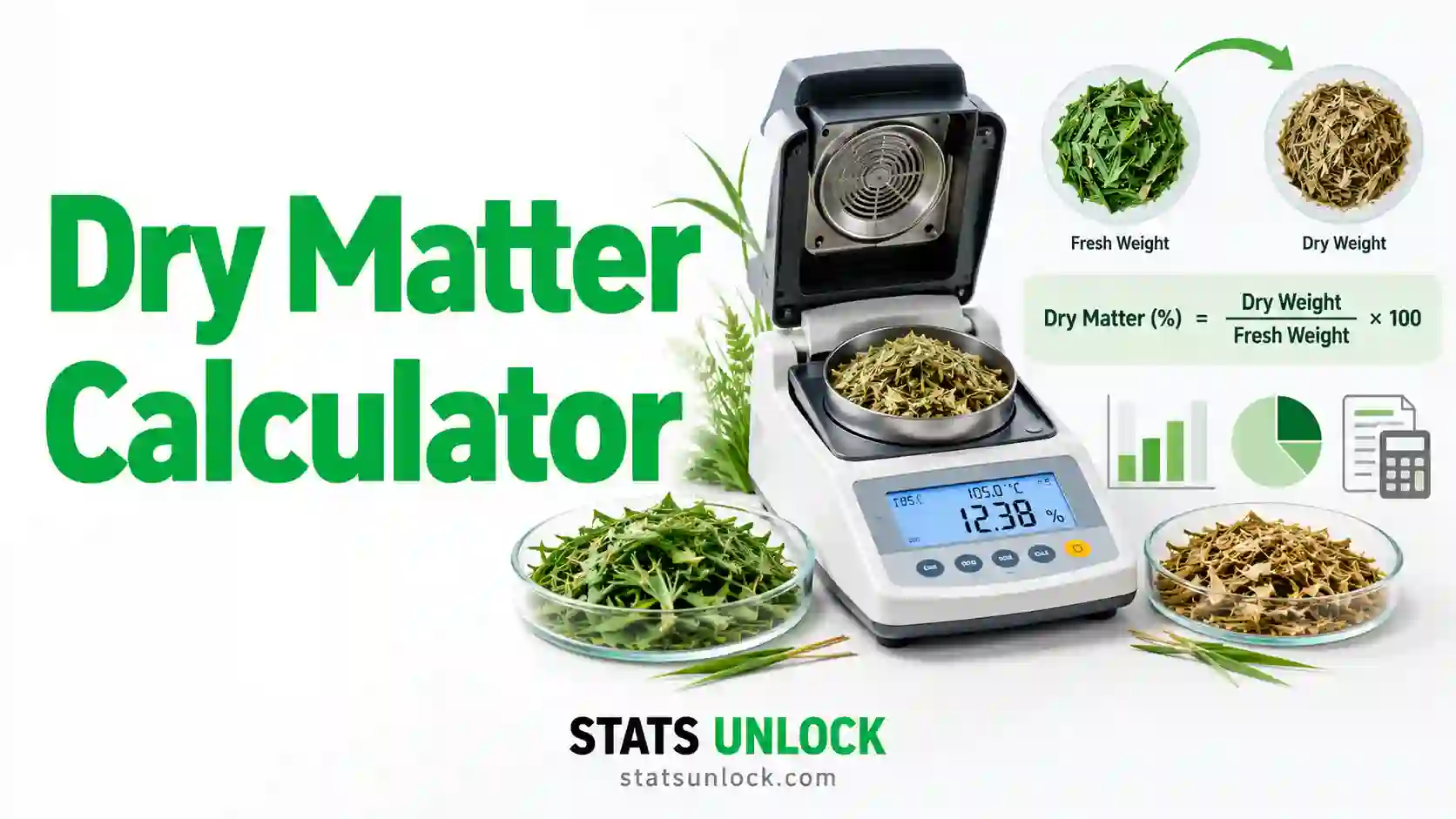

Dry Matter Calculator
Convert dog food and cat food labels to a dry matter basis with calories and per-1000-kcal values, convert any feed between as fed and dry matter, measure dry matter content by drying, plan cattle dry matter intake and rations, calculate fat in dry matter for cheese, and compare two foods, with every step, a figure and four charts.
By StatsUnlock Team · Formulas from AAFCO nutrient profiles, NRC and NASEM nutrient requirements and the Codex cheese standard, checked against published pet food and feed science · Last updated:
⚡ 0. Quick Answer
A dry matter calculator uses dry matter % = 100 − moisture % and nutrient on a dry matter basis = as-fed % ÷ dry matter % × 100. A canned dog food with 78% moisture and 8% protein has 22% dry matter, so its protein is 8 ÷ 22 × 100 = 36.4% on a dry matter basis, more than many dry kibbles.
Rule of thumb: never compare wet and dry foods on the label numbers. Convert both to a dry matter basis, or better, to grams per 1000 kcal. For livestock, mix as fed but balance on a dry matter basis.
⭐ Key Takeaways
- A dry matter calculator turns 8% protein at 78% moisture into 36.4% protein on a dry matter basis (22% dry matter).
- A dry cat food at 10% moisture and 32% protein is 35.6% protein on a dry matter basis: almost the same as the canned dog food.
- Hay at 88% DM with 16% crude protein as fed is 18.2% CP on a dry matter basis; 10 kg as fed is 8.8 kg of dry matter.
- A 600 kg cow eating 3.5% of body weight as dry matter needs 21 kg DM, which is 46.7 kg of a 45% DM feed.
- Cheese with 33% fat and 37% moisture has 52.4% fat in dry matter: full fat under the Codex standard.
📚 1. What Is Dry Matter and How Do You Calculate It?
Dry matter is everything in a food or feed except water: protein, fat, carbohydrate, fiber and minerals. Because water content varies so much (about 10% in kibble, 75 to 82% in canned food, 30 to 40% DM in silage), nutrients are compared and requirements are set on a dry matter basis. Nutrient requirement tables for dogs and cats (NRC, 2006) and for beef and dairy cattle (NASEM, 2016; NASEM, 2021) are written this way. A dry matter calculator removes the water so that a wet food and a dry food, or two feeds, can be compared fairly.
A worked one-liner: DM = 100 − 78 = 22%; protein DMB = 8 ÷ 22 × 100 = 36.4%; fat DMB = 5 ÷ 22 × 100 = 22.7%; energy ≈ 10 × (3.5 × 8 + 8.5 × 5 + 3.5 × 5) = 880 kcal/kg as fed = 4000 kcal/kg DM.
Who uses it: pet owners and veterinary teams comparing dog and cat foods, including phosphorus for kidney diets; animal science students; nutritionists and farmers balancing cattle rations; feed and forage labs reporting results; and dairy technologists calculating fat in dry matter for cheese labeling.
Quick answers to the questions people ask most
How do you calculate dry matter basis?
Subtract the moisture percentage from 100 to get the dry matter percentage, then divide each as-fed nutrient by the dry matter and multiply by 100. A food with 78% moisture and 8% protein has 22% dry matter, so its protein on a dry matter basis is 8 ÷ 22 × 100 = 36.4%.
How do you calculate dry matter basis of dog food?
Read the guaranteed analysis on the bag or can. Dry matter is 100 minus the moisture maximum. Divide protein, fat and fiber by the dry matter and multiply by 100. A kibble with 10% moisture and 26% protein is 28.9% protein on a dry matter basis; a can with 78% moisture and 9% protein is 40.9%.
How do you calculate dry matter basis of cat food?
Use the same steps as for dog food. A wet cat food at 82% moisture and 10% protein has 18% dry matter and 55.6% protein on a dry matter basis. A dry cat food at 10% moisture and 32% protein has 90% dry matter and 35.6% protein. The wet food carries more protein once water is removed.
How do you convert dry matter to as fed?
Multiply the dry matter value by the dry matter percentage and divide by 100. Silage at 35% dry matter with 8.5% crude protein in the dry matter contains 8.5 × 35 ÷ 100 = 2.98% protein as fed. To feed 12 kg of dry matter, offer 12 ÷ 0.35 = 34.3 kg as fed.
How do you calculate dry matter percentage of a feed sample?
Weigh the sample, dry it in an oven or microwave to constant mass, and weigh it again. Dry matter % = dry mass ÷ wet mass × 100, after subtracting the container. A 100 g silage sample that dries to 35 g has 35% dry matter and 65% moisture.
How do you calculate fat in dry matter for cheese?
Divide the fat percentage by the dry matter percentage (100 minus moisture) and multiply by 100. Cheese with 33% fat and 37% moisture has 63% dry matter and 52.4% fat in dry matter, which is full fat (45 to 60%) under the Codex General Standard for Cheese.
| Food or feed | Typical moisture | Dry matter | 8% as fed becomes |
|---|---|---|---|
| Dry kibble | 8 to 12% | 88 to 92% | 8.7 to 9.1% DM |
| Semi-moist pet food | about 25 to 35% | 65 to 75% | 10.7 to 12.3% DM |
| Canned pet food | 75 to 82% | 18 to 25% | 32 to 44% DM |
| Hay | 10 to 15% | 85 to 90% | 8.9 to 9.4% DM |
| Corn silage | 60 to 70% | 30 to 40% | 20 to 27% DM |
| Fresh pasture | 75 to 85% | 15 to 25% | 32 to 53% DM |
🧮 2. Enter Your Data
Values from the guaranteed analysis, as printed. Ash is often listed in the typical analysis or on the maker’s website.
One food per line: moisture %, an as-fed nutrient %, and an optional label, separated by commas or tabs. A header row is skipped.
📊 3. Results and Step-by-Step Working
Working (Given, Required, Equation, Substitute, Solve)
Uncertainty budget
Step by step
Full results table
Your food, drawn from the numbers
Charts
Four plots that change with the mode: as fed against dry matter, where the calories or dry matter come from, and how the result responds to the inputs.
1.
2.
3.
4.
🧠 4. Understanding Your Dry Matter Result, In Detail
4.1 What the result means
___
4.2 The formula
___
4.3 The detail that changes the answer
___
4.4 Accuracy and limits
___
4.5 What to do next
___
4.6 Dry matter basis or per 1000 kcal?
A dry matter basis removes water, which is enough to compare most feeds. Pet foods also differ widely in fat and therefore in energy, and an animal eats to meet its energy needs. Expressing a nutrient as grams per 1000 kcal shows how much of it arrives with each day’s calories. AAFCO’s dry matter minimums assume 4000 kcal per kg of dry matter, so for very high-fat foods the per-1000-kcal comparison is the more reliable one. Energy here uses modified Atwater factors (3.5, 8.5 and 3.5 kcal/g for protein, fat and carbohydrate), which predict measured metabolizable energy well on average but can underestimate high-quality diets (Hall et al., 2013; Asaro et al., 2017).
4.7 Why label numbers are not analyses
The guaranteed analysis lists minimum crude protein and fat and maximum fiber and moisture. Measured contents often exceed the protein and fat minimums and can fall short of other claims (Hill et al., 2009; Gosper et al., 2016). Carbohydrate is rarely printed and is calculated by difference, so it carries all the other errors. Ask the manufacturer for typical (average) analyses and calorie content when precision matters (Zicker, 2008).
4.8 Measuring dry matter in feeds
Dry matter is measured by drying to constant mass, but the method matters: fermented feeds such as silage lose volatile acids and alcohols, so oven dry matter can understate true dry matter (Thiex & Richardson, 2003). On farms, the dry matter of wet ingredients varies enough from day to day that frequent checks pay off (St-Pierre & Weiss, 2015).
✍ 5. How to Write Dry Matter Results in a Report: Detailed Results
A nutrient value in a report needs the number, the basis (as fed, dry matter or per 1000 kcal), the source (label guarantee, typical analysis or laboratory analysis) and the dry matter used. The seven write-ups below are filled from the dry matter calculator; they show the headline example until you press Calculate.
Showing the headline example (canned dog food). Press Calculate above to fill all seven write-ups with your own result.
5.1 Style rules
| Rule | Write | Avoid |
|---|---|---|
| State the basis | 36.4% crude protein (DM basis) | 36.4% protein |
| Give the dry matter | 22% DM (78% moisture) | no moisture stated |
| Name the source | from the guaranteed analysis | “the food contains” |
| Use per 1000 kcal for pets | 90.9 g protein/1000 kcal ME | comparing as-fed % |
| Rations on DM, mixing as fed | 13.3% CP of DM; 47 kg as fed | mixing the two |
| Cheese: FDM with moisture | 52% fat in dry matter (37% moisture) | 52% fat |
5.2 Seven ready-to-copy write-ups
∑ 6. What Is the Dry Matter Basis Calculation? All Formulas Used
🔀 7. How Do You Calculate Dry Matter Basis? Flowchart, Step by Step
The same worked problem as Sections 0, 9, 10, 11 and 14: canned dog food, 78% moisture, 8% protein, 5% fat, 1.5% fiber, 2.5% ash.
📝 8. How to Use This Dry Matter Calculator
- Pick what you want to calculate. Choose a mode in Section 2: a dog or cat food label, as fed and dry matter conversion, dry matter content from drying, cattle intake and rations, cheese fat in dry matter, or a comparison of two foods.
- Load a sample or type your values. Twelve worked problems are in the sample menu. Sample 1 is the headline canned dog food. Nothing is calculated until you press Calculate Dry Matter.
- Copy the label exactly. Enter moisture, crude protein, crude fat, fiber and ash as printed in the guaranteed analysis. Add phosphorus, calcium or sodium on extra lines.
- Choose species and life stage. Dog or cat, adult or growth, sets the AAFCO protein and fat minimums used for the check.
- For feeds, enter dry matter or moisture. The convert mode takes either; add a feed amount in kg to convert masses as well as percentages.
- For cattle, enter body weight and intake. Use a target intake as % of body weight, or list ration ingredients with kg as fed, % DM, % crude protein and price.
- Press Calculate Dry Matter. Press the button or Enter. Dry matter basis values, energy, a Verified badge, the formula and every step appear in Section 3.
- Read the figure and charts. The figure draws your food as fed and on a dry matter basis; four charts show the bases, calories, sensitivity and benchmarks.
- Copy the write-up. Section 5 fills seven ready texts for a report, a log, code, an exam, chat, a results paragraph and a table.
- Download or run a batch. Download Doc or PDF, or convert many foods at once from a CSV of moisture and nutrient values in the Batch tab.
📈 9. How to Calculate Dry Matter Basis in Excel
One formula per nutrient. The sheet repeats the headline problem (canned dog food, 78% moisture, 8% protein, 5% fat), so the numbers match Sections 0, 7, 10, 11 and 14.
=B2/(100-A2)*100. It returns 36.36.9.1 The formulas you need
| You want | Excel formula | Note |
|---|---|---|
| Dry matter % | =100-A2 | A2 = moisture |
| Nutrient, dry matter basis | =B2/(100-$A$2)*100 | Fill right for each nutrient |
| Dry matter to as fed | =C2*(100-$A$2)/100 | |
| Carbohydrate by difference | =100-SUM(A2:E2) | moisture, protein, fat, fiber, ash |
| Energy, kcal/kg (modified Atwater) | =10*(3.5*B2+8.5*C2+3.5*F2) | F2 = carbohydrate |
| Grams per 1000 kcal | =B2*10/(G2/1000) | G2 = kcal/kg |
| Ration dry matter % | =SUMPRODUCT(B2:B4,C2:C4)/SUM(B2:B4) | kg as fed, % DM |
| As fed for a DM target | =A2*B2/100/(C2/100) | BW, DMI %, feed DM % |
| Cheese fat in dry matter | =A2/(100-B2)*100 | fat, moisture |
9.2 Step by step
1 Enter the label
Moisture in A2, protein in B2, fat in C2.
A2 78, B2 8, C2 5.
2 Dry matter
In D2 type =100-A2.
D2 shows 22.
3 Dry matter basis
In E2 type =B2/$D$2*100 and fill right to F2.
E2 36.36, F2 22.73.
9.3 Many foods
Put one food per row and fill the formulas down. Sort by the dry matter basis column, not the as-fed column, to rank foods by protein.
9.4 Why Excel may differ from R or Python
| Situation | What happens | Fix |
|---|---|---|
| Rounded dry matter | Rounding 22.4 to 22 changes every DMB value | Round only the final values |
| ROUND | Excel rounds half away from zero; R and Python round half to even | Format instead of rounding |
| Percent format | Typing 78% stores 0.78 | Enter plain numbers or use =B2/(1-A2) |
9.5 Charting
Select the as-fed and dry matter basis columns for several foods and insert a Clustered Column chart. The wet foods’ bars jump when water is removed.
9.6 Errors you may see
#DIV/0!: moisture entered as 100.- A value above 100%: dry matter typed where moisture was needed.
- Numbers 100 times too small: cells formatted as percent.
📈 10. How to Calculate Dry Matter Basis in R
A complete, copy-and-run script that reproduces the dry matter calculator for the headline problem. It converts a canned dog food label to a dry matter basis with modified Atwater energy and per-1000-kcal values, converts feed between as fed and dry matter, plans a cattle ration, calculates cheese fat in dry matter and saves one 300 dpi figure.
10.1 The complete script
R, base only, saves dry_matter_basis.png
# Dry matter calculator in base R (StatsUnlock)
dmb <- function(asfed, moisture) {               # % as fed -> % of dry matter
  if (any(moisture < 0 | moisture >= 100)) stop("moisture must be 0 to below 100")
  asfed / (100 - moisture) * 100
}
# headline: canned dog food, guaranteed analysis
lab <- c(moisture = 78, protein = 8, fat = 5, fiber = 1.5, ash = 2.5)
if (sum(lab) > 100) stop("label adds to more than 100 %")
nfe <- 100 - sum(lab)
dm <- round(dmb(c(lab[-1], nfe = nfe), lab["moisture"]), 2); print(dm)
me <- 10 * (3.5 * lab["protein"] + 8.5 * lab["fat"] + 3.5 * nfe)   # modified Atwater, kcal/kg
cat(sprintf("ME %.0f kcal/kg as fed (%.0f per kg DM); protein %.1f g/1000 kcal\n",
            me, me / 0.22, lab["protein"] * 10 / (me / 1000)))
# feed: hay at 88 % DM, 16 % CP as fed; silage 35 % DM, 8.5 % CP of DM
cat(sprintf("hay CP %.2f %% of DM; silage CP %.2f %% as fed\n", 16 / 0.88, 8.5 * 0.35))
# ration: kg as fed, % DM, % CP of DM
r <- data.frame(af = c(30, 8, 9), dm = c(35, 88, 89), cp = c(8, 18, 16))
kg_dm <- r$af * r$dm / 100
cat(sprintf("ration: %.2f kg DM, %.1f %% DM, %.1f %% CP of DM\n",
            sum(kg_dm), 100 * sum(kg_dm) / sum(r$af), sum(kg_dm * r$cp) / sum(kg_dm)))
# cheese: fat in dry matter and MFFB
fat <- 33; moist <- 37
cat(sprintf("FDM %.1f %%, MFFB %.1f %%\n", fat / (100 - moist) * 100, moist / (100 - fat) * 100))
png("dry_matter_basis.png", width = 7, height = 4, units = "in", res = 300)
barplot(rbind(c(8, 5, 5), c(dm["protein"], dm["fat"], dm["nfe"])), beside = TRUE,
        names.arg = c("protein", "fat", "carbohydrate"), col = c("grey70", "#9333ea"),
        legend.text = c("as fed", "dry matter basis"), ylab = "%")
invisible(dev.off())
10.2 Output
protein     fat   fiber     ash     nfe
  36.36   22.73    6.82   11.36   22.73
ME 880 kcal/kg as fed (4000 per kg DM); protein 90.9 g/1000 kcal
hay CP 18.18 % of DM; silage CP 2.97 % as fed
ration: 25.55 kg DM, 54.4 % DM, 13.3 % CP of DM
FDM 52.4 %, MFFB 55.2 %
10.3 Traps
- dmb() is vectorized: pass a column of moistures and a column of nutrients.
- Stop if the label adds to more than 100%.
- Ration DM must be weighted by kg as fed.
10.4 What each part does
| Block | Purpose |
|---|---|
| dmb() | Checks that the label adds to 100% or less, then as fed ÷ DM fraction |
| Energy | Modified Atwater 3.5, 8.5, 3.5 kcal/g and grams per 1000 kcal |
| Feeds and ration | As fed ↔ DM and a DM-weighted ration |
| Middle blocks | Hay and silage conversion, a three-ingredient ration and cheese fat in dry matter |
| Last block | Protein, fat and carbohydrate as fed against the dry matter basis, saved at 300 dpi |
10.5 Adapting it
Change the label values for your food, or pass whole columns: dmb() is vectorized and works on a data frame of many foods at once.
📈 11. How to Calculate Dry Matter Basis in Python
A complete, copy-and-run script that reproduces the dry matter calculator for the headline problem. It converts a canned dog food label to a dry matter basis with modified Atwater energy and per-1000-kcal values, converts feed between as fed and dry matter, plans a cattle ration, calculates cheese fat in dry matter and saves one 300 dpi figure.
Install once: pip install numpy matplotlib
11.1 The complete script
Python with NumPy and Matplotlib, saves dry_matter_basis.png
# Dry matter calculator in Python (StatsUnlock)
import numpy as np
import matplotlib.pyplot as plt

def dmb(asfed, moisture):
    """Nutrient % as fed -> % of dry matter."""
    asfed, moisture = np.asarray(asfed, float), np.asarray(moisture, float)
    if ((moisture < 0) | (moisture >= 100)).any():
        raise ValueError("moisture must be 0 to below 100")
    return asfed / (100 - moisture) * 100

lab = {"moisture": 78, "protein": 8, "fat": 5, "fiber": 1.5, "ash": 2.5}   # canned dog food
if sum(lab.values()) > 100:
    raise ValueError("label adds to more than 100 %")
nfe = 100 - sum(lab.values())
for k in ("protein", "fat", "fiber", "ash"):
    print(f"{k}: {dmb(lab[k], lab['moisture']):.2f} % DM")
print(f"carbohydrate (NFE): {dmb(nfe, lab['moisture']):.2f} % DM")

me = 10 * (3.5 * lab["protein"] + 8.5 * lab["fat"] + 3.5 * nfe)        # modified Atwater
print(f"ME {me:.0f} kcal/kg as fed ({me / 0.22:.0f} per kg DM); protein {lab['protein'] * 10 / (me / 1000):.1f} g/1000 kcal")

print(f"hay CP {16 / 0.88:.2f} % of DM; silage CP {8.5 * 0.35:.2f} % as fed")

af, dm, cp = np.array([30, 8, 9]), np.array([35, 88, 89]), np.array([8, 18, 16])   # ration
kg_dm = af * dm / 100
print(f"ration: {kg_dm.sum():.2f} kg DM, {100 * kg_dm.sum() / af.sum():.1f} % DM, {(kg_dm * cp).sum() / kg_dm.sum():.1f} % CP of DM")

fat, moist = 33, 37                                                       # cheese
print(f"FDM {fat / (100 - moist) * 100:.1f} %, MFFB {moist / (100 - fat) * 100:.1f} %")

x = np.arange(3); w = 0.38
fig, ax = plt.subplots(figsize=(7, 4))
ax.bar(x - w / 2, [8, 5, nfe], w, label="as fed", color="grey")
ax.bar(x + w / 2, dmb([8, 5, nfe], 78), w, label="dry matter basis", color="#9333ea")
ax.set_xticks(x, ["protein", "fat", "carbohydrate"]); ax.set_ylabel("%"); ax.legend()
fig.tight_layout(); fig.savefig("dry_matter_basis.png", dpi=300)
11.2 Output
protein: 36.36 % DM
fat: 22.73 % DM
fiber: 6.82 % DM
ash: 11.36 % DM
carbohydrate (NFE): 22.73 % DM
ME 880 kcal/kg as fed (4000 per kg DM); protein 90.9 g/1000 kcal
hay CP 18.18 % of DM; silage CP 2.97 % as fed
ration: 25.55 kg DM, 54.4 % DM, 13.3 % CP of DM
FDM 52.4 %, MFFB 55.2 %
11.3 Traps
- dmb() accepts arrays or pandas columns.
- Moisture of 100 would divide by zero; it is rejected.
- Keep percentages as numbers, not fractions, throughout.
11.4 What each part does
| Block | Purpose |
|---|---|
| dmb() | Checks that the label adds to 100% or less, then as fed ÷ DM fraction |
| Energy | Modified Atwater 3.5, 8.5, 3.5 kcal/g and grams per 1000 kcal |
| Feeds and ration | As fed ↔ DM and a DM-weighted ration |
| Middle blocks | Hay and silage conversion, a three-ingredient ration and cheese fat in dry matter |
| Last block | Protein, fat and carbohydrate as fed against the dry matter basis, saved at 300 dpi |
11.5 Adapting it
Change the label values for your food, or pass whole columns: dmb() is vectorized and works on a data frame of many foods at once.
📋 12. Dry Matter Conversion Tables and Standards
12.1 As fed to dry matter multiplier
| Moisture (%) | Dry matter (%) | Multiply as fed by | 8% as fed becomes | 0.2% as fed becomes |
|---|---|---|---|---|
| 0 | 100 | 1.000 | 8.00% | 0.200% |
| 5 | 95 | 1.053 | 8.42% | 0.211% |
| 8 | 92 | 1.087 | 8.70% | 0.217% |
| 10 | 90 | 1.111 | 8.89% | 0.222% |
| 12 | 88 | 1.136 | 9.09% | 0.227% |
| 15 | 85 | 1.176 | 9.41% | 0.235% |
| 20 | 80 | 1.250 | 10.00% | 0.250% |
| 30 | 70 | 1.429 | 11.43% | 0.286% |
| 40 | 60 | 1.667 | 13.33% | 0.333% |
| 50 | 50 | 2.000 | 16.00% | 0.400% |
| 60 | 40 | 2.500 | 20.00% | 0.500% |
| 65 | 35 | 2.857 | 22.86% | 0.571% |
| 70 | 30 | 3.333 | 26.67% | 0.667% |
| 75 | 25 | 4.000 | 32.00% | 0.800% |
| 78 | 22 | 4.545 | 36.36% | 0.909% |
| 80 | 20 | 5.000 | 40.00% | 1.000% |
| 82 | 18 | 5.556 | 44.44% | 1.111% |
| 85 | 15 | 6.667 | 53.33% | 1.333% |
| 90 | 10 | 10.000 | 80.00% | 2.000% |
DMB = as fed × 100 ÷ (100 − moisture). Exact. Last checked: October 2026.
12.2 AAFCO minimum protein and fat
| Profile | Crude protein, % DM | Crude fat, % DM | Protein, g/1000 kcal | Fat, g/1000 kcal |
|---|---|---|---|---|
| Dog, adult maintenance | 18 | 5.5 | 45 | 13.75 |
| Dog, growth and reproduction | 22.5 | 8.5 | 56.25 | 21.25 |
| Cat, adult maintenance | 26 | 9 | 65 | 22.5 |
| Cat, growth and reproduction | 30 | 9 | 75 | 22.5 |
AAFCO dog and cat food nutrient profiles (2016 revision for dogs), stated on a dry matter basis assuming 4000 kcal ME/kg DM; g/1000 kcal = % DM × 2.5. Last checked: October 2026.
12.3 Codex cheese classes
| Fat in dry matter | Term | MFFB | Firmness term |
|---|---|---|---|
| ≥ 60% | High fat | < 51% | Extra hard |
| ≥ 45% and < 60% | Full fat | 49 to 56% | Hard |
| ≥ 25% and < 45% | Medium fat | 54 to 69% | Firm or semi-hard |
| ≥ 10% and < 25% | Partially skimmed | > 67% | Soft |
| < 10% | Skim |
Codex General Standard for Cheese (CXS 283-1978); the MFFB ranges overlap as published. Last checked: October 2026.
12.4 Dry matter intake and as-fed feed (3% of body weight)
| Body weight (kg) | kg DM/day | As fed at 35% DM | at 50% DM | at 88% DM |
|---|---|---|---|---|
| 300 | 9.0 | 25.7 | 18.0 | 10.2 |
| 400 | 12.0 | 34.3 | 24.0 | 13.6 |
| 500 | 15.0 | 42.9 | 30.0 | 17.0 |
| 600 | 18.0 | 51.4 | 36.0 | 20.5 |
| 700 | 21.0 | 60.0 | 42.0 | 23.9 |
| 800 | 24.0 | 68.6 | 48.0 | 27.3 |
Illustrative; actual intake depends on class of animal, production and diet (NASEM, 2016; NASEM, 2021). Last checked: October 2026.
12.5 Modified Atwater energy
| Nutrient | kcal per g (modified) | Example: 1% as fed adds |
|---|---|---|
| Crude protein | 3.5 | 35 kcal/kg |
| Crude fat | 8.5 | 85 kcal/kg |
| Carbohydrate (NFE) | 3.5 | 35 kcal/kg |
Factors used for pet food calorie statements; prediction accuracy reviewed by Hall et al. (2013). Last checked: October 2026.
📈 13. Dry Matter Calculation Examples: Worked Problems
Eight worked problems that cover what a dry matter calculator meets: a kibble, a renal cat food, a hay test, an oven dry matter, a steer, a cheese, food cost and the classic ration mistake. Each number was checked in Python.
Dry dog food label
Kibble has little water.
A kibble lists 10% moisture, 26% crude protein and 16% crude fat.
| Quantity | Value | Note |
|---|---|---|
| Dry matter | 90% | 100 − 10 |
| Protein (DM) | 28.89% | 26 ÷ 0.90 |
| Fat (DM) | 17.78% | 16 ÷ 0.90 |
What it means: Both are above the AAFCO adult dog minimums (18% and 5.5%).
How to write it: "Protein 28.9% and fat 17.8% on a dry matter basis."
Phosphorus in a wet cat food
Small as fed, large on DM.
A wet cat food has 80% moisture and 0.15% phosphorus.
| Quantity | Value | Note |
|---|---|---|
| Dry matter | 20% | |
| Phosphorus (DM) | 0.75% | 0.15 ÷ 0.20 |
| Same as a kibble with | 0.68% as fed | at 10% moisture |
What it means: Compare renal diets on DM or per 1000 kcal (Ross et al., 2006).
How to write it: "Phosphorus 0.75% on a dry matter basis."
Hay test: as fed to dry matter
Lab reports both.
Hay at 88% dry matter tests 16% crude protein as fed.
| Quantity | Value | Note |
|---|---|---|
| Crude protein (DM) | 18.18% | 16 ÷ 0.88 |
| 10 kg as fed | 8.8 kg DM | 10 × 0.88 |
| Water in 10 kg | 1.2 kg |
What it means: Wet feeds change far more.
How to write it: "Crude protein 18.2% of DM."
Oven dry matter of silage
Dry mass ÷ wet mass.
A tray weighs 15.0 g; with silage 115.0 g; after drying 50.0 g.
| Quantity | Value | Note |
|---|---|---|
| Dry matter | 35.0% | 35.0 ÷ 100.0 |
| Moisture | 65.0% | |
| As fed per kg DM | 2.86 kg | 1 ÷ 0.35 |
What it means: Oven drying loses some volatiles, slightly understating DM (Thiex and Richardson, 2003).
How to write it: "Dry matter 35.0% (oven, constant mass)."
Steer intake on a wet ration
DM first, then as fed.
A 450 kg steer eats 2.5% of body weight as dry matter; the ration is 60% DM.
| Quantity | Value | Note |
|---|---|---|
| Dry matter intake | 11.25 kg/day | 450 × 0.025 |
| As fed | 18.75 kg/day | 11.25 ÷ 0.60 |
| Water in the feed | 7.5 kg/day |
What it means: Recalculate when the ration DM changes.
How to write it: "DMI 11.25 kg/day = 18.75 kg as fed."
Brie-type cheese
FDM and MFFB.
A soft-ripened cheese has 28% fat and 48% moisture.
| Quantity | Value | Note |
|---|---|---|
| Fat in dry matter | 53.85% | full fat |
| MFFB | 66.67% | firm or semi-hard band |
| Dry matter | 52% |
What it means: FDM stays constant as the cheese dries.
How to write it: "Fat in dry matter 53.8%."
Cost per kg of dry matter
You pay for water too.
Kibble costs 4.00 per kg at 90% DM; canned food 6.00 per kg at 22% DM.
| Quantity | Value | Note |
|---|---|---|
| Kibble | 4.44 per kg DM | |
| Canned | 27.27 per kg DM | |
| Ratio | 6.1× | canned vs kibble |
What it means: Per 1000 kcal is the fairest price comparison.
How to write it: "Kibble 4.44 and canned 27.27 per kg of dry matter."
Averaging ingredient dry matter
Weight by kg fed.
A ration has 30 kg of 35% DM silage, 8 kg of 88% hay and 9 kg of 89% grain.
| Quantity | Value | Note |
|---|---|---|
| Wrong (simple mean) | 70.7% | ignores amounts |
| Right (weighted) | 54.4% | 25.55 ÷ 47 |
| Error | 16.3 points | overstates DM |
What it means: Weight every ration figure by as-fed kg.
How to write it: "Ration dry matter 54.4%."
✏️ 14. How Do You Calculate Dry Matter by Hand and Measure It? Steps
The written method, calculator keys and a drying procedure, for the headline problem: canned dog food, 78% moisture, 8% protein, 5% fat, 1.5% fiber, 2.5% ash.
14.1 The written method
- Dry matter. 100 − 78 = 22%.
- Protein. 8 ÷ 22 × 100 = 36.4%.
- Fat. 5 ÷ 22 × 100 = 22.7%.
- Carbohydrate. 100 − 78 − 8 − 5 − 1.5 − 2.5 = 5% as fed = 22.7% DM.
- Energy. 10 × (28 + 42.5 + 17.5) = 880 kcal/kg.
- Check. 36.4% × 0.22 = 8.0% ✓
14.2 On a calculator
| Step | Keys | Display |
|---|---|---|
| Protein DMB | 8÷(100−78)×100= | 36.364 |
| Energy | 10×(3.5×8+8.5×5+3.5×5)= | 880 |
| As fed for 21 kg DM at 45% | 21÷0.45= | 46.667 |
14.3 Lab SOP: dry matter of a feed or food by oven drying
Purpose
Determine the dry matter percentage of a feed, forage or food sample.
Equipment
Forced-air oven (for example 100 to 105 °C, or as your method specifies); balance readable to 0.01 g; aluminum trays; desiccator; gloves.
Hazards and controls
Hot trays and oven: use gloves. Fatty samples can smoke; do not leave a microwave unattended when drying forage.
Procedure
- Weigh an empty tray.
- Add a representative, well-mixed sample (about 100 g for forage, less for dry feed) and weigh.
- Dry to constant mass (often overnight).
- Cool in a desiccator and weigh.
- DM % = (dry − tray) ÷ (wet − tray) × 100. Run duplicates.
Record sheet
| Item | Value | Unit |
|---|---|---|
| Tray | 20.00 | g |
| Tray + wet | 120.00 | g |
| Tray + dry | 55.00 | g |
| Dry matter | 35.00 ± 0.01 | % |
Acceptance criteria
Duplicates within about 1 percentage point for forages; mass change under 0.1% on further drying. These are teaching-lab criteria; follow your laboratory’s method where they differ (Thiex & Richardson, 2003).
Sources of error and their direction
- Incomplete drying: DM high.
- Volatiles lost (silage): DM low.
- Moisture regained while cooling: DM high.
- Unrepresentative sample: either way.
- Charring of sugary samples: DM low.
14.4 Practice problems
1. A food has 75% moisture and 10% protein. Protein on a DM basis?
40.0%
2. Kibble: 12% moisture, 30% protein. DMB?
34.09%
3. Silage 38% DM, 9% CP of DM. CP as fed?
3.42%
4. You need 15 kg DM of a 40% DM feed. As fed?
37.5 kg
5. A 200 g sample dries to 176 g. DM %?
88.0%
6. Cheese: 25% fat, 45% moisture. FDM?
45.45%
7. Wet cat food 80% moisture, 11% protein, 5% fat, 1% fiber, 2% ash. Carbohydrate DM?
5.0%
8. Same food: kcal/kg (modified Atwater)?
845 kcal/kg
9. 700 kg cow at 3% DMI, 50% DM feed. As fed?
42 kg
10. Price 3.00/kg at 88% DM. Price per kg DM?
3.41
14.5 Mistakes that lose marks
- Dividing by moisture instead of dry matter.
- Comparing wet and dry foods as fed.
- Converting masses the same way as percentages.
- Averaging ration DM without weights.
- Leaving out the basis in the answer.
- Forgetting ash in carbohydrate by difference.
14.6 Check-yourself and lab questions
Check: Why is dry matter basis needed for pet foods?
Water content varies from about 10 to 82%, which hides nutrient differences.
Check: Do masses convert the same way as percentages?
No: kg DM = kg as fed × DM fraction; percentages are divided.
Check: Why can carbohydrate by difference be wrong?
It inherits every other error and includes ash if ash is missing.
Check: What does FDM stay constant with?
Ripening and drying of the cheese, unlike fat %.
Lab: Why dry to constant mass?
To be sure all removable water has gone.
Lab: Why can oven DM of silage be low?
Volatile acids and alcohols are lost with the water.
Lab: Why sample several places in a silo?
DM varies across the face and with depth.
Lab: Why record the drying temperature?
Different temperatures give different DM for some feeds.
✅ 15. Which Basis Should You Use?
| Situation | Use | Calculator mode | Example |
|---|---|---|---|
| Reading a pet food label | Dry matter basis | Label | 8% → 36.4% DM |
| Wet vs dry pet food | Per 1000 kcal and DM | Compare | kibble vs canned |
| Kidney or urinary diet checks | Phosphorus % DM and per 1000 kcal | Label (other nutrients) | 0.12% → 0.55% DM |
| Hay, silage and feed tests | Dry matter basis | Convert | 16% → 18.2% CP |
| Measuring silage moisture | Drying | Dry matter content | 35% DM |
| Feeding cattle | DM intake, then as fed | Cattle | 21 kg DM = 46.7 kg |
| Cheese labeling | Fat in dry matter | Cheese | 52.4% FDM |
- Foods differ mainly in water.
- You compare with requirements set on DM.
- You balance livestock rations.
- Foods differ a lot in fat and energy.
- The pet eats to meet energy needs.
- Comparing therapeutic diets (Ross et al., 2006).
🔧 16. Common Dry Matter Calculation Mistakes
Almost every wrong dry matter result comes from mixing bases or misreading the label. The dry matter calculator guards against each one below.
| Symptom | Cause | Fix |
|---|---|---|
| Canned food looks low in protein | Compared as fed with kibble | Convert both to DM |
| DM value above 100% | Used moisture where DM was needed | DM = 100 − moisture |
| Carbohydrate too high | Ash left out | Enter ash or note “carb + ash” |
| Values add to more than 100% | Typo, or typical and guaranteed values mixed | Use one source |
| Cows under-fed when silage is wetter | As-fed amount not adjusted | Re-measure DM, recalculate as fed |
| Ration DM taken as an average of DM%s | Not weighted | Σ(as fed × DM) ÷ Σ as fed |
| Kibble DM taken as 100% | Ignored the 8 to 12% water | Use the label moisture |
| Silage DM too low by oven | Volatiles lost | Use a correction or toluene distillation in research |
| Cheese fat compared at different ages | Moisture changed | Use fat in dry matter |
| Phosphorus compared as fed | Water differs | Use % DM or g/1000 kcal |
⚠️ 17. Assumptions and Limitations
| Assumption | How to check | If it fails |
|---|---|---|
| Label moisture is the actual moisture | It is a maximum | Real DM can be slightly higher |
| Carbohydrate by difference | Ash entered | Without ash, carbohydrate includes ash |
| Modified Atwater energy | Compare with the label kcal | Use the manufacturer’s ME when given |
| AAFCO minimums at 4000 kcal/kg DM | Per 1000 kcal comparison | For very energy-dense foods, use g/1000 kcal |
| DMI as % of body weight | Milk yield, growth, diet | Use NASEM intake equations |
| Oven DM equals true DM | Fermented feeds | Correct for volatiles |
| Codex FDM classes | National rules | Local labeling law may differ |
This calculator converts and compares; it does not formulate a complete diet. For pets with disease, work with a veterinarian. Cats on wet food take in more water, which matters for urinary health (Buckley et al., 2011).
🎯 18. Conclusion
Your result
The dry matter calculator gives 36.4% protein and 22.7% fat on a dry matter basis for this dog food (22% dry matter).
What the dry matter calculator does
Water hides what is in a food. This dry matter calculator removes it: pet food labels to a dry matter basis with energy and per-1000-kcal values, any nutrient between as fed and dry matter, dry matter content from drying, cattle intake and rations, fat in dry matter for cheese, and side-by-side food comparison, with every step shown.
Watch out for
- Compare wet and dry foods only on DM or per 1000 kcal.
- Enter ash, or treat carbohydrate as an upper bound.
- Labels are guarantees, not analyses.
- Re-measure wet feed dry matter often.
- Weight ration DM by amount fed.
Next steps
For the percentages behind dry matter, use the percent solution calculator; to prepare standards for feed analysis, the molarity calculator and dilution calculator help. Whatever the food, start and finish with the dry matter calculator.
❓ 19. Frequently Asked Questions
Q1. How do you calculate dry matter?
Subtract the moisture percentage from 100. A food with 78% moisture has 22% dry matter, and a kibble with 10% moisture has 90%. To measure it, weigh a sample, dry it to constant mass and divide the dry mass by the wet mass. Dry matter is everything except water: protein, fat, carbohydrate, fiber and minerals.
Q2. How do you calculate dry matter basis?
Divide the as-fed nutrient percentage by the dry matter percentage and multiply by 100. For a food with 78% moisture and 8% protein, dry matter is 22%, so protein on a dry matter basis is 8 ÷ 22 × 100 = 36.4%. Repeat for fat, fiber, ash and minerals such as phosphorus.
Q3. How do you calculate dry matter basis of dog food?
Take the guaranteed analysis, subtract moisture from 100, and divide each nutrient by that figure. A kibble with 10% moisture, 26% protein and 16% fat has 90% dry matter, so it is 28.9% protein and 17.8% fat on a dry matter basis. Canned food with 78% moisture and 9% protein is 40.9% protein.
Q4. How do you calculate dry matter basis of cat food?
Use the same steps. A wet cat food with 82% moisture and 10% protein has 18% dry matter and 55.6% protein on a dry matter basis. A dry cat food with 10% moisture and 32% protein is 35.6%. AAFCO sets 26% protein and 9% fat on a dry matter basis as minimums for adult cats.
Q5. How do you convert as fed to dry matter?
Divide the as-fed value by the dry matter fraction. Hay at 88% dry matter with 16% crude protein as fed has 16 ÷ 0.88 = 18.2% crude protein on a dry matter basis. Masses go the other way: 10 kg of that hay as fed contains 8.8 kg of dry matter.
Q6. How do you calculate as fed from dry matter?
Multiply the dry matter basis value by the dry matter fraction. Silage at 35% dry matter with 8.5% crude protein in the dry matter contains 8.5 × 0.35 = 2.98% protein as fed. To supply 12 kg of dry matter, feed 12 ÷ 0.35 = 34.3 kg of the silage as fed.
Q7. How do you calculate crude protein on a dry matter basis?
Crude protein (DM basis) = crude protein as fed ÷ (100 − moisture) × 100. A feed with 12% moisture and 14% crude protein as fed has 14 ÷ 88 × 100 = 15.9% crude protein on a dry matter basis. Laboratory feed reports usually print both columns: as received and dry matter.
Q8. How do you calculate dry matter percentage of a feed?
Weigh a representative sample, dry it at about 100 to 105 °C in an oven, or in short bursts in a microwave, until the mass stops falling, and weigh again. Dry matter % = dry mass ÷ wet mass × 100 after subtracting the container. A 100 g sample drying to 35 g is 35% dry matter.
Q9. How do you calculate carbohydrate in pet food?
Carbohydrate, or nitrogen-free extract, is calculated by difference: 100 minus moisture, protein, fat, fiber and ash. Labels rarely list ash; if it is missing, the result includes ash and overstates carbohydrate. For the canned food in our example, 100 − 78 − 8 − 5 − 1.5 − 2.5 = 5% as fed, or 22.7% on a dry matter basis.
Q10. How do you calculate calories in dog food from the label?
Use modified Atwater factors: kcal per kg = 10 × (3.5 × protein % + 8.5 × fat % + 3.5 × carbohydrate %). The canned food in our example gives 10 × (28 + 42.5 + 17.5) = 880 kcal/kg as fed, or 4000 kcal/kg of dry matter. Measured energy can differ by several percent from this estimate.
Q11. Why compare pet foods per 1000 kcal?
Pets eat to meet their energy needs, so a nutrient’s amount per 1000 kcal shows how much arrives with each day’s food. It corrects for both water and fat differences. Protein per 1000 kcal = protein % as fed × 10 ÷ (kcal per kg ÷ 1000). AAFCO’s adult dog minimum of 18% DM equals 45 g per 1000 kcal.
Q12. How do you calculate phosphorus on a dry matter basis?
Divide the as-fed phosphorus by the dry matter fraction. A wet cat food with 78% moisture and 0.12% phosphorus has 0.12 ÷ 0.22 = 0.55% phosphorus on a dry matter basis. Kidney diets are compared on this basis or per 1000 kcal, because as-fed values of wet and dry foods are not comparable.
Q13. How do you calculate fat in dry matter for cheese?
Fat in dry matter = fat % ÷ (100 − moisture %) × 100. A cheese with 33% fat and 37% moisture has 63% dry matter and 52.4% fat in dry matter. The Codex General Standard for Cheese calls 45 to under 60% full fat, 25 to under 45% medium fat, and 60% or more high fat.
Q14. How do you calculate dry matter intake for cattle?
Multiply body weight by intake as a percentage of body weight. A 600 kg cow eating 3.5% of body weight needs 21 kg of dry matter a day. Divide by the feed’s dry matter fraction for the as-fed amount: 21 ÷ 0.45 = 46.7 kg of a 45% DM feed. Production, diet and weather change intake.
Q15. How do you calculate the dry matter of a total mixed ration?
Multiply each ingredient’s as-fed kg by its dry matter fraction, add them up, and divide by the total as-fed kg. Thirty kg of 35% DM silage, 8 kg of 88% DM hay and 9 kg of 89% DM grain give 25.55 kg of dry matter in 47 kg, a 54.4% dry matter ration.
Q16. What is the difference between as fed and dry matter basis?
As fed describes the food exactly as eaten, including its water. Dry matter basis describes the same food with all water removed, so foods of different moisture can be compared. Requirements for animals are usually set on a dry matter basis, while mixing and feeding are done on an as-fed basis.
Q17. Why does canned food look lower in protein than kibble?
Because canned food is about three quarters water. A can with 8% protein and 78% moisture is 36.4% protein once water is removed, while a kibble with 26% protein and 10% moisture is 28.9%. The label numbers compare water content as much as nutrients, so always convert to a dry matter basis.
Q18. How accurate are pet food label values?
The guaranteed analysis shows minimum protein and fat and maximum fiber and moisture, not exact contents. Studies comparing labels with laboratory analyses found many foods exceeded the protein and fat minimums and some differed in other nutrients. For precise work, ask the manufacturer for a typical analysis and the metabolizable energy.
Q19. How do you calculate dry matter basis in Excel?
Put moisture in A2 and an as-fed nutrient in B2, then type =B2/(100-A2)*100. To go back, use =C2*(100-A2)/100. For a ration, put kg as fed in B and % DM in C and use =SUMPRODUCT(B2:B4,C2:C4)/SUM(B2:B4) for the ration dry matter percentage. Fill the formulas down to convert a whole list of foods at once, and keep plain numbers in the cells rather than percent formats.
Q20. Does dry matter basis matter for feed cost?
Yes. You pay for water as well as nutrients. Price per kg of dry matter = price per kg as fed ÷ dry matter fraction. Kibble at 4.00 per kg and 90% dry matter costs 4.44 per kg of dry matter, while canned food at 6.00 per kg and 22% dry matter costs 27.27.
📑 20. Cite This Tool
StatsUnlock. (2026). Dry matter calculator [Interactive laboratory tool]. https://statsunlock.com/dry-matter-calculator/@misc{statsunlock_dry_matter_calculator_2026, title={Dry Matter Calculator}, author={{StatsUnlock Team}}, year={2026}, note={Interactive laboratory tool}, url={https://statsunlock.com/dry-matter-calculator/}}Label nutrients were converted to a dry matter basis (as-fed % ÷ dry matter fraction) and energy was estimated with modified Atwater factors using the StatsUnlock Dry Matter Calculator (2026).🔗 21. Related Tools
Make standard solutions for feed and food analysis.
Dilute extracts and standards before analysis.
w/w and w/v percentages, the same arithmetic as % DM.
Write very small mineral concentrations clearly.
Density of liquid feeds, milk and whey.
Oven drying temperatures in °C and °F.
Calcium and magnesium in livestock drinking water.
Mass and velocity: a physics companion for lab classes.
More lab, chemistry and measurement tools from StatsUnlock, with worked steps, code and references.
📖 22. Glossary of Terms
| Term | Plain-English meaning |
|---|---|
| AAFCO | Association of American Feed Control Officials; publishes dog and cat food nutrient profiles. |
| As fed | The food as eaten, including water. |
| Ash | Mineral residue after burning a sample. |
| Carbohydrate (NFE) | Nitrogen-free extract, calculated by difference. |
| Crude fat | Fat measured by ether extraction. |
| Crude fiber | Insoluble fiber fraction on a label. |
| Crude protein | Nitrogen × 6.25. |
| Dry matter (DM) | Everything except water; 100 − moisture. |
| Dry matter basis (DMB) | Nutrient as % of dry matter. |
| Dry matter intake (DMI) | Kilograms of dry matter eaten per day. |
| Fat in dry matter (FDM) | Cheese fat as % of its dry matter. |
| Guaranteed analysis | Label minimums and maximums for key nutrients. |
| Metabolizable energy (ME) | Energy available to the animal after fecal and urinary losses. |
| MFFB | Moisture on a fat-free basis, sets cheese firmness. |
| Modified Atwater factors | 3.5, 8.5, 3.5 kcal/g for protein, fat, carbohydrate. |
| Moisture | Water content, % of the food as fed. |
| Per 1000 kcal | Grams of a nutrient per 1000 kcal of energy. |
| Silage | Fermented, moist forage, often 30 to 40% DM. |
| TMR | Total mixed ration fed to cattle. |
| Typical analysis | Average measured composition, from the manufacturer. |
📚 23. References
Peer-reviewed sources behind this dry matter calculator: nutrient requirements of dogs, cats and cattle, pet food labels and their accuracy, metabolizable energy prediction, feed moisture and ash methods, feed variation on farms, dry matter intake, cat protein and kidney diets, water intake, and measurement uncertainty. Standards (AAFCO nutrient profiles, Codex CXS 283-1978, JCGM 100:2008) are named where they are used. Every DOI checked October 2026.
- Allen, M. S. (2000). Effects of diet on short-term regulation of feed intake by lactating dairy cattle. Journal of Dairy Science, 83(7), 1598–1624. https://doi.org/10.3168/jds.S0022-0302(00)75030-2
- Asaro, N. J., Guevara, M., Berendt, K., Zijlstra, R. T., & Shoveller, A. K. (2017). Digestibility is similar between commercial diets that provide ingredients with different perceived glycemic responses and the inaccuracy of using the modified Atwater calculation to calculate metabolizable energy. Veterinary Sciences, 4(4), 54. https://doi.org/10.3390/vetsci4040054
- Buckley, C. M. F., Hawthorne, A. J., Colyer, A., & Stevenson, A. E. (2011). Effect of dietary water intake on urinary output, specific gravity and relative supersaturation for calcium oxalate and struvite in the cat. British Journal of Nutrition, 106(S1), S128–S130. https://doi.org/10.1017/S0007114511001875
- Cole, T. J. (2015). Too many digits: The presentation of numerical data. Archives of Disease in Childhood, 100(7), 608–609. https://doi.org/10.1136/archdischild-2014-307149
- Goldberg, D. (1991). What every computer scientist should know about floating-point arithmetic. ACM Computing Surveys, 23(1), 5–48. https://doi.org/10.1145/103162.103163
- Gosper, E. C., Raubenheimer, D., Machovsky-Capuska, G. E., & Chaves, A. V. (2016). Discrepancy between the composition of some commercial cat foods and their package labelling and suitability for meeting nutritional requirements. Australian Veterinary Journal, 94(1–2), 12–17. https://doi.org/10.1111/avj.12397
- Hall, J. A., Melendez, L. D., & Jewell, D. E. (2013). Using gross energy improves metabolizable energy predictive equations for pet foods whereas undigested protein and fiber content predict stool quality. PLoS ONE, 8(1), e54405. https://doi.org/10.1371/journal.pone.0054405
- Hill, R. C., Choate, C. J., Scott, K. C., & Molenberghs, G. (2009). Comparison of the guaranteed analysis with the measured nutrient composition of commercial pet foods. Journal of the American Veterinary Medical Association, 234(3), 347–351. https://doi.org/10.2460/javma.234.3.347
- Kragten, J. (1994). Calculating standard deviations and confidence intervals with a universally applicable spreadsheet technique. Analyst, 119(10), 2161–2165. https://doi.org/10.1039/AN9941902161
- Laflamme, D. P., & Hannah, S. S. (2013). Discrepancy between use of lean body mass or nitrogen balance to determine protein requirements for adult cats. Journal of Feline Medicine and Surgery, 15(8), 691–697. https://doi.org/10.1177/1098612X12474448
- National Academies of Sciences, Engineering, and Medicine. (2016). Nutrient requirements of beef cattle (8th rev. ed.). The National Academies Press. https://doi.org/10.17226/19014
- National Academies of Sciences, Engineering, and Medicine. (2021). Nutrient requirements of dairy cattle (8th rev. ed.). The National Academies Press. https://doi.org/10.17226/25806
- National Research Council. (2006). Nutrient requirements of dogs and cats. The National Academies Press. https://doi.org/10.17226/10668
- Ross, S. J., Osborne, C. A., Kirk, C. A., Lowry, S. R., Koehler, L. A., & Polzin, D. J. (2006). Clinical evaluation of dietary modification for treatment of spontaneous chronic kidney disease in cats. Journal of the American Veterinary Medical Association, 229(6), 949–957. https://doi.org/10.2460/javma.229.6.949
- St-Pierre, N. R., & Weiss, W. P. (2015). Partitioning variation in nutrient composition data of common feeds and mixed diets on commercial dairy farms. Journal of Dairy Science, 98(7), 5004–5015. https://doi.org/10.3168/jds.2015-9431
- Thiex, N., & Richardson, C. R. (2003). Challenges in measuring moisture content of feeds. Journal of Animal Science, 81(12), 3255–3266. https://doi.org/10.2527/2003.81123255x
- Thiex, N., Novotny, L., & Crawford, A. (2012). Determination of ash in animal feed: AOAC Official Method 942.05 revisited. Journal of AOAC International, 95(5), 1392–1397. https://doi.org/10.5740/jaoacint.12-129
- Thompson, A. (2008). Ingredients: Where pet food starts. Topics in Companion Animal Medicine, 23(3), 127–132. https://doi.org/10.1053/j.tcam.2008.04.004
- Weiss, W. P., Conrad, H. R., & St. Pierre, N. R. (1992). A theoretically-based model for predicting total digestible nutrient values of forages and concentrates. Animal Feed Science and Technology, 39(1–2), 95–110. https://doi.org/10.1016/0377-8401(92)90034-4
- Zicker, S. C. (2008). Evaluating pet foods: How confident are you when you recommend a commercial pet food? Topics in Companion Animal Medicine, 23(3), 121–126. https://doi.org/10.1053/j.tcam.2008.04.003