

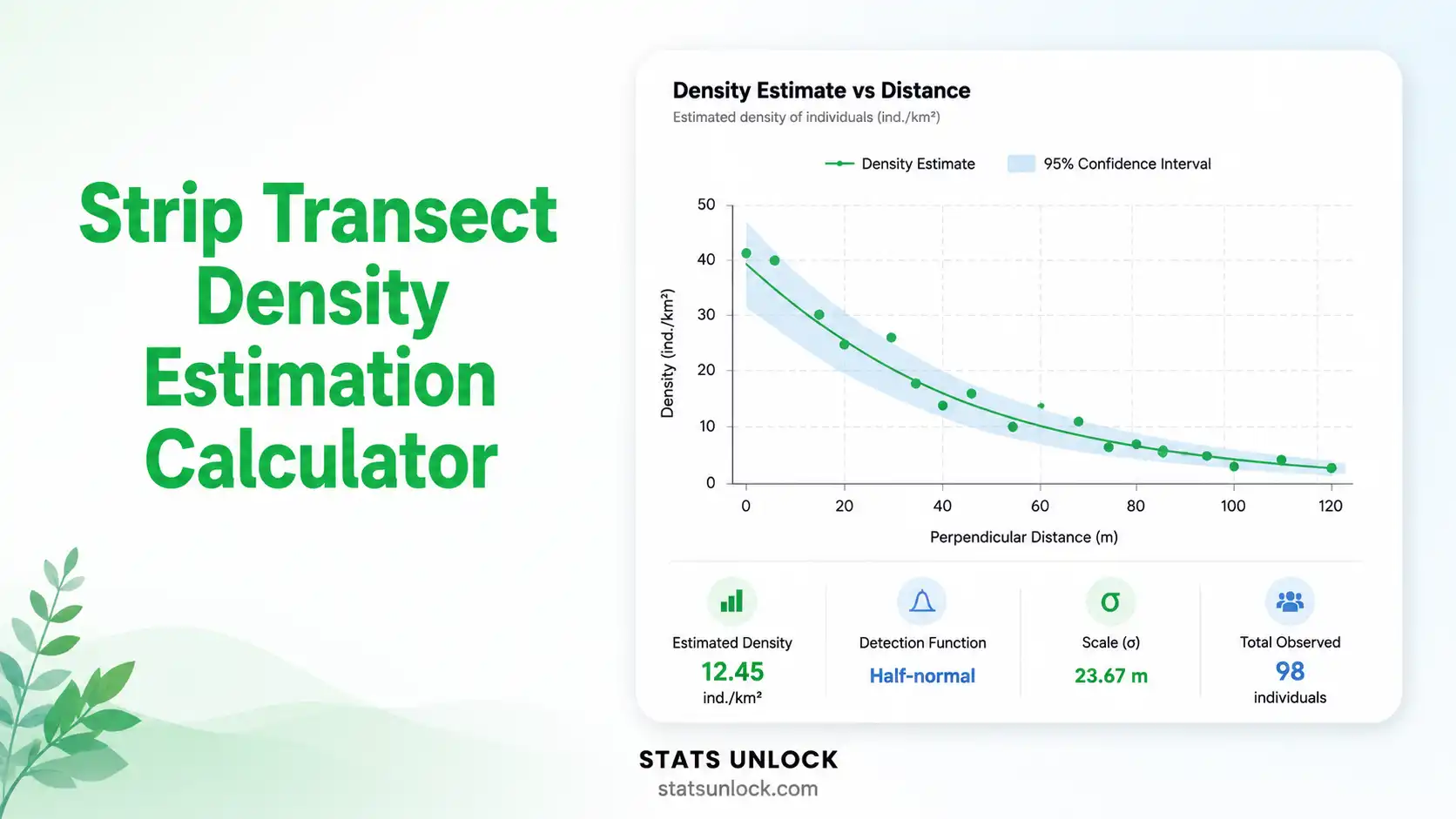

Strip Transect Density Estimation Calculator
Free online wildlife density estimation tool using strip transect sampling. Calculate animal density and 95% confidence intervals from fixed-strip counts — simple, fast, and assumption-driven (perfect detection within the strip).
🚶 How Strip Transect Data Is Collected
Observers walk along a straight transect line and record every animal seen within a fixed strip of half-width w on either side of the line. Unlike line transect (which models declining detection with distance), strip transect assumes 100% detection within the strip — every animal in the strip is counted. The tool calculates density as a simple count divided by the surveyed area.
📖 How this diagram maps to the analysis
Step 1 — Field protocol. Observer walks a pre-set transect line of length L at a constant pace and records every animal seen within a fixed strip of half-width w on either side of the line. Distance is NOT measured to each detection — only the presence/absence inside the strip matters for strip transect.
Step 2 — Data structure. Each row in your CSV / textarea is one detection (you can enter perpendicular distances to log them, but strip transect ignores the values beyond confirming they fall within ±w). With total length L and n total detections, you have one column per species (multi-species mode) or one combined column (single-species mode).
Step 3 — What the tool calculates. No detection function is fitted — strip transect assumes g(x) = 1 for all x within the strip (perfect detection). Density is calculated directly as D̂ = n · E(s) / (2 · w · L), where the surveyed area is 2·w·L (strip of half-width w on each side of the line, for total length L).
Step 4 — Why truncation matters. Animals beyond w are excluded by the survey design — they are not in the surveyed strip. Strip width w should be chosen narrow enough that every animal within it is detected with certainty (the 100% detection assumption holds).
📊 Data Input
Comma-separated input (default). Format: 52, 48, 55, 61, 47, ... — one detection distance per value, in meters.
Enter detection distances row-by-row. Click "Add Row" for more entries, then click "Use This Data" to load.
| # | Distance (m) |
|---|
Download Sample Data
Try the tool with real-world example datasets — includes multi-species CSV files, README, and instructions for USA wildlife (White-tailed Deer, Pronghorn, Coyote).
⚙️ Survey Configuration
Enter the value in your chosen units (right →). Default: 50 km.
Choose any unit — internally converted to meters.
Strip extends from −w to +w on either side of the transect line. Total strip width = 2w. Choose narrow enough that every animal inside is detected. Default: 50 m.
Counts every animal within ±w of the line. Assumes 100% detection inside the strip (no detection function needed).
For imperfect detection / cryptic species, use line transect distance sampling instead.
Choose the area unit appropriate to your study (USA defaults: per km² or per mi²).
📈 Analysis Results
Strip Transect Density Equation
The animal density (D̂) is calculated directly from the count and the surveyed strip area — no detection function is fitted because strip transect assumes 100% detection within the strip:
- D̂: estimated animal density (animals per unit area, e.g., per km²)
- n: total number of detections within the strip
- E(s): expected cluster size (mean group size)
- w: strip half-width (m) — the strip extends from −w to +w on either side
- L: total transect length surveyed (m or km)
- Astrip: total surveyed strip area = 2 · w · L
- Pa: detection probability — assumed = 1.0 (every animal in strip is detected)
⚠️ Assumption: If detection within the strip is <100% (cryptic species, dense cover), density will be biased downward. Use line transect distance sampling instead to estimate Pa from a fitted detection function.
📋 Detailed Results
📊 Visualizations
💡 Click any chart to download it as a 16:9 publication-ready PNG — 2560 × 1440 px (QHD), white background, embedded title and caption. Perfect for journals, slide decks, and posters.
📏 Distance Distribution Histogram
Frequency of detections within distance bins (within the strip). If counts drop off near w, real detection may be imperfect — consider line transect.
📊 Density Estimate with 95% CI
Bar = D̂ point estimate. Whiskers = 95% lower & upper CI. Multi-species runs add a dark "Community Total" bar. Hover for exact LCL/UCL.
📐 Methodology
Run the analysis above to generate the full methodology with citations, parameter values, and software-ready Methods text.
🧭 Detailed Interpretation of Results
Run the analysis above to generate the full detailed interpretation.
✍️ How to Write Your Results in Research
Run the analysis above to auto-fill five publication-ready reporting templates.
🪧 Research Poster Panel
Run the analysis above to generate a complete, attractively-designed research poster.
🎯 Detailed Conclusion
Run the analysis above to generate a full multi-section conclusion.
📐 Technical Notes & Formula Derivation
Show full formula derivation, assumptions, and limitations
Distance sampling foundation (Buckland et al. 2001): Strip transect sampling assumes animals are distributed independently of the transect line and that detection within the strip is essentially perfect. Observers walk the line and record every animal seen within a fixed perpendicular distance w on either side. Unlike line transect, no detection function is fitted — detection is assumed = 1.0 inside the strip by design.
Density formula derivation: Total animals within the strip = D · 2wL, where 2wL is the surveyed area (a strip of half-width w on each side of the line for total length L). Because detection inside the strip is assumed perfect, every animal in this area is detected: n = D · 2wL. Solving for D gives D̂ = n / (2 · w · L). With cluster detections, multiply by mean cluster size: D̂ = n · E(s) / (2 · w · L). Effective strip half-width ESW = w (no detection function is fitted).
Three core assumptions: (1) Every animal inside the strip is detected — g(x) = 1 for all 0 ≤ x ≤ w. (2) Animals are detected at their original positions before any movement in response to the observer. (3) The strip half-width w is accurately delineated in the field so the surveyed area 2wL is known.
Limitations: Violations of perfect detection inside the strip systematically bias density downward — strip transect cannot detect or correct this bias from the data themselves. Choose w narrow enough that 100% detection is defensible for the least-detectable species. Small sample sizes (n < 30) produce wide confidence intervals. Habitat-specific stratification is recommended when detectability or density varies by cover.
Variance estimation: Because Pa is fixed at 1.0 with no estimation uncertainty, the variance of D̂ depends only on encounter-rate variance and cluster-size variance: var(D̂) = D̂² × (CVn² + CVE(s)²). Log-normal 95% confidence intervals are reported.
✅ When to Use Strip Transect Density Estimation
Strip transect is the simplest and fastest distance-sampling method — appropriate when detection is essentially 100% within a known strip (open habitat, conspicuous species).
✓ Use when:
- ✓ Surveying ungulates (white-tailed deer, mule deer, pronghorn, elk) across rangelands or open forests
- ✓ Detection within the chosen strip is essentially perfect (open habitat, conspicuous species, aerial surveys at low altitude)
- ✓ Habitat is open enough that animals are not concealed within ±w of the line
- ✓ Strip half-width w can be chosen narrow enough to keep detection at ~100%
- ✓ You need absolute density (animals/km²) rather than relative indices, and a method simpler than line transect distance sampling
✗ Do NOT use when:
- ✗ Detection inside the strip is clearly < 100% (cryptic species, dense cover) — use line transect distance sampling instead
- ✗ Sample size is very small (n < 30) — switch to mark-recapture or occupancy
- ✗ Habitat blocks straight-line walking (dense swamp, cliff terrain) — use point counts with a stratified design
- ✗ Animals respond strongly to observer presence before being recorded (use unobtrusive methods like camera traps)
🌎 Real-world USA examples:
- White-tailed deer density in Pennsylvania state forests (Game Commission aerial strip surveys)
- Pronghorn surveys in Wyoming sagebrush steppe (BLM aerial strip surveys)
- Mule deer monitoring in Colorado mountain parks (CPW spotlight transects)
- Wild turkey distance sampling in Texas Hill Country (TPWD ground transects)
📘 How to Use This Tool
- Choose your survey mode — Single Species (one animal) or Multi-Species (multiple animals on the same transect).
- Enter detection data — for each detection, record either a count (1 per row) or, optionally, a perpendicular distance from the line in meters (used only for the histogram). Example:
52, 48, 55, 61, 47, ... - Optionally name your study area (e.g., "Yellowstone National Park") — auto-fills all reports and the research poster.
- Set total transect length (L) in km, mi, or m. USA users typically use km or mi.
- Set strip half-width (w) in meters — choose narrow enough that detection inside the strip is effectively 100% (typical: 25–50 m for forest birds, 100–200 m for ungulates in open country).
- Set output unit — per km², per mi² (USA), per ha, or per acre (USA).
- Click "Run Strip Transect Analysis" to compute density, surveyed area (2·w·L), encounter rate (n/L), and 95% CI.
- Review the two visualizations — distance distribution histogram and density estimate with 95% CI.
- Download Doc or PDF — full publication-ready report including poster, interpretation, and references.
❓ Frequently Asked Questions
What is strip transect density estimation?
How do you calculate wildlife density from strip transects?
What is effective strip width (ESW)?
What is the difference between strip transect and line transect?
How many detections are needed for strip transect?
How do I choose strip half-width (w) for a strip transect survey?
Why does strip transect not use Pa?
What is the encounter rate in strip transect surveys?
Can strip transect be used for multiple species?
How accurate is strip transect density estimation?
📚 References
Foundational and current peer-reviewed sources on strip transect sampling, distance sampling theory, and wildlife population estimation methods used in this calculator. Click any citation to open the source in a new tab.
- Buckland, S. T., Anderson, D. R., Burnham, K. P., Laake, J. L., Borchers, D. L., & Thomas, L. (2001). Introduction to Distance Sampling: Estimating Abundance of Biological Populations. Oxford University Press.
- Buckland, S. T., Rexstad, E. A., Marques, T. A., & Oedekoven, C. S. (2015). Distance Sampling: Methods and Applications. Springer.
- Thomas, L., Buckland, S. T., Rexstad, E. A., Laake, J. L., Strindberg, S., et al. (2010). Distance software: design and analysis of distance sampling surveys for estimating population size. Journal of Applied Ecology, 47(1), 5–14.
- Burnham, K. P., Anderson, D. R., & Laake, J. L. (1980). Estimation of density from line transect sampling of biological populations. Wildlife Monographs, 72, 3–202.
- Williams, B. K., Nichols, J. D., & Conroy, M. J. (2002). Analysis and Management of Animal Populations. Academic Press.
- Miller, D. L., Rexstad, E., Thomas, L., Marshall, L., & Laake, J. L. (2019). Distance Sampling in R. Journal of Statistical Software, 89(1), 1–28.
- Anderson, D. R., Laake, J. L., Crain, B. R., & Burnham, K. P. (1979). Guidelines for line transect sampling of biological populations. Journal of Wildlife Management, 43(1), 70–78.
- Marques, T. A., Thomas, L., Fancy, S. G., & Buckland, S. T. (2007). Improving estimates of bird density using multiple-covariate distance sampling. The Auk, 124(4), 1229–1243.
- U.S. Fish & Wildlife Service. (2022). Distance Sampling Protocol for Wildlife Surveys on National Wildlife Refuges. USFWS Technical Report.
- Pollock, K. H., Nichols, J. D., Simons, T. R., Farnsworth, G. L., Bailey, L. L., & Sauer, J. R. (2002). Large-scale wildlife monitoring studies: statistical methods for design and analysis. Environmetrics, 13(2), 105–119.
- Fewster, R. M., Buckland, S. T., Burnham, K. P., Borchers, D. L., Jupp, P. E., et al. (2009). Estimating the encounter rate variance in distance sampling. Biometrics, 65(1), 225–236.
- Marques, F. F. C., & Buckland, S. T. (2003). Incorporating covariates into standard line transect analyses. Biometrics, 59(4), 924–935.
- U.S. Geological Survey. (2020). Wildlife Population Estimation Field Manual. USGS Patuxent Wildlife Research Center.
- Texas Parks & Wildlife Department. (2023). Distance Sampling Guidelines for White-tailed Deer Population Surveys. TPWD Wildlife Division.
- Colorado Parks & Wildlife. (2022). Mule Deer Population Monitoring: Distance Sampling Protocol. CPW Wildlife Research.
- Akaike, H. (1973). Information theory and an extension of the maximum likelihood principle. In B. N. Petrov & F. Csáki (Eds.), Second International Symposium on Information Theory (pp. 267–281). Akadémiai Kiadó.
- Burnham, K. P., & Anderson, D. R. (2002). Model Selection and Multimodel Inference: A Practical Information-Theoretic Approach (2nd ed.). Springer.
- Buckland, S. T., Laake, J. L., & Borchers, D. L. (2010). Double-observer line transect methods: Levels of independence. Biometrics, 66(1), 169–177.
- Marsh, H., & Sinclair, D. F. (1989). Correcting for visibility bias in strip transect aerial surveys of aquatic fauna. Journal of Wildlife Management, 53(4), 1017–1024.
- Abramowitz, M., & Stegun, I. A. (1965). Handbook of Mathematical Functions with Formulas, Graphs, and Mathematical Tables. Dover Publications.
- Borchers, D. L., Buckland, S. T., & Zucchini, W. (2002). Estimating Animal Abundance: Closed Populations. Springer-Verlag.
- Marques, T. A., & Buckland, S. T. (2004). Covariate models for the detection function. Journal of Applied Ecology, 41(2), 366–377.
- Reynolds, R. T., Scott, J. M., & Nussbaum, R. A. (1980). A variable circular-plot method for estimating bird numbers. The Condor, 82(3), 309–313.
- Royle, J. A., Dawson, D. K., & Bates, S. (2004). Modeling abundance effects in distance sampling. Ecology, 85(6), 1591–1597.
- The Wildlife Society. (2020). Standards and Methods for Population Estimation in Wildlife Management. TWS Technical Review 20-01.