

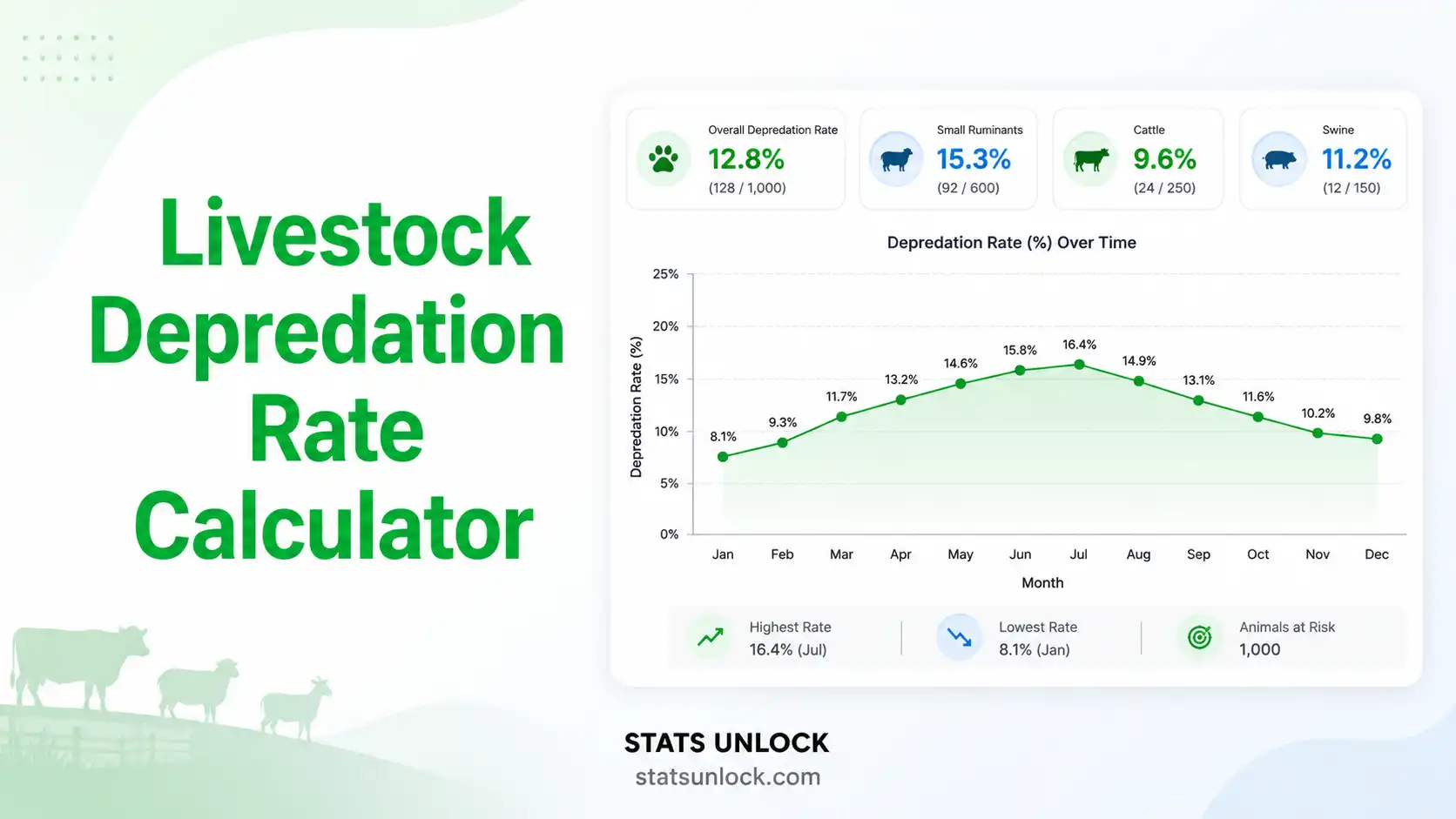

Livestock Depredation Rate Calculator
A free, professional online tool for ranchers, wildlife biologists, and conservation scientists to quantify livestock killed by predators, per-household loss, predator-specific kill rates, and economic damage from human–wildlife conflict.
1📥 Data Input
Enter the number of livestock killed by predators per household, ranch, or year. Use sample data, paste your own, or upload a spreadsheet.
15 valid values entered
If blank, ranches will be auto-labelled as "Ranch 1, Ranch 2, …".
| Ranch / Household | Livestock Killed | Predator |
|---|
2⚙️ Analysis Configuration
Configure denominators, time period, value per head, and group label. Group name is fully editable.
Total head of livestock owned across all households / ranches
Used for economic-loss calculations. Defaults to USD.
📐 Technical Notes — Formulas, Assumptions & Limitations
Extended Formula Derivation
The Livestock Depredation Rate (LDR) is a proportion-based metric expressed as a percentage. The annual formula is:
LDRannual (%) = (∑ Ki / Ntotal) × 100
For multi-year datasets, normalise by years exposed: LDRper year = LDRtotal / Y, where Y = years observed.
Variance & Confidence Interval
Bootstrap 95% CI is computed from 1,000 resamples of the household-level kill counts. The standard binomial CI may also be used: CI = p̂ ± 1.96 √(p̂(1−p̂)/N), where p̂ = LDR / 100 and N = total livestock at risk.
Per-Household Loss
Mean kills per household = ∑ Ki / H, where H = number of households / ranches. Median is reported when distribution is heavily skewed (Gini > 0.4).
Economic Loss
Direct loss = ∑ Ki × market value per head. Indirect losses (reduced weight gain, stress-induced abortions, increased husbandry cost) are typically 1.5–3× the direct loss but are not computed here.
Assumptions
- All kills correctly attributed to predators (forensic verification recommended)
- Denominator Ntotal is accurate at start of period (does not include births during the period)
- Households reported losses honestly and completely (no under-reporting bias)
- The time period is uniform across all households
Limitations
- Does not separate confirmed vs probable kills — use USDA-WS forensic categories where possible
- Missing carcasses cause systematic under-estimation (10–30% in extensive grazing systems)
- Scavenging by non-killing predators inflates apparent kill counts (use bite-pattern forensics)
- Single-year data are unstable — multi-year averages are recommended
🕐 When to Use This Tool
Decision Checklist
- ✅ You have predator-caused kill counts per household, ranch, or year
- ✅ You know the total livestock-at-risk (denominator)
- ✅ Sampling effort is standardised (same time period, same reporting protocol)
- ✅ You need a publication-ready metric for an ecology / wildlife journal or USDA report
- ❌ Do NOT use if you only have presence/absence of predators (no kill counts) → use occupancy modelling instead
- ❌ Do NOT use if causes of death are mixed and unverified — separate predator kills from disease & weather first
- ❌ Do NOT use if households differ greatly in herd size and you cannot weight by exposure
Real-World USA Examples
- Wyoming wolf-cattle conflict: Comparing depredation rates across ranches inside vs outside wolf-recovery zones to inform compensation policy.
- Montana sheep operations: Quantifying coyote-caused lamb losses before and after deployment of livestock guardian dogs.
- Idaho mountain lion management: Estimating cattle losses to assess effectiveness of preventive management zones.
- Minnesota dairy & black-bear conflict: Tracking annual calf depredation as basis for non-lethal deterrent grants.
Sampling Design Guidance
- Minimum 30 households or 12 months of records for stable estimates
- Three consecutive years of data smooth out seasonal and inter-annual variation
- Replicate ranches (≥ 5 per treatment) are required for statistical comparison
- Always report S (sample size = households) and N (total livestock at risk)
Related Metrics — Decision Tree
Need a single rate per ranch/year?           → Livestock Depredation Rate (this tool)
  → Want predator-specific rates?            → Stratify by predator species
  → Want economic damage?                    → Multiply kills × market value
Need to know predator presence?              → Camera Trap Detection Rate
Need to compare multiple sites?              → Bootstrap CI + Mann-Whitney U test
Need to estimate "missing" kills?            → Carcass Detection Probability model
Need spatially explicit risk?                → Resource Selection Function (RSF)
📖 How to Use This Tool — Step-by-Step Guide
- STEP 1 — Enter Your Data: Use the Paste/Type tab (free text or Column Entry mode), the Upload tab (CSV/Excel — pick the column with kill counts), or the Manual Table tab. Example: "52, 48, 55, 61" = livestock killed in households 1–4.
- STEP 2 — Pick a Sample Dataset: Five real-world USA datasets are pre-loaded — Wyoming wolves, Montana coyotes, Idaho mountain lion + wolf, New Mexico coyote + cougar, Minnesota black bear + wolf.
- STEP 3 — Configure Settings: Set the Group Name (editable — auto-fills throughout the report), total livestock at risk (denominator), time period, livestock type, market value per head, and dominant predator.
- STEP 4 — Run the Analysis: Click the green "▶ Run Analysis" button. The tool computes total kills, depredation rate (%), per-household loss, economic damage, and 95% CI.
- STEP 5 — Read the Summary Cards: Green = LOW depredation (<1%), amber = MODERATE (1–5%), red = HIGH (>5%). Per-household loss and economic damage are colour-coded similarly.
- STEP 6 — Read the Results Table: A grouped 7-section table — Core Depredation Rate (total kills, total at risk, period-specific LDR, annual LDR %, 95% CI, USDA tier), Per-Household Central Tendency (mean, median, SEM, t-CI), Per-Household Dispersion (SD, CV, range, IQR, Q1, Q3, P90, P95, dispersion), Distribution Shape (skewness, excess kurtosis), Loss Concentration (Gini, top-3 and bottom-3 household shares), Exposure & Economics (mean exposure, loss density, total economic loss, mean loss per ranch), and Predator (dominant species and pressure index).
- STEP 7 — Examine All Six Charts: Bar chart (kills per household), pie chart (predator share), Lorenz cumulative loss curve, frequency histogram, box-and-whisker plot (five-number summary with outlier flags), and Pareto chart (80/20 loss analysis). Together they reveal magnitude, distribution, outliers, and concentration of loss.
- STEP 8 — Read the Interpretation: Five paragraphs explain what was found, what the rate means ecologically, magnitude in practical ranching terms, statistical vs practical significance, and limitations.
- STEP 9 — Copy a Reporting Example: Five publication-ready templates — Ecology Journal, Thesis, Plain-Language Policy Brief, Conference Abstract, Long-Term Monitoring. One-click copy.
- STEP 10 — Export Your Results: Download Doc (.txt) for emails & shareable summaries; Download PDF for printing or attaching to USDA compensation claims.
7❓ Frequently Asked Questions
Q1. What is livestock depredation rate and when should I use it?
Livestock Depredation Rate (LDR) is the percentage of livestock killed by wild predators in a defined herd or community over a known period. Use it whenever you need to quantify human–wildlife conflict, justify compensation claims, or compare predator pressure across ranches, seasons, or predator-control treatments. Common in USDA-Wildlife Services reports, wolf-recovery monitoring, and grazing allotment assessments.
Q2. What data do I need to calculate livestock depredation rate?
You need: (1) the number of livestock killed by predators per household, ranch, or year (counts only), and (2) the total livestock at risk (denominator). Optional but recommended fields: predator species, market value per head, time period, and forensic verification status (confirmed / probable / possible).
Q3. What does a high vs low livestock depredation rate mean?
A rate above 5% per year is generally HIGH and indicates severe predator pressure, vulnerable husbandry practices, or both. 1–5% is MODERATE — typical of working ranches in wolf or mountain lion range. Below 1% is LOW and often indicates effective non-lethal deterrents (guardian dogs, fladry, electronic alarms) or low predator density. The USDA-NASS national average for cattle is around 0.2%.
Q4. How does livestock depredation rate differ from total mortality rate?
Total mortality includes all causes — disease, weather, accidents, theft, calving complications. Depredation rate isolates only confirmed or strongly suspected predator-caused deaths. Always distinguish the two when reporting compensation losses or justifying lethal control. USDA classifies kills as "confirmed", "probable", "possible", and "unknown".
Q5. What are the assumptions and limitations of livestock depredation rate?
It assumes that all kills are correctly attributed to predators and the denominator is accurate. It does NOT account for missing carcasses (under-reporting), scavenging by non-killing predators, or differential search effort. Use forensic carcass evidence to verify predator identity. For extensive grazing systems, real losses may be 2–3× reported losses.
Q6. How much sampling effort do I need for depredation rate to be reliable?
At least 30 households or 12 months of records are recommended. Smaller samples produce unstable estimates dominated by single-year outliers. For ranch-level estimates, three consecutive years of data are ideal to smooth seasonal and inter-annual variation.
Q7. Can I compare livestock depredation rates between ranches or years?
Yes — but only if reporting protocols and predator surveillance effort were similar. Standardise the denominator (livestock-at-risk per year) and report mean ± SD. Use bootstrap confidence intervals or Mann-Whitney U tests when comparing small samples. Avoid comparing rates across different forensic verification regimes.
Q8. How do I report livestock depredation rate in a journal or USDA report?
Report the rate as a percentage with 95% CI, total livestock killed, total livestock at risk, predator species composition, and economic damage where applicable. See the five reporting templates in this tool's Results section — covering ecology journal style, thesis/dissertation style, plain-language policy brief, conference abstract, and long-term monitoring report formats.
Q9. Can I use this calculator for published research or a university thesis?
Yes, as a teaching, exploratory, and verification tool. For peer-reviewed research, also verify with R (stats package, boot package for confidence intervals) or USDA-NASS official protocols. Cite as: Stats Unlock. (2025). Livestock Depredation Rate Calculator. Retrieved from https://statsunlock.com
Q10. My livestock depredation rate seems unexpectedly high — what might have gone wrong?
Common causes: kills attributed to predators without forensic confirmation (over-counting), denominator excludes new births during the year, scavenging events double-counted as separate kills, or one outlier ranch dominates the mean. Check the raw input table, confirm USDA-WS forensic classes, and consider reporting median alongside the mean.
📚 References
The following references support the methods used in this livestock depredation rate calculator, covering human–wildlife conflict, predator-livestock loss assessment, and best practices in conservation biology.
- Treves, A., & Karanth, K. U. (2003). Human–carnivore conflict and perspectives on carnivore management worldwide. Conservation Biology, 17(6), 1491–1499. https://doi.org/10.1111/j.1523-1739.2003.00059.x
- Mech, L. D., & Boitani, L. (Eds.). (2003). Wolves: Behavior, ecology, and conservation. University of Chicago Press.
- USDA-APHIS Wildlife Services. (2023). Cattle and calves death loss in the United States due to predator and nonpredator causes, 2020. National Agricultural Statistics Service. https://www.nass.usda.gov
- Bangs, E. E., et al. (2005). Managing wolf–human conflict in the northwestern United States. In People and Wildlife: Conflict or Coexistence? (pp. 340–356). Cambridge University Press. https://doi.org/10.1017/CBO9780511614774.022
- Muhly, T. B., & Musiani, M. (2009). Livestock depredation by wolves and the ranching economy in the Northwestern U.S. Ecological Economics, 68(8–9), 2439–2450. https://doi.org/10.1016/j.ecolecon.2009.04.008
- Stone, S. A., et al. (2017). Adaptive use of nonlethal strategies for minimizing wolf–sheep conflict in Idaho. Journal of Mammalogy, 98(1), 33–44. https://doi.org/10.1093/jmammal/gyw188
- Eklund, A., et al. (2017). Limited evidence on the effectiveness of interventions to reduce livestock predation by large carnivores. Scientific Reports, 7, 2097. https://doi.org/10.1038/s41598-017-02323-w
- Bradley, E. H., et al. (2015). Effects of wolf removal on livestock depredation recurrence and wolf recovery in Montana, Idaho, and Wyoming. Journal of Wildlife Management, 79(8), 1337–1346. https://doi.org/10.1002/jwmg.948
- Ramler, J. P., et al. (2014). Crying wolf? A spatial analysis of wolf location and depredations on calf weight. American Journal of Agricultural Economics, 96(3), 631–656. https://doi.org/10.1093/ajae/aat100
- Inskip, C., & Zimmermann, A. (2009). Human–felid conflict: A review of patterns and priorities worldwide. Oryx, 43(1), 18–34. https://doi.org/10.1017/S003060530899030X
- Mizutani, F. (1999). Impact of leopards on a working ranch in Laikipia, Kenya. African Journal of Ecology, 37(2), 211–225. https://doi.org/10.1046/j.1365-2028.1999.00170.x
- Sommers, A. P., et al. (2010). Quantifying economic impacts of large-carnivore depredation on bovine calves. Journal of Wildlife Management, 74(7), 1425–1434. https://doi.org/10.2193/2009-070
- Linnell, J. D. C., et al. (2012). The challenges and opportunities of coexisting with wild ungulates in human-dominated landscapes. NINA Report 783. Norwegian Institute for Nature Research.
- R Core Team. (2024). R: A language and environment for statistical computing. R Foundation for Statistical Computing. https://www.R-project.org/
- Defenders of Wildlife. (2024). Coexisting with carnivores: Practical tools for ranchers. https://defenders.org