

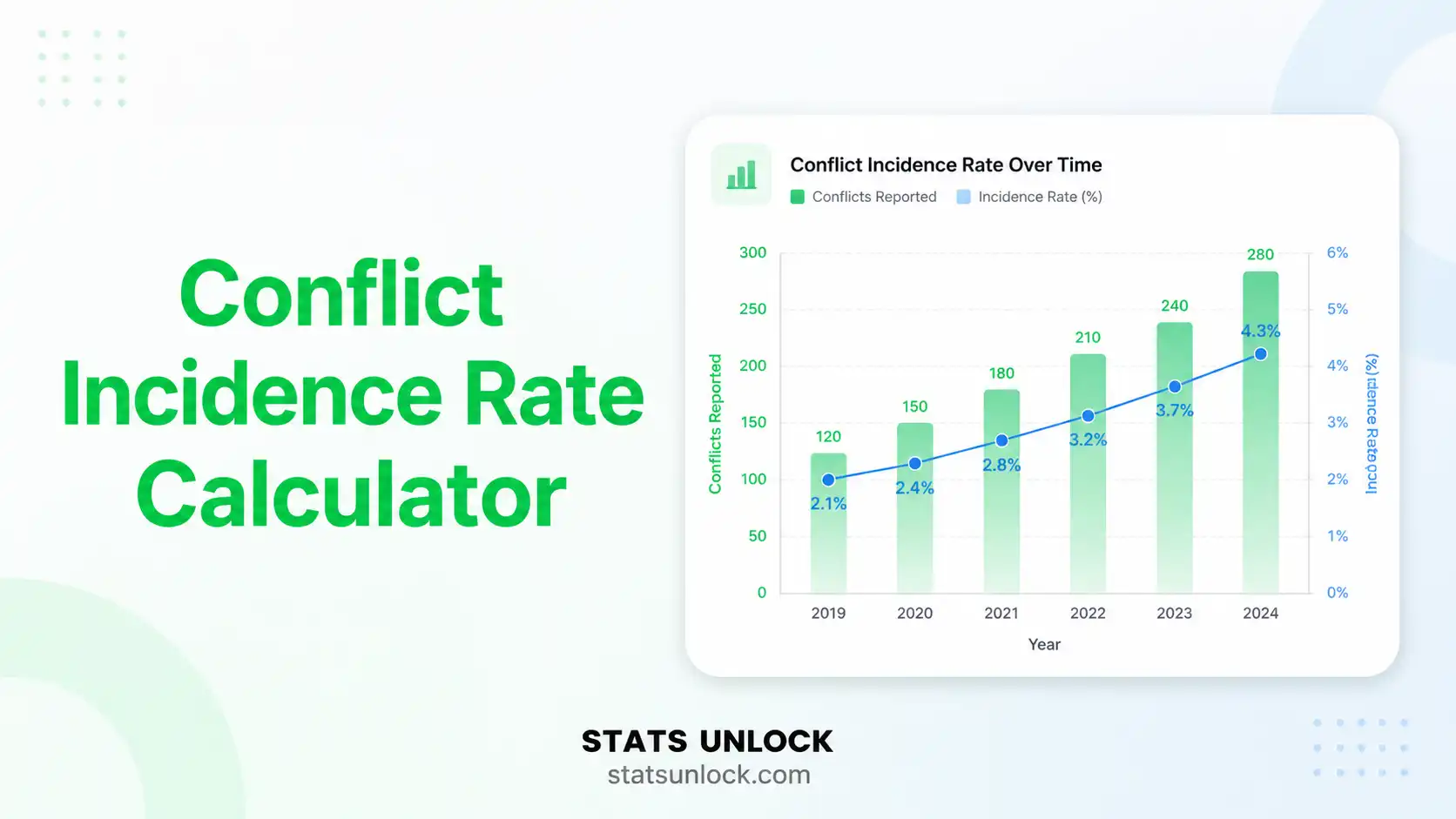

Conflict Incidence Rate Calculator
Quantify human-wildlife conflict pressure (HWC) per 100 households or per km² — for livestock depredation, crop raiding, property damage, and human injury studies
📥 Data Input
⚙️ Analysis Configuration
📊 Results
Conflict Incidence Rate Equation
The Conflict Incidence Rate (CIR) is calculated as:
- CIR: Conflict Incidence Rate (incidents per N households or units)
- Total Conflict Incidents: Sum of all reported HWC events across the sample
- Total Sampling Units (N): Number of households, farms, or km² surveyed
- Rate Base: Standardisation multiplier (typically 100, 1,000, or 10,000)
- 95% CI: Confidence interval calculated using the Poisson exact method (Garwood, 1936)
📋 Detailed Results
| Statistic | Value | Description |
|---|
📈 Visualizations
📊 Incidents per Sampling Unit
🥧 Conflict Distribution Profile
📉 Cumulative Incident Curve
🎯 Severity Tier Distribution
📝 Interpretation Results
✍️ How to Write Your Results in Research
Five publication-ready reporting templates and a research poster panel — all auto-filled with your computed conflict incidence rate values.
📌 Key conventions for this style
- Report rate, numerator, denominator, and 95% CI
- State the observation window in months or trap-equivalent
- Compare to a published baseline rate when available
- Cite the original incidence rate methodology (Inskip & Zimmermann, 2009)
📌 Key conventions for this style
- Methods paragraph: data source, sampling design, software
- Results paragraph: rate + 95% CI + comparison
- State the analysis package (e.g., R, base epitools)
- Cite both the index methodology and a HWC reference text
📌 Key conventions for this style
- Avoid all symbols and Greek letters
- Express rates as comparative statements ("higher than", "1 in 5")
- Always end with a management implication
- Suitable for funders, agencies, and local government readers
📌 Key conventions for this style
- Strict word limit (150–250 words)
- Four labelled sections: Background, Methods, Results, Conclusion
- Lead with the problem statement, end with the implication
- No citations except in the Methods section
📌 Key conventions for this style
- Year-over-year trend reporting required
- Clear separation of data, analysis, and recommendation
- Standard tables for spatial breakdown
- Suitable for USFWS, USDA-APHIS, state DNR reports
🪧 Research Poster Panel
A print-ready, conference-grade research poster panel — auto-filled with your computed values. Use as the scaffold for your A0 or 36×48 in. poster.
Run analysis to generate poster title
Subtitle pending analysis
📍 Introduction
Run the analysis above to generate the introduction.
🔬 Methods
Run the analysis above to generate the methods.
📊 Results
💭 Discussion
Run the analysis above to generate the discussion.
🎯 Take-Home Message
📌 Poster design specifications
- Typography: Title 72–96 pt bold; section headers 36–48 pt; body 24–28 pt minimum (readable at 1 m)
- Colour palette: White background, deep forest green (#16a34a) primary accent, amber (#d97706) for cautionary notes, muted red (#dc2626) for danger; never more than 3 accent colours
- Standard sizes: A0 portrait (841×1189 mm), A0 landscape (1189×841 mm), 36×48 in (914×1219 mm — North American standard), A1 portrait (594×841 mm)
- Print resolution: 300 dpi minimum; export as PDF (not PNG) for print shops
- Software: Canva (free), PowerPoint, Adobe Illustrator, or Inkscape; export PDF/X-1a for professional printing
- Zone allocation: Title bar 10–12% · Intro+Methods 20–25% · Results 40–45% (largest) · Discussion+Conclusions 20–25% · Footer 5–8%
🔧 Technical Notes
Extended formula derivation, assumptions, and limitations
Extended formula
CIR = (Σ xi / N) × k
95% CI (Poisson exact) = [χ²α/2,2x/2N , χ²1−α/2,2(x+1)/2N] × k
where xi = incidents in unit i, N = total sampling units, k = rate base (100, 1,000, …), x = total incidents, χ² = chi-square quantile.
Assumptions
- Conflict events are independent across sampling units
- Detection probability is uniform across units (or detection bias is corrected)
- The denominator (households or area) is stable during the observation window
- Incident definition is consistent across all enumerators
- Counts follow a Poisson distribution (mean ≈ variance)
Limitations
- Does not weight incident severity (a single fatality is treated equal to a crop loss)
- Rare events (n < 5) yield wide confidence intervals
- Self-reporting bias may inflate or deflate the true rate
- Seasonal effects are masked when using annual aggregation
- Spatial autocorrelation across neighbouring units violates independence — consider mixed-effects models
🎯 When to Use This Tool
✓ / ✗ Decision Checklist
- You have conflict incident counts standardised across a defined number of sampling units
- You want to compare conflict pressure across sites, seasons, species, or management zones
- Your sampling effort is consistent (same household count, same observation window per site)
- You need a publication-ready HWC metric for an ecology journal or agency report
- Do NOT use if sampling effort differs greatly between sites — standardise first
- Do NOT use if your data are presence/absence only — use occupancy modelling instead
- Do NOT use as the only metric for severity — supplement with damage cost or injury index
🌍 Real-World USA Examples
- Yellowstone Wolf-Livestock Conflict (Montana, Wyoming, Idaho): Annual depredation rates per 100 ranches calculated for USDA-APHIS Wildlife Services compensation programs
- Florida Black Bear Property Damage (Ocala / Apalachicola): Trash and beehive incidents per 100 households tracked by Florida Fish and Wildlife Conservation Commission
- White-tailed Deer Crop Raiding (Pennsylvania, Ohio, Wisconsin): Crop damage events per 100 farms tracked across agricultural extension surveys
- Coyote Pet-Attack Rates (Los Angeles, Cook County IL): Urban coyote conflict rate per 10,000 residents — reported in municipal wildlife dashboards
- American Alligator Nuisance Rate (Florida): Nuisance complaints per 1,000 lakeshore parcels — Florida Statewide Alligator Harvest Program data
📐 Sampling Design Guidance
- Minimum 30 sampling units (households, farms, or km²) for stable rate estimates
- Minimum 12-month observation window to capture seasonal variation
- Standardise incident definition with written field guide before data collection
- Replicate sites (≥ 3) needed for statistical comparison between treatment groups
- Use Poisson regression for between-site comparison when covariates are involved
🔀 Related Metrics — Decision Tree
Need a single conflict pressure number? → Conflict Incidence Rate (this tool)
→ Want to weight by severity (fatality vs property)? → Damage Cost Index
→ Want to model space-time clusters? → Conflict Hotspot Analysis (Getis-Ord Gi*)
→ Want to compare with covariates? → Poisson / Negative Binomial regression
Need detection-corrected estimates? → Occupancy modelling
Need to model the per-event probability? → Risk Mapping / MaxEnt
🧭 How to Use This Tool — 10 Steps
- Define your sampling unit — household, farm, village, or km² grid cell. All counts must use the same denominator.
- Define a clear incident type — livestock depredation, crop damage, property damage, or human injury. Use one type per analysis.
- Set the observation window — typically 12 months. Shorter windows miss seasonal variation.
- Enter your data — paste comma-separated counts, upload a CSV/Excel column, or use manual entry.
- Set the rate base — per 100 (default), per 1,000, or per 10,000 sampling units.
- Enter total sampling units — total households, farms, or area surveyed.
- Set confidence level — 95% is the default and is appropriate for most studies.
- Click Calculate — the tool computes the rate, 95% CI, and severity tier (HIGH / MODERATE / LOW).
- Review the four visualizations — bar plot, distribution profile, cumulative curve, and severity tier breakdown.
- Export the report — copy a reporting template, download the .txt summary, or print to PDF for your study file.
💡 Worked USA Example — Yellowstone Wolf Conflict
A wildlife biologist surveys 12 ranching communities in Park County, Montana, recording wolf-livestock depredation incidents over the 2024 calendar year. Counts: 52, 48, 55, 61, 47, 39, 58, 44, 50, 53, 49, 56. Total households surveyed: 245. Setting rate base = 100 yields CIR ≈ 247.8 incidents per 100 households per year, indicating an exceptionally high conflict pressure tier — consistent with active depredation hotspots reported by USDA-APHIS Wildlife Services.
❓ Frequently Asked Questions
What is the conflict incidence rate and when should I use it?
The conflict incidence rate (CIR) is the number of human-wildlife conflict events (livestock loss, crop damage, property damage, or human injury) per 100 sampling units (households, farms, villages, or square kilometers) during a defined time window. Use CIR to compare conflict pressure across sites, seasons, or species in a standardized way. A typical use case is comparing wolf depredation rates across multiple ranching counties or quantifying urban coyote pressure across census tracts.
What data do I need to calculate the conflict incidence rate?
You need a list of conflict counts per sampling unit (e.g., incidents recorded per household, per farm, or per village) collected over a defined time period. The denominator (number of households or area) must be standardized across the comparison. The Paste tab works best for small datasets (<30 units), while the Upload tab handles large agency datasets exported from spreadsheets.
What does a high vs low CIR value mean ecologically?
A high CIR (above 25 incidents per 100 households per year) indicates serious conflict pressure requiring management intervention. A moderate CIR (10–25) suggests targeted mitigation such as livestock guarding dogs, fencing, or compensation programs. A low CIR (below 10) is typical of stable coexistence zones or areas with low wildlife density. These thresholds vary by species — large carnivore CIRs above 5 may already indicate concern, while ungulate crop-raiding CIRs of 50+ are not unusual.
How does CIR differ from total conflict counts?
Total counts ignore exposure — a village with 200 households reporting 30 incidents has a different conflict pressure than a village with 50 households reporting 30 incidents. CIR standardizes counts by exposure (the denominator) so that sites of different sizes can be compared directly. This is the same principle as crime rate vs total crime in epidemiology.
What are the assumptions and limitations of CIR?
CIR assumes equal detection probability across sampling units, complete reporting of incidents, and stable household or farm counts during the sampling period. It does not account for severity (a single fatality vs. crop loss are weighted equally) or imperfect detection. For severity-adjusted analysis, supplement with a damage cost index or human injury weighting scheme. For detection-corrected analysis, use occupancy or N-mixture models.
How much sampling effort do I need for CIR to be reliable?
For a stable estimate, sample at least 30 sampling units (households or farms) and a minimum 12-month observation window to capture seasonal variation. Sites with fewer than 30 households need wider confidence intervals and bootstrapping. For rare events (incidents < 5 total), the Poisson exact CI may span an order of magnitude — interpret cautiously.
Can I compare CIR values between sites or seasons?
Yes, but only when sampling protocols are standardized — same incident definition, same observation window, and similar denominator units. Use Poisson confidence intervals or chi-square tests for formal comparison. For multi-site comparison with covariates (habitat, livestock density, distance to forest), use Poisson or negative binomial regression instead of raw CIR comparison.
How do I report CIR in a journal or conservation report?
Report the rate, the numerator (total incidents), the denominator (number of sampling units), the observation period, and a 95% confidence interval. Example: CIR = 18.4 incidents per 100 households per year (95% CI: 14.2–23.6, n = 245 households, Jan–Dec 2024). See Section 2.7 for five complete reporting templates.
Can I use this calculator for published research or a thesis?
This tool is designed for educational use, exploratory field analysis, and agency reporting. For peer-reviewed research, verify results with established statistical software (R epitools package, SAS PROC GENMOD, or SPSS) and cite the original incidence rate methodology. Site citation: Stats Unlock. (2025). Conflict Incidence Rate Calculator. Retrieved from https://statsunlock.com.
My CIR seems unexpectedly high or low — what might have gone wrong?
Check for: (1) double-counted incidents (one event reported by both household and ranch agency), (2) inconsistent incident definitions across enumerators, (3) wrong denominator (using total population when households are needed), (4) seasonal bias if the window is shorter than 12 months, and (5) data entry errors in the input column. Compare your dataset against the five sample USA datasets in this tool to verify the calculation logic.
🔍 Conclusion
▶ Run the analysis above to generate a personalised conclusion for your dataset.
📚 References
Selected peer-reviewed sources for the conflict incidence rate methodology and human-wildlife conflict analysis. All references in APA 7th edition.
- Inskip, C., & Zimmermann, A. (2009). Human-felid conflict: A review of patterns and priorities worldwide. Oryx, 43(1), 18–34. https://doi.org/10.1017/S003060530899030X
- Treves, A., & Karanth, K. U. (2003). Human-carnivore conflict and perspectives on carnivore management worldwide. Conservation Biology, 17(6), 1491–1499. https://doi.org/10.1111/j.1523-1739.2003.00059.x
- Dickman, A. J. (2010). Complexities of conflict: The importance of considering social factors for effectively resolving human-wildlife conflict. Animal Conservation, 13(5), 458–466. https://doi.org/10.1111/j.1469-1795.2010.00368.x
- Madden, F. (2004). Creating coexistence between humans and wildlife: Global perspectives on local efforts to address human-wildlife conflict. Human Dimensions of Wildlife, 9(4), 247–257. https://doi.org/10.1080/10871200490505675
- Woodroffe, R., Thirgood, S., & Rabinowitz, A. (Eds.). (2005). People and wildlife: Conflict or coexistence? Cambridge University Press. https://doi.org/10.1017/CBO9780511614774
- Distefano, E. (2005). Human-wildlife conflict worldwide: Collection of case studies, analysis of management strategies and good practices. FAO. https://www.fao.org/3/au241e/au241e.pdf
- Garwood, F. (1936). Fiducial limits for the Poisson distribution. Biometrika, 28(3/4), 437–442. https://doi.org/10.2307/2333958
- Nyhus, P. J. (2016). Human-wildlife conflict and coexistence. Annual Review of Environment and Resources, 41, 143–171. https://doi.org/10.1146/annurev-environ-110615-085634
- Conover, M. R. (2002). Resolving human-wildlife conflicts: The science of wildlife damage management. CRC Press. https://doi.org/10.1201/9781420032581
- USDA APHIS Wildlife Services. (2024). Program Data Reports — Annual Tables. United States Department of Agriculture. https://www.aphis.usda.gov/aphis/ourfocus/wildlifedamage/pdr
- Bombieri, G., Naves, J., Penteriani, V., et al. (2019). Brown bear attacks on humans: A worldwide perspective. Scientific Reports, 9, 8573. https://doi.org/10.1038/s41598-019-44341-w
- Karanth, K. K., Gopalaswamy, A. M., DeFries, R., & Ballal, N. (2012). Assessing patterns of human-wildlife conflicts and compensation around a Central Indian protected area. PLoS ONE, 7(12), e50433. https://doi.org/10.1371/journal.pone.0050433
- Naughton-Treves, L., Grossberg, R., & Treves, A. (2003). Paying for tolerance: Rural citizens' attitudes toward wolf depredation and compensation. Conservation Biology, 17(6), 1500–1511. https://doi.org/10.1111/j.1523-1739.2003.00060.x
- Florida Fish and Wildlife Conservation Commission. (2024). Florida Black Bear Management Plan — Annual Report. https://myfwc.com/wildlifehabitats/wildlife/bear/
- Pennsylvania Game Commission. (2024). White-tailed Deer Crop Damage Survey — Annual Summary. https://www.pgc.pa.gov