

MANOVA Calculator – Free Multivariate ANOVA Tool | StatsUnlock

MANOVA Calculator – Free Online Multivariate ANOVA Tool | Effect Size & Wilks' Lambda

📋 Data Input

Enter values for each group. Each group can have 2–6 dependent variables (DVs). Enter values comma-separated. All groups must have the same number of DVs.

→ Name each DV below (editable)
Supports .csv, .txt, .xlsx, .xls — headers auto-detected. Select one Group column (text/categorical) and one or more DV columns (numeric). Rows are split into groups automatically.

Enter values directly in the grid. Each row = one observation. Each column = one dependent variable (DV). Add rows as needed.

⚙️ Test Configuration

🧮 Technical Notes — Formulas Used

The MANOVA calculator uses the following formulas to compute multivariate test statistics, effect sizes, and post-hoc comparisons.

Total Sum-of-Squares-and-Cross-Products Matrix (T)
T = ΣiΣj (xij − x̄)(xij − x̄)′
Tp×p matrix of total variability across all p dependent variables
xijObservation vector for subject j in group i (length p)
Grand mean vector across all groups and subjects
Between-Groups SSCP Matrix (B) & Within-Groups SSCP Matrix (W)
B = Σi ni(x̄i−x̄)(x̄i−x̄)′  |  W = ΣiΣj(xij−x̄i)(xij−x̄i)′
BBetween-groups matrix — captures how much group centroids deviate from the grand mean
WWithin-groups (error) matrix — captures variability of subjects around their group centroid
iMean vector for group i
niNumber of observations in group i
Wilks' Lambda (Λ)
Λ = |W| / |W + B| = ∏i 1/(1+λi)
|W|Determinant of the within-groups SSCP matrix
|W+B|Determinant of the total SSCP matrix (T = W + B)
λiEigenvalues of W⁻¹B — measure group separation on each discriminant function
Range0 (perfect separation) to 1 (no group differences); smaller Λ → larger effect
Pillai's Trace (V)
V = Σi λi/(1+λi) = trace[B(B+W)&sup-1;]
VSum of explained proportions across all discriminant functions; range 0 to s = min(p, k−1)
traceSum of diagonal elements of a matrix
NoteMost robust statistic — recommended when sample sizes are unequal or covariance matrices differ
F-Approximation for Wilks' Lambda (Rao, 1951)
F = [(1−Λ1/t)/Λ1/t] × [df2/df1]
t= √[(p²(k−1)²−4) / (p²+(k−1)²−5)] when p(k−1) > 2, else 1
df1= p(k−1) — numerator degrees of freedom
df2= wt − [p(k−1)−2]/2, where w = N − k − (p−k+2)/2
pNumber of dependent variables; k = number of groups; N = total sample size
Partial Eta-Squared (Effect Size)
η²p = 1 − Λ1/t
η²pProportion of multivariate variance explained by the grouping factor, controlling for other effects
Benchmarks0.01 small · 0.06 medium · 0.14 large (Cohen, 1988)
NoteFor Pillai: η²p = V/s; for Hotelling: η²p = T/(T+s)
Univariate F-test (Follow-up ANOVA per DV)
Fj = MSBj / MSWj  , df = (k−1, N−k)
MSBjMean square between groups for dependent variable j = SS_B(j) / (k−1)
MSWjMean square within groups for DV j = SS_W(j) / (N−k)
NoteRun only after a significant MANOVA; use Bonferroni-corrected α = 0.05/p for each DV
📌 When to Use MANOVA

This free MANOVA calculator is designed for researchers, students, and analysts who need to compare three or more groups across multiple continuous dependent variables simultaneously. MANOVA tests whether group centroids differ significantly in multivariate space — a question that cannot be answered by running separate ANOVAs without inflating Type I error.

✅ Use MANOVA When:

You have two or more continuous dependent variables measured on the same subjects
You have one categorical independent variable (grouping factor) with 2 or more levels
Your dependent variables are moderately correlated (r = 0.30–0.70 is ideal)
You have at least 20 observations per group (more than the number of DVs)
You want to control the family-wise Type I error rate across DVs
Do NOT use if your DVs are not correlated — run separate ANOVAs instead
Do NOT use if dependent variables are categorical — use log-linear analysis or chi-square
Do NOT use if DVs are redundant (r > 0.90) — remove multicollinear variables first
Do NOT use if group n is smaller than the number of DVs — model will be underdetermined

🌍 Real-World Examples

🏥 Clinical Psychology — Therapy Comparison
A researcher compares three therapy groups (CBT, mindfulness, waitlist control) on three DVs: anxiety score, depression score, and quality-of-life index, all measured post-treatment. MANOVA tests whether any of the three therapy types differs from the others across the combined outcome battery.
🌱 Ecology — Fertilizer Treatment Effects
An ecologist compares four fertilizer types on plant height, leaf count, and chlorophyll concentration simultaneously. Because these three DVs are correlated (taller plants also have more leaves), MANOVA is more appropriate than three separate ANOVAs.
📚 Education — Teaching Method Effectiveness
An educational researcher compares two teaching methods (lecture vs. inquiry-based) on math scores, science scores, and reading comprehension. MANOVA reveals whether the two methods differ across the academic achievement profile as a whole.
💼 Business — Marketing Channel ROI
A marketing analyst compares social media, email, and paid ads on engagement rate, conversion rate, and customer retention simultaneously. MANOVA determines whether the three channels produce different multi-metric performance profiles.

🌿 Decision Tree — MANOVA vs Alternatives

Multiple DVs, 1 grouping factor → MANOVA (this tool) ├─ Significant MANOVA → Run follow-up ANOVAs per DV (Bonferroni α) │ └─ Significant ANOVA per DV → Tukey HSD post-hoc for group pairs └─ Non-significant → No follow-up tests justified One DV, 3+ groups → One-Way ANOVA One DV, 2 groups → Independent Samples t-test Multiple DVs, repeated measures → Repeated-Measures MANOVA (Profile Analysis) Multiple DVs, 2+ IVs → Two-Way MANOVA / Factorial MANOVA DVs are categorical → Chi-Square / Log-Linear Analysis DVs are ordinal, non-normal → Non-parametric alternatives (Kruskal-Wallis per DV)
📖 How to Use This MANOVA Calculator — Step-by-Step

Follow these 10 steps to run a MANOVA analysis. The worked example uses therapy groups (CBT, Mindfulness, Control) assessed on anxiety and depression scores.

1
Choose or Enter Your Data
Use the "Paste / Type Data" tab to enter comma-separated values per group and per dependent variable. For example: Group 1 (CBT), DV1 (Anxiety): 52, 48, 55, 61, 47; DV2 (Depression): 38, 35, 41, 44, 33. Each group must have the same number of DVs.
2
Set the Number of Dependent Variables
Select how many DVs you have (2–6) from the dropdown. Give each DV a meaningful name (editable label fields). The groups will automatically update their input sections to match your DV count.
3
Name Your Groups
Each group has an editable name field at the top. Click on the green label (e.g., "Group 1") and type your actual group name such as "CBT", "Mindfulness", or "Control". Add or remove groups using the buttons below the input area.
4
Upload a CSV or Excel File (Optional)
Click the Upload tab and select a .csv, .txt, .xlsx, or .xls file. A column picker appears — click the column names you want to assign as each dependent variable. Selected columns are highlighted green. Then click "Use Selected Columns" to load data.
5
Configure the Test Settings
Set your alpha level (default 0.05), choose a multivariate test statistic (Wilks' Lambda is the most common and recommended), select post-hoc options, and choose your effect size metric. For most research, the defaults are appropriate.
6
Run the Analysis
Click the green "▶ Run MANOVA Analysis" button. The tool computes the B and W matrices, eigenvalues, Wilks' Lambda, F-approximation, p-value, partial η², and univariate follow-up tests for each DV.
7
Read the Summary Cards
Five cards appear at the top of the results: Wilks' Λ, Pillai's V, F-statistic, p-value, and partial η². Green cards indicate a significant result at your alpha level; amber indicates borderline; red indicates non-significance.
8
Examine the Four Visualizations
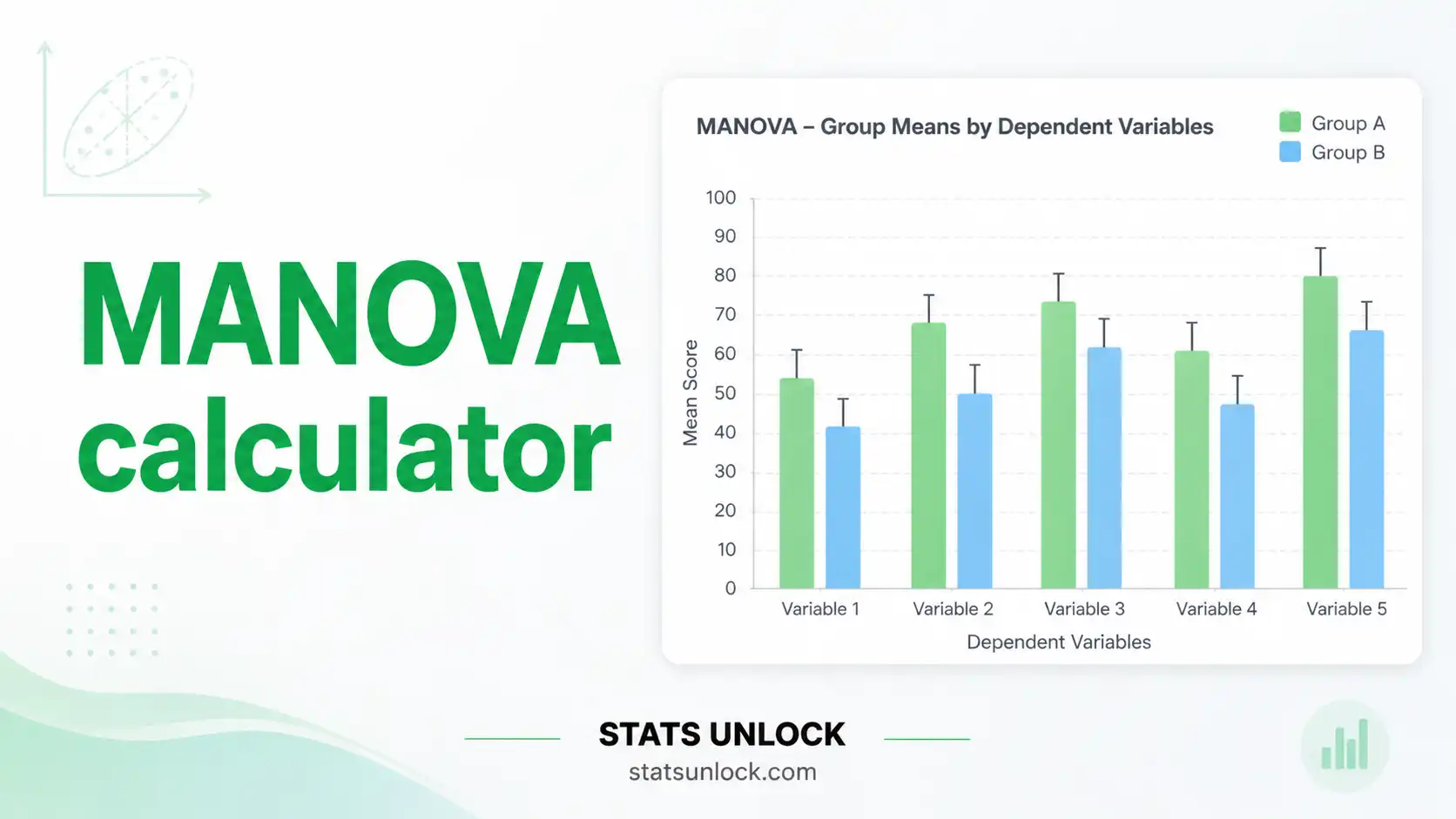
Four charts appear below the results: (1) Group Means by DV — a grouped bar chart; (2) Box Plot distributions per group; (3) Discriminant Score Plot showing centroid separation; (4) Effect size (η²p) per DV. These help you see where groups differ.
9
Read the Detailed Interpretation
The Interpretation Results section gives 5 paragraphs in plain English. The How to Write Your Results section provides five complete, auto-filled reporting templates (APA 7th, Thesis, Plain-Language, Abstract, Pre-Registration) with Copy buttons.
10
Export Your Results
Click "Download Doc" for a plain-text report suitable for pasting into Word. Click "Download PDF" to open the browser print dialog — choose "Save as PDF". Use "Copy Summary" to paste a quick summary into email or slides.
Frequently Asked Questions
Q1. What is MANOVA and when should I use it?

MANOVA (Multivariate Analysis of Variance) is a parametric hypothesis test that determines whether two or more groups differ significantly across two or more continuous dependent variables at the same time. It is the multivariate extension of ANOVA and is preferred over running separate ANOVAs when dependent variables are correlated, because it controls the experiment-wise Type I error rate. A classic example: comparing CBT, mindfulness, and control groups on anxiety, depression, and stress simultaneously — one MANOVA instead of three separate ANOVAs.

Q2. What is a p-value in MANOVA and how do I interpret it?

The p-value in MANOVA represents the probability of observing multivariate group differences this large (or larger) by chance, assuming the null hypothesis is true — i.e., all group centroids are equal in multivariate space. A p-value of 0.03 means there is only a 3% chance of seeing these group differences by random sampling if the groups truly did not differ. Note: the p-value is NOT the probability that the null hypothesis is true. Always pair the p-value with an effect size (Wilks' Λ or η²p) to convey the magnitude of differences.

Q3. Does statistical significance in MANOVA mean group differences are practically important?

No. Statistical significance (p < 0.05) only confirms that group differences are unlikely due to sampling error. With very large samples, even tiny group differences that are clinically or practically trivial can produce p < 0.001. Always interpret effect size alongside p-values. Partial η² below 0.06 indicates a small effect even if the MANOVA is highly significant. Report both: Wilks' Λ = 0.72, F(4, 86) = 3.89, p = .006, partial η² = .15 (large effect).

Q4. What is Wilks' Lambda and partial eta-squared, and how do I interpret them?

Wilks' Lambda (Λ) ranges from 0 to 1. A value near 0 means the groups are very well separated in multivariate space; a value near 1 means the groups overlap almost completely with no meaningful differences. Partial eta-squared (η²p) is the complementary effect size: η²p = 1 − Λ^(1/t). Cohen's (1988) benchmarks: η²p = 0.01 small, 0.06 medium, 0.14 large. So if Λ = 0.72 and η²p = 0.15, that is a large multivariate effect — 15% of the variance in the combined DV space is attributable to group membership.

Q5. What are the MANOVA assumptions and what if my data violate them?

MANOVA requires: (1) Multivariate normality — each DV should be approximately normally distributed within each group. Assess with Shapiro-Wilk per DV. MANOVA is robust when n is large (n ≥ 20 per group). (2) Homogeneity of covariance matrices — Box's M test checks this assumption. Box's M is very sensitive to non-normality, so a significant result does not always mean a real violation. MANOVA is robust to this violation when group sizes are equal. (3) Independence of observations — each participant contributes one row of data. (4) No multicollinearity — correlations among DVs should not exceed r = 0.90. If violated, remove redundant variables.

Q6. How large a sample do I need for MANOVA to be reliable?

The minimum is n > p per group (more observations than dependent variables). A practical rule of thumb is at least 20 observations per group for reliable estimates. For 80% power to detect a medium multivariate effect (η²p ≈ 0.06) with 3 groups and 2 DVs at α = 0.05, approximately 80–100 total observations are recommended. Unequal group sizes reduce the robustness of Box's M and increase sensitivity to non-normality. Always conduct a power analysis before data collection.

Q7. Why run MANOVA instead of multiple separate ANOVAs?

Running k separate ANOVAs for k dependent variables inflates the family-wise Type I error rate. With 5 DVs each tested at α = 0.05, the probability of at least one false positive is 1 − 0.95⁵ = 23% — far above the intended 5%. MANOVA tests all DVs simultaneously, keeping the overall error rate at α = 0.05. Additionally, MANOVA detects group differences that may be invisible when DVs are examined individually, because it accounts for the correlations among DVs and can detect multivariate patterns that no single ANOVA would find.

Q8. How do I report MANOVA results in APA 7th edition format?

APA 7th format: A one-way MANOVA was conducted to examine whether [groups] differed on [list of DVs]. Box's M test indicated homogeneity of covariance matrices was [satisfied/violated], Box's M = ___, F(___, ___) = ___, p = ___. There was a statistically significant multivariate effect of [IV], Wilks' Λ = ___, F(___, ___) = ___, p = ___, partial η² = ___. Univariate follow-up ANOVAs (Bonferroni-corrected α = ___) indicated significant effects for [list significant DVs]. See the "How to Write Your Results" section above for five complete auto-filled reporting templates including APA, thesis, plain-language, abstract, and pre-registration styles.

Q9. Can I use this calculator for published research or university assignments?

This MANOVA calculator is designed for educational use, learning, and exploratory analysis. For peer-reviewed publication or formal dissertation work, verify results using R (car package: Manova()), SPSS (GLM multivariate), SAS (PROC GLM), or Python (statsmodels). The mathematical approach in this tool is consistent with established multivariate statistics textbooks (Field, 2018; Tabachnick & Fidell, 2019). To cite this tool: STATS UNLOCK. (2025). MANOVA calculator. Retrieved from https://statsunlock.com/manova-calculator.

Q10. What should I do if my MANOVA result is non-significant?

A non-significant MANOVA (p > α) does not prove the groups are identical — it means the data do not provide sufficient evidence to reject the null hypothesis. This could be due to: insufficient sample size (low power), a small true effect, high within-group variability, or poorly chosen dependent variables. Check your statistical power post-hoc by estimating the power you had given your observed effect size and sample size. Consider a Bayesian MANOVA (computing Bayes Factor) to quantify evidence in favour of the null hypothesis. Also verify that the MANOVA assumptions were met, as violations can mask true effects.

📚 References

The following references support the statistical methods used in this MANOVA calculator, covering multivariate analysis of variance, effect size interpretation, Wilks' Lambda, and best practices in multivariate hypothesis testing and p-value reporting.

1. Wilks, S. S. (1932). Certain generalizations in the analysis of variance. Biometrika, 24(3–4), 471–494. https://doi.org/10.1093/biomet/24.3-4.471
2. Pillai, K. C. S. (1955). Some new test criteria in multivariate analysis. Annals of Mathematical Statistics, 26(1), 117–121. https://doi.org/10.1214/aoms/1177728599
3. Rao, C. R. (1951). An asymptotic expansion of the distribution of Wilks' criterion. Bulletin de l'Institut International de Statistique, 33, 177–180.
4. Cohen, J. (1988). Statistical power analysis for the behavioral sciences (2nd ed.). Lawrence Erlbaum Associates.
5. Tabachnick, B. G., & Fidell, L. S. (2019). Using multivariate statistics (7th ed.). Pearson Education. Pearson
6. Field, A. (2018). Discovering statistics using IBM SPSS statistics (5th ed.). SAGE Publications.
7. Huberty, C. J., & Morris, J. D. (1989). Multivariate analysis versus multiple univariate analyses. Psychological Bulletin, 105(2), 302–308. https://doi.org/10.1037/0033-2909.105.2.302
8. Olson, C. L. (1976). On choosing a test statistic in multivariate analysis of variance. Psychological Bulletin, 83(4), 579–586. https://doi.org/10.1037/0033-2909.83.4.579
9. Stevens, J. P. (2009). Applied multivariate statistics for the social sciences (5th ed.). Routledge.
10. Lakens, D. (2013). Calculating and reporting effect sizes to facilitate cumulative science: A practical primer for t-tests and ANOVAs. Frontiers in Psychology, 4, 863. https://doi.org/10.3389/fpsyg.2013.00863
11. American Psychological Association. (2020). Publication manual of the American Psychological Association (7th ed.). APA. https://doi.org/10.1037/0000165-000
12. Hotelling, H. (1931). The generalization of Student's ratio. Annals of Mathematical Statistics, 2(3), 360–378. https://doi.org/10.1214/aoms/1177732979
13. Fox, J., & Weisberg, S. (2019). An R companion to applied regression (3rd ed.). SAGE Publications. https://cran.r-project.org/package=car
14. R Core Team. (2024). R: A language and environment for statistical computing. R Foundation for Statistical Computing. https://www.R-project.org/
15. NIST/SEMATECH. (2013). e-Handbook of statistical methods. National Institute of Standards and Technology. https://www.itl.nist.gov/div898/handbook/

Leave a Reply

Your email address will not be published. Required fields are marked *

Previous Post
Next Post

© 2026 STATS UNLOCK . statsunlock.com –  All Rights Reserved.