

Kruskal-Wallis Test Calculator – Free Online Non-Parametric ANOVA Tool | StatsUnlock

Kruskal-Wallis Test Calculator – Free Online Non-Parametric ANOVA Tool | StatsUnlock
StatsUnlock · Hypothesis Test

Kruskal-Wallis Test
Calculator

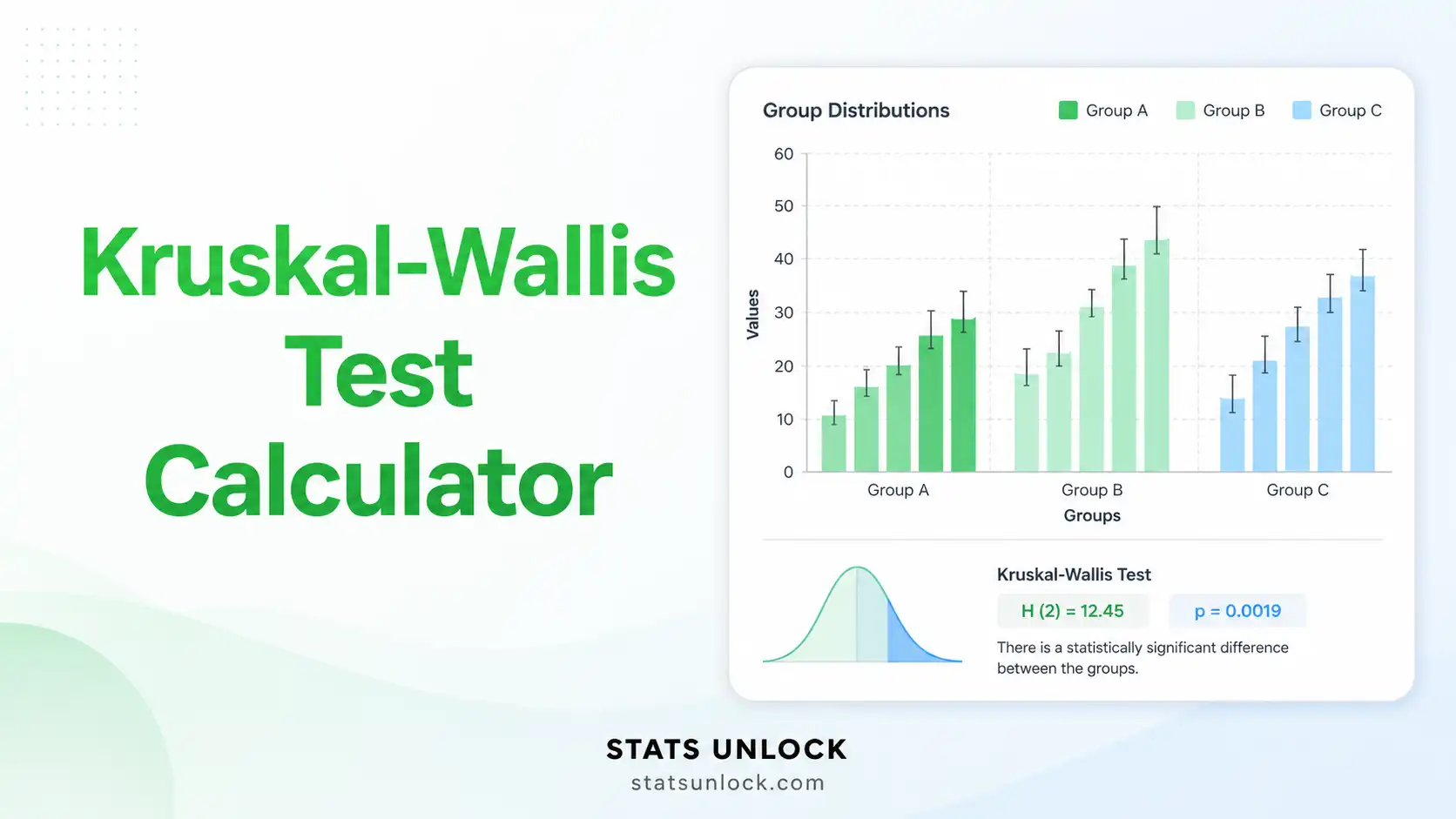
A free online non-parametric ANOVA calculator. Compare 3 or more independent groups, get H statistic, p-value, epsilon-squared effect size, Dunn's post-hoc test, and APA-ready reporting.

Non-Parametric 3+ Groups Inferential Free

📥 1. Enter Your Data

Dataset 1 is pre-loaded. Switch to load any of the 5 examples.
Supports .csv, .txt, .xlsx, .xls — first row treated as group headers if non-numeric. Each numeric column = one group.

⚙ 2. Configure the Test

Standard for most research is .05.
Bonferroni is most conservative.
Adjusts H for tied ranks.
📐 Technical Notes & Formulas

Test Statistic — Kruskal-Wallis H

H = (12 / (N(N+1))) · Σ (Rj² / nj) − 3(N+1)
H  = Kruskal-Wallis test statistic
N  = total sample size across all groups (Σ nj)
k  = number of groups
nj = sample size of group j
Rj = sum of ranks for group j (after pooling and ranking all values)

Tie Correction

Hcorrected = H / (1 − ΣTi / (N³ − N))
Ti = ti³ − ti, where ti is the size of tied group i

Degrees of Freedom & p-value

df = k − 1
p-value = P(χ² > H | df = k − 1)

The p-value is computed from the chi-square distribution with k − 1 degrees of freedom (right-tailed; Kruskal-Wallis is always one-tailed).

Effect Size — Epsilon-Squared (ε²)

ε² = H / (N − 1)
ε² ranges from 0 (no effect) to 1 (perfect group separation)
Benchmarks: < .01 negligible · .01–.06 small · .06–.14 medium · > .14 large

Effect Size — Eta-Squared (η²H)

η²H = (H − k + 1) / (N − k)

Dunn's Post-hoc Test

zij = (R̄i − R̄j) / √[ (N(N+1)/12) · (1/ni + 1/nj) ]
i, R̄j = mean ranks of groups i and j
p-value from standard normal Z, then adjusted with Bonferroni or Benjamini-Hochberg

Why Kruskal-Wallis (Technical Notes)

  • Robust to non-normal data — works on ordinal or skewed continuous data.
  • Tests whether group distributions are identical; with similar shapes, it tests differences in medians.
  • The chi-square approximation is reliable when each group has at least 5 observations.
  • If significant, run Dunn's post-hoc with adjustment to identify which pairs differ.
  • Loses power compared to one-way ANOVA when ANOVA assumptions actually hold.
🎯 When to Use This Kruskal-Wallis Test

This free Kruskal-Wallis test calculator is designed for researchers, students, and analysts who need a non-parametric alternative to one-way ANOVA. Use it whenever you compare a continuous or ordinal outcome across three or more independent groups and the data are skewed, ordinal, or fail normality.

Decision Checklist

  • ✅ You have 3 or more independent groups
  • ✅ Your dependent variable is ordinal or continuous
  • ✅ Observations within each group are independent
  • ✅ Data are not normally distributed (or sample is small)
  • ❌ Do NOT use if groups are paired/repeated → use Friedman test
  • ❌ Do NOT use if you have only 2 groups → use Mann-Whitney U test
  • ❌ Do NOT use if data are normally distributed and variances equal → use One-Way ANOVA (more powerful)

Real-World Examples

  1. Education — comparing exam scores across three teaching methods (lecture, flipped, online) with skewed grade distributions.
  2. Medical Research — comparing pain scores (1–10 ordinal scale) across four drug regimens.
  3. Ecology — comparing species abundance counts across five forest habitat types where counts are right-skewed.
  4. Psychology — comparing depression inventory scores across three therapy types in a small clinical trial.
  5. Business — comparing customer satisfaction ratings (1–10) across three retail stores.

Sample Size Guidance

  • Minimum recommended: 5 observations per group for chi-square approximation.
  • For reliable detection of medium effects (ε² ≈ .06): n ≥ 15 per group.
  • For small effects: aim for n ≥ 30 per group.
  • With fewer than 5 per group, use exact permutation tests (run 10,000 iterations in R via the coin package).

Decision Tree — Picking the Right Test

3+ independent groups ├─ Normal + equal variance → One-Way ANOVA ├─ Not normal / ordinal → KRUSKAL-WALLIS H TEST (this calculator) └─ Repeated measures → Friedman Test 2 independent groups ├─ Normal → Independent t-test └─ Not normal / ordinal → Mann-Whitney U Test
📘 How to Use This Kruskal-Wallis Calculator

Follow these 10 steps to run a complete Kruskal-Wallis analysis on your data.

Step 1 — Enter Your Data

Three input options: (a) Paste comma-separated values per group, (b) upload a CSV/Excel file, or (c) type values into the manual table. Each group needs at least 2 values; 5+ is recommended.

Step 2 — Choose a Sample Dataset

Five built-in datasets cover education, pharmacology, agriculture, sleep research, and customer satisfaction. Dataset 1 (Teaching Method exam scores) loads on first render.

Step 3 — Configure Test Settings

Set α (default .05), choose a post-hoc method (Dunn's with Bonferroni is the conservative default), and decide on tie correction (recommended on).

Step 4 — Run the Analysis

Click the green "Run Kruskal-Wallis Analysis" button. Computation is instant for any reasonable dataset size.

Step 5 — Read the Summary Cards

Four cards show H, df, p-value, and ε² effect size. The p-value card is colored green when significant, red when not.

Step 6 — Read the Full Results Table

The full table shows H, H corrected for ties, df, p-value, sample size, all group medians, mean ranks, both effect sizes (ε² and η²H), and your interpretation labels.

Step 7 — Examine Both Visualizations

Chart 1 is a box plot per group with jittered raw data — look for medians, IQR, and outliers. Chart 2 plots the chi-square distribution with H marked and the rejection region shaded.

Step 8 — Check Assumptions

Independence (must be design-checked), no severe ties, and similar distribution shapes are flagged. Severe shape differences mean H tests distributions, not medians.

Step 9 — Read the Interpretation & Write-Up

Five ready-made paragraphs (APA, Thesis, Plain-Language, Abstract, Pre-Registration) auto-fill with your numbers — copy whichever fits your venue.

Step 10 — Export Your Results

Two buttons: Download Doc gives a plain-text .txt report. Download PDF triggers print-to-PDF with the full structured report.

❓ Frequently Asked Questions

Q1. What is the Kruskal-Wallis test and when should I use it?

The Kruskal-Wallis H test is a non-parametric test that compares the distributions of three or more independent groups using ranked data. It is the rank-based equivalent of one-way ANOVA. Use it when you would run a one-way ANOVA but your data are ordinal, skewed, or fail the normality assumption — for example, comparing patient pain scores across four drug treatments.

Q2. What is a p-value, and how do I interpret it for the Kruskal-Wallis test?

The p-value is the probability of obtaining an H statistic as extreme as the one observed if all groups truly came from identical distributions. It is not the probability that the null hypothesis is true. Example: a p-value of .03 means there is a 3% chance of seeing this result by chance if no real difference existed; reject H₀ when p < α.

Q3. Does statistical significance equal practical importance?

No. With large samples a Kruskal-Wallis test can flag tiny, practically irrelevant differences as significant. Always report effect size (epsilon-squared or eta-squared H) alongside the p-value, and judge whether the magnitude matters in your domain — a 1-point difference on a 10-point scale rarely changes clinical or business decisions.

Q4. What is epsilon-squared and how do I interpret it?

Epsilon-squared (ε²) is the proportion of variance in ranks explained by group membership. Cohen-style benchmarks (Tomczak & Tomczak, 2014): < .01 negligible, .01–.06 small, .06–.14 medium, and > .14 large. A large effect (ε² > .14) means the groups differ in ways most observers would notice without statistics.

Q5. What assumptions does the Kruskal-Wallis test require?

Three core assumptions: (a) observations are independent within and between groups, (b) the dependent variable is ordinal or continuous, and (c) group distributions have similar shapes if the result is to be interpreted as a difference in medians. If shapes differ, the result is more general — a difference in distributions. Violation of independence is fatal; violation of shape similarity narrows the interpretation.

Q6. How large a sample do I need for Kruskal-Wallis to be reliable?

At least 5 observations per group is the minimum for the chi-square approximation to behave well. For 80% power to detect a medium effect (ε² ≈ .06) with three groups at α = .05, plan for roughly 15–20 per group; for small effects, aim for 30+ per group. With fewer than 5 per group, switch to exact permutation methods.

Q7. Is Kruskal-Wallis one-tailed or two-tailed?

Kruskal-Wallis is always evaluated on the right tail of the chi-square distribution. The H statistic is non-negative, and a large H signals divergence among groups in either direction. There is no one-tailed vs two-tailed choice for the omnibus test — directional questions should be answered with planned post-hoc comparisons.

Q8. How do I report Kruskal-Wallis results in APA 7th edition format?

Report H with degrees of freedom in parentheses, the exact p-value (or p < .001), and an effect size: H(2) = 14.32, p < .001, ε² = .26. When significant, follow with Dunn's post-hoc results and corrected p-values. See the "How to Write Your Results" section above for five fully filled-in templates.

Q9. Can I use this calculator for my published research or thesis?

Yes — for educational use, exploratory analysis, and thesis chapter drafts. For final journal submissions, replicate results in R (kruskal.test(), FSA::dunnTest()) or Python (scipy.stats.kruskal, scikit-posthocs). Cite the tool as: STATS UNLOCK. (2026). Kruskal-Wallis test calculator. Retrieved from https://statsunlock.com.

Q10. What if my Kruskal-Wallis result is non-significant — is my hypothesis wrong?

A non-significant result (p > α) does not prove the null hypothesis. It only means the data do not provide enough evidence to reject H₀. The cause may be a small effect, low sample size, low power, or genuine equivalence. Run a power analysis to check whether your study could plausibly detect the effect you cared about, and consider a Bayesian alternative if you want positive evidence for equivalence.

📚 References

The following references support the statistical methods used in this Kruskal-Wallis test calculator, covering p-value interpretation, effect size, and best practices in non-parametric hypothesis testing.

  1. Kruskal, W. H., & Wallis, W. A. (1952). Use of ranks in one-criterion variance analysis. Journal of the American Statistical Association, 47(260), 583–621. https://doi.org/10.1080/01621459.1952.10483441
  2. Dunn, O. J. (1964). Multiple comparisons using rank sums. Technometrics, 6(3), 241–252. https://doi.org/10.1080/00401706.1964.10490181
  3. Conover, W. J., & Iman, R. L. (1981). Rank transformations as a bridge between parametric and nonparametric statistics. The American Statistician, 35(3), 124–129. https://doi.org/10.1080/00031305.1981.10479327
  4. Tomczak, M., & Tomczak, E. (2014). The need to report effect size estimates revisited. An overview of some recommended measures of effect size. Trends in Sport Sciences, 1(21), 19–25.
  5. Cohen, J. (1988). Statistical power analysis for the behavioral sciences (2nd ed.). Lawrence Erlbaum Associates.
  6. Field, A. (2018). Discovering statistics using IBM SPSS statistics (5th ed.). SAGE Publications.
  7. Hollander, M., Wolfe, D. A., & Chicken, E. (2014). Nonparametric statistical methods (3rd ed.). Wiley. https://doi.org/10.1002/9781119196037
  8. Siegel, S., & Castellan, N. J. (1988). Nonparametric statistics for the behavioral sciences (2nd ed.). McGraw-Hill.
  9. Benjamini, Y., & Hochberg, Y. (1995). Controlling the false discovery rate: A practical and powerful approach to multiple testing. Journal of the Royal Statistical Society: Series B, 57(1), 289–300. https://doi.org/10.1111/j.2517-6161.1995.tb02031.x
  10. Lakens, D. (2013). Calculating and reporting effect sizes to facilitate cumulative science. Frontiers in Psychology, 4, 863. https://doi.org/10.3389/fpsyg.2013.00863
  11. American Psychological Association. (2020). Publication manual of the American Psychological Association (7th ed.). APA. https://doi.org/10.1037/0000165-000
  12. R Core Team. (2024). R: A language and environment for statistical computing. R Foundation for Statistical Computing. https://www.R-project.org/
  13. Virtanen, P., Gommers, R., Oliphant, T. E., et al. (2020). SciPy 1.0: Fundamental algorithms for scientific computing in Python. Nature Methods, 17, 261–272. https://doi.org/10.1038/s41592-020-0772-5
  14. Mangiafico, S. S. (2016). Summary and analysis of extension program evaluation in R, version 1.20.05. https://rcompanion.org/handbook/
  15. NIST/SEMATECH. (2013). e-Handbook of statistical methods. National Institute of Standards and Technology. https://www.itl.nist.gov/div898/handbook/

Leave a Reply

Your email address will not be published. Required fields are marked *

Previous Post
Next Post

© 2026 STATS UNLOCK . statsunlock.com –  All Rights Reserved.