

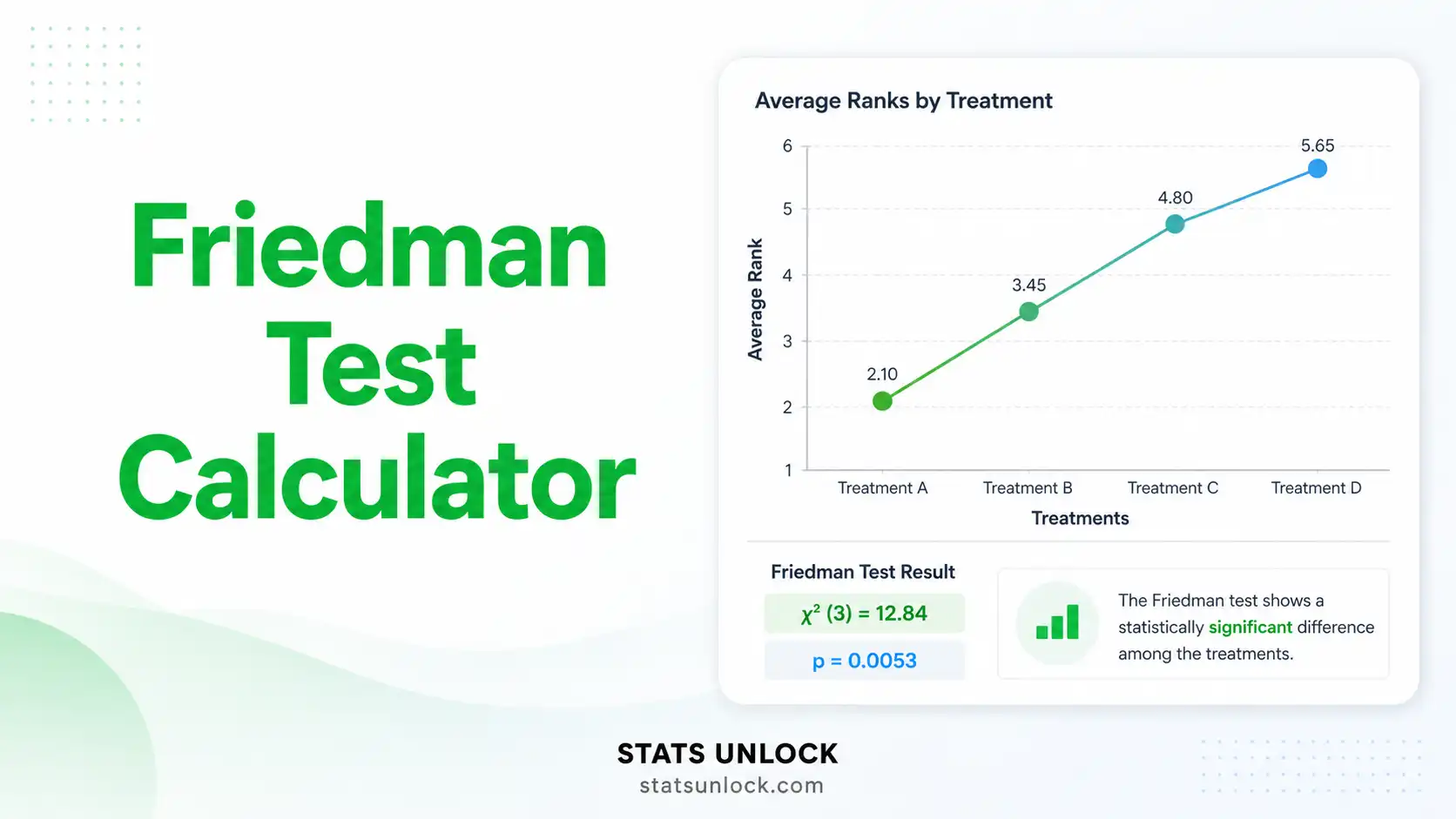

Friedman Test Calculator
Free online Friedman test calculator for nonparametric repeated measures. Get chi-square, p-value, Kendall's W effect size, post-hoc Nemenyi comparisons, charts, and APA-format results — all in your browser.
📥 1. Enter Your Data
Enter data in the grid. Each row = same subject across conditions.
⚙️ 2. Test Configuration
🧮 8. Technical Notes & Formulas
A. Formulas Used
Friedman Chi-Square Statistic (χ²F):
χ²F = [12 / (n · k · (k + 1))] · Σ Rj² − 3 · n · (k + 1)
Where:
χ²F= Friedman test statisticn= number of subjects (blocks / rows)k= number of conditions (treatments / columns)Rj= sum of ranks for condition j across all subjectsΣ Rj²= sum of squared rank totals across all k conditions
Tie Correction (when ties exist within subjects):
χ²F_corrected = χ²F / C
C = 1 − [Σ (tᵢ³ − tᵢ)] / [n · (k³ − k)]
Where: tᵢ = number of tied values in the i-th tie group within a subject. The correction divides χ²F by C, slightly inflating the statistic to compensate for tied ranks.
Degrees of Freedom:
df = k − 1
P-value:
p = 1 − F_χ²(χ²F, df)
F_χ²  =  cumulative chi-square distribution function with df = k − 1
Kendall's W (Coefficient of Concordance — effect size):
W = χ²F / [n · (k − 1)]
Where: W ranges from 0 (no agreement among rankings) to 1 (complete agreement). Cohen (1988) benchmarks: W ≈ 0.1 small, 0.3 medium, 0.5 large.
Mean Rank per Condition:
R̄j = Rj / n
Nemenyi Critical Difference (post-hoc):
CD = q_α · √[ k · (k + 1) / (6 · n) ]
Where: q_α = critical value from the Studentized range distribution (Tukey) at significance level α; two mean ranks differ significantly when |R̄ᵢ − R̄ⱼ| ≥ CD.
B. Technical Notes
- Assumptions: (1) one group of n subjects measured under k conditions; (2) dependent variable at least ordinal; (3) random sample; (4) blocks (subjects) mutually independent. Normality and sphericity are not required.
- Sample-size guidance: Chi-square approximation is reliable when n ≥ 10 with k = 3, or n ≥ 6 with k ≥ 4. With smaller samples, use exact Friedman tables or Monte-Carlo permutation.
- Tie handling: Within-block ties get average ranks. The tie correction (C) is applied automatically when ties exist; omit only for replication of older textbook examples.
- Follow-up: A significant Friedman result tells you that at least one pair of conditions differs — not which pairs. Use the Nemenyi, Conover, or Bonferroni-corrected pairwise Wilcoxon tests to localize the differences.
- Alternative tests: If only two conditions, use Wilcoxon signed-rank. If assumptions of normality + sphericity hold, repeated-measures ANOVA is more powerful. If the data are continuous and you have a between-subjects factor too, consider mixed models.
✍️ 9. How to Write Friedman Test Results in APA 7 Format
When reporting Friedman test calculator results in APA 7 format, you must include the chi-square statistic, degrees of freedom, sample size, exact p-value, and an effect size (Kendall's W). The Friedman test is the nonparametric repeated measures alternative to repeated-measures ANOVA, so APA reporting follows the same structure with a few critical adjustments.
APA 7 Template
Methods Section Template
"To compare [outcome] across [k] repeated conditions, a Friedman test was performed using StatsUnlock (statsunlock.com). The Friedman test was selected as the nonparametric alternative to repeated-measures ANOVA because [normality was violated / data were ordinal]. Significant omnibus results were followed by [Nemenyi / Conover] post-hoc pairwise comparisons. Effect size was reported using Kendall's coefficient of concordance (W). Statistical significance was assessed at α = .05."
Results Section Template
"A Friedman test indicated that [DV] differed significantly across the [k] conditions, χ²(2, N = 12) = 14.50, p < .001, Kendall's W = 0.60, indicating a large effect. Post-hoc Nemenyi tests revealed that [Condition C] (Mdn = X) yielded significantly higher [DV] than [Condition A] (Mdn = Y, p = .006), while [Condition C] vs [Condition B] did not reach significance (p = .124)."
Important Reporting Rules
- Italicise χ², p, N, W, and Mdn.
- Write
p < .001when p is below 0.001 — neverp = .000. - Report exact p-values when p ≥ .001 (e.g.,
p = .023). - Always include effect size — Kendall's W is the standard for Friedman.
- Report the median (Mdn) and IQR per condition, not the mean and SD.
- Disclose the tie-correction status if ties were present.
🧭 10. When to Use the Friedman Test
This free Friedman test calculator is designed for researchers, students, and analysts comparing three or more related measurements taken on the same subjects when parametric assumptions are violated.
Decision Checklist
- You have one group of subjects measured under 3 or more conditions or time points
- The same subjects appear in every condition (related / paired design)
- Your dependent variable is ordinal, or continuous but non-normally distributed
- The repeated-measures ANOVA assumptions (normality, sphericity) are violated
- Your sample size is too small for the central limit theorem to rescue normality
- Do NOT use if you only have 2 conditions → use Wilcoxon signed-rank instead
- Do NOT use if subjects are independent across groups → use Kruskal-Wallis instead
- Do NOT use if your data are normal AND sphericity holds → repeated-measures ANOVA is more powerful
- Do NOT use for nominal (categorical, unordered) data → use Cochran's Q for binary outcomes
Real-World Examples
- Medical / Pharmacology: A pain clinic measures pain scores (0–10 scale) for the same 15 patients under three drugs (Drug A, B, C). The Friedman test asks: do the three drugs produce different pain reductions?
- Education: 20 students take exams under four teaching methods (lecture, flipped, gamified, project-based). Are exam-rank distributions different across methods?
- Psychology: 12 anxiety patients are rated on the Beck Anxiety Inventory before, during, and after a 4-week mindfulness program. Did anxiety scores change across time points?
- Wildlife / Ecology: The same 8 plots are surveyed in three seasons (winter, spring, summer); does mean species richness rank differ across seasons?
- Marketing: 25 consumers rate three packaging designs on a 7-point preference scale. Are the designs ranked differently?
Sample-Size Guidance
- Chi-square approximation reliable: n ≥ 10 with k = 3, or n ≥ 6 with k ≥ 4.
- For smaller n, use exact Friedman tables or Monte-Carlo permutation tests.
- Power analysis: with W ≈ 0.30 (medium effect) at α = .05, n ≈ 30–40 yields ~80% power for k = 3.
Decision Tree
📖 11. How to Use This Friedman Test Calculator
Step-by-Step Walkthrough
Worked example: 12 patients rate pain (0–10) under three drugs (A, B, C). We want to know whether the drugs differ.
- STEP 1 — Enter your data. Three input methods are available: paste/type comma-separated values into the textareas (one row per condition); upload a CSV or Excel file with one column per condition; or use the manual grid for small datasets. Each row across all conditions = the same subject.
- STEP 2 — Choose a sample dataset. Five built-in datasets cover medical, education, weight-loss, mood-therapy, and ecology domains. Dataset 1 (Drug Pain Relief) loads on first render.
- STEP 3 — Configure test settings. Pick alpha (.05 default), post-hoc method (Nemenyi default), decimal places, and tie correction (apply by default).
- STEP 4 — Click "Run Friedman Test". The calculator validates your data (equal n per condition, all numeric, k ≥ 3) and computes the test in milliseconds.
- STEP 5 — Read the summary cards. Four cards show χ²-statistic, df, p-value (green if significant, red if not), and Kendall's W effect size.
- STEP 6 — Read the full results table. Includes χ²F, df, p-value, Kendall's W with magnitude label (small/medium/large), n, k, mean ranks, and tie correction status.
- STEP 7 — Examine the two charts. The box plot shows the raw distribution per condition; the bar chart shows mean ranks. A significant Friedman test corresponds to visibly different mean ranks across bars.
- STEP 8 — Check the assumption panel. Verifies sample size, equal-n requirement, and tie status with green/yellow/red badges.
- STEP 9 — Read the interpretation. Section 6 auto-fills five paragraphs (plain-language interpretation) and five APA reporting templates.
- STEP 10 — Export. Download Doc (.txt) for plain text; Download PDF for a print-formatted report; Copy summary for a one-line APA string.
❓ 12. Frequently Asked Questions
Q1. What is the Friedman test and when should I use it?
The Friedman test is a nonparametric repeated-measures hypothesis test that detects differences in three or more related measurements taken on the same subjects. It works on within-subject ranks instead of raw values, making it ideal when data are ordinal or when normality and sphericity assumptions of repeated-measures ANOVA are violated. Typical use: comparing 3+ drug treatments measured on the same patients.
Q2. What is a p-value, and how do I interpret it for the Friedman test?
The Friedman p-value is the probability of obtaining a chi-square statistic as large or larger than the one computed if the null hypothesis (no difference across conditions) were true. A p-value of 0.03 means there is a 3% chance of seeing this rank pattern by chance alone if the conditions truly produced the same distribution. Reject H₀ when p < α.
Q3. What does statistical significance mean — and does it equal practical importance?
Statistical significance (p < α) only tells you the result is unlikely under H₀. Practical importance comes from the effect size — Kendall's W for the Friedman test. With large samples, even tiny rank differences can be statistically significant; always report W alongside the p-value to communicate the magnitude of the effect.
Q4. What is Kendall's W and how do I interpret it?
Kendall's W (coefficient of concordance) is the standard effect-size metric for the Friedman test. It ranges from 0 (no agreement among subjects on rankings — pure noise) to 1 (perfect agreement — every subject ranks conditions identically). Cohen's (1988) benchmarks: W ≈ 0.1 small, 0.3 medium, 0.5 large. A W of 0.6 means strong concordance among subjects in how they rank conditions.
Q5. What assumptions does the Friedman test require?
The Friedman test requires only four assumptions: (1) one group of n subjects measured under k ≥ 3 conditions; (2) dependent variable at least ordinal; (3) blocks (subjects) mutually independent; (4) random sample. Crucially, it does not require normality, equal variance, or sphericity — making it robust where repeated-measures ANOVA fails.
Q6. How large a sample do I need for the Friedman test?
For the chi-square approximation to be reliable: at least 10 subjects with k = 3 conditions, or at least 6 subjects with k ≥ 4 conditions. Below those thresholds, use exact Friedman p-value tables or a Monte-Carlo permutation test. Power analysis: with W = 0.30 (medium) at α = .05, n ≈ 30–40 yields ~80% power for k = 3.
Q7. What is the difference between the Friedman test and repeated-measures ANOVA?
Repeated-measures ANOVA assumes normality and sphericity of differences; the Friedman test assumes neither because it operates on within-subject ranks. ANOVA is more powerful when its assumptions hold, but Friedman is the safer and often more appropriate choice for ordinal data, small samples, or skewed/heavy-tailed distributions.
Q8. What post-hoc tests follow a significant Friedman test?
The most common post-hoc procedures are: Nemenyi (default, uses Studentized range), Conover-Iman (more powerful, recommended after a significant omnibus), and Bonferroni-corrected pairwise Wilcoxon signed-rank tests. Each compares all k(k−1)/2 condition pairs while controlling family-wise error.
Q9. How do I report Friedman test results in APA 7 format?
Report: χ²(df, N = ___) = ___, p [< / =] ___, Kendall's W = ___. Example: "A Friedman test indicated significant differences across the three drug conditions, χ²(2, N = 12) = 14.50, p < .001, W = 0.60." Add post-hoc results and median + IQR per condition. Section 9 of this page contains five fully filled-in APA examples.
Q10. Can I use this calculator for my published research or university assignment?
Yes — this Friedman test calculator is designed for both education and research. For peer-reviewed publications we recommend cross-checking results in R (friedman.test()), Python (scipy.stats.friedmanchisquare), or SPSS. Citation: STATS UNLOCK. (2026). Friedman test calculator. Retrieved from https://statsunlock.com/friedman-test-calculator.
📚 13. References
The following references support the statistical methods used in this Friedman test calculator, covering nonparametric hypothesis testing, effect-size interpretation (Kendall's W), and APA-format reporting for repeated-measures research.
- Friedman, M. (1937). The use of ranks to avoid the assumption of normality implicit in the analysis of variance. Journal of the American Statistical Association, 32(200), 675–701. https://doi.org/10.1080/01621459.1937.10503522
- Friedman, M. (1940). A comparison of alternative tests of significance for the problem of m rankings. Annals of Mathematical Statistics, 11(1), 86–92. https://doi.org/10.1214/aoms/1177731944
- Kendall, M. G., & Babington Smith, B. (1939). The problem of m rankings. Annals of Mathematical Statistics, 10(3), 275–287. https://doi.org/10.1214/aoms/1177732186
- Conover, W. J. (1999). Practical Nonparametric Statistics (3rd ed.). John Wiley & Sons.
- Nemenyi, P. B. (1963). Distribution-free multiple comparisons [Doctoral dissertation, Princeton University].
- Cohen, J. (1988). Statistical power analysis for the behavioral sciences (2nd ed.). Lawrence Erlbaum Associates.
- Field, A. (2018). Discovering statistics using IBM SPSS statistics (5th ed.). SAGE Publications.
- Sheskin, D. J. (2011). Handbook of parametric and nonparametric statistical procedures (5th ed.). Chapman & Hall/CRC.
- Pereira, D. G., Afonso, A., & Medeiros, F. M. (2015). Overview of Friedman's test and post-hoc analysis. Communications in Statistics — Simulation and Computation, 44(10), 2636–2653. https://doi.org/10.1080/03610918.2014.931971
- Demšar, J. (2006). Statistical comparisons of classifiers over multiple data sets. Journal of Machine Learning Research, 7, 1–30. https://www.jmlr.org/papers/v7/demsar06a.html
- American Psychological Association. (2020). Publication manual of the American Psychological Association (7th ed.). APA. https://doi.org/10.1037/0000165-000
- Tomczak, M., & Tomczak, E. (2014). The need to report effect size estimates revisited. An overview of some recommended measures of effect size. Trends in Sport Sciences, 1(21), 19–25.
- R Core Team. (2024). R: A language and environment for statistical computing. R Foundation for Statistical Computing. https://www.R-project.org/
- Virtanen, P., Gommers, R., Oliphant, T. E., et al. (2020). SciPy 1.0: Fundamental algorithms for scientific computing in Python. Nature Methods, 17, 261–272. https://doi.org/10.1038/s41592-020-0772-5
- NIST/SEMATECH. (2013). e-Handbook of Statistical Methods. National Institute of Standards and Technology. https://www.itl.nist.gov/div898/handbook/