

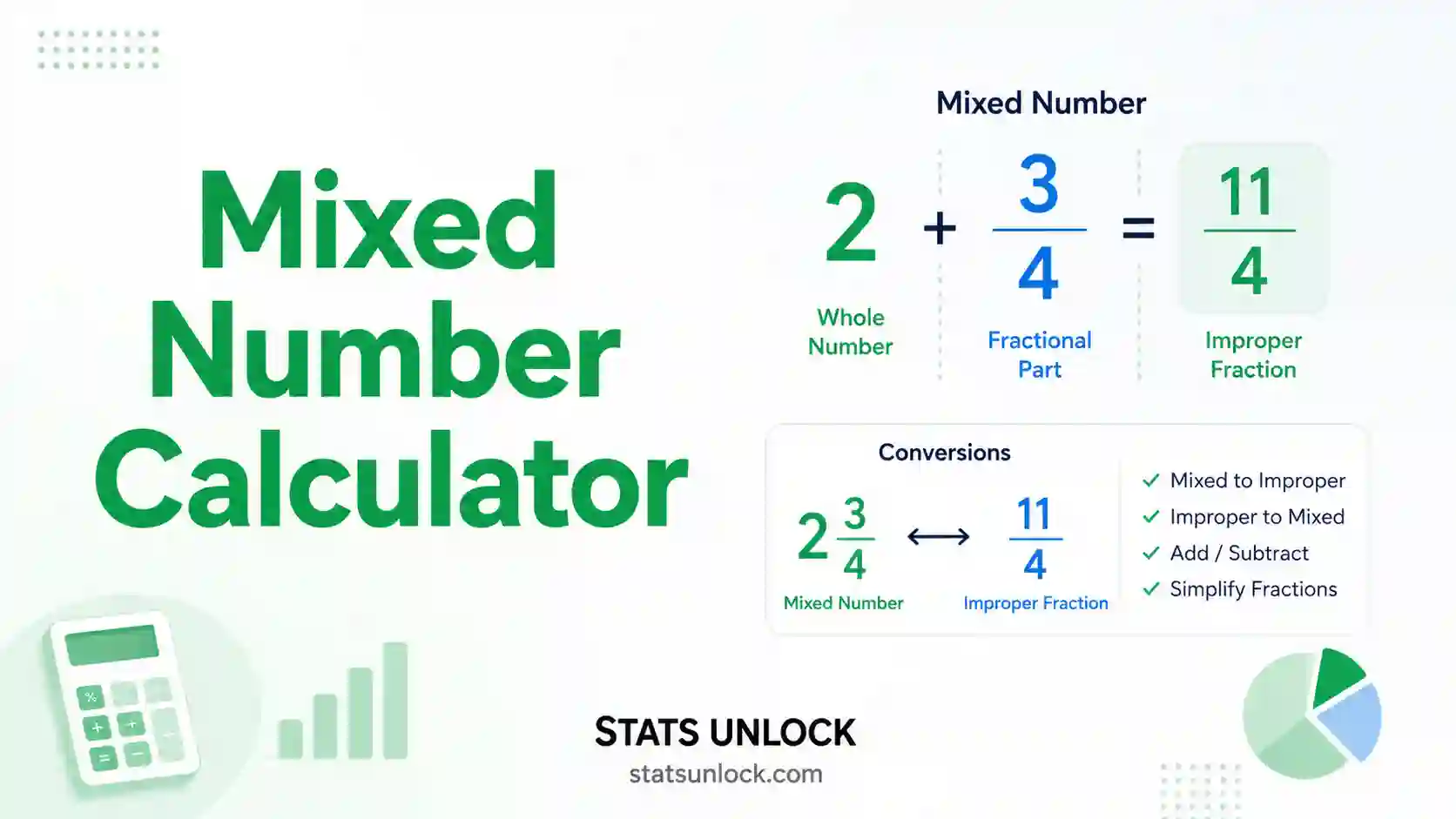

Mixed Number Calculator
Add, subtract, multiply and divide mixed numbers and fractions, with every step of the working shown. Convert between mixed numbers, improper fractions and decimals, simplify any fraction, and see the answer drawn as fraction bars and on a number line.
⚡ 0. Quick Answer
A mixed number is a whole number written next to a proper fraction, such as 2 3/4. It means "two wholes plus three quarters".
To calculate with mixed numbers, turn each one into an improper fraction first, do the arithmetic, then convert the answer back. For 2 3/4 you multiply the whole number by the denominator and add the numerator: (2 × 4) + 3 = 11, giving 11/4. Once both numbers are improper fractions, addition and subtraction need a common denominator, multiplication multiplies straight across, and division flips the second fraction and multiplies.
Worked example: 2 3/4 + 1 2/3 = 11/4 + 5/3 = 33/12 + 20/12 = 53/12 = 4 5/12.
Key takeaways
- A mixed number is a whole number plus a proper fraction, like 2 3/4, and always means addition: 2 + 3/4.
- Convert to an improper fraction before calculating: multiply the whole by the denominator, add the numerator, keep the denominator.
- Adding and subtracting need a common denominator; multiplying and dividing do not.
- To divide, flip the second fraction and multiply. This is the step students forget most often.
- Always simplify the final answer by dividing the numerator and denominator by their greatest common divisor, and convert any improper result back to a mixed number.
📚 1. What Is a Mixed Number?
A mixed number, sometimes called a mixed fraction, combines a whole number and a proper fraction into one value. Written 2 3/4, it is read "two and three quarters" and it means exactly 2 + 3/4. The invisible plus sign between the whole part and the fraction part is the single most useful thing to remember, because every rule that follows comes from it.
The three ways to write the same value:
- Mixed number, 2 3/4. Easiest to picture and the usual way to give a final answer.
- Improper fraction, 11/4. The numerator is bigger than the denominator. This is the form you must use for calculating.
- Decimal, 2.75. Convenient for measuring and for calculators, but it cannot always be written exactly, as 1/3 shows.
What this calculator gives you: the answer as a simplified mixed number, as an improper fraction and as a decimal; the full step-by-step working including the lowest common denominator; the greatest common divisor used to simplify; a fraction-bar diagram of both inputs and the result; and a number line showing where the answer sits.
A worked one-liner: to add 2 3/4 and 1 2/3, rewrite them as 11/4 and 5/3, find the common denominator 12 to get 33/12 and 20/12, add the numerators to get 53/12, then convert back to 4 5/12.
Who uses mixed numbers: school pupils from roughly age nine upward, cooks halving and doubling recipes, carpenters and engineers working in inches, tailors measuring fabric, and anyone reading a tape measure. Mixed numbers are preferred in everyday life because 2 3/4 cups is easier to picture than 11/4 cups, while improper fractions are preferred in algebra because they are easier to compute with.
| Form | Example | Best for |
|---|---|---|
| Mixed number | 2 3/4 | Final answers, measuring, everyday use |
| Improper fraction | 11/4 | Calculating, algebra, any multiplication or division |
| Proper fraction | 3/4 | Parts of a single whole, where the value is under 1 |
| Decimal | 2.75 | Calculators, money, measurement tools |
🧮 2. Set Up Your Calculation
Leave the whole box empty or set it to 0 for a plain fraction. Negative values are allowed in the whole box.
Type each term as a mixed number such as 2 3/4, a fraction such as 5/8, a whole number such as 3, or a decimal such as 1.25. Operations are applied left to right.
📊 3. Results
🧠 4. Understanding Your Answer, In Detail
4.1 Why you convert to an improper fraction first
A mixed number is really two numbers joined by a hidden plus sign, so 2 3/4 is 2 + 3/4. That is fine for reading but awkward for calculating, because every operation would have to be applied to both parts separately and then recombined. Converting to a single improper fraction removes the problem: 11/4 is one number, not two, so the ordinary fraction rules apply directly.
The conversion itself is just counting in quarters. Each whole contains 4 quarters, so 2 wholes are 8 quarters, and adding the extra 3 quarters gives 11 quarters, written 11/4. That is where the rule "multiply the whole by the denominator and add the numerator" comes from. It is not an arbitrary trick, it is counting how many parts you have in total.
4.2 Why adding and subtracting need a common denominator
You can only add quantities that are measured in the same units. Three quarters plus two thirds is like three cups plus two spoons, meaningless until both are expressed in the same size of piece. The common denominator is that shared unit. For quarters and thirds, the smallest piece both can be cut into is twelfths, so 3/4 becomes 9/12 and 2/3 becomes 8/12, and now they can be added.
Any common denominator works, including simply multiplying the two denominators together. Using the lowest common denominator just keeps the numbers smaller and reduces how much simplifying you have to do at the end. If you multiply 4 by 3 you get 12, which here happens to be the lowest anyway; with 4 and 6 you would get 24, while the lowest common denominator is only 12.
4.3 Why multiplying and dividing do not
This surprises people who have just learned the common denominator rule for addition. Multiplication of fractions means taking a part of a part, and that works regardless of what the denominators are: two thirds of three quarters is simply (2 × 3) over (3 × 4), which is 6/12 or 1/2. There is no need to make the pieces the same size first because you are not combining them, you are scaling one by the other.
Division is multiplication in disguise. Dividing by 3/4 asks how many three-quarters fit into your number, and that is the same as multiplying by 4/3. Flipping the second fraction, its reciprocal, converts the division into a multiplication and everything proceeds as before. Forgetting to flip, or flipping the wrong fraction, is the most common single mistake in this whole topic.
4.4 What simplifying actually does
Simplifying does not change the value, only the way it is written. 6/12 and 1/2 are the same quantity; one is just expressed in smaller pieces than necessary. To simplify you divide the numerator and denominator by their greatest common divisor, the largest number that goes into both exactly. For 6 and 12 that is 6, giving 1/2.
Most teachers and every exam board expect final answers in lowest terms, and expect an improper result to be converted back to a mixed number. This calculator does both automatically, and shows you the greatest common divisor it used so you can check the step by hand.
4.5 Reading the fraction bars and the number line
The fraction bars in chart 1 show each input as full bars for the whole part plus a partially shaded bar for the fraction. Chart 2 draws the answer the same way, so you can see immediately whether the result is bigger or smaller than what you started with. This is a useful sanity check: if you added two positive numbers and the answer looks smaller, something has gone wrong.
The number line in chart 3 puts every value on a shared scale. It is the fastest way to spot an error of a whole unit, which is the most common arithmetic slip when converting back from an improper fraction. The circle model in chart 4 is the traditional classroom picture, useful if that is how you were taught.
4.6 Improper fractions are not wrong
An improper fraction is one where the numerator is at least as large as the denominator, such as 11/4. The name is unfortunate, because there is nothing improper about it. In algebra and in most higher mathematics the improper form is actually preferred, because it is a single number and easier to manipulate. The mixed form is preferred for final answers in school arithmetic and for practical measuring.
Check what your course expects. Many exam schemes accept either form as long as the fraction is fully simplified, but some require one specifically, and losing a mark for the wrong form is a frustrating way to lose it.
4.7 Negative mixed numbers
A negative mixed number applies the minus sign to the whole quantity, not just to the whole-number part. So −2 3/4 means −(2 + 3/4) = −2.75, not −2 + 0.75. This trips people up constantly, and it is why this calculator asks for the sign on the whole-number box and applies it to the entire value.
When subtracting a larger mixed number from a smaller one, expect a negative answer and check that the sign has been carried through the conversion correctly. Working in improper fractions throughout makes this much safer than trying to subtract the whole parts and fraction parts separately.
4.8 When the answer is a whole number or zero
If the fraction part of the answer reduces to zero, the result is a whole number and should be written without a fraction: 3, not 3 0/1. If the numerator itself is zero, the answer is simply 0. The calculator handles both cases, and the fraction bars will show complete bars with no partial bar attached.
4.9 Checking your answer
Three quick checks catch nearly every mistake. First, convert everything to decimals and verify the arithmetic roughly: 2.75 + 1.667 should be about 4.42, and 4 5/12 is 4.4167, so that agrees. Second, check the size makes sense: adding two positive numbers must give a larger answer, and multiplying by a number less than 1 must give a smaller one. Third, confirm the fraction is fully simplified by checking that no number divides both the numerator and denominator.
✍ 5. How to Show Your Working
▶ Run the calculator above to auto-fill all five layouts with your numbers.
📌 What markers look for
- Show the conversion to improper fractions explicitly. Most mark schemes award a method mark for it.
- Show the common denominator you chose and both equivalent fractions.
- Show the unsimplified answer before the simplified one.
- Give the final answer as a simplified mixed number unless told otherwise.
📌 What markers look for
- Line up the equals signs so the chain of equalities is easy to follow.
- Never write two different values either side of one equals sign.
- One operation per line; do not combine steps to save space.
- This layout is expected in most secondary school and GCSE style answers.
📌 What markers look for
- Answer in a full sentence, restating what the number represents.
- Include units every time, such as cups, metres or hours.
- Round only if the question asks you to, and say what you rounded to.
- A bare number with no units usually loses the final mark.
📌 What markers look for
- Use this as a check, not as your main working, unless the question allows decimals.
- Remember that thirds, sevenths and ninths do not terminate, so the decimal is approximate.
- Write "approximately" or use the wavy equals sign when the decimal is rounded.
- If the decimal check disagrees with your fraction answer, the fraction working has an error.
📌 What markers look for
- Name the operation and say why each step was needed.
- Explain the common denominator as "making the pieces the same size".
- If dividing, say explicitly that you flipped the second fraction and multiplied.
- Being able to explain the method in words is the best test of whether you understand it.
∑ 6. Formulas Used
📝 7. How to Use This Calculator
- Pick a mode. Two mixed numbers handles one operation on two values and is what most people need. Longer chain takes three or more terms. Convert and simplify turns any single value into every other form. Compare and order sorts a list of mixed formats.
- Type the first number. Put the whole-number part in the wide box and the fraction in the two narrow boxes, top over bottom. For a plain fraction such as 5/8, leave the whole box empty or set it to 0.
- Choose the operation. Press one of the four buttons between the numbers for add, subtract, multiply or divide. The selected one turns solid green.
- Type the second number the same way. Negative values go in the whole box, and the minus applies to the whole quantity, so −2 3/4 means minus two and three quarters.
- Or load a worked example. Ten built-in examples cover every operation plus the awkward cases: borrowing when subtracting, a negative answer, an answer that comes out whole, and a division by zero that the calculator refuses.
- Set your output preferences. Choose whether the answer appears as a mixed number, an improper fraction or both, whether to simplify, how many decimal places to show, and whether to display the full working.
- Press Calculate. Nothing is computed until you do, and changing any input clears the previous result so you never read a stale answer.
- Read the big answer first, then the steps. The step panel shows the conversion to improper fractions, the common denominator, the arithmetic, the greatest common divisor used to simplify and the conversion back, all with your actual numbers.
- Check the four diagrams. Fraction bars for the inputs, fraction bars for the answer, a number line showing where everything sits, and a circle model. If the picture looks wrong, the arithmetic probably is.
- Copy the working out. Section 5 gives five layouts, from standard school method to a plain-English explanation, each auto-filled with your numbers and ready to paste into homework.
📈 8. How to Do Mixed Number Arithmetic in Excel and Google Sheets
Spreadsheets and calculators both handle fractions, but neither does it the way a maths lesson does. Excel stores everything as a decimal underneath and only displays a fraction, which causes most of the confusion people run into. This section shows how to enter mixed numbers correctly, how to make Excel show a fraction answer, and the exact keystrokes on a Casio and a TI calculator.
0 3/4 with a leading zero and a space, otherwise Excel reads 3/4 as the date 3 April. For a mixed number, type it exactly as you would say it: 2 3/4.8.1 Typing a mixed number into Excel
| You type | Excel stores | Excel shows | Note |
|---|---|---|---|
2 3/4 | 2.75 | 2 3/4 | Correct. Space between whole and fraction |
0 3/4 | 0.75 | 3/4 | Correct for a proper fraction. The leading zero is essential |
3/4 | Date value | 04-Mar | Wrong. Excel reads it as a date |
11/4 | Date value | 04-Nov | Wrong. Improper fractions must be entered as a formula or a decimal |
=11/4 | 2.75 | 2.75 | Correct value, but displays as a decimal until you format it |
Row 4 is the trap. Without the leading zero Excel converts 3/4 into a date and the value becomes a serial number, not a fraction.
8.2 Making Excel display the answer as a fraction
Excel calculates in decimals, so =2.75+1.6667 gives 4.4167. To see 4 5/12 instead, change the cell format.
- Select the answer cell.
- Press Ctrl + 1 to open Format Cells.
- Choose Fraction in the Category list.
- Pick a type. Up to one digit gives halves and quarters; up to two digits gives twelfths and sixteenths; up to three digits is the most precise.
- Or use a custom format code such as
# ??/??for a mixed number, or??/??for an improper-style fraction.
The same sum shown three ways. Row 3 displays 4 1/2, which is wrong, purely because the format allows only one digit in the denominator. Row 4 with two digits gives the correct 4 5/12.
8.3 Useful Excel formulas for fractions
| You want | Formula | Example result |
|---|---|---|
| Whole-number part of a mixed number | =TRUNC(A1) | 2 from 2.75 |
| Fractional part only | =A1-TRUNC(A1) | 0.75 from 2.75 |
| Greatest common divisor | =GCD(6,12) | 6 |
| Lowest common denominator | =LCM(4,3) | 12 |
| Numerator over a fixed denominator | =A1*12 | 33 for 2.75 in twelfths |
| Improper fraction as text | =TEXT(A1*4,"0")&"/4" | 11/4 |
| Mixed number as text | =TEXT(A1," # ??/??") | 2 3/4 |
| Convert a decimal to nearest 16th | =ROUND(A1*16,0)/16 | 2.75 stays 2.75 |
Google Sheets uses the same formulas and the same Format → Number → Custom number format route, with identical format codes such as # ??/??.
8.4 On a Casio scientific calculator
- Press the fraction key, marked a b/c or a small stacked box.
- Type the whole number, press a b/c, type the numerator, press a b/c again, then type the denominator. For 2 3/4 that is
2 [a b/c] 3 [a b/c] 4. - Enter the operation, then the second mixed number the same way, and press =.
- The answer appears as a mixed number in lowest terms automatically.
- Press SHIFT then a b/c to toggle between the mixed number and the improper fraction. Press S<=>D to toggle between fraction and decimal.
8.5 On a TI-84
- Press ALPHA then Y= to open the FRAC shortcut menu.
- Choose n/d for a simple fraction or Un/d for a mixed number.
- Type the whole part, arrow right, type the numerator, arrow down, type the denominator, then arrow right to leave the fraction.
- Enter the operation and second number, then press ENTER.
- If the answer shows as a decimal, press MATH then 1: ▶Frac and ENTER to convert it back to a fraction.
On the TI-84 the answer is given as an improper fraction by default. Use MATH → 2: ▶Dec for a decimal, or the Un/d conversion in the FRAC menu for a mixed number.
8.6 The same sum in R and Python, at a glance
These one-liners are the short version. Full runnable scripts, with figures and line-by-line notes, are in Section 9 (R) and Section 10 (Python) below.
| Tool | Code | Note |
|---|---|---|
| Python, exact | from fractions import Fraction; Fraction(11,4) + Fraction(5,3) | Returns Fraction(53, 12), always in lowest terms |
| Python, mixed output | divmod(f.numerator, f.denominator) | Gives (4, 5), the whole part and remainder |
| R, exact | library(MASS); fractions(11/4 + 5/3) | Returns 53/12 |
| R, decimal | 11/4 + 5/3 | Returns 4.416667 |
0.1 + 0.2 gives 0.30000000000000004, not 0.3. Use the fractions module for exact arithmetic. This calculator uses whole-number arithmetic throughout for the same reason, so its answers are exact rather than rounded.8.7 Why your Excel answer might differ from R or Python
All three tools agree on the mathematics. They disagree on what they store and what they show, which is where nearly every reported mismatch comes from.
| Situation | What happens | Fix |
|---|---|---|
| Excel shows 4 5/12, R prints 4.416667 | Excel is applying a fraction display format to a stored decimal; R printed the raw double | Neither is wrong. Compare Excel's stored value in the formula bar with R's print(dec, digits = 10) |
| Excel displays 1/2 where the true answer is 5/12 | The "up to one digit" fraction format snaps to the nearest single-digit denominator | Use # ??/?? or "up to two digits". R and Python never approximate the denominator |
| A sum is out by 0.0000000001 | Excel and plain R both work in binary floating point; 1/3 and 1/12 cannot be stored exactly | Use exact integer arithmetic: Python's Fraction, the R script in section 9, or this calculator |
| Blank cells shrink your total | SUM and AVERAGE silently skip blanks, so n is smaller than you think | =COUNT(range) to confirm n. In R use na.omit(), in Python .dropna() |
| A fraction typed as text is ignored | Left-aligned entries such as 3/4 pasted from a document are text, not numbers | =ISNUMBER(A1) to check, then retype or wrap in =VALUE() |
| Excel gives 2, R gives 2.75 | Someone used =INT(A1) or // instead of true division | TRUNC and INT differ on negatives: TRUNC(-2.75) is −2, INT(-2.75) is −3 |
| Rounding shown is not rounding stored | Decimal places on screen are cosmetic; the stored value keeps every digit | Use =ROUND(A1,4) if you need the stored value rounded, then say so in your write-up |
4 5/12 and still fail an =A1=B1 test, because one holds 4.41666666666667 and the other holds 4.4167. Compare rounded values, =ROUND(A1,6)=ROUND(B1,6), or compare the fractions as integers by cross-multiplying.8.8 Charting mixed numbers in Excel
A bar chart of fraction values is the quickest way to spot a mistyped denominator, and it is the same figure the R and Python scripts save for you.
- Put the labels in column A as text, such as
2 3/4, and the decimal values in column B, such as=2+3/4. - Select both columns, then Insert → Charts → Bar → Clustered Bar.
- Right-click the axis, choose Format Axis, and set the minimum to 0 so the bars are not visually exaggerated.
- Right-click a bar, choose Add Data Labels, then format those labels as
# ??/??so the chart is labelled in fractions rather than decimals.
Two formatting changes make it publication-ready: delete the gridlines, and set the answer bar to a different colour from the two inputs so the eye lands on the result first.
8.9 Spreadsheet and calculator problems you will hit
| Symptom | Why | Fix |
|---|---|---|
| Excel shows a date instead of a fraction | You typed 3/4 with no leading zero | Type 0 3/4, with a zero and a space |
| Fraction displays wrongly, such as 1/2 instead of 5/12 | The fraction format allows too few digits in the denominator | Use "up to two digits" or the custom code # ??/?? |
| Answer shows as a long decimal | The cell is in General format | Ctrl + 1, choose Fraction |
| Sum of fractions is off by a tiny amount | Floating-point rounding inside the spreadsheet | Use exact whole-number arithmetic, as this page does, or round the display |
| Casio shows an improper fraction | The calculator is in improper mode | Press SHIFT then the fraction key to toggle |
| TI-84 gives a decimal answer | Default output mode | MATH then 1: ▶Frac, then ENTER |
| Cell is left-aligned and will not calculate | The entry was stored as text | Retype it, or use =VALUE() to convert |
📈 9. How to Do Mixed Number Arithmetic in R
R will happily give you 11/4 + 5/3 as 4.416667, but a decimal is not what a maths answer looks like and it is not what you can hand in. The script below keeps everything in exact integer numerator and denominator form, simplifies with the greatest common divisor, and prints the answer as a mixed number, an improper fraction and a decimal at once, so it agrees to the last digit with the calculator at the top of this page.
Rscript mixed.R, and needs no packages at all. The only line you change is the A and B definition near the top: each is c(whole, numerator, denominator).9.1 The complete script
# ------------------------------------------------------------------
# Exact mixed number arithmetic in base R
# Add, subtract, multiply or divide two mixed numbers with no rounding
# ------------------------------------------------------------------

set.seed(42)   # only matters if you extend this with random practice sums

# --- 1. YOUR DATA -------------------------------------------------
# Each number is c(whole, numerator, denominator). Negatives go on the whole part.
A  <- c(2, 3, 4)      # 2 3/4
B  <- c(1, 2, 3)      # 1 2/3
op <- "+"             # one of "+", "-", "*", "/"

# Reading a batch from a CSV instead? Columns: aw,an,ad,bw,bn,bd,op
# d <- read.csv("sums.csv"); d <- na.omit(d)

# --- 2. HELPERS ---------------------------------------------------
to_improper <- function(m) {                 # c(w,n,d) -> c(num, den)
  if (m[3] == 0) stop("Denominator cannot be zero.")
  s   <- if (m[1] < 0) -1 else 1
  num <- abs(m[1]) * m[3] + m[2]
  c(s * num, m[3])
}

gcd_int <- function(a, b) { a <- abs(a); b <- abs(b)
  while (b > 0) { t <- b; b <- a %% b; a <- t }; if (a == 0) 1 else a }

simplify <- function(f) {
  if (f[2] < 0) f <- -f                      # keep the sign on the numerator
  g <- gcd_int(f[1], f[2]); c(f[1] / g, f[2] / g)
}

combine <- function(x, y, op) {
  r <- switch(op,
    "+" = c(x[1] * y[2] + y[1] * x[2], x[2] * y[2]),
    "-" = c(x[1] * y[2] - y[1] * x[2], x[2] * y[2]),
    "*" = c(x[1] * y[1],               x[2] * y[2]),
    "/" = { if (y[1] == 0) stop("Cannot divide by zero.")
            c(x[1] * y[2], x[2] * y[1]) },
    stop("Unknown operator."))
  simplify(r)
}

as_mixed <- function(f) {                    # c(num,den) -> printable mixed string
  s <- if (f[1] < 0) "-" else ""
  n <- abs(f[1]); d <- f[2]
  w <- n %/% d; r <- n %% d
  if (r == 0) paste0(s, w)
  else if (w == 0) paste0(s, r, "/", d)
  else paste0(s, w, " ", r, "/", d)
}

# --- 3. COMPUTE ---------------------------------------------------
Ai  <- to_improper(A)
Bi  <- to_improper(B)
lcd <- Ai[2] * Bi[2] / gcd_int(Ai[2], Bi[2])   # lowest common denominator
ans <- combine(Ai, Bi, op)
dec <- ans[1] / ans[2]

# --- 4. PRINTED SUMMARY -------------------------------------------
cat("Problem            :", as_mixed(Ai), op, as_mixed(Bi), "\n")
cat("Improper fractions :", Ai[1], "/", Ai[2], op, Bi[1], "/", Bi[2], "\n")
cat("Lowest common den. :", lcd, "\n")
cat("Answer (mixed)     :", as_mixed(ans), "\n")
cat("Answer (improper)  :", paste0(ans[1], "/", ans[2]), "\n")
cat("Answer (decimal)   :", round(dec, 4), "\n")
cat("Verdict            : ",
    if (ans[2] == 1) "the answer is a whole number, so no fraction part remains."
    else if (abs(ans[1]) < ans[2]) "the answer is a proper fraction, smaller than one whole."
    else "the answer is an improper fraction, written above as a mixed number in lowest terms.",
    "\n", sep = "")

# --- 5. ONE 300 dpi FIGURE ----------------------------------------
png("mixed_number_result.png", width = 1800, height = 1100, res = 300)
par(mar = c(4, 5, 3, 1))
vals <- c(Ai[1] / Ai[2], Bi[1] / Bi[2], dec)
labs <- c(as_mixed(Ai), as_mixed(Bi), as_mixed(ans))
bp <- barplot(vals, names.arg = labs, horiz = TRUE, las = 1,
              col = c("#93c5fd", "#93c5fd", "#276dc3"), border = NA,
              xlab = "Value on the number line",
              main = paste("Exact result:", as_mixed(Ai), op, as_mixed(Bi), "=", as_mixed(ans)))
text(vals, bp, labels = round(vals, 4), pos = 4, cex = .8, xpd = TRUE)
abline(v = 0, col = "#94a3b8")
dev.off()
cat("Figure saved to mixed_number_result.png\n")

# Optional exact display if you have MASS installed:
# library(MASS); fractions(11/4 + 5/3)   # 53/12
9.2 What each part does
| Line or function | What it does and why it is there |
|---|---|
to_improper() | Turns c(w,n,d) into a single numerator over a denominator using (whole × denominator) + numerator. The sign is pulled out first so −2 3/4 becomes −11/4, not −8 + 3. |
gcd_int() | Euclid's algorithm. R has no built-in integer GCD in base, so this is written out. It never returns 0, which would break the division in simplify(). |
simplify() | Divides numerator and denominator by their GCD and forces any minus sign onto the numerator, so 3/-4 is normalised to -3/4. |
combine() | Cross-multiplication for add and subtract, straight multiplication for times, and multiply-by-the-reciprocal for divide. Division by zero stops with a message rather than returning Inf. |
%/% and %% | Integer division and remainder. These are what split an improper fraction back into a whole part and a leftover, and they are the R equivalent of Python's divmod. |
lcd | Computed as the product of the denominators divided by their GCD. This is the number the working on this page uses when it rewrites both fractions over a common denominator. |
png(..., res = 300) | Opens a 300 dpi device before plotting. Without res, R writes a 72 dpi image that looks soft in a report. dev.off() closes and writes the file — miss it and the PNG stays empty. |
set.seed(42) | Nothing here is random, but it is kept so that if you extend the script with randomly generated practice questions, the output stays reproducible. |
9.3 What the figure shows
The bar chart puts both inputs and the answer on the same number line, so you can see at a glance whether the result is plausible. In the default example, 2.75 and 1.6667 sit as pale bars and 4.4167 — 4 5/12 — sits below them in R blue. If the answer bar is shorter than both inputs after an addition, or longer than the first after a subtraction of a positive, you have an input error rather than an arithmetic one.
9.4 Common R problems and fixes
| Problem | Cause | Fix |
|---|---|---|
11/4 + 5/3 returns 4.416667, not 53/12 | R divides in double precision by default | Keep numerator and denominator as separate integers, as this script does, or use MASS::fractions() for display |
0.1 + 0.2 == 0.3 is FALSE | Binary floating point cannot represent 0.1 exactly | Never compare fractions as decimals. Compare a_num * b_den == b_num * a_den instead |
| A negative mixed number comes out wrong | The minus was applied to the whole part only | to_improper() pulls the sign out before converting, which is why −2 3/4 gives −11/4 |
Error in if (b > 0) with missing value | An NA reached gcd_int() from a CSV | Add na.omit() when you read the file, as the commented line shows |
| The PNG file is blank or locked | dev.off() was never called, or the file is open in a viewer | Run dev.off(), or while (dev.cur() > 1) dev.off() to close stuck devices |
| Answer denominator is huge, such as 1200 | You skipped the simplify step | Every result passes through simplify(); call it yourself if you extend the script |
%% gives an unexpected sign | R's modulo follows the sign of the divisor | Work with abs() and reattach the sign at the end, as as_mixed() does |
9.5 Useful one-liners
| Task | Line |
|---|---|
| Decimal to a fraction display | MASS::fractions(4.416667) |
| Mixed number straight to decimal | 2 + 3/4 |
| Whole part and remainder | c(53 %/% 12, 53 %% 12) |
| GCD and LCM in one go | g <- gcd_int(4,3); c(g, 4*3/g) |
| Simplify a fraction | simplify(c(24, 36)) |
| Round to the nearest sixteenth | round(2.7333 * 16) / 16 |
| Order a vector of mixed numbers | sort(c(2+3/4, 1+2/3, 3+1/8)) |
| Write the results to CSV | write.csv(data.frame(mixed = as_mixed(ans), dec = dec), "out.csv", row.names = FALSE) |
Run it with Rscript mixed-number-arithmetic.R from a terminal, or paste it into the RStudio console. The figure lands in your working directory — check it with getwd().
📈 10. How to Do Mixed Number Arithmetic in Python
Python is the easiest of the three, because the standard library already has an exact fraction type. Fraction(11,4) + Fraction(5,3) returns Fraction(53, 12), already in lowest terms, with no floating point anywhere. The script below wraps that in the mixed-number input and output that fractions does not give you, and prints the same three forms as the calculator above.
mixed.py and run python mixed.py. The only line you change is the A, B and OP block near the top, where each number is (whole, numerator, denominator).Only the figure needs an install: pip install matplotlib. Add pandas only if you want the CSV batch mode.
10.1 The complete script
# ------------------------------------------------------------------
# Exact mixed number arithmetic in Python
# Uses fractions.Fraction, so nothing is ever rounded during the maths
# ------------------------------------------------------------------

import random
from fractions import Fraction
from math import gcd

import matplotlib
matplotlib.use("Agg")             # write a file without opening a window
import matplotlib.pyplot as plt

random.seed(42)                   # only matters if you generate practice sums

# --- 1. YOUR DATA -------------------------------------------------
A  = (2, 3, 4)      # 2 3/4   as (whole, numerator, denominator)
B  = (1, 2, 3)      # 1 2/3
OP = "+"            # one of "+", "-", "*", "/"

# Batch from a CSV instead? Columns: aw,an,ad,bw,bn,bd,op
# import pandas as pd
# df = pd.read_csv("sums.csv").dropna()

# --- 2. HELPERS ---------------------------------------------------
def to_fraction(m):
    """(whole, num, den) -> Fraction, with the sign taken from the whole part."""
    w, n, d = m
    if d == 0:
        raise ZeroDivisionError("Denominator cannot be zero.")
    sign = -1 if w < 0 else 1
    return Fraction(sign * (abs(w) * d + n), d)      # Fraction reduces on creation

def combine(x, y, op):
    if op == "+": return x + y
    if op == "-": return x - y
    if op == "*": return x * y
    if op == "/":
        if y == 0:
            raise ZeroDivisionError("Cannot divide by zero.")
        return x / y
    raise ValueError("Unknown operator: " + op)

def as_mixed(f):
    """Fraction -> '4 5/12' style string, in lowest terms."""
    sign = "-" if f < 0 else ""
    n, d = abs(f.numerator), f.denominator
    whole, rem = divmod(n, d)
    if rem == 0:  return f"{sign}{whole}"
    if whole == 0: return f"{sign}{rem}/{d}"
    return f"{sign}{whole} {rem}/{d}"

# --- 3. COMPUTE ---------------------------------------------------
fa, fb = to_fraction(A), to_fraction(B)
lcd    = fa.denominator * fb.denominator // gcd(fa.denominator, fb.denominator)
ans    = combine(fa, fb, OP)
dec    = float(ans)

# --- 4. PRINTED SUMMARY -------------------------------------------
print(f"Problem            : {as_mixed(fa)} {OP} {as_mixed(fb)}")
print(f"Improper fractions : {fa.numerator}/{fa.denominator} {OP} {fb.numerator}/{fb.denominator}")
print(f"Lowest common den. : {lcd}")
print(f"Answer (mixed)     : {as_mixed(ans)}")
print(f"Answer (improper)  : {ans.numerator}/{ans.denominator}")
print(f"Answer (decimal)   : {dec:.4f}")

if ans.denominator == 1:
    verdict = "the answer is a whole number, so there is no fraction part left."
elif abs(ans) < 1:
    verdict = "the answer is a proper fraction, smaller than one whole."
else:
    verdict = "the answer is an improper fraction, shown above as a mixed number in lowest terms."
print(f"Verdict            : {verdict}")

# --- 5. ONE 300 dpi FIGURE ----------------------------------------
vals   = [float(fa), float(fb), dec]
labels = [as_mixed(fa), as_mixed(fb), as_mixed(ans)]
colors = ["#93c5fd", "#93c5fd", "#3776ab"]

fig, ax = plt.subplots(figsize=(6.0, 3.4))
bars = ax.barh(labels, vals, color=colors)
for bar, v in zip(bars, vals):
    ax.text(v, bar.get_y() + bar.get_height() / 2, f" {v:.4f}",
            va="center", fontsize=9)
ax.set_xlabel("Value on the number line")
ax.set_title(f"Exact result: {as_mixed(fa)} {OP} {as_mixed(fb)} = {as_mixed(ans)}")
ax.axvline(0, color="#94a3b8", linewidth=.8)
ax.spines[["top", "right"]].set_visible(False)
fig.savefig("mixed_number_result.png", dpi=300, bbox_inches="tight")
print("Figure saved to mixed_number_result.png")
10.2 What each part does
| Line or function | What it does and why it is there |
|---|---|
Fraction(n, d) | Exact rational arithmetic. It reduces on creation, so Fraction(24,36) is already Fraction(2,3) and every result comes out in lowest terms without a simplify step. |
to_fraction() | Applies (whole × denominator) + numerator, pulling the sign out first so −2 3/4 becomes −11/4 rather than −8 + 3, which is the single most common bug in home-made versions. |
divmod(n, d) | Returns the whole part and remainder in one call, which is exactly the improper-to-mixed conversion. divmod(53, 12) gives (4, 5), that is 4 5/12. |
math.gcd | Used only for the lowest common denominator shown in the working. The arithmetic itself does not need it, because Fraction reduces internally. |
float(ans) | The one deliberate conversion to floating point, done at the very end for display and plotting only. Do it earlier and you reintroduce rounding. |
matplotlib.use("Agg") | Selects a file-only backend so the script runs on a server or in CI with no display attached. Drop this line in Jupyter. |
dpi=300, bbox_inches="tight" | Publication resolution and no clipped labels. Matplotlib's default is 100 dpi, which looks soft when printed. |
random.seed(42) | Reproducibility insurance for when you extend the script to generate random practice questions. |
10.3 What the figure shows
Both inputs and the answer are drawn as horizontal bars on one shared scale, with the exact decimal printed at the end of each. The answer bar is Python blue so it is easy to pick out. It is a sanity check rather than a result: an addition whose answer bar is shorter than either input, or a multiplication by a number below one whose answer grew, means an input was mistyped.
10.4 Common Python problems and fixes
| Problem | Cause | Fix |
|---|---|---|
0.1 + 0.2 gives 0.30000000000000004 | Binary floating point cannot store 0.1 exactly | Use Fraction throughout, and convert to float only for display |
Fraction(0.75) gives a huge denominator | Passing a float hands over its binary approximation | Pass integers, Fraction(3, 4), or a string, Fraction("0.75") |
11/4 gives 2.75, not a fraction | In Python 3 a single slash is true division | Use Fraction(11, 4); // is floor division and gives 2 |
| Negative results split oddly | divmod(-53, 12) floors towards minus infinity and gives (-5, 7) | Take abs() first and reattach the sign, as as_mixed() does |
ZeroDivisionError | A zero denominator, or a divide by a zero fraction | Both are raised deliberately with a readable message; catch them in a try block for batch runs |
ModuleNotFoundError: matplotlib | Matplotlib is not in the standard library | pip install matplotlib, or delete the figure block — the maths does not need it |
| Nothing appears when you run it | The Agg backend never opens a window | That is intended. Open mixed_number_result.png, or in Jupyter remove use("Agg") and add plt.show() |
| The answer disagrees with the spreadsheet | Excel rounded the display, Python did not | Compare ans.numerator/ans.denominator with Excel's stored value, not with what the cell shows |
10.5 Useful one-liners
| Task | Line |
|---|---|
| Add two mixed numbers, exactly | Fraction(11,4) + Fraction(5,3) |
| Improper to mixed | divmod(53, 12) |
| Simplify a fraction | Fraction(24, 36) |
| Decimal string to exact fraction | Fraction("2.75") |
| Nearest fraction with a small denominator | Fraction(0.4167).limit_denominator(16) |
| Lowest common denominator | 4 * 3 // gcd(4, 3) |
| Sort a list of mixed numbers | sorted([Fraction(11,4), Fraction(5,3), Fraction(25,8)]) |
| Write results out | open("out.csv","w").write(f"{as_mixed(ans)},{float(ans):.4f}") |
All three routes agree on the same worked example: Excel stores 4.416667, R prints 4 5/12 and 53/12, and Python returns Fraction(53, 12). Only Excel needs the display format changed before you can see the fraction, which is the one genuine difference between them.
📋 11. Reference Tables
11.1 Mixed numbers and improper fractions
Multiply the whole by the denominator, add the numerator, keep the denominator.
| Mixed number | Working | Improper fraction | Decimal |
|---|---|---|---|
| 1 1/2 | (1 × 2) + 1 = 3 | 3/2 | 1.5 |
| 2 3/4 | (2 × 4) + 3 = 11 | 11/4 | 2.75 |
| 3 1/3 | (3 × 3) + 1 = 10 | 10/3 | 3.3333… |
| 4 2/5 | (4 × 5) + 2 = 22 | 22/5 | 4.4 |
| 5 5/8 | (5 × 8) + 5 = 45 | 45/8 | 5.625 |
| 7 3/10 | (7 × 10) + 3 = 73 | 73/10 | 7.3 |
| 10 1/4 | (10 × 4) + 1 = 41 | 41/4 | 10.25 |
Conclusion: the denominator never changes during this conversion. Only the numerator grows.
11.2 Lowest common denominators
Use the LCM column as the common denominator when adding or subtracting.
| Denominators | GCD | LCM (use this) | Product (also works, but larger) |
|---|---|---|---|
| 2 and 3 | 1 | 6 | 6 |
| 3 and 4 | 1 | 12 | 12 |
| 4 and 6 | 2 | 12 | 24 |
| 5 and 10 | 5 | 10 | 50 |
| 6 and 8 | 2 | 24 | 48 |
| 8 and 12 | 4 | 24 | 96 |
| 9 and 12 | 3 | 36 | 108 |
| 7 and 5 | 1 | 35 | 35 |
Conclusion: when the GCD is 1 the denominators share no factors, so the LCM equals the product and multiplying them together is already the smallest option.
11.3 Common fractions as decimals
| Fraction | Decimal | Type | Fraction | Decimal | Type |
|---|---|---|---|---|---|
| 1/2 | 0.5 | Terminates | 1/9 | 0.1111… | Recurring |
| 1/3 | 0.3333… | Recurring | 1/10 | 0.1 | Terminates |
| 1/4 | 0.25 | Terminates | 1/12 | 0.0833… | Recurring |
| 1/5 | 0.2 | Terminates | 1/16 | 0.0625 | Terminates |
| 1/6 | 0.1667… | Recurring | 2/3 | 0.6667… | Recurring |
| 1/8 | 0.125 | Terminates | 3/4 | 0.75 | Terminates |
| 5/8 | 0.625 | Terminates | 7/16 | 0.4375 | Terminates |
Conclusion: a fraction terminates as a decimal only when its simplified denominator has no prime factors other than 2 and 5. That is why halves, quarters, fifths, eighths, tenths and sixteenths all terminate, while thirds, sixths, ninths and twelfths recur forever.
11.4 All four operations on the same pair
Using 2 3/4 and 1 2/3, which are 11/4 and 5/3.
| Operation | Working | Improper answer | Mixed answer | Decimal |
|---|---|---|---|---|
| Add | 33/12 + 20/12 | 53/12 | 4 5/12 | 4.4167 |
| Subtract | 33/12 − 20/12 | 13/12 | 1 1/12 | 1.0833 |
| Multiply | (11 × 5) / (4 × 3) | 55/12 | 4 7/12 | 4.5833 |
| Divide | 11/4 × 3/5 = 33/20 | 33/20 | 1 13/20 | 1.65 |
Conclusion: notice that only addition and subtraction used the common denominator of 12. Multiplication went straight across, and division flipped the second fraction first.
11.5 Which operation needs which step
| Step | Add | Subtract | Multiply | Divide |
|---|---|---|---|---|
| Convert to improper fractions | Yes | Yes | Yes | Yes |
| Find a common denominator | Yes | Yes | No | No |
| Flip the second fraction | No | No | No | Yes |
| Operate on numerators only | Yes | Yes | No, both parts | No, both parts |
| Simplify the result | Yes | Yes | Yes | Yes |
| Convert back to a mixed number | Yes | Yes | Yes | Yes |
Conclusion: the only two rows that differ between operations are the common denominator and the flip. Everything else is identical, which is why converting to improper fractions first makes all four operations feel the same.
📈 12. Worked Examples
Two and three quarters plus one and two thirds
The standard addition case, with unlike denominators.
A recipe needs 2 3/4 cups of flour for the base and 1 2/3 cups for the topping. How much flour in total?
| Step | Value | Note |
|---|---|---|
| First number | 2 3/4 = 11/4 | Converted to an improper fraction |
| Second number | 1 2/3 = 5/3 | Converted to an improper fraction |
| Operation | Add | What we are doing |
| Common denominator | 12 | LCM of 4 and 3 |
| Rewritten | 33/12 + 20/12 | Same value, same size pieces |
| Before simplifying | 53/12 | Result of the arithmetic |
| Simplified | 53/12 | Divided top and bottom by their GCD |
| As a mixed number | 4 5/12 | The usual final form |
| As a decimal | 4.416667 | For checking |
What it means: Quarters and thirds cannot be added directly, so both are rewritten in twelfths. Thirty-three twelfths plus twenty twelfths is fifty-three twelfths, which is four whole cups and five twelfths left over.
How to write it: "You need 4 5/12 cups of flour in total."
Five and a half minus two and three quarters
Subtraction where the fraction part of the second number is larger.
A plank is 5 1/2 feet long. You cut off 2 3/4 feet. How much is left?
| Step | Value | Note |
|---|---|---|
| First number | 5 1/2 = 11/2 | Converted to an improper fraction |
| Second number | 2 3/4 = 11/4 | Converted to an improper fraction |
| Operation | Subtract | What we are doing |
| Common denominator | 4 | LCM of 2 and 4 |
| Rewritten | 22/4 − 11/4 | Same value, same size pieces |
| Before simplifying | 11/4 | Result of the arithmetic |
| Simplified | 11/4 | Divided top and bottom by their GCD |
| As a mixed number | 2 3/4 | The usual final form |
| As a decimal | 2.75 | For checking |
What it means: Working in improper fractions avoids the borrowing that catches people out. Eleven halves becomes twenty-two quarters, minus eleven quarters gives eleven quarters, which is two and three quarters. If you had tried to subtract the fraction parts directly you would have hit 1/2 minus 3/4 and needed to borrow a whole.
How to write it: "There are 2 3/4 feet of plank remaining."
Two and a half times one and a third
Multiplication needs no common denominator at all.
A room is 2 1/2 metres by 1 1/3 metres. What is its floor area?
| Step | Value | Note |
|---|---|---|
| First number | 2 1/2 = 5/2 | Converted to an improper fraction |
| Second number | 1 1/3 = 4/3 | Converted to an improper fraction |
| Operation | Multiply | What we are doing |
| Multiply across | (5 × 4) / (2 × 3) | No common denominator needed |
| Before simplifying | 20/6 | Result of the arithmetic |
| Simplified | 10/3 | Divided top and bottom by their GCD |
| As a mixed number | 3 1/3 | The usual final form |
| As a decimal | 3.333333 | For checking |
What it means: Five halves times four thirds is twenty sixths, which simplifies to ten thirds, or three and one third. Notice that no common denominator was needed. Multiplying fractions means taking a part of a part, so the denominators simply multiply together.
How to write it: "The floor area is 3 1/3 square metres."
Three and a third divided by one and a sixth
The keep, change, flip rule in action.
You have 3 1/3 litres of paint and each door needs 1 1/6 litres. How many doors can you paint?
| Step | Value | Note |
|---|---|---|
| First number | 3 1/3 = 10/3 | Converted to an improper fraction |
| Second number | 1 1/6 = 7/6 | Converted to an improper fraction |
| Operation | Divide | What we are doing |
| Flip the second | 6/7 | The reciprocal |
| Now multiply | 10/3 × 6/7 | Division becomes multiplication |
| Before simplifying | 60/21 | Result of the arithmetic |
| Simplified | 20/7 | Divided top and bottom by their GCD |
| As a mixed number | 2 6/7 | The usual final form |
| As a decimal | 2.857143 | For checking |
What it means: Ten thirds divided by seven sixths becomes ten thirds times six sevenths, which is sixty twenty-firsts, simplifying to twenty sevenths or two and six sevenths. In practice you can paint two full doors with most of a third door's worth left over.
How to write it: "You can paint 2 6/7 doors, so two complete doors with paint to spare."
Minus two and a half plus one and a quarter
Where the minus sign applies to the whole quantity, not just the whole number.
A temperature falls 2 1/2 degrees then rises 1 1/4 degrees. What is the net change?
| Step | Value | Note |
|---|---|---|
| First number | -2 1/2 = -5/2 | Converted to an improper fraction |
| Second number | 1 1/4 = 5/4 | Converted to an improper fraction |
| Operation | Add | What we are doing |
| Common denominator | 4 | LCM of 2 and 4 |
| Rewritten | -10/4 + 5/4 | Same value, same size pieces |
| Before simplifying | -5/4 | Result of the arithmetic |
| Simplified | -5/4 | Divided top and bottom by their GCD |
| As a mixed number | -1 1/4 | The usual final form |
| As a decimal | -1.25 | For checking |
What it means: The key point is that −2 1/2 means minus two and a half, that is −2.5, not −2 + 0.5. Converting first gives −5/2, which becomes −10/4. Adding 5/4 gives −5/4, or minus one and a quarter. The net change is a fall.
How to write it: "The net change is −1 1/4 degrees, a fall of one and a quarter degrees."
One and a half plus one and a half
When the fraction part cancels out completely.
Two pieces of ribbon each 1 1/2 metres long are joined. How long is the result?
| Step | Value | Note |
|---|---|---|
| First number | 1 1/2 = 3/2 | Converted to an improper fraction |
| Second number | 1 1/2 = 3/2 | Converted to an improper fraction |
| Operation | Add | What we are doing |
| Common denominator | 2 | LCM of 2 and 2 |
| Rewritten | 3/2 + 3/2 | Same value, same size pieces |
| Before simplifying | 6/2 | Result of the arithmetic |
| Simplified | 3/1 | Divided top and bottom by their GCD |
| As a mixed number | 3 | The usual final form |
| As a decimal | 3 | For checking |
What it means: Three halves plus three halves is six halves, which simplifies to three exactly. The answer should be written as the whole number 3, not as 3 0/1 or 6/2. When the remainder is zero the fraction part disappears entirely.
How to write it: "The joined ribbon is 3 metres long."
Three quarters times two thirds
Where simplifying makes a big difference to the final form.
Two thirds of a three-quarter-full tank is drawn off. What fraction of a full tank is that?
| Step | Value | Note |
|---|---|---|
| First number | 3/4 = 3/4 | Converted to an improper fraction |
| Second number | 2/3 = 2/3 | Converted to an improper fraction |
| Operation | Multiply | What we are doing |
| Multiply across | (3 × 2) / (4 × 3) | No common denominator needed |
| Before simplifying | 6/12 | Result of the arithmetic |
| Simplified | 1/2 | Divided top and bottom by their GCD |
| As a mixed number | 1/2 | The usual final form |
| As a decimal | 0.5 | For checking |
What it means: Multiplying across gives six twelfths. That is a correct answer but not a finished one: the greatest common divisor of 6 and 12 is 6, so dividing both by 6 gives one half. Most mark schemes will not award full credit for 6/12 because it is not in lowest terms.
How to write it: "One half of a full tank was drawn off."
Eleven quarters minus five thirds
Starting from improper fractions rather than mixed numbers.
Two quantities are given as improper fractions rather than mixed numbers. The method is identical, because converting to improper form is the first step anyway.
| Step | Value | Note |
|---|---|---|
| First number | 2 3/4 = 11/4 | Converted to an improper fraction |
| Second number | 1 2/3 = 5/3 | Converted to an improper fraction |
| Operation | Subtract | What we are doing |
| Common denominator | 12 | LCM of 4 and 3 |
| Rewritten | 33/12 − 20/12 | Same value, same size pieces |
| Before simplifying | 13/12 | Result of the arithmetic |
| Simplified | 13/12 | Divided top and bottom by their GCD |
| As a mixed number | 1 1/12 | The usual final form |
| As a decimal | 1.083333 | For checking |
What it means: Because the inputs are already improper fractions, the first step is done for you. Thirty-three twelfths minus twenty twelfths is thirteen twelfths, which converts back to one and one twelfth. This is the same calculation as example 1 with subtraction instead of addition.
How to write it: "The difference is 1 1/12."
🧪 13. Practice and Teaching Notes
How to practise properly: working through problems you can already do builds speed but not understanding. The sequence below moves through the genuinely different cases, and each one fails in a different way if the method is not solid.
- Start with the same denominator. 2 1/5 + 1 3/5 needs no common denominator, so you can focus purely on converting to improper fractions and back again.
- Move to one denominator dividing the other. 3 1/2 + 1 3/4 needs only the second denominator, so the common denominator step is easy to see.
- Then unrelated denominators. 2 3/4 + 1 2/3 needs a genuine lowest common multiple, which is where most errors start.
- Practise subtraction that would need borrowing. 5 1/2 − 2 3/4 is the classic. Converting to improper fractions first removes the borrowing entirely, which is the whole point of the method.
- Add a negative answer. 1 1/4 − 3 1/2 checks that you carry the sign correctly.
- Multiply where cancelling helps. 3/4 × 8/9 can be cancelled before multiplying, keeping the numbers small.
- Divide by a proper fraction. 2 1/2 ÷ 1/4 gives an answer larger than you started with, which surprises people and tests whether they understand what division by a fraction means.
- Finish with an answer that simplifies dramatically. 3/4 × 2/3 gives 6/12, which must be reduced to 1/2.
How to generate your own practice: pick two denominators from the table in section 11.2, choose numerators smaller than each denominator, add whole parts between 1 and 5, then work the problem by hand before checking it here. Doing it by hand first is what builds the skill; the calculator is for checking, not for replacing the working.
| Skill being tested | Try this | Answer |
|---|---|---|
| Same denominator | 2 1/5 + 1 3/5 | 3 4/5 |
| One denominator divides the other | 3 1/2 + 1 3/4 | 5 1/4 |
| Unrelated denominators | 2 3/4 + 1 2/3 | 4 5/12 |
| Subtraction needing borrowing | 5 1/2 − 2 3/4 | 2 3/4 |
| Negative answer | 1 1/4 − 3 1/2 | −2 1/4 |
| Multiplication with cancelling | 3/4 × 8/9 | 2/3 |
| Division by a proper fraction | 2 1/2 ÷ 1/4 | 10 |
| Answer needing simplification | 3/4 × 2/3 | 1/2 |
Every answer above was computed with this calculator and can be reproduced by typing the problem into section 2.
Teaching notes: the single idea worth labouring is that a mixed number contains a hidden plus sign. Once a learner genuinely believes that 2 3/4 means 2 + 3/4, the conversion rule stops being a trick to memorise and becomes obvious counting. The second idea worth labouring is that a common denominator is about making the pieces the same size, which is why it is needed for adding but not for multiplying. Students who can explain that distinction in their own words rarely make the classic error of hunting for a common denominator before multiplying.
Common misconceptions to watch for:
- Adding numerators and denominators separately, giving 1/2 + 1/3 = 2/5.
- Reading −2 3/4 as −2 + 3/4 rather than −(2 + 3/4).
- Looking for a common denominator before multiplying, which wastes time but does still work.
- Flipping the first fraction instead of the second when dividing, or flipping both.
- Believing an improper fraction is an error rather than a valid form.
- Stopping at 6/12 without simplifying to 1/2.
🎯 14. When to Use Mixed Numbers
Mixed numbers and improper fractions are the same values in different clothes. Choosing the right form is about who is reading the answer.
Use a mixed number when:
- ✓ You are giving a final answer in school arithmetic, where it is normally expected.
- ✓ The value has to be pictured or measured, such as 2 3/4 cups or 5 1/2 inches.
- ✓ You are reading a tape measure, a recipe or a set of building plans.
- ✓ The reader needs to see at a glance roughly how big the number is.
Use an improper fraction when:
- ✓ You are in the middle of a calculation. Always convert before you compute.
- ✓ You are doing algebra, where a single fraction is far easier to manipulate.
- ✓ You are multiplying or dividing, where the mixed form is actively unhelpful.
- ✓ Your course or exam board specifically asks for it.
Use a decimal when:
- ✓ You are working with money, where two decimal places is the convention.
- ✓ You are entering values into a calculator, spreadsheet or measuring instrument.
- ✓ The fraction terminates, so nothing is lost in the conversion.
- ✗ But not when the fraction recurs, such as 1/3, because the decimal is only ever an approximation.
Real-world examples:
- Cooking, halving a recipe that calls for 3 1/2 cups, which is 7/2 ÷ 2 = 7/4 = 1 3/4 cups.
- Carpentry, adding board widths in inches where everything is in sixteenths and halves.
- Sewing, calculating fabric from a pattern quoted in yards and fractions.
- Construction, working out how many 2 1/4 metre lengths fit into a 15 metre run.
- Time, expressing 2 hours 45 minutes as 2 3/4 hours before multiplying by an hourly rate.
- School and exams, from upper primary through to GCSE and equivalent courses.
Decision rule: calculate in improper fractions, present in mixed numbers, and convert to a decimal only when the fraction terminates or when the context demands it.
🔧 15. Troubleshooting and Common Mistakes
| Symptom | Likely cause | Fix |
|---|---|---|
| 1/2 + 1/3 came out as 2/5 | You added the numerators and the denominators separately | Find a common denominator first. Only the numerators are added, never the denominators |
| The answer is far too big after dividing | You flipped the first fraction instead of the second | Keep the first, change the sign, flip only the second |
| The answer is far too small after dividing | You forgot to flip at all and multiplied straight across | Division always requires the reciprocal of the second number |
| Negative answer has the wrong size | You read −2 3/4 as −2 + 3/4 | The minus applies to the whole value, so −2 3/4 = −2.75 |
| Subtraction gave a fraction you cannot take away | You tried to subtract the fraction parts directly and needed to borrow | Convert both to improper fractions first and the problem disappears |
| Marker crossed out a correct-looking answer | The fraction was not simplified, such as 6/12 instead of 1/2 | Divide top and bottom by their greatest common divisor |
| Answer written as 3 0/1 | The remainder was zero | Write it as the whole number 3 |
| Calculator says the result is undefined | You divided by zero, either a zero whole number with a zero numerator, or a zero denominator | Check the second number. Division by zero has no answer |
| "Denominator cannot be zero" message | A denominator box was left as 0 or blank | Every denominator must be a whole number of 1 or more |
| Numerator larger than denominator in the input | You typed an improper fraction into the mixed-number boxes | Not an error. The calculator handles it and normalises the answer, but check it is what you meant |
| Decimal check disagrees with the fraction answer | An arithmetic slip in the fraction working, or the decimal was rounded too early | Recheck the fraction working. The decimal is only ever a check, never the source of truth |
| Excel shows a date instead of your fraction | You typed 3/4 without a leading zero | Type 0 3/4 with a space. See section 8 |
⚖ 16. Rules and Limitations
Rules the calculator follows
- A mixed number means addition. 2 3/4 is treated as 2 + 3/4 throughout.
- The sign belongs to the whole value. A minus in the whole-number box applies to the entire quantity, so −2 3/4 is −11/4, not −8/4 + 3/4.
- All arithmetic is exact. Whole-number arithmetic is used throughout rather than decimals, so there is no floating-point rounding error. The decimal shown is converted from the exact fraction at the end, not used during the calculation.
- Answers are simplified by default. The numerator and denominator are divided by their greatest common divisor, found with Euclid's algorithm.
- Improper results convert back to mixed numbers unless you ask for the improper form.
- A zero remainder gives a whole number, written without any fraction part.
- Denominators must be non-zero whole numbers. A zero denominator is rejected rather than silently ignored.
- Chains are evaluated left to right, not by the usual order of operations. This is stated explicitly because it matters.
Limitations
- The chain mode applies operations strictly left to right and does not respect BIDMAS or PEMDAS. For an expression where multiplication should come before addition, calculate it in stages.
- There is no bracket support. Break bracketed expressions into separate calculations.
- Inputs must be rational numbers. Irrational values such as pi or a square root cannot be entered as exact fractions.
- Very large numerators and denominators beyond about fifteen digits will lose precision, since JavaScript integers are exact only to that point. Everyday fraction work is far below this limit.
- Recurring decimals entered as input are approximate. Typing 0.333 gives 333/1000, not 1/3. Type the fraction directly when you need it exactly.
- The decimal output is rounded for display to the number of places you choose. The underlying fraction remains exact.
- The tool covers arithmetic and conversion. It does not solve equations, handle algebraic fractions with variables, or work with ratios and proportions.
🏁 17. Conclusion
A mixed number calculator is most useful when it shows the working rather than just the answer, because the arithmetic itself is rarely the hard part. What makes fractions difficult is knowing which steps a particular operation needs, and that is entirely predictable once you see the pattern: every operation begins by converting to improper fractions and ends by simplifying and converting back, and the only steps that vary in between are the common denominator for adding and subtracting, and the flip for dividing.
The idea that unlocks all of it is that a mixed number hides a plus sign. Two and three quarters is two plus three quarters, and once that is genuinely believed, the conversion rule stops being something to memorise. Each whole contains four quarters, so two wholes are eight quarters, and adding the three you already had gives eleven quarters. Nobody needs to remember "multiply the whole by the bottom and add the top" if they can see that it is simply counting.
The second idea worth carrying away is why a common denominator exists at all. You can only add quantities measured in the same units, so quarters and thirds must both become twelfths before they can be combined. That also explains why multiplication needs no such step: multiplying is scaling one quantity by another rather than combining them, so the sizes of the pieces never have to match. Students who understand that distinction stop wasting time hunting for common denominators in multiplication questions.
Three habits will catch nearly every mistake before it costs you a mark. Convert to a decimal and check the answer is roughly the right size. Check the direction of change makes sense, since adding two positive numbers must give something larger and multiplying by less than one must give something smaller. And confirm that no whole number divides both the top and the bottom of your final fraction, because an unsimplified answer is the most common reason a correct calculation still loses credit.
Type your problem into the calculator above, read the steps rather than just the answer, and check the fraction bars against what you expected. Then come back to this mixed number calculator to verify your own working, because the fastest way to get good at fractions is to do them by hand first and use a tool only to confirm you were right.
❓ 18. Frequently Asked Questions
Q1. What is a mixed number?
A mixed number is a whole number written alongside a proper fraction, such as 2 3/4. It means the whole number plus the fraction, so 2 3/4 is 2 + 3/4, which equals 2.75. It is also called a mixed fraction.
Q2. How do you turn a mixed number into an improper fraction?
Multiply the whole number by the denominator, add the numerator, and keep the same denominator. For 2 3/4: (2 × 4) + 3 = 11, so the answer is 11/4. The denominator never changes during this conversion.
Q3. How do you turn an improper fraction into a mixed number?
Divide the numerator by the denominator. The whole-number part of the answer becomes the whole number, and the remainder becomes the new numerator over the same denominator. For 11/4: 11 ÷ 4 = 2 remainder 3, so the answer is 2 3/4.
Q4. How do you add mixed numbers?
Convert both to improper fractions, rewrite them over a common denominator, add the numerators only, then simplify and convert back. For example 2 3/4 + 1 2/3 becomes 11/4 + 5/3 = 33/12 + 20/12 = 53/12 = 4 5/12.
Q5. How do you subtract mixed numbers?
Exactly as you add them, but subtract the numerators. Converting to improper fractions first is especially useful here, because it removes the need to borrow a whole when the second fraction is larger than the first, as in 5 1/2 − 2 3/4.
Q6. How do you multiply mixed numbers?
Convert both to improper fractions, then multiply the numerators together and the denominators together. No common denominator is needed. For 2 1/2 × 1 1/3: 5/2 × 4/3 = 20/6 = 10/3 = 3 1/3.
Q7. How do you divide mixed numbers?
Convert both to improper fractions, then keep the first, change the divide to a multiply, and flip the second fraction upside down. For 3 1/3 ÷ 1 1/6: 10/3 ÷ 7/6 becomes 10/3 × 6/7 = 60/21 = 20/7 = 2 6/7.
Q8. Why do you need a common denominator for adding but not for multiplying?
Because adding combines quantities, and you can only combine parts that are the same size, just as you cannot add three cups to two spoons. Multiplying takes a part of a part, which works whatever the piece sizes are, so the denominators simply multiply together.
Q9. Is an improper fraction wrong?
No. An improper fraction is one where the numerator is at least as large as the denominator, such as 11/4, and it is a perfectly valid number. In algebra and higher mathematics the improper form is usually preferred. Mixed numbers are preferred for final answers in school arithmetic and for practical measuring.
Q10. What does a negative mixed number mean?
The minus sign applies to the whole quantity, not just the whole-number part. So −2 3/4 means −(2 + 3/4) = −2.75, not −2 + 0.75 = −1.25. This is one of the most common misreadings in the whole topic.
Q11. How do you simplify a fraction?
Divide the numerator and denominator by their greatest common divisor, the largest number that goes into both exactly. For 6/12 the greatest common divisor is 6, so the fraction simplifies to 1/2. A fraction is fully simplified when the only number dividing both parts is 1.
Q12. What is the lowest common denominator?
It is the smallest number that both denominators divide into exactly, which is their lowest common multiple. For 4 and 3 it is 12. Any common denominator works, including simply multiplying the two together, but the lowest one keeps the numbers smaller and reduces the simplifying needed afterwards.
Q13. How do you convert a mixed number to a decimal?
Divide the numerator by the denominator, then add the whole number. For 2 3/4: 3 ÷ 4 = 0.75, plus 2 gives 2.75. Alternatively convert to the improper fraction 11/4 and divide 11 by 4, which gives the same answer.
Q14. Why do some fractions give recurring decimals?
A fraction terminates as a decimal only when its simplified denominator has no prime factors other than 2 and 5, because our number system is base ten. That is why halves, quarters, fifths, eighths and tenths terminate, while thirds, sixths, sevenths, ninths and twelfths recur forever.
Q15. How do you compare two mixed numbers?
Compare the whole-number parts first; if they differ, that settles it. If they are the same, convert the fraction parts to a common denominator and compare the numerators, or simply cross multiply. The compare mode on this page does it for you and shows the values on a shared number line.
Q16. How do you type a mixed number into Excel?
Type it exactly as you would say it, with a space between the whole number and the fraction: 2 3/4. For a fraction under 1 you must include a leading zero, as in 0 3/4, otherwise Excel converts it into a date. Section 8 covers this in detail.
Q17. How do you enter a mixed number on a calculator?
On a Casio, press the a b/c key between each part: 2, then a b/c, then 3, then a b/c, then 4. On a TI-84, press ALPHA then Y= to open the FRAC menu and choose Un/d. Full keystrokes for both are in section 8.
Q18. Can the answer be a whole number?
Yes. If the fraction part of the result reduces to zero, the answer is a whole number and should be written without any fraction. For example 1 1/2 + 1 1/2 = 3, written as 3 rather than 3 0/1 or 6/2.
Q19. What happens if I divide by zero?
Division by zero has no answer, so the calculator refuses rather than returning a misleading value. This happens if the second number is zero, or if you enter a zero denominator. Every denominator must be a whole number of 1 or more.
Q20. Can I use this calculator for homework?
Yes, and the step-by-step panel is designed for exactly that: it shows the conversion, the common denominator, the arithmetic and the simplification so you can follow the method rather than just copy an answer. The most effective way to use it is to work the problem by hand first, then check it here.
Q21. How do you work with mixed numbers in R?
Keep the numerator and denominator as separate integers rather than dividing, because 11/4 + 5/3 in R returns the decimal 4.416667. Convert each mixed number with (whole × denominator) + numerator, combine by cross-multiplying, then divide through by the greatest common divisor. MASS::fractions() will display a decimal as a fraction, and %/% with %% splits an improper fraction back into a mixed number. The complete runnable script is in section 9.
Q22. How do you work with mixed numbers in Python?
Use the standard library fractions module: Fraction(11,4) + Fraction(5,3) returns Fraction(53, 12), already in lowest terms and with no rounding at any point. Convert back to a mixed number with divmod(53, 12), which gives 4 and remainder 5, that is 4 5/12. Never pass a float to Fraction, since Fraction(0.75) hands over a binary approximation; pass integers or a string instead. The full script is in section 10.
📑 19. Cite This Tool
StatsUnlock. (2026). Mixed number calculator [Interactive maths tool]. https://statsunlock.com/mixed-number-calculator/@misc{statsunlock_mixednumber_2026, title={Mixed Number Calculator}, author={{StatsUnlock}}, year={2026}, note={Interactive maths tool}, url={https://statsunlock.com/mixed-number-calculator/}}Worked solutions checked using the StatsUnlock Mixed Number Calculator (2026), which performs exact whole-number fraction arithmetic and displays the full method: conversion to improper fractions, lowest common denominator, simplification by greatest common divisor, and conversion back to a mixed number.🔗 20. Related Tools
Where mixed numbers show up in real life. Rooms measured as 12 1/2 by 9 3/4 feet, converted straight to area.
Open the tool →Degrees, minutes and seconds work like a mixed number with a whole part and a fractional remainder.
Open the tool →A worked example of a remainder that will not divide evenly: 52 weeks and 1 odd day, or 52 1/7 weeks.
Open the tool →Averaging fractional measurements. Enter the decimal values from this page and get seven kinds of average.
Open the tool →The middle value of an even-sized set is itself a halfway point, often best written as a mixed number.
Open the tool →Once your fractions become a dataset, summarise it with quartiles, a median and a box plot.
Open the tool →📖 21. Glossary of Terms
| Term | Plain-English meaning |
|---|---|
| Common denominator | A shared bottom number that lets two fractions be added or subtracted. |
| Denominator | The bottom number of a fraction. It says how many equal parts one whole is cut into. |
| Equivalent fractions | Different-looking fractions with the same value, such as 1/2, 2/4 and 6/12. |
| Greatest common divisor (GCD) | The largest whole number that divides two numbers exactly. Used to simplify. |
| Improper fraction | A fraction whose numerator is at least as big as its denominator, such as 11/4. Not an error. |
| Lowest common denominator (LCD) | The smallest common denominator available, equal to the LCM of the denominators. |
| Lowest common multiple (LCM) | The smallest number that two numbers both divide into exactly. |
| Lowest terms | A fraction is in lowest terms when no number except 1 divides both top and bottom. |
| Mixed number | A whole number next to a proper fraction, such as 2 3/4. It means whole plus fraction. |
| Numerator | The top number of a fraction. It says how many of the equal parts you have. |
| Proper fraction | A fraction whose numerator is smaller than its denominator, so its value is under 1. |
| Quotient | The whole-number result of a division, before any remainder. |
| Rational number | Any number that can be written as one whole number over another. All fractions are rational. |
| Reciprocal | A fraction turned upside down. The reciprocal of 3/4 is 4/3. Used when dividing. |
| Recurring decimal | A decimal whose digits repeat forever, such as 0.3333 for 1/3. |
| Remainder | What is left over after a division. It becomes the numerator of a mixed number. |
| Simplify | Rewrite a fraction with the smallest possible numbers without changing its value. |
| Terminating decimal | A decimal that stops, such as 0.75 for 3/4. |
| Unit fraction | A fraction with 1 on top, such as 1/4. The building block of all other fractions. |
| Whole number part | The counting-number portion of a mixed number, the 2 in 2 3/4. |
📚 22. References
The following curriculum documents, research papers and reference works support the methods used in this mixed number calculator, covering fraction arithmetic, common student misconceptions and how fractions are taught.
- National Council of Teachers of Mathematics. (2000). Principles and standards for school mathematics. NCTM. https://www.nctm.org/standards/
- Siegler, R. S., Fazio, L. K., Bailey, D. H., & Zhou, X. (2013). Fractions: The new frontier for theories of numerical development. Trends in Cognitive Sciences, 17(1), 13–19. https://doi.org/10.1016/j.tics.2012.11.004
- Siegler, R. S., et al. (2012). Early predictors of high school mathematics achievement. Psychological Science, 23(7), 691–697. https://doi.org/10.1177/0956797612440101
- Booth, J. L., & Newton, K. J. (2012). Fractions: Could they really be the gatekeeper's doorman? Contemporary Educational Psychology, 37(4), 247–253. https://doi.org/10.1016/j.cedpsych.2012.07.001
- Ni, Y., & Zhou, Y. D. (2005). Teaching and learning fraction and rational numbers: The origins and implications of whole number bias. Educational Psychologist, 40(1), 27–52. https://doi.org/10.1207/s15326985ep4001_3
- Van de Walle, J. A., Karp, K. S., & Bay-Williams, J. M. (2019). Elementary and middle school mathematics: Teaching developmentally (10th ed.). Pearson. https://search.worldcat.org/title/1091235570
- Lamon, S. J. (2020). Teaching fractions and ratios for understanding (4th ed.). Routledge. https://doi.org/10.4324/9781003008057
- Behr, M. J., Lesh, R., Post, T. R., & Silver, E. A. (1983). Rational number concepts. In R. Lesh & M. Landau (Eds.), Acquisition of Mathematics Concepts and Processes (pp. 91–126). Academic Press. https://www.cehd.umn.edu/ci/rationalnumberproject/83_1.html
- Fazio, L., & Siegler, R. (2011). Teaching fractions. International Academy of Education, UNESCO. https://unesdoc.unesco.org/ark:/48223/pf0000217968
- Department for Education. (2021). Mathematics programmes of study: Key stages 1 and 2, national curriculum in England. https://www.gov.uk/government/publications/national-curriculum-in-england-mathematics-programmes-of-study
- Common Core State Standards Initiative. (2010). Mathematics standards, Number and Operations: Fractions. https://www.thecorestandards.org/Math/Content/NF/
- Wu, H. (2011). Understanding numbers in elementary school mathematics. American Mathematical Society. https://doi.org/10.1090/mbk/079
- Charalambous, C. Y., & Pitta-Pantazi, D. (2007). Drawing on a theoretical model to study students' understandings of fractions. Educational Studies in Mathematics, 64, 293–316. https://doi.org/10.1007/s10649-006-9036-2
- Gould, P. (2005). Really broken numbers. Australian Primary Mathematics Classroom, 10(3), 4–10. https://eric.ed.gov/?id=EJ793990
- Weisstein, E. W. (n.d.). Mixed fraction. MathWorld, A Wolfram Web Resource. https://mathworld.wolfram.com/MixedFraction.html
- Weisstein, E. W. (n.d.). Greatest common divisor. MathWorld, A Wolfram Web Resource. https://mathworld.wolfram.com/GreatestCommonDivisor.html
- Knuth, D. E. (1997). The art of computer programming, Volume 2: Seminumerical algorithms (3rd ed.). Addison-Wesley. https://search.worldcat.org/title/312994415
- Goldberg, D. (1991). What every computer scientist should know about floating-point arithmetic. ACM Computing Surveys, 23(1), 5–48. https://doi.org/10.1145/103162.103163
- Python Software Foundation. (2024). fractions, Rational numbers. Python documentation. https://docs.python.org/3/library/fractions.html
- Microsoft. (2024). Format numbers as fractions. Microsoft Support. https://support.microsoft.com/en-us/office/format-numbers-as-fractions