

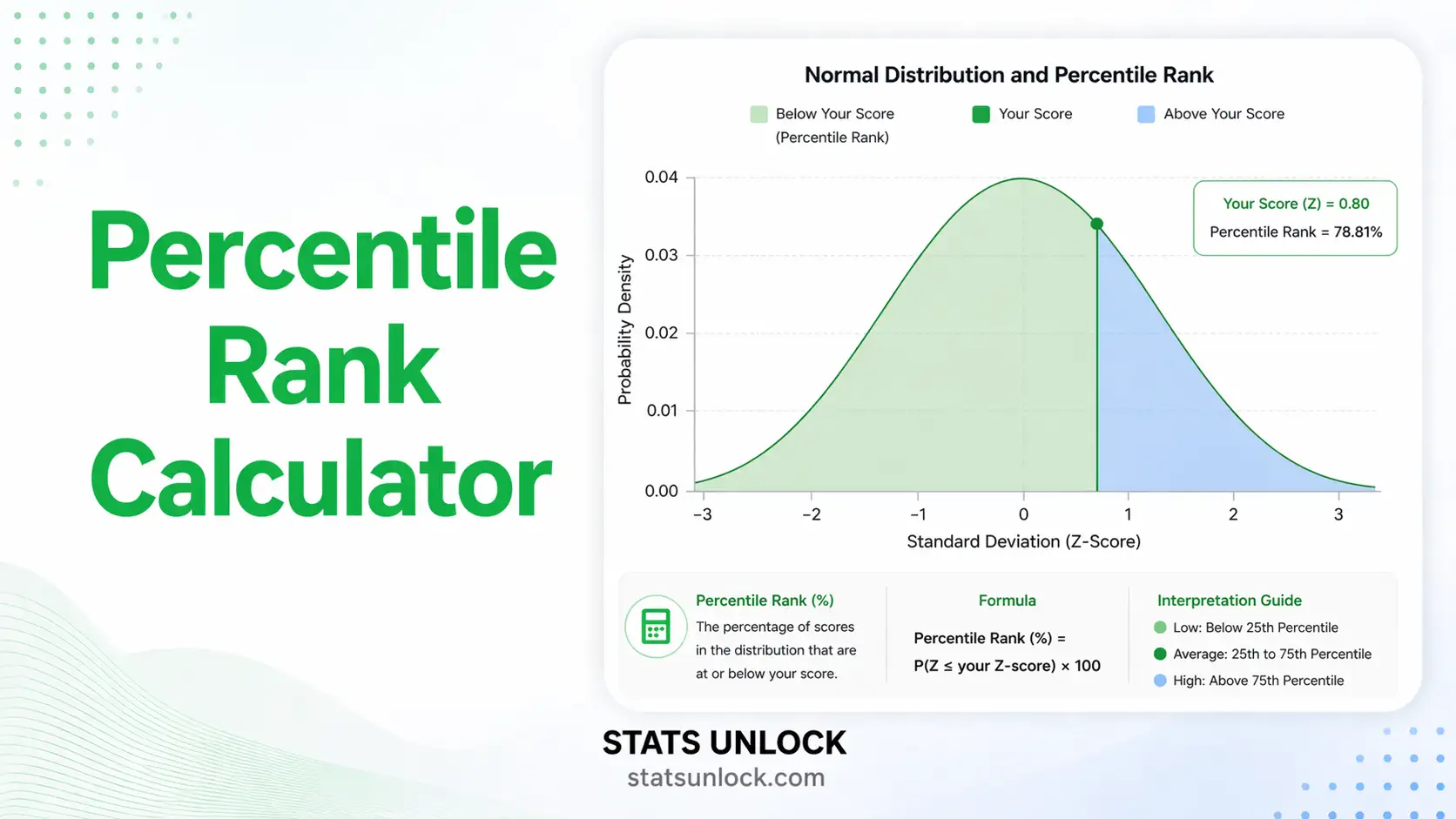

Percentile Rank Calculator
Free online descriptive statistics tool — calculate percentile rank, cumulative percentage, quartile position, z-score, and more from any dataset.
Data Input
Enter numbers separated by commas or line breaks. Non-numeric values are ignored.
Supports .csv, .txt, .xlsx, .xls — headers detected automatically.
Enter individual values; click + to add more rows.
When to Use Percentile Rank
When to Use This Tool
Percentile rank is a key descriptive statistic used to compare individual scores to a reference distribution. Use this tool when you need to:
- Understand how a score compares to others in a dataset
- Report test or assessment results in standardised form
- Identify outliers or extreme values in a distribution
- Create normative tables for educational or clinical assessments
- Communicate statistical position to non-technical audiences
Decision Tree
Do you want to compare a score to a group?
Yes → Is the data ordinal or continuous?
Continuous → Use Percentile Rank ✓
Ordinal → Use Percentile Rank or Median
No → Use Z-score or raw descriptive statistics
✅ Ideal for:
Test score reporting, clinical norms, growth charts, survey benchmarking
Test score reporting, clinical norms, growth charts, survey benchmarking
⚠️ Use caution:
Very small samples (n < 10), highly skewed distributions without transformation
Very small samples (n < 10), highly skewed distributions without transformation
❌ Avoid when:
Comparing across datasets with very different n, or when interval properties matter more
Comparing across datasets with very different n, or when interval properties matter more
How to Use This Calculator
Step-by-Step Guide
- Enter your data — paste numbers in the Type/Paste tab, upload a .csv or .xlsx file, or add individual values manually.
- Select a sample dataset (optional) — choose from the dropdown to explore a pre-loaded example.
- Enter a score to evaluate (optional) — leave blank to compute percentile ranks for all values.
- Choose the percentile rank method — Inclusive (standard), Exclusive, or Nearest Rank.
- Click "Calculate Percentile Rank" — results appear instantly below.
- Read the Key Results cards — view percentile rank, z-score, quartile, and cumulative percentage at a glance.
- Explore the charts — Score Distribution shows where values fall; the ECDF shows cumulative proportions.
- Check the full table — every value in your dataset is ranked with its percentile rank and interpretation.
- Read the Interpretation — plain-language paragraphs explain what the results mean.
- Export results — download as .txt, .xlsx, .docx, or print as PDF.
Example: If you enter the dataset "45, 67, 72, 89, 55, 91, 63, 78, 84, 60" and evaluate score 78, the calculator returns PR ≈ 75.0%, z-score = +0.52, Q3 band, meaning the score is above 75% of all values.
Frequently Asked Questions
FAQ — Percentile Rank in Descriptive Statistics
What is percentile rank?
Percentile rank is the percentage of values in a dataset that fall at or below a given score. A percentile rank of 75 means the score is higher than 75% of all observations in the group.
How do you calculate percentile rank step by step?
1. Count the number of values below the target score (B).
2. Count the number of values equal to the target score (E).
3. Count the total number of values (N).
4. Apply the formula: PR = (B + 0.5 × E) / N × 100.
2. Count the number of values equal to the target score (E).
3. Count the total number of values (N).
4. Apply the formula: PR = (B + 0.5 × E) / N × 100.
What is the difference between percentile and percentile rank?
A percentile is a value (e.g., the 90th percentile is 85 marks). A percentile rank is the percentage of scores that fall at or below a specific value (e.g., score 85 has a percentile rank of 90). They are related but expressed differently.
Can percentile rank be above 100 or below 0?
No. Percentile rank always ranges from 0 to 100. The lowest possible value receives a PR close to 0, and the highest value receives a PR close to 100.
What is a good percentile rank?
Context determines what is "good." In academic settings, PR > 75 is generally above average. In clinical screening, deviations from the 5th or 95th percentile are often flagged. In competitive exams, PR > 90 typically indicates top performance.
How is percentile rank used in education?
Percentile rank for test scores shows how a student performs relative to peers. Standardised tests such as SAT, GRE, and NEET report percentile ranks. A percentile rank of 95 means the student outperformed 95% of all test takers.
What is the relationship between percentile rank and z-score?
The z-score measures standard deviations from the mean. For normally distributed data, each z-score corresponds to a specific percentile rank. For example, z = +1.65 ≈ 95th percentile rank. This calculator computes both values for each observation.
How do you calculate percentile rank from mean and standard deviation?
Calculate z = (X − mean) / SD, then look up the cumulative probability for that z-score in a standard normal table and multiply by 100. This is valid only when data is approximately normally distributed.
What is cumulative percentage in descriptive statistics?
Cumulative percentage is the running total of relative frequencies up to and including a given value. It is the empirical CDF expressed as a percentage, and is closely related to — but not identical to — percentile rank.
Can I upload a CSV to calculate percentile rank?
Yes. Use the Upload tab to import .csv, .xlsx, or .xls files. The tool auto-detects numeric columns, lets you pick the column, previews the first 8 rows, and loads the data with one click.
Which percentile rank method should I choose?
The Inclusive method (recommended) is most common in education and social sciences. The Exclusive method is preferred in some engineering contexts. The Nearest Rank method is used in Excel's PERCENTRANK.EXC function.
Is this tool free to use?
Yes. The STATS UNLOCK percentile rank calculator is completely free with no registration, no limits, and no watermarks. Results can be downloaded as .txt, .xlsx, .docx, or printed as PDF.
References
The percentile rank calculator, cumulative percentage, and z-score computations implemented here follow established descriptive statistics methodology documented in the references below.
- Hays, W. L. (1994). Statistics (5th ed.). Harcourt Brace College Publishers.
- Field, A. (2018). Discovering Statistics Using IBM SPSS Statistics (5th ed.). SAGE Publications.
- Howell, D. C. (2012). Statistical Methods for Psychology (8th ed.). Cengage Learning.
- Siegel, S., & Castellan, N. J. (1988). Nonparametric Statistics for the Behavioral Sciences (2nd ed.). McGraw-Hill.
- Nunnally, J. C., & Bernstein, I. H. (1994). Psychometric Theory (3rd ed.). McGraw-Hill.
- Glass, G. V., & Hopkins, K. D. (1996). Statistical Methods in Education and Psychology (3rd ed.). Allyn & Bacon.
- Cohen, J. (1988). Statistical Power Analysis for the Behavioral Sciences (2nd ed.). Lawrence Erlbaum Associates. https://doi.org/10.4324/9780203771587
- Pallant, J. (2020). SPSS Survival Manual (7th ed.). Open University Press.
- Cizek, G. J., & Bunch, M. B. (2007). Standard Setting: A Guide to Establishing and Evaluating Performance Standards on Tests. SAGE. https://doi.org/10.4135/9781412985918
- Kolen, M. J., & Brennan, R. L. (2014). Test Equating, Scaling, and Linking (3rd ed.). Springer. https://doi.org/10.1007/978-1-4939-0317-7
- Wilcox, R. R. (2012). Introduction to Robust Estimation and Hypothesis Testing (3rd ed.). Academic Press.
- R Core Team. (2024). R: A Language and Environment for Statistical Computing. R Foundation. https://www.r-project.org