

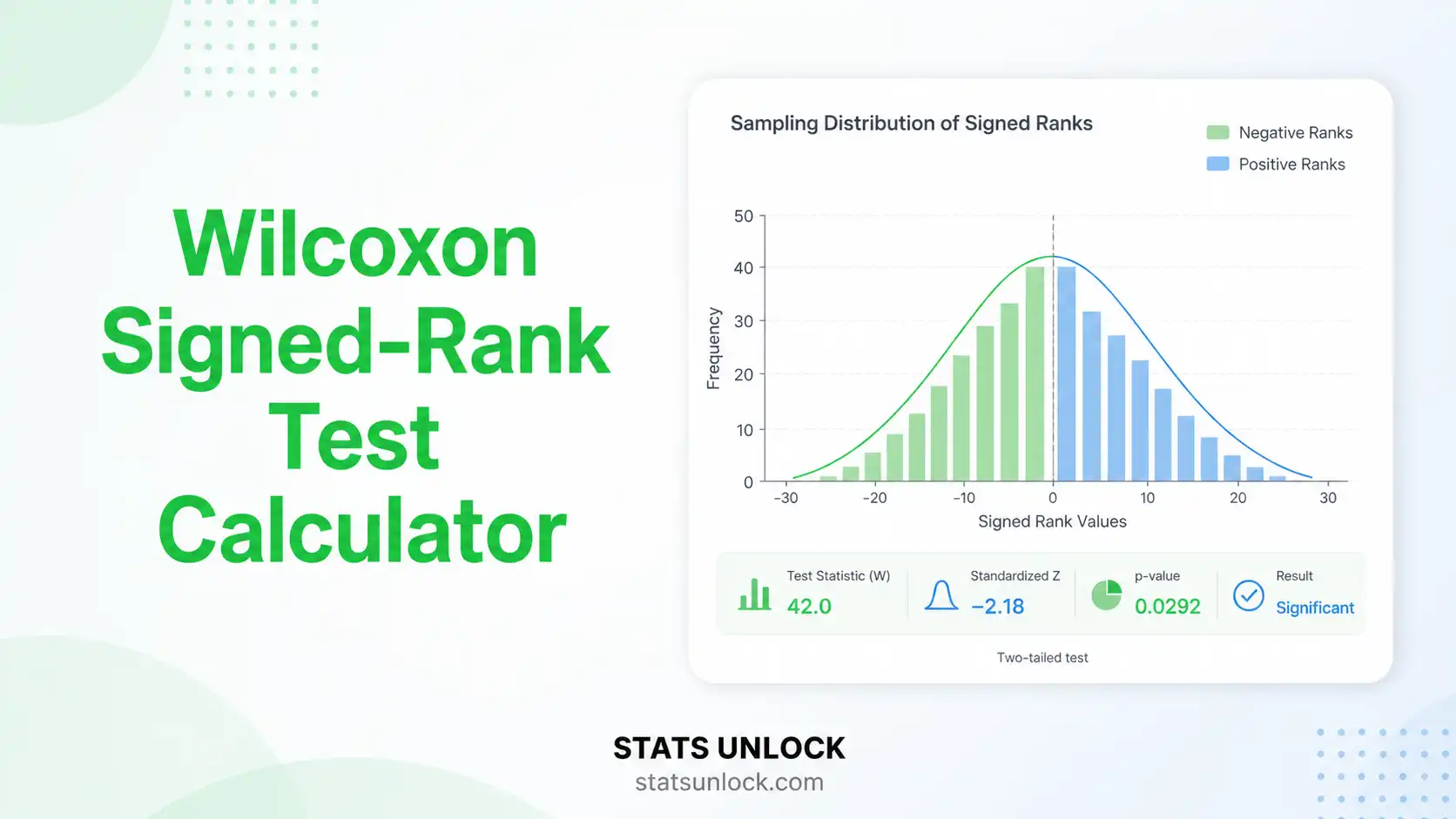

Wilcoxon Signed-Rank Test Calculator
Run a free Wilcoxon Signed-Rank Test online for paired or matched-pairs data. Get the W statistic, exact and normal-approximation p-value, effect size r, median difference, 95% confidence interval, distribution charts, APA-format results, and a downloadable PDF report — all in one click.
📥 Step 1 — Enter Your Paired Data
Enter paired values: each comma position in Group 1 must match the same position in Group 2 (e.g., participant #1's pre-score and post-score). Pairs must have equal length.
Edit cells directly. Click "+ Add Row" to extend the dataset.
| # | Group 1 | Group 2 |
|---|
⚙️ Step 2 — Test Configuration
🔍 Detailed Interpretation of Results
Below are five auto-generated paragraphs that translate the Wilcoxon Signed-Rank Test output into plain English. Every value updates dynamically when you re-run the analysis with new data or settings.
📝 How to Write Your Results in Research (5 Examples)
Five ready-to-use reporting templates for the Wilcoxon Signed-Rank Test, auto-filled with your computed values. Click 📋 Copy on any card to copy the full passage to your clipboard.
🎯 Conclusion
Run the Wilcoxon Signed-Rank Test above to see a full evidence-based conclusion that integrates the median difference, the W statistic, the standardised Z, the p-value at your chosen α, the effect size r, the 95% confidence interval, and the practical relevance for the named comparison (e.g., Pre-Treatment vs Post-Treatment).
📐 Technical Notes & Formulas
Sub-section A — Formulas Used
1. Signed-rank statistic (W⁺):
2. Mean and variance of W under H₀:
3. Standardised Z (normal approximation):
4. Effect size r:
5. Confidence interval for the median difference (Hodges–Lehmann):
Sub-section B — Technical Notes
The Wilcoxon Signed-Rank Test does not require normality of the differences, but it does assume that the distribution of differences is symmetric around its median. When the differences are heavily skewed, the Sign Test is preferred. With n < 20, prefer the exact permutation p-value over the normal approximation. Tied absolute differences receive average ranks and reduce the variance of W; the tie correction in formula (2) above adjusts for this. Pairs with zero difference are dropped (Wilcoxon's method) or kept with zero rank (Pratt's method) — choose in the configuration panel above.
🎯 When to Use the Wilcoxon Signed-Rank Test
This free Wilcoxon Signed-Rank Test calculator is designed for paired or matched-pairs data when the assumption of normality required by the paired t-test is violated. It is the standard non-parametric alternative for before/after, repeated-measures, or twin-study designs.
Decision Checklist
Real-World Examples
Sample Size Guidance
- Minimum: 6 non-zero pairs for any meaningful exact p-value.
- Recommended: n ≥ 20 non-zero pairs for the normal-approximation Z to be accurate.
- Power: For 80% power to detect a medium effect (r = 0.30) at α = 0.05 (two-tailed), plan for ≈ 50 pairs.
- Power: For 80% power to detect a large effect (r = 0.50), ≈ 18 pairs are usually sufficient.
Decision Tree
📚 How to Use This Wilcoxon Signed-Rank Test Calculator — 10 Steps
Enter Your Paired Data
Paste comma-separated values into Group 1 (Before / Pre) and Group 2 (After / Post). Each comma position must correspond to the same subject. Example:52, 48, 55, 61, 47, ...Choose a Sample Dataset (optional)
Five built-in datasets cover therapy, tutoring, diet, reaction time, and camera-trap detections — useful for testing the tool or learning the workflow.Edit Group Names
Replace "Pre-Treatment" / "Post-Treatment" with names that fit your study (e.g., "Baseline" / "Week 8") — these labels propagate through every chart, table, and APA-format result.Configure Test Settings
Set α (0.05 default), tail type (two-tailed unless you have a pre-registered direction), continuity correction (Yes is standard), and zero-difference method (Wilcoxon drops zeros; Pratt keeps them).Click Run Analysis
Computation is instant. The page scrolls to the results section and renders four summary cards, a full results table, two charts, and an assumption-check panel.Read the Summary Cards
W, Z, p-value, and effect size r. Green border = significant at α; amber = non-significant; red = unable to compute (e.g., insufficient n).Examine Both Charts
Box plot shows the central tendency and spread of each group; the difference distribution shows whether differences are symmetric around zero (the test's key assumption).Check Assumptions
Pairs are independent (PASS by design), data are at least ordinal, differences symmetric (warn if skewness > 1), and n is adequate (warn if n < 20).Read the Detailed Interpretation
Five auto-generated paragraphs cover what was found, the p-value framing, the effect-size magnitude, practical vs statistical significance, and limitations of your specific run.Export Your Results
Use Download Doc for a .txt file (great for emails / shared notes) and Download PDF for a print-ready A4 report (ideal for thesis appendices and supervisor reviews).❓ Frequently Asked Questions
Q1. What is the Wilcoxon Signed-Rank Test and when should I use it?
The Wilcoxon Signed-Rank Test is a non-parametric hypothesis test that compares two related (paired) samples to determine whether the median of their differences equals zero. It is the standard alternative to the paired t-test when the differences are not normally distributed, are ordinal, or contain outliers. A common use case is comparing patient symptom scores before and after a treatment when the difference distribution is skewed.
Q2. What is a p-value, and how do I interpret it for the Wilcoxon Signed-Rank Test?
The p-value is the probability of observing a sum of signed ranks (W) at least as extreme as the one obtained, assuming the true median difference is zero. It is not the probability that the null hypothesis is true. Example: a p-value of 0.03 means there is a 3% chance of seeing this result or one more extreme by chance alone if the treatment had truly no effect.
Q3. What does statistical significance mean — and does it equal practical importance?
Statistical significance (p < α) only tells you the result is unlikely under the null hypothesis. With very large samples, even tiny median differences become statistically significant. Always pair the p-value with the effect size r and the actual median difference in raw units to judge practical or clinical importance.
Q4. What is the effect size r and how do I interpret it?
For the Wilcoxon Signed-Rank Test, the standard effect size is r = |Z| / √N. Cohen's (1988) benchmarks classify r = 0.10 as small (the groups overlap heavily), r = 0.30 as medium (a noticeable difference visible in plots), and r = 0.50 as large (the groups separate clearly). Always report r alongside the p-value.
Q5. What assumptions does the Wilcoxon Signed-Rank Test require, and what if my data violate them?
Assumptions: (1) observations are paired, (2) the dependent variable is at least ordinal, (3) pairs are independent of one another, and (4) the distribution of differences is symmetric around the median. If symmetry is severely violated (skewness > 1.5), use the Sign Test instead, which only assumes a continuous distribution. Normality is not required.
Q6. How large a sample do I need for the Wilcoxon Signed-Rank Test to be reliable?
An absolute minimum of 6 non-zero pairs is required for a non-trivial exact p-value. With n < 20, prefer exact p-values; for n ≥ 20, the normal-approximation Z is accurate. For 80% power to detect a medium effect (r = 0.30) at α = 0.05 (two-tailed), aim for approximately 50 pairs.
Q7. What is the difference between one-tailed and two-tailed Wilcoxon tests?
A two-tailed test detects a median difference in either direction (the standard, conservative choice). A one-tailed test is more powerful but commits to a direction (e.g., scores will only go up) before data collection. Use two-tailed by default unless you have a strong, pre-specified theoretical reason to expect change in one direction only.
Q8. How do I report Wilcoxon Signed-Rank Test results in APA 7 format?
The standard APA 7 format reads: "A Wilcoxon Signed-Rank Test indicated that post-treatment scores were significantly higher than pre-treatment scores, W = 142.0, Z = 3.21, p = .001, r = 0.65, Mdn difference = 4.0." See the "How to Write Your Results" section above for five filled-in templates: APA 7, thesis, plain-language, conference abstract, and pre-registration style.
Q9. Can I cite this calculator in my published research or thesis?
Yes. Cite as: STATS UNLOCK. (2026). Wilcoxon Signed-Rank Test Calculator. Retrieved from https://statsunlock.com/wilcoxon-signed-rank-test-calculator/. For formal publication, verify the final reported values against R (wilcox.test(x, y, paired = TRUE)), Python (scipy.stats.wilcoxon), or SPSS — the algorithms are identical, but reviewers expect a peer-reviewed software citation.
Q10. What should I do if my Wilcoxon test result is non-significant?
A non-significant result (p > α) means the data do not provide enough evidence to reject the null hypothesis of zero median difference — it does not prove the null is true. Check your statistical power: small samples often fail to detect real effects (Type II error). Consider running a Bayesian Wilcoxon test (BF₁₀) to quantify evidence in favour of the null, or planning a larger replication study.
📚 References
The following references support the statistical methods used in this Wilcoxon Signed-Rank Test calculator, covering effect size interpretation, p-value reporting, and best practices in non-parametric hypothesis testing.
- Wilcoxon, F. (1945). Individual comparisons by ranking methods. Biometrics Bulletin, 1(6), 80–83. https://doi.org/10.2307/3001968
- Pratt, J. W. (1959). Remarks on zeros and ties in the Wilcoxon signed rank procedures. Journal of the American Statistical Association, 54(287), 655–667. https://doi.org/10.1080/01621459.1959.10501526
- Hodges, J. L., & Lehmann, E. L. (1963). Estimates of location based on rank tests. Annals of Mathematical Statistics, 34(2), 598–611. https://doi.org/10.1214/aoms/1177704172
- Cohen, J. (1988). Statistical power analysis for the behavioral sciences (2nd ed.). Lawrence Erlbaum Associates.
- Field, A. (2018). Discovering statistics using IBM SPSS statistics (5th ed.). SAGE Publications.
- Conover, W. J. (1999). Practical nonparametric statistics (3rd ed.). John Wiley & Sons.
- Hollander, M., Wolfe, D. A., & Chicken, E. (2014). Nonparametric statistical methods (3rd ed.). John Wiley & Sons.
- Fritz, C. O., Morris, P. E., & Richler, J. J. (2012). Effect size estimates: Current use, calculations, and interpretation. Journal of Experimental Psychology: General, 141(1), 2–18. https://doi.org/10.1037/a0024338
- Rosenthal, R. (1991). Meta-analytic procedures for social research (Rev. ed.). SAGE Publications. https://doi.org/10.4135/9781412984997
- Lakens, D. (2013). Calculating and reporting effect sizes to facilitate cumulative science: A practical primer for t-tests and ANOVAs. Frontiers in Psychology, 4, 863. https://doi.org/10.3389/fpsyg.2013.00863
- American Psychological Association. (2020). Publication manual of the American Psychological Association (7th ed.). APA. https://doi.org/10.1037/0000165-000
- Kerby, D. S. (2014). The simple difference formula: An approach to teaching nonparametric correlation. Comprehensive Psychology, 3, 1–9. https://doi.org/10.2466/11.IT.3.1
- R Core Team. (2024). R: A language and environment for statistical computing. R Foundation for Statistical Computing. https://www.R-project.org/
- Virtanen, P., Gommers, R., Oliphant, T. E., et al. (2020). SciPy 1.0: Fundamental algorithms for scientific computing in Python. Nature Methods, 17, 261–272. https://doi.org/10.1038/s41592-020-0772-5
- NIST/SEMATECH. (2013). e-Handbook of statistical methods. National Institute of Standards and Technology. https://www.itl.nist.gov/div898/handbook/