

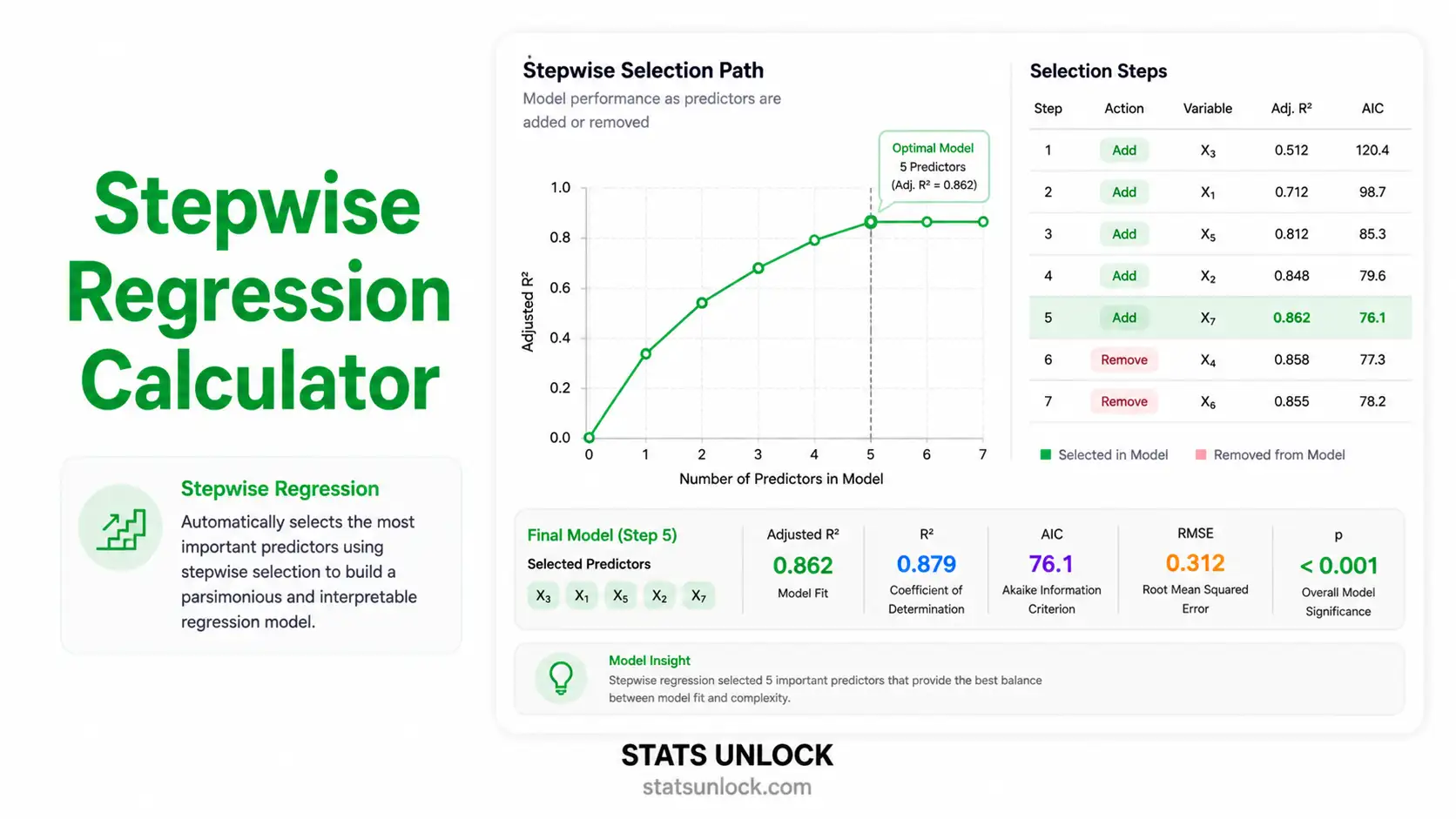

Stepwise Regression Calculator
Free, in-browser stepwise regression with forward, backward and bidirectional selection — built for researchers, students and analysts who need a parsimonious linear model fast.
📊 Step 1 — Enter Your Data
Enter values comma-separated (e.g. 52, 48, 55, 61, 47, ...).
Newlines are also accepted. Each predictor and the outcome must have the same number of values.
Quick manual entry — type one row at a time. Click + Add row to extend.
⚙️ Step 2 — Configure the Stepwise Procedure
📈 Step 3 — Summary of the Final Model
📋 Final Model — Coefficient Table
These are the coefficients of the predictors retained by the stepwise procedure, with standard errors, t-statistics, p-values and confidence intervals.
Model Fit Statistics
ANOVA — Overall Model F-test
🔁 Step-by-Step Selection History
Trace of every variable added or removed during the stepwise procedure. Each row shows the model state after that step, together with the criterion value used to make the decision.
🎨 Colourful Visualisations
📌 Observed vs Predicted Y
Points hugging the diagonal indicate strong predictive performance of the final model.
📌 Residuals vs Fitted
A random cloud around zero supports linearity and homoscedasticity.
📌 Standardised Coefficients (β)
Bar length = effect strength; colour by sign. Green bars = positive effect, pink = negative.
📌 AIC Path Across Steps
Lower AIC = better trade-off between fit and parsimony. The endpoint is the chosen model.
🔍 Assumption Checks for the Final Model
📤 Step 4 — Export Your Results
💡 Step 5 — Detailed Interpretation of Results
Run the analysis above to generate a detailed, plain-language interpretation tailored to your data.
📝 How to Write Your Results in Research (5 Reporting Styles)
A bidirectional stepwise multiple linear regression was conducted to identify ___ that predicted ___. Using AIC as the selection criterion, the final model retained ___ predictors and explained a significant proportion of variance, R² = ___, adjusted R² = ___, F(___, ___) = ___, p ___ ___. ___
📌 Key conventions for APA 7
- Italicise statistical symbols: F, p, R², β.
- If p < .001 write "p < .001" (never "p = .000").
- Always report adjusted R² for stepwise models — raw R² alone is misleading.
- State both the selection direction and criterion (AIC / BIC / p-value).
- Report 95% CI for each retained coefficient.
To identify the most parsimonious set of predictors of ___, a bidirectional stepwise multiple linear regression was conducted (α = ___, AIC criterion). Predictors were entered into a candidate pool of ___ variables. Linearity, normality of residuals, homoscedasticity and absence of multicollinearity (VIF < 5) were assessed prior to interpretation. The procedure converged on a final model retaining ___ predictors. Results are reported below: F(___, ___) = ___, p ___ ___, R² = ___, adjusted R² = ___, AIC = ___. ___
📌 Key conventions for thesis style
- Name the software (e.g., "Analyses were performed with the StatsUnlock Stepwise Regression Calculator, cross-validated against R 4.3.2 stats::step()").
- Always justify why stepwise was chosen over theory-driven entry.
- Report VIF and residual diagnostics in supplementary material.
- Flag the inflated Type I error caveat once in your Methods.
We examined which factors best explain ___ in our sample. Out of ___ variables considered, ___ stood out as meaningful predictors. Together they account for about ___% of the variation in ___. The strongest factor was ___, where each one-unit increase was associated with a change of about ___ units in the outcome. The likelihood that the overall pattern is due to chance is less than ___. These findings suggest that future programmes targeting ___ should focus on ___.
📌 Key conventions for plain language
- Avoid every Greek letter and statistical symbol.
- Translate R² into "% of variation explained".
- Convert p-value into "less than 1 in X" framing.
- Anchor every coefficient in real-world units.
- Close with a practice or policy implication.
Background: Identifying parsimonious predictors of ___ remains a key analytic challenge in ___ research.
Methods: We applied bidirectional stepwise multiple linear regression (AIC criterion, α = ___) to a candidate pool of ___ predictors with n = ___ observations.
Results: The final model retained ___ predictors: ___. The model was statistically significant, F(___, ___) = ___, p ___ ___, R² = ___, adjusted R² = ___, AIC = ___.
Conclusion: ___ emerged as the dominant driver of ___. Findings inform ___ and warrant validation in an independent sample.
📌 Key conventions for abstracts
- Strict 4-label structure (Background / Methods / Results / Conclusion).
- Italicise statistical symbols.
- Always state n and selection criterion.
- Conclusion sentence must go beyond restating results — state implication.
Pre-registered hypothesis: We hypothesised that a subset of ___ candidate predictors would jointly explain a non-trivial portion of variance in ___. Hypothesis registered at osf.io/xxxxx prior to data analysis.
Analysis plan: Bidirectional stepwise multiple linear regression with AIC entry/removal; α = ___ for confirmatory tests on the final model; SESOI = adjusted R² ≥ 0.10. Multicollinearity flagged at VIF > 5.
Observed result: With n = ___ observations on ___ candidate predictors, the procedure retained ___ variables: ___. F(___, ___) = ___, p ___ ___, R² = ___, adjusted R² = ___, AIC = ___, BIC = ___. The pre-specified SESOI was ___.
Reproducibility note: Computation performed in JavaScript via the StatsUnlock Stepwise Regression Calculator (statsunlock.com); results cross-checked against R::stats::step(). Data and configuration archived at github.com/[repo].
📌 Key conventions for open science
- State the SESOI before analysis.
- Cite the pre-registration record (OSF, AsPredicted).
- Report both AIC and BIC for transparency.
- Archive data and config publicly.
- Always cross-check stepwise results against a regularised method (LASSO).
📐 Technical Notes & Formulas (open / close)
A. Multiple Linear Regression (the underlying model)
B. OLS Estimation
C. Selection Criteria
D. Effect Sizes & Goodness of Fit
E. Algorithmic Notes
- Forward: Start with intercept-only model. At each step, add the predictor whose inclusion most improves the criterion (lowest AIC / smallest p-value below α). Stop when no addition improves the criterion.
- Backward: Start with the full model. At each step, remove the predictor whose deletion most improves (or least worsens) the criterion (largest p-value above α). Stop when no removal improves the criterion.
- Bidirectional: At each step consider both adding any excluded predictor and removing any included predictor. Apply whichever single move best improves the criterion.
- The OLS solver in this tool uses Gauss-Jordan elimination on (Xᵀ X) | Xᵀ y, with a small ridge term (1e-8 · I) added when the matrix is near-singular to avoid blow-up — coefficient estimates are equivalent to OLS under standard conditions.
- p-values for individual coefficients use a two-sided Student's t distribution with n − k − 1 degrees of freedom.
🎯 When to Use Stepwise Regression
Use stepwise regression for exploratory model building when you have many candidate predictors of a continuous outcome and limited theoretical guidance about which to keep. It is best positioned as a hypothesis-generating tool, not a confirmatory one.
Decision Checklist
- You have a single continuous outcome (interval / ratio scale).
- You have 2 or more candidate predictors (continuous or dummy-coded categorical).
- Sample size ≥ 10–20 observations per candidate predictor.
- Predictors are not perfectly collinear (VIF < 5 ideally, < 10 acceptable).
- Residuals are approximately normal and homoscedastic.
- Do NOT use for confirmatory hypothesis testing — use theory-driven hierarchical regression instead.
- Do NOT use as the sole inference tool in small samples (n < 50) — Type I error inflates dramatically.
- Do NOT use when predictors are highly collinear — switch to LASSO, ridge, or elastic-net regression.
Real-World Examples
- Real estate analytics — choosing among 12 candidate house features (size, bedrooms, age, distance to city, school score, garage size, etc.) the best subset that predicts sale price.
- Education research — identifying which student-level factors (study hours, sleep, attendance, parental support, prior GPA) predict end-of-year exam performance.
- Ecology and field biology — discovering which habitat variables (canopy cover, distance to water, prey density, elevation, human disturbance) best predict species abundance.
- Marketing / business — finding which campaign variables (channel spend, frequency, creative type, audience age, season) drive product sales week-over-week.
- Health and clinical research — selecting from many lifestyle and biological measures the parsimonious subset that predicts cholesterol or blood pressure.
Sample-Size Guidance
- 10 observations per candidate predictor is the absolute minimum.
- 20 per predictor gives reasonable stability of selected variables.
- For a candidate pool of 5 predictors, aim for n = 100 +.
- When n < 50, prefer regularised regression (LASSO, ridge) and bootstrap validation.
Related Tests — Decision Tree
🧭 How to Use This Tool — Step-by-Step Guide
01 Enter Your Data
Choose one of the three input modes: Paste, Upload, or Manual. Each predictor needs a name and a comma-separated list of values; the Outcome (Y) goes in the orange block. All columns must have the same number of rows.
Size: 1200, 1500, 1800, 2100, 2400 · Price: 250, 310, 360, 420, 47002 Try a Sample Dataset
Use the green Sample Dataset dropdown to instantly load one of five worked examples — house prices, exam scores, crop yield, salaries, or cholesterol. The first dataset is pre-loaded so you can run the tool immediately.
03 Configure the Procedure
Pick the direction (forward / backward / bidirectional), the criterion (AIC / BIC / p-value), and the alpha. AIC + bidirectional is the most defensible default for exploratory work.
04 Run the Analysis
Click ▶ Run Stepwise Regression. The tool fits a model at every step, evaluates the criterion, and chooses the move that most improves it.
05 Read the Summary Cards
The cards across the top show R², adjusted R², F, p, AIC, BIC, RMSE and the number of predictors retained. Green cards indicate significance at your chosen α; amber/red flag a non-significant or borderline model.
06 Read the Coefficient Table
For each retained predictor, the coefficient (B), standardised β, standard error, t, p-value, 95% CI and VIF are reported. Significant coefficients are coloured green; non-significant ones red.
07 Examine the Visualisations
Four interlinked charts: (1) Observed vs Predicted, (2) Residuals vs Fitted, (3) Standardised coefficient bar chart, (4) AIC trajectory across steps. Together they tell you how well the final model fits and how confident you should be in the variable selection path.
08 Check the Assumptions
The assumption panel runs five automatic checks: linearity, normality of residuals, homoscedasticity, multicollinearity (VIF), and influential points. Green ✅ = pass, amber ⚠️ = caution, red ❌ = violated.
09 Read the Interpretation & 5 Examples
Section 5 spells out, in plain English, what the analysis found, what the p-value and R² actually mean, what the practical magnitude is, and what the limitations are. The five reporting templates auto-fill with your numbers — copy whichever style your supervisor or journal expects.
10 Export Your Results
Use Download Doc for a plain-text record (great for emailing to a co-author) and Download PDF for a publication-ready printable report. Both contain the full table, charts and APA-style write-up.
❓ Frequently Asked Questions
Q1. What is stepwise regression and when should I use it?
Stepwise regression is an automated variable-selection method that iteratively adds or removes predictors from a multiple linear regression model based on statistical criteria (p-value, AIC, or BIC). It produces a parsimonious final equation from a large candidate pool.
Use it for exploratory work when you have many possible predictors and want a small, interpretable model — for example, choosing among 10 house features the subset that best predicts sale price.
Q2. What is a p-value, and how do I interpret it for stepwise regression?
The p-value of a coefficient is the probability of observing a t-statistic at least as extreme as the one calculated, if that predictor's true effect were zero. A p-value of 0.03 means there is a 3% chance of seeing the observed effect by chance alone.
It is not the probability that the null hypothesis is true. In stepwise regression, p-values are also used as the entry/removal criterion when "p-value" is the chosen criterion.
Q3. What does statistical significance mean — and does it equal practical importance?
Statistical significance (p < α) only tells you the effect is unlikely to be zero. With large samples, even tiny coefficients become "significant" without being practically meaningful.
Always look at the standardised β (effect strength) and adjusted R² (variance explained) alongside p-values to judge real-world importance.
Q4. What is the standardised β and how do I interpret it?
The standardised β is the coefficient you would obtain if all predictors and the outcome were z-scored. It expresses the change in outcome (in SDs) for a 1-SD change in the predictor.
Cohen's benchmarks: |β| ≈ 0.10 small, ≈ 0.30 medium, ≈ 0.50 large. Compare β across predictors to rank their relative importance — something raw B coefficients cannot do when scales differ.
Q5. What assumptions does stepwise regression require, and what if my data violate them?
The same five assumptions as multiple linear regression apply: (1) linearity, (2) independence of errors, (3) normality of residuals, (4) homoscedasticity, (5) low multicollinearity.
If normality fails, use bootstrap CIs or robust regression. If homoscedasticity fails, use weighted least squares (WLS) or White-corrected SEs. If VIF > 5, switch to ridge / LASSO / elastic-net.
Q6. How large a sample do I need for stepwise regression to be reliable?
Common rules of thumb are 10–20 observations per candidate predictor. For 5 candidate predictors, target 50–100 observations; for 10, target 100–200.
Very small samples (n < 50) are unstable: predictors get selected on chance correlations and the model often does not replicate. Use bootstrap variable-selection counts to check stability.
Q7. What is the difference between forward, backward, and bidirectional stepwise?
Forward starts empty and only adds. Backward starts full and only removes. Bidirectional combines both — at each step it can add or remove. Bidirectional is the most defensible default because variables that look useful early can later be dropped if a better predictor enters.
Q8. How do I report stepwise regression results in APA 7 format?
Report the selection method, criterion, final model F, df, p, R², adjusted R², AIC and 95% CIs for each retained coefficient. See the Section 5 → "How to Write Your Results" cards above for five auto-filled templates (APA, thesis, plain-language, abstract, pre-registration).
Q9. Can I use this calculator for my published research or university assignment?
Yes for educational use, exploratory analysis, classwork and thesis appendices. For a peer-reviewed publication, cross-check the final model in R (stats::step), Python (statsmodels) or SPSS, and report the validation in your methods.
Suggested citation: StatsUnlock. (2025). Stepwise Regression Calculator. https://statsunlock.com/stepwise-regression-calculator/
Q10. What should I do if stepwise picks a predictor I think is unimportant?
Stepwise selection is purely statistical — it ignores your theory. If a chosen predictor lacks a substantive rationale, examine its standardised β, partial correlation and VIF. Consider re-running with that variable forced out, or replace stepwise with a theory-driven hierarchical regression.
You can also bootstrap the selection 1,000 times and report only predictors selected in > 60% of resamples.
🏁 Conclusion — When Stepwise Regression Earns Its Place
What this tool does for you
The StatsUnlock Stepwise Regression Calculator brings every step of forward, backward and bidirectional variable selection into a single, in-browser interface. It computes OLS coefficients, t-tests, F-tests, AIC, BIC, adjusted R², VIF and 95% confidence intervals, traces the full selection history, and produces four publication-ready visualisations — without sending your data anywhere. Everything runs locally in your browser.
Why parsimony matters
In real research, predictors are cheap and degrees of freedom are expensive. A model with too many predictors fits the training data beautifully but fails to replicate. A model with too few misses real signal. Stepwise regression — used responsibly — is one of the oldest and most widely taught tools for navigating that trade-off, especially when you genuinely have no prior theory to rank predictors. The AIC and BIC criteria embedded here formalise that trade-off: they reward better fit but penalise every additional parameter.
Honest limits
Stepwise selection has been criticised for decades. It capitalises on chance correlations, inflates Type I error, produces optimistic R² values, and yields confidence intervals that are too narrow because they ignore the selection step itself. None of those criticisms make stepwise wrong — they make it insufficient on its own for confirmatory inference. Treat the final model as a hypothesis to be tested, not a finished claim.
How to use it well
First, run the procedure here to identify a parsimonious candidate model. Second, cross-check it against a regularised method — LASSO or elastic-net — to confirm the same predictors survive a different penalty. Third, validate the model on a hold-out sample (or via 5-fold cross-validation) before publishing the predictive R². Finally, when you write up results, always state the selection direction, the criterion (AIC vs BIC vs p-value), the alpha level, the candidate pool size, and the diagnostic checks performed.
What to take away
Stepwise regression is best understood as a structured, defensible search through a high-dimensional predictor space. This tool gives you that search in a single click, with full transparency about every step, and produces the exact statistics, interpretations and reporting templates that journals, supervisors and policy reviewers expect. Pair it with theory, cross-validation and a regularised cross-check — and stepwise becomes a sharp, reliable instrument rather than a black box.
📚 References
The following references support the statistical methods used in this stepwise regression calculator, covering variable selection, multiple linear regression, and best practices in p-value interpretation and effect size reporting.
- Efroymson, M. A. (1960). Multiple regression analysis. In Mathematical Methods for Digital Computers (pp. 191–203). Wiley.
- Akaike, H. (1974). A new look at the statistical model identification. IEEE Transactions on Automatic Control, 19(6), 716–723. https://doi.org/10.1109/TAC.1974.1100705
- Schwarz, G. (1978). Estimating the dimension of a model. The Annals of Statistics, 6(2), 461–464. https://doi.org/10.1214/aos/1176344136
- Cohen, J. (1988). Statistical power analysis for the behavioral sciences (2nd ed.). Lawrence Erlbaum Associates.
- Harrell, F. E. (2015). Regression Modeling Strategies (2nd ed.). Springer. https://doi.org/10.1007/978-3-319-19425-7
- Field, A. (2018). Discovering statistics using IBM SPSS statistics (5th ed.). SAGE Publications.
- Hocking, R. R. (1976). The analysis and selection of variables in linear regression. Biometrics, 32(1), 1–49. https://doi.org/10.2307/2529336
- Burnham, K. P., & Anderson, D. R. (2002). Model selection and multimodel inference (2nd ed.). Springer.
- Tibshirani, R. (1996). Regression shrinkage and selection via the lasso. Journal of the Royal Statistical Society: Series B, 58(1), 267–288. https://doi.org/10.1111/j.2517-6161.1996.tb02080.x
- Hastie, T., Tibshirani, R., & Friedman, J. (2009). The Elements of Statistical Learning (2nd ed.). Springer. https://doi.org/10.1007/978-0-387-84858-7
- James, G., Witten, D., Hastie, T., & Tibshirani, R. (2021). An Introduction to Statistical Learning (2nd ed.). Springer. https://doi.org/10.1007/978-1-0716-1418-1
- American Psychological Association. (2020). Publication manual of the American Psychological Association (7th ed.). APA. https://doi.org/10.1037/0000165-000
- R Core Team. (2024). R: A language and environment for statistical computing. R Foundation for Statistical Computing. https://www.R-project.org/
- Whittingham, M. J., Stephens, P. A., Bradbury, R. B., & Freckleton, R. P. (2006). Why do we still use stepwise modelling in ecology and behaviour? Journal of Animal Ecology, 75(5), 1182–1189. https://doi.org/10.1111/j.1365-2656.2006.01141.x
- NIST/SEMATECH. (2013). e-Handbook of Statistical Methods. National Institute of Standards and Technology. https://www.itl.nist.gov/div898/handbook/