
Redox Reaction Balancer
Balance any redox reaction in acidic, basic or neutral solution by the half-reaction (ion-electron) method or the oxidation-number method. Type a skeleton equation and get the balanced equation, both half-reactions, the electrons transferred, the oxidising and reducing agents, E°cell, every step, a figure and four charts.
⚡ 0. Quick Answer
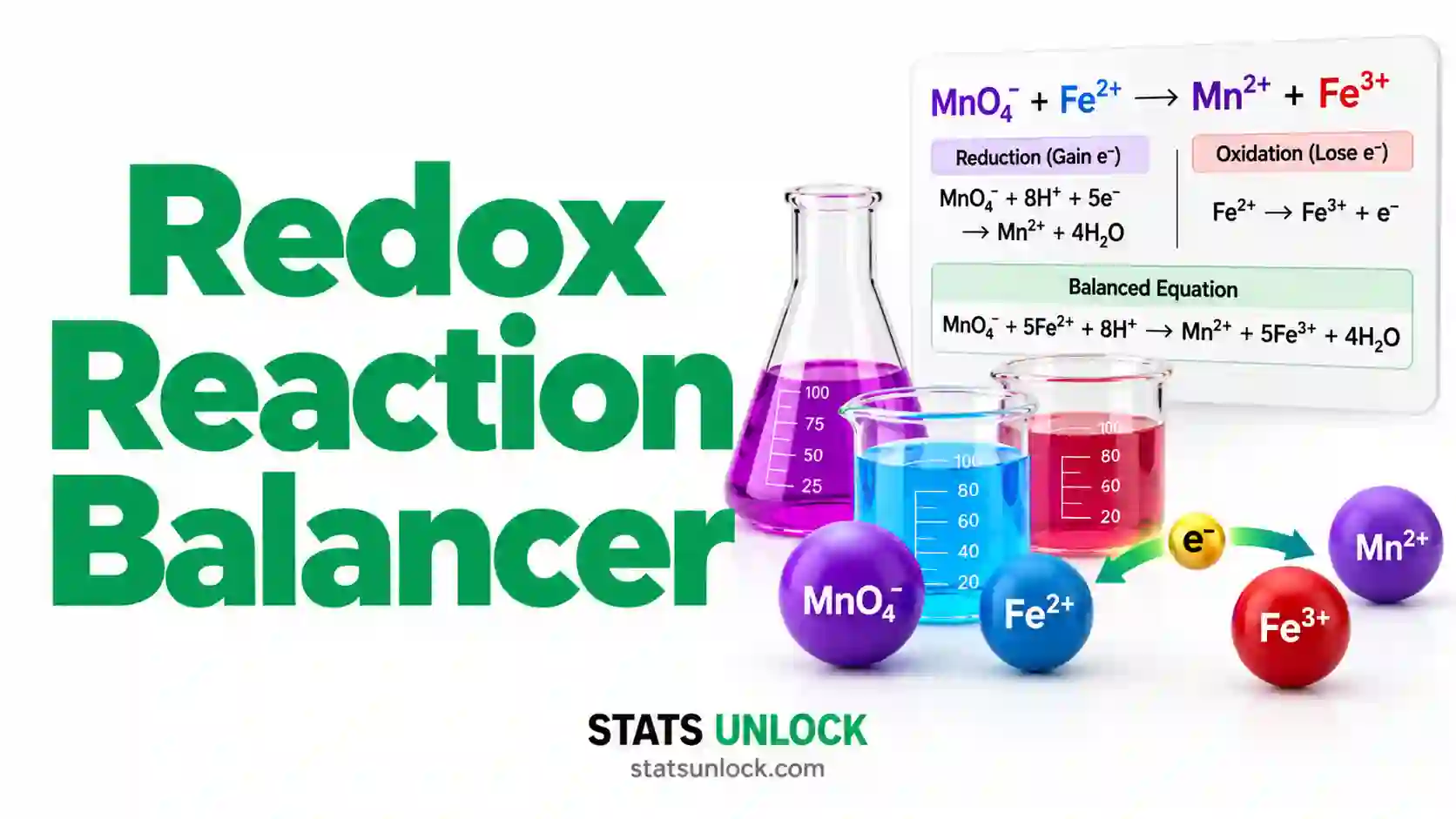
To balance a redox reaction, split it into an oxidation half-reaction and a reduction half-reaction. In each half, balance the atoms other than O and H, then O with H2O, then H with H+, then charge with electrons. Multiply the halves so the electrons lost equal the electrons gained, add them and cancel. Permanganate and iron(II) in acidic solution:
Rule of thumb: electrons never appear in the final equation, and both atoms and total charge must match (+17 on each side here). In basic solution, add one OH− to both sides for every H+, combine them into water and cancel: 2MnO4− + 6I− + 4H2O → 2MnO2 + 3I2 + 8OH−.
🔑 Key Takeaways
- Oxidation is loss of electrons (the oxidation number goes up); reduction is gain (it goes down). OIL RIG.
- The half-reaction (ion-electron) method balances each half separately; the oxidation-number method balances the change in oxidation numbers first. Both give the same answer.
- In MnO4− + Fe2+, Mn goes from +7 to +2 (gains 5 e−) and Fe from +2 to +3 (loses 1 e−), so 5 Fe2+ are needed for each MnO4−.
- Acidic solution: add H2O and H+. Basic solution: finish with OH− and H2O, never H+.
- With standard potentials, E°cell = E°cathode − E°anode = 1.51 − 0.771 = +0.739 V, so this reaction is spontaneous (ΔG° = −356.5 kJ/mol).
📚 1. What Is a Redox Reaction Balancer, and How Does Balancing Redox Reactions Work?
A redox reaction is a reaction in which electrons move from one species to another. The species that loses electrons is oxidised and acts as the reducing agent; the species that gains them is reduced and acts as the oxidising agent. A balanced redox equation must conserve three things at once: every kind of atom, the total charge, and the electrons (lost = gained).
A redox reaction balancer does that bookkeeping for you. It reads the skeleton equation, assigns oxidation numbers to every atom, works out which element is oxidised and which is reduced, splits the reaction into two half-reactions, balances each one with H2O, H+ (or OH−) and electrons, equalises the electrons, adds the halves and cancels. Every answer is then checked three ways: atoms, charge and an independent electron count.
A worked one-liner: copper dissolves in nitric acid as Cu + NO3− → Cu2+ + NO. Copper loses 2 e− and nitrogen (+5 → +2) gains 3 e−; the lowest common multiple is 6, so 3 Cu and 2 NO3− react: 3Cu + 2NO3− + 8H+ → 3Cu2+ + 2NO + 4H2O.
Who uses it: balancing redox reactions is taught in NCERT Class 11 (“Redox Reactions”, including the oxidation number method and the half reaction method), tested in JEE, NEET, AP Chemistry, A level, IB and the MCAT, and used every day in titrations (permanganate, dichromate, iodine–thiosulfate), electrochemistry, corrosion, batteries and water treatment.
| Skeleton | Medium | Balanced redox equation | e− |
|---|---|---|---|
| MnO4− + Fe2+ → Mn2+ + Fe3+ | Acidic | MnO4− + 5Fe2+ + 8H+ → Mn2+ + 5Fe3+ + 4H2O | 5 |
| Cr2O72− + Fe2+ → Cr3+ + Fe3+ | Acidic | Cr2O72− + 6Fe2+ + 14H+ → 2Cr3+ + 6Fe3+ + 7H2O | 6 |
| MnO4− + I− → MnO2 + I2 | Basic | 2MnO4− + 6I− + 4H2O → 2MnO2 + 3I2 + 8OH− | 6 |
| Cl2 → Cl− + ClO3− | Basic | 3Cl2 + 6OH− → 5Cl− + ClO3− + 3H2O | 5 |
| KMnO4 + HCl → KCl + MnCl2 + Cl2 + H2O | Molecular | 2KMnO4 + 16HCl → 2KCl + 2MnCl2 + 5Cl2 + 8H2O | 10 |
What this free redox reaction balancer solves
One tool covers every kind of redox balancing in a typical course: balancing redox reactions in acidic solution, balancing redox reactions in basic solution, neutral solution, the oxidation number method, the ion electron method, disproportionation, reactions with three reactants, single half-reactions, and checking an answer you already wrote. Press Try it to load an example, then press the button to see the working.
| Problem | What it works out | Example | |
|---|---|---|---|
| Balance a redox reaction in acidic solution | Both half-reactions, H2O and H+, electrons, E°cell | MnO4− + Fe2+ → 5 e− | |
| Balance a redox reaction in basic solution | Acidic balance, then OH− added and water cancelled | MnO4− + I− → MnO2 + I2 | |
| Peroxide redox | The electron-balanced ratio (a plain matrix balance gives many) | 2MnO4− + 5H2O2 | |
| Disproportionation | One species in both half-reactions | Cl2 → Cl− + ClO3− | |
| Oxidation number method | Molecular equations with spectator ions | 2KMnO4 + 16HCl | |
| Three reactants, two elements oxidised | As and S both lose electrons | 3As2S3 + 28NO3− | |
| Write a balanced half-reaction | One half with its electrons | Cr2O72− → 2Cr3+, 6 e− | |
| Neutral solution | Water as reactant, OH− or H+ as product | MnO4− + I− → MnO2 + IO3− | |
| Check my answer | Atoms, charge, lowest terms and the electron ratio | 4Fe2+ + 2O2 (wrong) |
Free, with no sign-up. Everything runs in your browser: nothing you type is sent to a server or stored.
En español: ¿cómo se balancea una reacción redox? Separa la oxidación y la reducción, balancea en cada semirreacción los átomos, el oxígeno con H2O, el hidrógeno con H+ y la carga con electrones; iguala los electrones y suma: MnO4− + 5Fe2+ + 8H+ → Mn2+ + 5Fe3+ + 4H2O.
How accurate is this redox reaction balancer?
Coefficients are exact whole numbers from integer arithmetic, so there is no rounding. Oxidation numbers follow the IUPAC rules (Karen, McArdle & Takats, 2016). Every answer must pass three checks before it gets the Verified badge: atoms and charge are equal on both sides, the electrons lost equal the electrons gained, and an independent electron count from the oxidation numbers gives the same number. Where a plain matrix balance also has a single answer, it is compared as well (Alberty, 1991). Standard potentials are tabulated values at 25 °C (Bratsch, 1989); different tables can differ by a few hundredths of a volt. The R and Python scripts in Sections 10 and 11 return the same MnO4− + 5Fe2+ + 8H+ balance and E°cell = +0.739 V.
Studies of how students learn redox find that most errors come from the conventions, not the arithmetic: adding H+ in basic solution, forgetting to balance charge, or confusing the oxidising agent with the species that is oxidised (Garnett & Treagust, 1992; Brandriet & Bretz, 2014). That is why the results label each half and each agent.
🧮 2. Enter Your Reaction in the Redox Reaction Balancer
1. What do you want to do?
2. Skeleton equation (unbalanced)
Write charges after the formula: MnO4-, Fe2+, Cr2O7^2-, SO4{2-} and Fe³⁺ all work. Use -> for the arrow. You do not need to add H+, OH− or H2O: the balancer adds them.
Press Enter in the box to balance. Nothing is calculated until you press the button.
📊 3. Your Results: Balanced Redox Reaction with Steps
🧠 4. What Does Your Balanced Redox Equation Mean?
4.1 Oxidation, reduction and OIL RIG
Oxidation Is Loss of electrons and Reduction Is Gain. In terms of oxidation numbers, an element that is oxidised goes up (Fe +2 → +3) and an element that is reduced goes down (Mn +7 → +2). Oxidation and reduction always happen together: the electrons lost by one species are gained by another, which is why a redox equation is split into two half-reactions and then put back together.
4.2 Oxidising agent and reducing agent
The oxidising agent is the reactant that takes electrons, so it is itself reduced (MnO4−, Cr2O72−, Cl2, H2O2, NO3−). The reducing agent gives electrons away and is oxidised (Fe2+, I−, C2O42−, metals such as Zn and Cu). Name the whole species, not just the element: the oxidising agent is MnO4−, not Mn.
4.3 Electrons transferred (n)
The number n is the electrons that move in the balanced equation as written: the lowest common multiple of the electrons in the two half-reactions, divided by any common factor at the end. It is 5 for MnO4− + 5Fe2+, 6 for dichromate and iron(II), and 10 for 2MnO4− + 5C2O42−. You need n for ΔG° = −nFE°, the Nernst equation and Faraday’s laws of electrolysis.
4.4 Acidic, basic and neutral solution
| Medium | Balance O with | Balance H with | The final equation may contain |
|---|---|---|---|
| Acidic | H2O | H+ | H+ and H2O, never OH− |
| Basic | H2O (as in acid) | H+, then add the same number of OH− to both sides | OH− and H2O, never H+ |
| Neutral | H2O | H+; if H+ ends up as a reactant, convert it to OH− on the product side | H2O as a reactant; H+ or OH− only as products |
| Molecular | H2O as written | The acid as written (HCl, HNO3, H2SO4) | Only the species you typed |
The same skeleton can give a different balanced equation in a different medium. Permanganate with iodide gives MnO2 in basic solution (2MnO4− + 6I− + 4H2O → 2MnO2 + 3I2 + 8OH−) but Mn2+ in acid, so the products themselves depend on the medium.
4.5 Disproportionation and comproportionation
In a disproportionation one species is both oxidised and reduced: chlorine in hot base gives chloride (−1) and chlorate (+5), 3Cl2 + 6OH− → 5Cl− + ClO3− + 3H2O, and hydrogen peroxide decomposes as 2H2O2 → O2 + 2H2O. In a comproportionation two forms meet in the middle: IO3− + 5I− + 6H+ → 3I2 + 3H2O. The balancer puts the shared species in both half-reactions and adds the amounts.
4.6 E°cell, ΔG° and the equilibrium constant
When both couples are in the built-in table of standard reduction potentials, the results add E°cell = E°cathode − E°anode, where the cathode is the reduction half. A positive E°cell means the reaction is spontaneous under standard conditions; ΔG° = −nFE° and log K = nE° ÷ 0.05916 at 25 °C. For permanganate and iron(II), 1.51 − 0.771 = +0.739 V, ΔG° = −356.5 kJ/mol and K ≈ 1062: the reaction goes to completion, which is why permanganate titrations of iron work.
4.7 Sum of coefficients
Multiple-choice questions often ask for the sum of the coefficients in the balanced equation. The results table gives it, counting H+, OH− and H2O but not electrons: for MnO4− + 5Fe2+ + 8H+ → Mn2+ + 5Fe3+ + 4H2O it is 14 + 10 = 24.
4.8 A field note on where redox answers go wrong
Marking redox equations, the same slips come up: putting electrons on the wrong side, balancing atoms but not charge, writing H+ in an answer for basic solution, multiplying only one species of a half-reaction instead of the whole half, and leaving electrons in the final equation. Some textbooks add to the confusion by mixing the oxygen, hydrogen and electron definitions of redox (Österlund, Berg & Ekborg, 2010), so the step list always says which rule is being used.
✍ 5. How to Write a Balanced Redox Answer
📌 Conventions examiners look for
- Smallest whole-number coefficients; no electrons in the final equation.
- Charges written as superscripts with the number before the sign: Fe3+, not Fe+3.
- State the medium: “in acidic solution” or “in basic solution”.
📌 Conventions
- Electrons appear on the product side.
- Show it balanced for atoms and charge on its own.
📌 Conventions
- Electrons appear on the reactant side.
- This is the form used in tables of standard reduction potentials.
📌 Conventions
- Give n for the equation as written; doubling the equation doubles n but not E°.
- E° values are intensive: never multiply them by coefficients.
📌 Conventions
- Write charges with a caret: MnO4^- and Fe^2+.
- Write the arrow as ->.
∑ 6. Rules and Equations for Balancing Redox Reactions
Balancing redox reactions rests on three conservation rules and a handful of equations. The cards below give each one with a worked number from the permanganate and iron(II) example.
🔀 7. Steps to Balance a Redox Reaction: Flowchart
This flowchart follows the half reaction method on the same problem used in the Excel, R, Python and by-hand sections: balance MnO4− + Fe2+ → Mn2+ + Fe3+ in acidic solution.
Check any box yourself: the Excel sheet in Section 9, the R script in Section 10 and the Python script in Section 11 all return this equation and E°cell = +0.739 V.
📝 8. How to Use This Redox Reaction Balancer
- Choose what you want to do. Balance a full redox equation, balance one half-reaction, or check a balanced equation you already wrote.
- Type the skeleton equation. Write MnO4- + Fe2+ -> Mn2+ + Fe3+ with charges after each formula; the preview shows every species with its oxidation numbers.
- Leave out H+, OH− and H2O. The balancer adds them in the right amounts; if you type them, they are used to choose the medium.
- Pick the medium. Choose acidic, basic or neutral solution, or leave it on automatic (acidic unless you typed OH−; molecular equations are balanced as written).
- Pick the method. The half-reaction (ion-electron) method or the oxidation-number method; both give the same equation.
- Or load a sample. Sixteen samples cover acidic, basic and neutral solution, disproportionation, three reactants, the oxidation-number method and answer checking.
- Press the button. Nothing is calculated before you press it, and changing the input clears the old answer.
- Read the half-reactions and the steps. The Verified badge means atoms, charge and electrons all balance.
- Read E°cell when it is shown. It appears when both couples are in the table of standard reduction potentials.
- Copy, share or batch. Copy the equation, share a link, download a report, or balance a whole worksheet on the Batch tab.
📈 9. How to Balance Redox Reactions in Excel
Excel cannot read a chemical equation, but it is ideal for the electron bookkeeping of the oxidation number method: the change in oxidation number, the electrons per formula, the lowest common multiple, the multipliers, an atom-and-charge check with SUMPRODUCT, and E°cell, ΔG° and K. The sheet uses the headline problem, so it must return 5 Fe2+ per MnO4− and E°cell = +0.739 V, the same as the redox reaction balancer above.
=LCM(F2,F3) gives the electrons transferred, and =LCM(F2,F3)/F2 is the multiplier for the oxidation half.9.1 The functions you need
| You want | Excel formula | Note |
|---|---|---|
| Electrons per formula | =ABS(D2-C2)*E2 | |change| × atoms that change |
| Electrons transferred | =LCM(F2,F3) | LCM(1, 5) = 5 |
| Multiplier | =LCM(F2,F3)/F2 | 5 for the Fe half |
| Atoms on one side | =SUMPRODUCT(B$2:B$4,C2:C4) | Coefficients × subscripts |
| E°cell | =B2-B3 | Cathode minus anode |
| ΔG° (kJ/mol) | =-B5*96485*B4/1000 | −nFE° |
| K | =10^(B5*B4/0.05916) | At 25 °C |
9.2 Step by step
1 Electrons from oxidation numbers
One row per element that changes: oxidation number before and after, atoms that change, and electrons.
Fe loses 1 e−; Mn gains 5 e−.
2 Equalise the electrons
The lowest common multiple is the number of electrons transferred; divide it by each count for the multipliers.
=LCM(F2,F3) =G2/F2
Multiply the iron half by 5 and the permanganate half by 1.
3 Check atoms and charge
Put the coefficients in a row and each species’ subscripts below; SUMPRODUCT totals each side.
=SUMPRODUCT($B$1:$D$1,B2:D2)
Every element and the charge (+17) match on both sides.
4 E°cell, ΔG° and K
Type the two standard reduction potentials and n.
=B2-B3 =-B5*96485*B4/1000
E°cell +0.739 V; ΔG° −356.5 kJ/mol; the reaction is spontaneous.
9.3 Awkward cases
- Two elements oxidised in one formula (As2S3, FeS2): add one row per element and
SUMthem for the electrons per formula: As2S3 loses 2 × 2 + 3 × 8 = 28. - Fractional oxidation numbers (Fe3O4, S4O62−): work with the total for the formula, not per atom, so the electrons come out whole.
- Disproportionation: count the electrons per product (ClO3− 5, Cl− 1) rather than per reactant.
9.4 Why your Excel answer might differ
| Situation | What happens | Fix |
|---|---|---|
| Multipliers swapped | Atoms balance only by luck | Oxidation half × LCM ÷ electrons lost |
| Electrons counted per atom | Cr2O72− gives 3 instead of 6 | Multiply by the atoms that change |
| E°cell sign wrong | Anode and cathode swapped | Cathode = reduction half |
| ΔG° a thousand times too big | J vs kJ | Divide by 1000 |
| Tool | Electrons transferred |
|---|---|
| Excel / Google Sheets | =LCM(F2,F3) |
| R | lost * gained / gcd(lost, gained) |
| Python | math.lcm(lost, gained) |
| Casio fx-991EX | LCM(1,5) = (in the calculation menu) |
9.5 Charting in Excel
- Next to the atom-check table, keep the reactant totals in one column and the product totals in the next.
- Insert → Clustered Column; every pair of bars must be equal, as in chart 1 above.
9.6 Excel errors you will probably hit
| Excel shows | Why | Fix |
|---|---|---|
#NUM! | LCM was given a negative number or zero | Use ABS on the electron counts |
#VALUE! | A charge typed as “2+” | Type charges as numbers: 2, −1 |
| Decimal LCM result | Electrons from a fractional oxidation number per atom | Use totals per formula |
📈 10. How to Balance Redox Reactions in R
This base R script writes the composition of every species (including H+ and H2O for acidic solution) as a matrix with one row per element and one for charge, finds the null space with svd, scales it to whole numbers, counts the electrons with the lowest common multiple, and gives E°cell, ΔG° and log K. For the headline problem it prints MnO4- + 5Fe2+ + 8H+ -> Mn2+ + 5Fe3+ + 4H2O and +0.739 V, matching the redox reaction balancer on this page.
Rscript redox_balance.R. Change only the sp data frame and the potentials.10.1 The complete script
R, base only, saves redox_balance.png
# ============================================================
# Redox reaction balancer in R (base R only):
# balance atoms + charge, count electrons, E°cell, ΔG° and K
# StatsUnlock - https://statsunlock.com/redox-reaction-balancer/
# ============================================================

# ---- 1. Species: element counts, charge and side (MnO4- + Fe2+ in acid) ----
sp <- data.frame(
  name   = c("MnO4-", "Fe2+", "H+", "Mn2+", "Fe3+", "H2O"),
  Mn     = c(1, 0, 0, 1, 0, 0),
  Fe     = c(0, 1, 0, 0, 1, 0),
  O      = c(4, 0, 0, 0, 0, 1),
  H      = c(0, 0, 1, 0, 0, 2),
  charge = c(-1, 2, 1, 2, 3, 0),
  side   = c(1, 1, 1, -1, -1, -1)       # 1 = reactant, -1 = product
)

# ---- 2. Matrix: one row per element plus charge; its null space is the balance
A <- t(as.matrix(sp[, c("Mn", "Fe", "O", "H", "charge")]) * sp$side)
v <- svd(A, nv = ncol(A))$v[, ncol(A)]           # vector with A %*% v = 0
v <- v / min(abs(v[abs(v) > 1e-9]))               # smallest coefficient = 1
for (k in 1:12) if (all(abs(v * k - round(v * k)) < 1e-6)) { v <- round(v * k); break }
if (v[1] < 0) v <- -v
coef <- v
side_txt <- function(s) paste(ifelse(coef[sp$side == s] == 1, "", coef[sp$side == s]), sp$name[sp$side == s], sep = "", collapse = " + ")
cat("Balanced:", side_txt(1), "->", side_txt(-1), "\n")

# ---- 3. Electrons: Fe +2 -> +3 loses 1, Mn +7 -> +2 gains 5 ----------------
lost <- 1; gained <- 5
gcd <- function(a, b) if (b == 0) a else gcd(b, a %% b)
n <- lost * gained / gcd(lost, gained)             # lowest common multiple
cat(sprintf("Oxidation x %d, reduction x %d, n = %d electrons\n", n / lost, n / gained, n))

# ---- 4. E°cell, ΔG° and K at 25 °C ---------------------------------------------
E_cell <- 1.51 - 0.771                             # E°(MnO4-/Mn2+) - E°(Fe3+/Fe2+)
dG <- -n * 96485.33212 * E_cell / 1000             # kJ/mol
logK <- n * E_cell / 0.05916
cat(sprintf("E°cell = %.3f V, ΔG° = %.1f kJ/mol, log K = %.1f\n", E_cell, dG, logK))

# ---- 5. Checks -------------------------------------------------------------
stopifnot(all(coef == c(1, 5, 8, 1, 5, 4)),
          all(A %*% coef == 0),                    # atoms and charge balance
          round(E_cell, 3) == 0.739, round(dG, 1) == -356.5)
cat("Verdict: Verified (all checks pass)\n")

# ---- 6. Figure: atoms and charge on each side --------------------------------
lhs <- colSums(sp[sp$side == 1, c("Mn", "Fe", "O", "H", "charge")] * coef[sp$side == 1])
rhs <- colSums(sp[sp$side == -1, c("Mn", "Fe", "O", "H", "charge")] * coef[sp$side == -1])
png("redox_balance.png", width = 2100, height = 1350, res = 300)
par(mar = c(4, 4.5, 3, 1))
barplot(rbind(lhs, rhs), beside = TRUE, col = c("#2563eb", "#16a34a"), legend.text = c("reactants", "products"),
        main = "Balanced redox equation: every pair matches", ylab = "count")
invisible(dev.off())
cat("Saved redox_balance.png\n")
Output: Balanced: MnO4- + 5Fe2+ + 8H+ -> Mn2+ + 5Fe3+ + 4H2O, Oxidation x 5, reduction x 1, n = 5 electrons, E°cell = 0.739 V, ΔG° = -356.5 kJ/mol, log K = 62.5, Verdict: Verified.
10.2 R traps
- The matrix method alone cannot fix reactions with two independent balances (MnO4− with H2O2); add the electron ratio as an extra row, or use the half-reaction method.
svdreturns a unit vector with decimals; divide by the smallest non-zero entry and multiply up until every value is whole.- Multiply each row by the side (+1 or −1) so products count as negative.
10.3 What each part does
| Part | What it does |
|---|---|
t(as.matrix(...) * sp$side) | Element and charge rows, products negative |
svd(A)$v[, ncol(A)] | The null space: coefficients that balance everything |
lost * gained / gcd(...) | Electrons transferred |
-n * 96485.33212 * E_cell / 1000 | ΔG° in kJ/mol |
stopifnot(...) | The checks, including A %*% coef == 0 |
10.4 The figure
The script saves redox_balance.png at 2100 × 1350 pixels and 300 dpi: atoms of each element and the total charge on the reactant and product sides, which must match pair by pair.
🐍 11. How to Balance Redox Reactions in Python
This script uses SymPy’s exact nullspace, so the coefficients are whole numbers with no rounding: one row per element plus a charge row, H+ and H2O added for acidic solution. It then counts the electrons, calculates E°cell, ΔG° and K, checks the answer and saves a 300 dpi chart. It is the same matrix check the redox reaction balancer runs in your browser.
Install once: pip install sympy matplotlib
11.1 The complete script
Python, saves redox_balance.png
# ============================================================
# Redox reaction balancer in Python (half-reaction method check):
# balance atoms + charge exactly, count electrons, E°cell, ΔG° and K
# StatsUnlock - https://statsunlock.com/redox-reaction-balancer/
# pip install sympy matplotlib
# ============================================================
from math import lcm
from sympy import Matrix, ilcm, igcd
import matplotlib
matplotlib.use("Agg")
import matplotlib.pyplot as plt

# ---- 1. Species: element counts and charge (MnO4- + Fe2+ in acid) --------
#  side +1 = reactant, -1 = product; H+ and H2O are added for acidic solution
species = [
    ("MnO4-", {"Mn": 1, "O": 4}, -1, +1),
    ("Fe2+",  {"Fe": 1},          2, +1),
    ("H+",    {"H": 1},           1, +1),
    ("Mn2+",  {"Mn": 1},          2, -1),
    ("Fe3+",  {"Fe": 1},          3, -1),
    ("H2O",   {"H": 2, "O": 1},   0, -1),
]

# ---- 2. One row per element plus one for charge; solve A x = 0 exactly ----
elements = sorted({e for _, c, _, _ in species for e in c})
rows = [[c.get(e, 0) * s for _, c, _, s in species] for e in elements]
rows.append([q * s for _, _, q, s in species])          # charge balance
basis = Matrix(rows).nullspace()
assert len(basis) == 1, "more than one balance: give the half-reactions"
v = basis[0]
v = v * ilcm(*[x.q for x in v])                            # clear fractions
g = abs(igcd(*[int(x) for x in v]))
coef = [int(x) // g for x in v]
if coef[0] < 0:
    coef = [-x for x in coef]

def side(sign):
    return " + ".join(f"{'' if k == 1 else k}{n}" for (n, _, _, s), k in zip(species, coef) if s == sign)
print("Balanced:", side(+1), "->", side(-1))

# ---- 3. Electrons: Fe +2 -> +3 loses 1 e-, Mn +7 -> +2 gains 5 e- --------
lost, gained = 1, 5
n = lcm(lost, gained)                                       # electrons transferred
print(f"Oxidation x {n // lost}, reduction x {n // gained}, n = {n} e-")

# ---- 4. Standard potentials (V), E°cell, ΔG° and K at 25 °C --------------
E_cathode, E_anode = 1.51, 0.771                            # MnO4-/Mn2+ and Fe3+/Fe2+
E_cell = E_cathode - E_anode
F = 96485.33212                                             # C/mol (CODATA 2018)
dG = -n * F * E_cell / 1000                                 # kJ/mol
logK = n * E_cell / 0.05916
print(f"E°cell = {E_cell:.3f} V, ΔG° = {dG:.1f} kJ/mol, K = 10^{logK:.1f}")

# ---- 5. Checks ------------------------------------------------------------
assert coef == [1, 5, 8, 1, 5, 4]
assert round(E_cell, 3) == 0.739 and round(dG, 1) == -356.5
print("Verdict: Verified (all checks pass)")

# ---- 6. Figure: atoms and charge on each side -----------------------------
labels = elements + ["charge"]
left = [sum(k * c.get(e, 0) for (_, c, _, s), k in zip(species, coef) if s == 1) for e in elements]
right = [sum(k * c.get(e, 0) for (_, c, _, s), k in zip(species, coef) if s == -1) for e in elements]
left.append(sum(k * q for (_, _, q, s), k in zip(species, coef) if s == 1))
right.append(sum(k * q for (_, _, q, s), k in zip(species, coef) if s == -1))
x = range(len(labels))
fig, ax = plt.subplots(figsize=(7, 4.5))
ax.bar([i - 0.2 for i in x], left, 0.4, label="reactants", color="#2563eb")
ax.bar([i + 0.2 for i in x], right, 0.4, label="products", color="#16a34a")
ax.set_xticks(list(x)); ax.set_xticklabels(labels)
ax.set_title("Balanced redox equation: every pair matches"); ax.legend()
fig.tight_layout(); fig.savefig("redox_balance.png", dpi=300)
print("Saved redox_balance.png")
Output: Balanced: MnO4- + 5Fe2+ + 8H+ -> Mn2+ + 5Fe3+ + 4H2O, Oxidation x 5, reduction x 1, n = 5 e-, E°cell = 0.739 V, ΔG° = -356.5 kJ/mol, K = 10^62.5, Verdict: Verified.
11.2 Python traps
len(basis) != 1means the species can react in more than one way; give the half-reactions or the electron ratio.- NumPy’s floating-point null space gives 0.0909 instead of 1/11; SymPy keeps exact fractions.
math.lcmneeds Python 3.9 or later.
11.3 Packages
pip install chempy balances ordinary equations with balance_stoichiometry; for redox in acidic or basic solution, add H+ or OH− and H2O to the species yourself, as this script does.
11.4 What each part does
| Part | What it does |
|---|---|
Matrix(rows).nullspace() | Exact coefficients that balance atoms and charge |
ilcm(...), igcd(...) | Clear fractions and reduce to lowest terms |
lcm(lost, gained) | Electrons transferred |
assert ... | The checks |
11.5 The figure
The script saves redox_balance.png at 300 dpi: reactant and product totals for every element and for charge.
📋 12. Redox Tables and Balancing Redox Reactions Worksheet
12.1 Standard reduction potentials and balanced half-reactions
Typical tabulated values at 25 °C, 1 mol/L and 1 bar, from strongest oxidising agent to strongest reducing agent (Bratsch, 1989; tables differ by a few hundredths of a volt). Each half-reaction was balanced by the same engine as the redox reaction balancer; these are the couples it uses for E°cell.
| Couple | Balanced reduction half-reaction | e− | E° (V) |
|---|---|---|---|
| F2 / F− | F2 + 2 e− → 2 F− | 2 | +2.87 |
| S2O82− / SO42− | S2O82− + 2 e− → 2 SO42− | 2 | +2.01 |
| Co3+ / Co2+ | Co3+ + e− → Co2+ | 1 | +1.92 |
| H2O2 / H2O | H2O2 + 2 H+ + 2 e− → 2 H2O | 2 | +1.78 |
| MnO4− / MnO2 | MnO4− + 4 H+ + 3 e− → MnO2 + 2 H2O | 3 | +1.70 |
| Ce4+ / Ce3+ | Ce4+ + e− → Ce3+ | 1 | +1.61 |
| Au3+ / Au | Au3+ + 3 e− → Au | 3 | +1.52 |
| MnO4− / Mn2+ | MnO4− + 8 H+ + 5 e− → Mn2+ + 4 H2O | 5 | +1.51 |
| BrO3− / Br2 | 2 BrO3− + 12 H+ + 10 e− → Br2 + 6 H2O | 10 | +1.48 |
| PbO2 / Pb2+ | PbO2 + 4 H+ + 2 e− → Pb2+ + 2 H2O | 2 | +1.46 |
| ClO3− / Cl− | ClO3− + 6 H+ + 6 e− → Cl− + 3 H2O | 6 | +1.45 |
| BrO3− / Br− | BrO3− + 6 H+ + 6 e− → Br− + 3 H2O | 6 | +1.42 |
| Cl2 / Cl− | Cl2 + 2 e− → 2 Cl− | 2 | +1.36 |
| Cr2O72− / Cr3+ | Cr2O72− + 14 H+ + 6 e− → 2 Cr3+ + 7 H2O | 6 | +1.33 |
| O2 / H2O | O2 + 4 H+ + 4 e− → 2 H2O | 4 | +1.229 |
| MnO2 / Mn2+ | MnO2 + 4 H+ + 2 e− → Mn2+ + 2 H2O | 2 | +1.224 |
| IO3− / I2 | 2 IO3− + 12 H+ + 10 e− → I2 + 6 H2O | 10 | +1.20 |
| IO3− / I− | IO3− + 6 H+ + 6 e− → I− + 3 H2O | 6 | +1.085 |
| Br2 / Br− | Br2 + 2 e− → 2 Br− | 2 | +1.066 |
| NO3− / NO | NO3− + 4 H+ + 3 e− → NO + 2 H2O | 3 | +0.958 |
| NO3− / HNO2 | NO3− + 3 H+ + 2 e− → HNO2 + H2O | 2 | +0.94 |
| Hg2+ / Hg | Hg2+ + 2 e− → Hg | 2 | +0.85 |
| ClO− / Cl− (basic) | ClO− + H2O + 2 e− → Cl− + 2 OH− | 2 | +0.81 |
| NO3− / NO2 | NO3− + 2 H+ + e− → NO2 + H2O | 1 | +0.80 |
| Ag+ / Ag | Ag+ + e− → Ag | 1 | +0.7996 |
| Fe3+ / Fe2+ | Fe3+ + e− → Fe2+ | 1 | +0.771 |
| O2 / H2O2 | O2 + 2 H+ + 2 e− → H2O2 | 2 | +0.695 |
| MnO4− / MnO2 (basic) | MnO4− + 2 H2O + 3 e− → MnO2 + 4 OH− | 3 | +0.595 |
| I2 / I− | I2 + 2 e− → 2 I− | 2 | +0.54 |
| Cu+ / Cu | Cu+ + e− → Cu | 1 | +0.52 |
| O2 / OH− (basic) | O2 + 2 H2O + 4 e− → 4 OH− | 4 | +0.401 |
| Cu2+ / Cu | Cu2+ + 2 e− → Cu | 2 | +0.337 |
| SO42− / SO2 | SO42− + 4 H+ + 2 e− → SO2 + 2 H2O | 2 | +0.17 |
| Cu2+ / Cu+ | Cu2+ + e− → Cu+ | 1 | +0.159 |
| Sn4+ / Sn2+ | Sn4+ + 2 e− → Sn2+ | 2 | +0.151 |
| S / H2S | S + 2 H+ + 2 e− → H2S | 2 | +0.144 |
| S4O62− / S2O32− | S4O62− + 2 e− → 2 S2O32− | 2 | +0.08 |
| H+ / H2 | 2 H+ + 2 e− → H2 | 2 | 0.00 |
| Fe3+ / Fe | Fe3+ + 3 e− → Fe | 3 | −0.04 |
| Pb2+ / Pb | Pb2+ + 2 e− → Pb | 2 | −0.126 |
| Sn2+ / Sn | Sn2+ + 2 e− → Sn | 2 | −0.13 |
| CrO42− / Cr(OH)3 (basic) | CrO42− + 4 H2O + 3 e− → Cr(OH)3 + 5 OH− | 3 | −0.13 |
| Ni2+ / Ni | Ni2+ + 2 e− → Ni | 2 | −0.257 |
| Co2+ / Co | Co2+ + 2 e− → Co | 2 | −0.28 |
| Cd2+ / Cd | Cd2+ + 2 e− → Cd | 2 | −0.40 |
| Cr3+ / Cr2+ | Cr3+ + e− → Cr2+ | 1 | −0.407 |
| CO2 / H2C2O4 | 2 CO2 + 2 H+ + 2 e− → H2C2O4 | 2 | −0.43 |
| Fe2+ / Fe | Fe2+ + 2 e− → Fe | 2 | −0.44 |
| Cr3+ / Cr | Cr3+ + 3 e− → Cr | 3 | −0.74 |
| Zn2+ / Zn | Zn2+ + 2 e− → Zn | 2 | −0.7618 |
| H2O / H2 (basic) | 2 H2O + 2 e− → H2 + 2 OH− | 2 | −0.8277 |
| Al3+ / Al | Al3+ + 3 e− → Al | 3 | −1.662 |
| Mg2+ / Mg | Mg2+ + 2 e− → Mg | 2 | −2.372 |
| Na+ / Na | Na+ + e− → Na | 1 | −2.71 |
| Ca2+ / Ca | Ca2+ + 2 e− → Ca | 2 | −2.868 |
| K+ / K | K+ + e− → K | 1 | −2.931 |
| Li+ / Li | Li+ + e− → Li | 1 | −3.0401 |
12.2 Balanced redox reaction examples in acidic and basic solution
Every row was balanced by the redox reaction balancer and passed the atom, charge and electron checks.
| Skeleton | Medium | Balanced equation | e− |
|---|---|---|---|
| MnO4− + Fe2+ → Mn2+ + Fe3+ | Acidic | MnO4− + 5 Fe2+ + 8 H+ → Mn2+ + 5 Fe3+ + 4 H2O | 5 |
| Cr2O72− + Fe2+ → Cr3+ + Fe3+ | Acidic | Cr2O72− + 6 Fe2+ + 14 H+ → 2 Cr3+ + 6 Fe3+ + 7 H2O | 6 |
| MnO4− + C2O42− → Mn2+ + CO2 | Acidic | 2 MnO4− + 5 C2O42− + 16 H+ → 2 Mn2+ + 10 CO2 + 8 H2O | 10 |
| MnO4− + H2O2 → Mn2+ + O2 | Acidic | 2 MnO4− + 5 H2O2 + 6 H+ → 2 Mn2+ + 5 O2 + 8 H2O | 10 |
| Cu + NO3− → Cu2+ + NO | Acidic | 3 Cu + 2 NO3− + 8 H+ → 3 Cu2+ + 2 NO + 4 H2O | 6 |
| Cu + NO3− → Cu2+ + NO2 | Acidic | Cu + 2 NO3− + 4 H+ → Cu2+ + 2 NO2 + 2 H2O | 2 |
| Zn + NO3− → Zn2+ + NH4+ | Acidic | 4 Zn + NO3− + 10 H+ → 4 Zn2+ + NH4+ + 3 H2O | 8 |
| IO3− + I− → I2 | Acidic | IO3− + 5 I− + 6 H+ → 3 I2 + 3 H2O | 5 |
| Cr2O72− + H2S → Cr3+ + S | Acidic | Cr2O72− + 3 H2S + 8 H+ → 2 Cr3+ + 3 S + 7 H2O | 6 |
| MnO4− + Cl− → Mn2+ + Cl2 | Acidic | 2 MnO4− + 10 Cl− + 16 H+ → 2 Mn2+ + 5 Cl2 + 8 H2O | 10 |
| S2O32− + I2 → S4O62− + I− | Acidic | 2 S2O32− + I2 → S4O62− + 2 I− | 2 |
| Fe2+ + O2 → Fe3+ | Acidic | 4 Fe2+ + O2 + 4 H+ → 4 Fe3+ + 2 H2O | 4 |
| MnO4− + I− → MnO2 + I2 | Basic | 2 MnO4− + 6 I− + 4 H2O → 2 MnO2 + 3 I2 + 8 OH− | 6 |
| Cl2 → Cl− + ClO3− | Basic | 3 Cl2 + 6 OH− → 5 Cl− + ClO3− + 3 H2O | 5 |
| Cr(OH)3 + ClO3− → CrO42− + Cl− | Basic | 2 Cr(OH)3 + ClO3− + 4 OH− → 2 CrO42− + Cl− + 5 H2O | 6 |
| MnO4− + SO32− → MnO42− + SO42− | Basic | 2 MnO4− + SO32− + 2 OH− → 2 MnO42− + SO42− + H2O | 2 |
| Al + NO3− → Al(OH)4− + NH3 | Basic | 8 Al + 3 NO3− + 5 OH− + 18 H2O → 8 Al(OH)4− + 3 NH3 | 24 |
| MnO4− + NO2− → MnO2 + NO3− | Basic | 2 MnO4− + 3 NO2− + H2O → 2 MnO2 + 3 NO3− + 2 OH− | 6 |
| Br2 → Br− + BrO3− | Basic | 3 Br2 + 6 OH− → 5 Br− + BrO3− + 3 H2O | 5 |
| MnO4− + I− → MnO2 + IO3− | Neutral | 2 MnO4− + I− + H2O → 2 MnO2 + IO3− + 2 OH− | 6 |
12.3 Balancing redox reactions worksheet with answers
Twenty-five questions in three groups: half-reactions, redox reactions in acidic solution, and redox reactions in basic or neutral solution and by the oxidation number method. Every answer was checked by the balancer. Cover the last column and try them first.
Free printable balancing redox reactions worksheet with answers (acidic, basic and oxidation number method).
| # | Question | Half-reactions or working | Answer |
|---|---|---|---|
| A. Write the balanced half-reaction | |||
| 1 | Balance the half-reaction Cr2O72− → Cr3+ in acidic solution. Is it an oxidation or a reduction? | Charge left +12, on the right +6. Add 6 e− to the left (more positive) side, so electrons are gained: reduction. | Cr2O72− + 14 H+ + 6 e− → 2 Cr3+ + 7 H2O (reduction) |
| 2 | Balance the half-reaction MnO4− → Mn2+ in acidic solution. Is it an oxidation or a reduction? | Charge left +7, on the right +2. Add 5 e− to the left (more positive) side, so electrons are gained: reduction. | MnO4− + 8 H+ + 5 e− → Mn2+ + 4 H2O (reduction) |
| 3 | Balance the half-reaction NO3− → NO in acidic solution. Is it an oxidation or a reduction? | Charge left +3, on the right 0. Add 3 e− to the left (more positive) side, so electrons are gained: reduction. | NO3− + 4 H+ + 3 e− → NO + 2 H2O (reduction) |
| 4 | Balance the half-reaction SO42− → SO2 in acidic solution. Is it an oxidation or a reduction? | Charge left +2, on the right 0. Add 2 e− to the left (more positive) side, so electrons are gained: reduction. | SO42− + 4 H+ + 2 e− → SO2 + 2 H2O (reduction) |
| 5 | Balance the half-reaction H2O2 → 0 in acidic solution. Is it an oxidation or a reduction? | Charge left +2, on the right 0. Add 2 e− to the left (more positive) side, so electrons are gained: reduction. | H2O2 + 2 H+ + 2 e− → 2 H2O (reduction) |
| 6 | Balance the half-reaction C2O42− → CO2 in acidic solution. Is it an oxidation or a reduction? | Charge left −2, on the right 0. Add 2 e− to the right (more positive) side, so electrons are lost: oxidation. | C2O42− → 2 CO2 + 2 e− (oxidation) |
| 7 | Balance the half-reaction O2 → 0 in basic solution. Is it an oxidation or a reduction? | Charge left +4, on the right 0. Add 4 e− to the left (more positive) side, so electrons are gained: reduction. | O2 + 2 H2O + 4 e− → 4 OH− (reduction) |
| 8 | Balance the half-reaction MnO4− → MnO2 in basic solution. Is it an oxidation or a reduction? | Charge left +3, on the right 0. Add 3 e− to the left (more positive) side, so electrons are gained: reduction. | MnO4− + 2 H2O + 3 e− → MnO2 + 4 OH− (reduction) |
| B. Balance in acidic solution | |||
| 9 | Complete and balance the following redox reaction in acidic solution: MnO4− + Fe2+ → Mn2+ + Fe3+ | Fe2+ → Fe3+ + e− MnO4− + 8 H+ + 5 e− → Mn2+ + 4 H2O | MnO4− + 5 Fe2+ + 8 H+ → Mn2+ + 5 Fe3+ + 4 H2O |
| 10 | Complete and balance the following redox reaction in acidic solution: Cr2O72− + Fe2+ → Cr3+ + Fe3+ | Fe2+ → Fe3+ + e− Cr2O72− + 14 H+ + 6 e− → 2 Cr3+ + 7 H2O | Cr2O72− + 6 Fe2+ + 14 H+ → 2 Cr3+ + 6 Fe3+ + 7 H2O |
| 11 | Complete and balance the following redox reaction in acidic solution: Cu + NO3− → Cu2+ + NO | Cu → Cu2+ + 2 e− NO3− + 4 H+ + 3 e− → NO + 2 H2O | 3 Cu + 2 NO3− + 8 H+ → 3 Cu2+ + 2 NO + 4 H2O |
| 12 | Complete and balance the following redox reaction in acidic solution: MnO4− + C2O42− → Mn2+ + CO2 | C2O42− → 2 CO2 + 2 e− MnO4− + 8 H+ + 5 e− → Mn2+ + 4 H2O | 2 MnO4− + 5 C2O42− + 16 H+ → 2 Mn2+ + 10 CO2 + 8 H2O |
| 13 | Complete and balance the following redox reaction in acidic solution: MnO4− + H2O2 → Mn2+ + O2 | H2O2 → O2 + 2 H+ + 2 e− MnO4− + 8 H+ + 5 e− → Mn2+ + 4 H2O | 2 MnO4− + 5 H2O2 + 6 H+ → 2 Mn2+ + 5 O2 + 8 H2O |
| 14 | Complete and balance the following redox reaction in acidic solution: Zn + NO3− → Zn2+ + NH4+ | Zn → Zn2+ + 2 e− NO3− + 10 H+ + 8 e− → NH4+ + 3 H2O | 4 Zn + NO3− + 10 H+ → 4 Zn2+ + NH4+ + 3 H2O |
| 15 | Complete and balance the following redox reaction in acidic solution: IO3− + I− → I2 | 2 I− → I2 + 2 e− 2 IO3− + 12 H+ + 10 e− → I2 + 6 H2O | IO3− + 5 I− + 6 H+ → 3 I2 + 3 H2O |
| 16 | Complete and balance the following redox reaction in acidic solution: Cr2O72− + H2S → Cr3+ + S | H2S → S + 2 H+ + 2 e− Cr2O72− + 14 H+ + 6 e− → 2 Cr3+ + 7 H2O | Cr2O72− + 3 H2S + 8 H+ → 2 Cr3+ + 3 S + 7 H2O |
| 17 | Complete and balance the following redox reaction in acidic solution: Cu + NO3− → Cu2+ + NO2 | Cu → Cu2+ + 2 e− NO3− + 2 H+ + e− → NO2 + H2O | Cu + 2 NO3− + 4 H+ → Cu2+ + 2 NO2 + 2 H2O |
| C. Basic or neutral solution, and the oxidation number method | |||
| 18 | Balance in basic solution: MnO4− + I− → MnO2 + I2 | 2 I− → I2 + 2 e− MnO4− + 2 H2O + 3 e− → MnO2 + 4 OH− | 2 MnO4− + 6 I− + 4 H2O → 2 MnO2 + 3 I2 + 8 OH− |
| 19 | Balance in basic solution: Cl2 → Cl− + ClO3− | Cl2 + 12 OH− → 2 ClO3− + 6 H2O + 10 e− Cl2 + 2 e− → 2 Cl− | 3 Cl2 + 6 OH− → 5 Cl− + ClO3− + 3 H2O |
| 20 | Balance in basic solution: Cr(OH)3 + ClO3− → CrO42− + Cl− | Cr(OH)3 + 5 OH− → CrO42− + 4 H2O + 3 e− ClO3− + 3 H2O + 6 e− → Cl− + 6 OH− | 2 Cr(OH)3 + ClO3− + 4 OH− → 2 CrO42− + Cl− + 5 H2O |
| 21 | Balance in basic solution: MnO4− + SO32− → MnO42− + SO42− | SO32− + 2 OH− → SO42− + H2O + 2 e− MnO4− + e− → MnO42− | 2 MnO4− + SO32− + 2 OH− → 2 MnO42− + SO42− + H2O |
| 22 | Balance in basic solution: Al + NO3− → Al(OH)4− + NH3 | Al + 4 OH− → Al(OH)4− + 3 e− NO3− + 6 H2O + 8 e− → NH3 + 9 OH− | 8 Al + 3 NO3− + 5 OH− + 18 H2O → 8 Al(OH)4− + 3 NH3 |
| 23 | Balance in neutral solution: MnO4− + I− → MnO2 + IO3− | I− + 3 H2O → IO3− + 6 H+ + 6 e− MnO4− + 2 H2O + 3 e− → MnO2 + 4 OH− | 2 MnO4− + I− + H2O → 2 MnO2 + IO3− + 2 OH− |
| 24 | Balance by the oxidation number method: KMnO4 + HCl → KCl + MnCl2 + Cl2 | Cl −1 → 0 (1 e− × 2 atoms = 2) = 2 e− lost; Mn +7 → +2 (5 e−); 5 Cl2 × 2 e− = 2 KMnO4 × 5 e− = 10 e− | 2 KMnO4 + 16 HCl → 2 KCl + 2 MnCl2 + 5 Cl2 + 8 H2O |
| 25 | Balance by the oxidation number method: Cu + HNO3 → Cu(NO3)2 + NO | Cu 0 → +2 (2 e−); N +5 → +2 (3 e−); 3 Cu × 2 e− = 2 NO × 3 e− = 6 e− | 3 Cu + 8 HNO3 → 3 Cu(NO3)2 + 2 NO + 4 H2O |
📈 13. Balancing Redox Reactions Examples
Eight balanced redox equations run through the balancer, from a titration in acid to a disproportionation in base. Each figure is drawn from the computed numbers: the electrons lost in the oxidation half (orange) and gained in the reduction half (blue) before and after they are made equal.
Permanganate and iron(II) in acid
The 1 : 5 ratio behind every iron titration.
Potassium permanganate oxidises iron(II) in sulfuric acid: MnO4− + Fe2+ → Mn2+ + Fe3+.
| Quantity | Value | Note |
|---|---|---|
| Balanced equation | MnO4− + 5 Fe2+ + 8 H+ → Mn2+ + 5 Fe3+ + 4 H2O | Net ionic equation in acidic solution |
| Oxidation half-reaction | Fe2+ → Fe3+ + e− | Electrons on the right: lost |
| Reduction half-reaction | MnO4− + 8 H+ + 5 e− → Mn2+ + 4 H2O | Electrons on the left: gained |
| Electrons transferred (n) | 5 | Electrons lost = electrons gained in the balanced equation |
| Oxidising agent | MnO4− | Is reduced (gains electrons); becomes Mn2+ |
| Reducing agent | Fe2+ | Is oxidised (loses electrons); becomes Fe3+ |
What it means: Mn goes from +7 to +2 (5 e− gained) and Fe from +2 to +3 (1 e− lost), so five Fe2+ react with each MnO4−. Eight H+ supply the hydrogen for the four waters made from permanganate’s oxygen.
How to write it: MnO4− + 5Fe2+ + 8H+ → Mn2+ + 5Fe3+ + 4H2O
Dichromate and iron(II)
Two chromium atoms, six electrons.
Acidified potassium dichromate oxidises iron(II): Cr2O72− + Fe2+ → Cr3+ + Fe3+.
| Quantity | Value | Note |
|---|---|---|
| Balanced equation | Cr2O72− + 6 Fe2+ + 14 H+ → 2 Cr3+ + 6 Fe3+ + 7 H2O | Net ionic equation in acidic solution |
| Oxidation half-reaction | Fe2+ → Fe3+ + e− | Electrons on the right: lost |
| Reduction half-reaction | Cr2O72− + 14 H+ + 6 e− → 2 Cr3+ + 7 H2O | Electrons on the left: gained |
| Electrons transferred (n) | 6 | Electrons lost = electrons gained in the balanced equation |
| Oxidising agent | Cr2O72− | Is reduced (gains electrons); becomes Cr3+ |
| Reducing agent | Fe2+ | Is oxidised (loses electrons); becomes Fe3+ |
What it means: Each Cr gains 3 electrons and there are two, so the reduction half takes 6. Six Fe2+ supply them; seven oxygens become seven waters with fourteen H+.
How to write it: Cr2O72− + 6Fe2+ + 14H+ → 2Cr3+ + 6Fe3+ + 7H2O
Permanganate and iodide in base
Balance in acid, then neutralise every H+.
In basic solution permanganate is reduced only to MnO2: MnO4− + I− → MnO2 + I2.
| Quantity | Value | Note |
|---|---|---|
| Balanced equation | 2 MnO4− + 6 I− + 4 H2O → 2 MnO2 + 3 I2 + 8 OH− | Net ionic equation in basic solution |
| Oxidation half-reaction | 2 I− → I2 + 2 e− | Electrons on the right: lost |
| Reduction half-reaction | MnO4− + 2 H2O + 3 e− → MnO2 + 4 OH− | Electrons on the left: gained |
| Electrons transferred (n) | 6 | Electrons lost = electrons gained in the balanced equation |
| Oxidising agent | MnO4− | Is reduced (gains electrons); becomes MnO2 |
| Reducing agent | I− | Is oxidised (loses electrons); becomes I2 |
What it means: The acidic balance has 8 H+ on the left. Adding 8 OH− to both sides turns them into 8 H2O; four of these cancel the four on the right, leaving 4 H2O as a reactant and 8 OH− as a product.
How to write it: 2MnO4− + 6I− + 4H2O → 2MnO2 + 3I2 + 8OH−
Chlorine in hot alkali
One species, two half-reactions.
Chlorine bubbled into hot sodium hydroxide gives chloride and chlorate: Cl2 → Cl− + ClO3−.
| Quantity | Value | Note |
|---|---|---|
| Balanced equation | 3 Cl2 + 6 OH− → 5 Cl− + ClO3− + 3 H2O | Net ionic equation in basic solution |
| Oxidation half-reaction | Cl2 + 12 OH− → 2 ClO3− + 6 H2O + 10 e− | Electrons on the right: lost |
| Reduction half-reaction | Cl2 + 2 e− → 2 Cl− | Electrons on the left: gained |
| Electrons transferred (n) | 5 | Electrons lost = electrons gained in the balanced equation |
| Oxidising agent | Cl2 | Is reduced (gains electrons); becomes Cl− |
| Reducing agent | Cl2 | Is oxidised (loses electrons); becomes ClO3− |
What it means: Cl2 appears in both halves: it is reduced to Cl− (2 e− per Cl2) and oxidised to ClO3− (10 e− per Cl2). The sum, 6Cl2 + 12OH−, divides by 2.
How to write it: 3Cl2 + 6OH− → 5Cl− + ClO3− + 3H2O
Potassium permanganate and hydrochloric acid
HCl plays two roles.
Concentrated hydrochloric acid reacts with potassium permanganate to give chlorine: KMnO4 + HCl → KCl + MnCl2 + Cl2 + H2O.
| Quantity | Value | Note |
|---|---|---|
| Balanced equation | 2 KMnO4 + 16 HCl → 2 KCl + 2 MnCl2 + 5 Cl2 + 8 H2O | Molecular equation, balanced as written |
| Electrons transferred (n) | 10 | Electrons lost = electrons gained in the balanced equation |
| Oxidising agent | KMnO4 | Is reduced (gains electrons); becomes MnCl2 |
| Reducing agent | HCl | Is oxidised (loses electrons); becomes Cl2 |
| Oxidation number of Mn | +7 → +2 | Goes down: reduced |
| Oxidation number of Cl | −1 → −1, 0 | Goes up: oxidised |
What it means: Mn gains 5 e− and each Cl2 formed means 2 e− lost, so 2 KMnO4 and 5 Cl2. Ten HCl are oxidised and six more supply chloride for KCl and MnCl2: 16 in all.
How to write it: 2KMnO4 + 16HCl → 2KCl + 2MnCl2 + 5Cl2 + 8H2O
Copper in dilute nitric acid
LCM of 2 and 3.
Copper dissolves in dilute nitric acid, giving nitrogen monoxide: Cu + NO3− → Cu2+ + NO.
| Quantity | Value | Note |
|---|---|---|
| Balanced equation | 3 Cu + 2 NO3− + 8 H+ → 3 Cu2+ + 2 NO + 4 H2O | Net ionic equation in acidic solution |
| Oxidation half-reaction | Cu → Cu2+ + 2 e− | Electrons on the right: lost |
| Reduction half-reaction | NO3− + 4 H+ + 3 e− → NO + 2 H2O | Electrons on the left: gained |
| Electrons transferred (n) | 6 | Electrons lost = electrons gained in the balanced equation |
| Oxidising agent | NO3− | Is reduced (gains electrons); becomes NO |
| Reducing agent | Cu | Is oxidised (loses electrons); becomes Cu2+ |
What it means: Copper loses 2 e−; nitrogen goes from +5 to +2 and gains 3. The lowest common multiple is 6: three Cu, two NO3−.
How to write it: 3Cu + 2NO3− + 8H+ → 3Cu2+ + 2NO + 4H2O
Permanganate and hydrogen peroxide
The electrons choose between many paper balances.
Hydrogen peroxide decolourises acidified permanganate and gives off oxygen: MnO4− + H2O2 → Mn2+ + O2.
| Quantity | Value | Note |
|---|---|---|
| Balanced equation | 2 MnO4− + 5 H2O2 + 6 H+ → 2 Mn2+ + 5 O2 + 8 H2O | Net ionic equation in acidic solution |
| Oxidation half-reaction | H2O2 → O2 + 2 H+ + 2 e− | Electrons on the right: lost |
| Reduction half-reaction | MnO4− + 8 H+ + 5 e− → Mn2+ + 4 H2O | Electrons on the left: gained |
| Electrons transferred (n) | 10 | Electrons lost = electrons gained in the balanced equation |
| Oxidising agent | MnO4− | Is reduced (gains electrons); becomes Mn2+ |
| Reducing agent | H2O2 | Is oxidised (loses electrons); becomes O2 |
What it means: Atoms and charge alone allow many ratios (for example with extra H2O2 decomposing). The electron balance fixes it: each H2O2 loses 2 e− to O2, each MnO4− gains 5.
How to write it: 2MnO4− + 5H2O2 + 6H+ → 2Mn2+ + 5O2 + 8H2O
Arsenic(III) sulfide and nitrate
Two elements oxidised in one formula.
Nitric acid oxidises As2S3 to arsenic acid and sulfate: As2S3 + NO3− → H3AsO4 + SO42− + NO.
| Quantity | Value | Note |
|---|---|---|
| Balanced equation | 3 As2S3 + 28 NO3− + 10 H+ + 4 H2O → 6 H3AsO4 + 9 SO42− + 28 NO | Net ionic equation in acidic solution |
| Oxidation half-reaction | As2S3 + 20 H2O → 2 H3AsO4 + 3 SO42− + 34 H+ + 28 e− | Electrons on the right: lost |
| Reduction half-reaction | NO3− + 4 H+ + 3 e− → NO + 2 H2O | Electrons on the left: gained |
| Electrons transferred (n) | 84 | Electrons lost = electrons gained in the balanced equation |
| Oxidising agent | NO3− | Is reduced (gains electrons); becomes NO |
| Reducing agent | As2S3 | Is oxidised (loses electrons); becomes H3AsO4, SO42− |
What it means: Arsenic (+3 → +5, two atoms) and sulfur (−2 → +6, three atoms) both lose electrons: 28 per As2S3. Nitrogen gains 3, so LCM = 84: three As2S3 and 28 NO3−.
How to write it: 3As2S3 + 28NO3− + 10H+ + 4H2O → 6H3AsO4 + 9SO42− + 28NO
✏️ 14. How to Balance Redox Reactions by Hand
This is the written method examiners expect, on the same problem as Sections 7, 9, 10 and 11: balance MnO4− + Fe2+ → Mn2+ + Fe3+ in acidic solution.
14.1 Steps to balance a redox reaction (half-reaction method)
- Assign oxidation numbers and find what changes: Mn +7 → +2 (reduced), Fe +2 → +3 (oxidised).
- Separate the redox reaction into its component half-reactions: Fe2+ → Fe3+ and MnO4− → Mn2+.
- Balance the atoms other than O and H in each half (here they already balance).
- Balance O by adding H2O: MnO4− → Mn2+ + 4H2O.
- Balance H by adding H+: MnO4− + 8H+ → Mn2+ + 4H2O.
- Balance charge by adding electrons to the more positive side: MnO4− + 8H+ + 5e− → Mn2+ + 4H2O and Fe2+ → Fe3+ + e−.
- Make the electrons equal: multiply the iron half by 5.
- Add the halves and cancel anything on both sides, including the 5 electrons.
- Basic solution only: add OH− to both sides for every H+, combine into water and cancel.
- Check atoms, charge (+17 = +17) and that the coefficients are the smallest whole numbers.
Reduction MnO4− + 8H+ + 5e− → Mn2+ + 4H2O
Sum MnO4− + 5Fe2+ + 8H+ → Mn2+ + 5Fe3+ + 4H2O
14.2 How to balance redox reactions in acidic solution
Dichromate oxidising iron(II) is the classic “complete and balance the following redox reaction in acidic solution” question. Chromium goes from +6 to +3, and there are two Cr atoms, so the reduction half takes 6 electrons:
Reduction Cr2O72− + 14H+ + 6e− → 2Cr3+ + 7H2O
Sum Cr2O72− + 6Fe2+ + 14H+ → 2Cr3+ + 6Fe3+ + 7H2O
14.3 How to balance redox reactions in basic solution
Balance as if in acid, then neutralise every H+. For permanganate and iodide giving MnO2 and I2: the halves are 2I− → I2 + 2e− (×3) and MnO4− + 4H+ + 3e− → MnO2 + 2H2O (×2). The acidic sum is 2MnO4− + 6I− + 8H+ → 2MnO2 + 3I2 + 4H2O. Add 8OH− to both sides; the 8H+ + 8OH− become 8H2O, and 4 cancel:
A shortcut that gives the same answer: in basic solution, for each O atom a side needs, add 2OH− to that side and one H2O to the other; for each H atom a side needs, add one H2O to that side and one OH− to the other. Either way, the final equation contains OH− and never H+.
14.4 Balancing redox reactions by the oxidation number method
The oxidation number method works directly on molecular equations with spectator ions, the usual Class 11 example being potassium permanganate with hydrochloric acid:
- Oxidation numbers: Mn +7 in KMnO4 → +2 in MnCl2 (gains 5 e−); Cl −1 in HCl → 0 in Cl2 (2 e− lost per Cl2).
- Cross-multiply: LCM(5, 2) = 10, so 2 KMnO4 and 5 Cl2.
- Balance the rest by inspection: 2 K → 2KCl; 2 Mn → 2MnCl2; Cl on the right = 2 + 4 + 10 = 16, so 16 HCl; 16 H → 8H2O, which also balances the 8 O.
Only 10 of the 16 HCl are oxidised; the other 6 supply chloride to KCl and MnCl2. That double role is why the oxidation number method handles molecular equations better than the half-reaction method.
14.5 Balancing redox reactions in neutral solution
In neutral solution, water is the reactant, and H+ or OH− can only be formed. Permanganate oxidising iodide to iodate gives 2MnO4− + I− + H2O → 2MnO2 + IO3− + 2OH−: the solution becomes slightly basic as the reaction runs.
14.6 Disproportionation
For Cl2 → Cl− + ClO3− in base, write Cl2 in both halves: Cl2 + 2e− → 2Cl− (×5) and Cl2 + 12OH− → 2ClO3− + 6H2O + 10e−. Adding gives 6Cl2 + 12OH− → 10Cl− + 2ClO3− + 6H2O; divide by 2: 3Cl2 + 6OH− → 5Cl− + ClO3− + 3H2O.
14.7 Balancing complex redox reactions with 3 reactants
When two elements in one formula are oxidised, count both. In As2S3 + NO3− → H3AsO4 + SO42− + NO, As goes +3 → +5 (2 atoms, 4 e−) and S goes −2 → +6 (3 atoms, 24 e−): 28 e− per As2S3. Nitrogen gains 3, so LCM = 84: 3 As2S3 and 28 NO3−, giving 3As2S3 + 28NO3− + 10H+ + 4H2O → 6H3AsO4 + 9SO42− + 28NO.
14.8 Do it in the lab: permanganate titration of iron(II)
Redox titration with potassium permanganate
- Pipette 25.00 mL of the iron(II) solution into a conical flask and add about 10 mL of 1 mol/L sulfuric acid (the H+ in the balanced equation).
- Fill a burette with 0.0200 mol/L KMnO4. Permanganate is its own indicator: it is purple, Mn2+ is almost colourless.
- Titrate until the first permanent pale pink colour lasts 30 seconds. Repeat until three titres agree within 0.10 mL.
- Use the 1 : 5 ratio from the balanced equation to find the moles of Fe2+.
Hazards: sulfuric acid is corrosive and potassium permanganate is an oxidiser that stains skin. Wear eye protection and gloves, and follow your school’s risk assessment.
Use sulfuric acid, not hydrochloric acid: permanganate oxidises Cl− to Cl2 (Section 14.4), which uses up extra titrant and gives a high result.
| Measurement | Value | Working |
|---|---|---|
| Fe2+ solution | 25.00 mL | pipetted |
| KMnO4 concentration | 0.0200 mol/L | standardised |
| Titres | 24.35, 24.30, 24.40 mL | concordant within 0.10 mL |
| Mean titre | 24.35 mL | (24.35 + 24.30 + 24.40) ÷ 3 |
| Moles of MnO4− | 4.870 × 10⁻⁴ mol | 0.0200 × 24.35 ÷ 1000 |
| Ratio from the balanced equation | MnO4− : Fe2+ = 1 : 5 | MnO4− + 5Fe2+ + 8H+ → … |
| Moles of Fe2+ | 2.435 × 10⁻³ mol | 5 × 4.870 × 10−4 |
| Concentration of Fe2+ | 0.0974 mol/L | 2.435 × 10⁻³ ÷ 0.02500 L |
| Iron in g/L | 5.44 g/L | 0.0974 × 55.845 g/mol |
Example data. Using the wrong ratio (1 : 1 instead of 1 : 5) would give 0.0195 mol/L, five times too low: the balanced redox equation is the whole calculation.
14.9 Balancing redox reactions practice problems with answers
Ten practice problems, easy to hard. Open each one to see the half-reactions and the answer.
1. Balance the half-reaction Fe3+ → Fe2+. How many electrons, and on which side?
Charge on the left +3, on the right +2. Add 1 e− to the left (more positive) side, so electrons are gained: reduction.
Answer: Fe3+ + e− → Fe2+ (reduction, 1 e⁻ gained)
2. Balance NO3− → NH4+ in acidic solution.
Charge on the left +9, on the right +1. Add 8 e− to the left (more positive) side, so electrons are gained: reduction.
Answer: NO3− + 10 H+ + 8 e− → NH4+ + 3 H2O (reduction, 8 e⁻ gained)
3. Balance Zn + Cu2+ → Zn2+ + Cu and find E°cell.
Zn → Zn2+ + 2 e−
Cu2+ + 2 e− → Cu
Answer: Zn + Cu2+ → Zn2+ + Cu (E°cell = +1.099 V) (2 e⁻ transferred)
4. Balance MnO4− + SO32− → Mn2+ + SO42− in acidic solution.
SO32− + H2O → SO42− + 2 H+ + 2 e−
MnO4− + 8 H+ + 5 e− → Mn2+ + 4 H2O
Answer: 2 MnO4− + 5 SO32− + 6 H+ → 2 Mn2+ + 5 SO42− + 3 H2O (10 e⁻ transferred)
5. Balance Cr2O72− + I− → Cr3+ + I2 in acidic solution.
2 I− → I2 + 2 e−
Cr2O72− + 14 H+ + 6 e− → 2 Cr3+ + 7 H2O
Answer: Cr2O72− + 6 I− + 14 H+ → 2 Cr3+ + 3 I2 + 7 H2O (E°cell = +0.790 V) (6 e⁻ transferred)
6. Balance H2O2 + Fe2+ → Fe3+ + H2O in acidic solution.
Fe2+ → Fe3+ + e−
H2O2 + 2 H+ + 2 e− → 2 H2O
Answer: H2O2 + 2 Fe2+ + 2 H+ → 2 Fe3+ + 2 H2O (E°cell = +1.009 V) (2 e⁻ transferred)
7. Balance MnO4− + Br− → MnO2 + BrO3− in basic solution.
Br− + 6 OH− → BrO3− + 3 H2O + 6 e−
MnO4− + 2 H2O + 3 e− → MnO2 + 4 OH−
Answer: 2 MnO4− + Br− + H2O → 2 MnO2 + BrO3− + 2 OH− (6 e⁻ transferred)
8. Balance the disproportionation P4 → PH3 + H2PO2− in basic solution.
P4 + 8 OH− → 4 H2PO2− + 4 e−
P4 + 12 H2O + 12 e− → 4 PH3 + 12 OH−
Answer: P4 + 3 OH− + 3 H2O → PH3 + 3 H2PO2− (3 e⁻ transferred)
9. Balance by the oxidation number method: K2Cr2O7 + HCl → KCl + CrCl3 + Cl2 + H2O.
Cl −1 → 0 (1 e− × 2 atoms = 2) = 2 e− lost; Cr +6 → +3 (3 e− × 2 atoms = 6) = 6 e− gained; 3 Cl2 × 2 e− = 1 K2Cr2O7 × 6 e− = 6 e−
Answer: K2Cr2O7 + 14 HCl → 2 KCl + 2 CrCl3 + 3 Cl2 + 7 H2O (6 e⁻ transferred)
10. Balance the ethanol breath-test reaction Cr2O72− + C2H5OH → Cr3+ + CH3COOH in acidic solution.
C2H5OH + H2O → CH3COOH + 4 H+ + 4 e−
Cr2O72− + 14 H+ + 6 e− → 2 Cr3+ + 7 H2O
Answer: 2 Cr2O72− + 3 C2H5OH + 16 H+ → 4 Cr3+ + 3 CH3COOH + 11 H2O (12 e⁻ transferred)
Want more practice on paper? Print the worksheet and check your answers.
14.10 Balancing redox reactions rules and mistakes that lose marks
Research on electrochemistry and redox learning finds that most lost marks come from the conventions, not the arithmetic (Garnett & Treagust, 1992; Rahayu et al., 2011).
- Leaving electrons in the final equation, or putting them on the wrong side of a half-reaction.
- Balancing atoms but not charge.
- Writing H+ in an answer for basic solution.
- Multiplying only one species when scaling a half-reaction.
- Counting electrons per atom instead of per formula (Cr2O72− takes 6, not 3).
- Changing a subscript (writing Fe2 to balance iron) instead of a coefficient.
- Calling the element (Mn) the oxidising agent instead of the species (MnO4−).
✅ 15. When Should You Use a Redox Reaction Balancer?
- You need a balanced redox equation in acidic or basic solution for homework, a lab report or an exam answer key.
- You want to see both half-reactions and the electrons before writing them yourself.
- You need the mole ratio for a redox titration (permanganate, dichromate, iodine–thiosulfate).
- You want to check whether your own balanced equation is right.
- What the products are: you must supply them (MnO4− gives Mn2+ in acid but MnO2 in base).
- Whether the reaction is fast enough to happen; E°cell says only whether it is favourable.
- Potentials under non-standard conditions (use the Nernst equation).
- Which of several possible products forms in a real mixture.
Four real examples
| Situation | Skeleton | Result |
|---|---|---|
| Iron tablet analysis by permanganate titration | MnO4− + Fe2+, acidic | 1 : 5 ratio, 5 e− |
| Standardising permanganate with sodium oxalate | MnO4− + C2O42−, acidic | 2 : 5 ratio, 10 e− |
| Iodometric titration | S2O32− + I2 | 2 : 1 ratio, 2 e− |
| Making bleach-type chlorate | Cl2 in hot base | 3Cl2 + 6OH−, disproportionation |
Decision tree
- Does any oxidation number change? No: it is not redox; balance it by inspection. Yes: go on.
- Is it written with ions (MnO4−, Fe2+)? Yes: the half-reaction method, in the medium the question gives.
- Is it a molecular equation with spectator ions (KMnO4 + HCl)? Yes: the oxidation-number method.
- Only one change (Cr2O72− → Cr3+)? Use “Balance one half-reaction”.
- Already balanced? Use “Check my balanced equation”.
🔧 16. Redox Reaction Balancer Troubleshooting
“Appears only on the reactant side”
Cause: an element other than O or H is missing from one side, for example Na in NaBiO3 + Mn2+ → Bi3+ + MnO4−. Fix: add the missing ion (Na+) to the products, or write the net ionic equation.
“No element changes its oxidation number”
Cause: it is a precipitation or acid–base reaction, or a charge is missing (Fe3 instead of Fe3+). Fix: check every charge in the preview; if it really is not redox, use the chemical equation balancer.
A charge is read wrongly
Cause: the charge was written before the number (Fe+3) or with a space. Fix: write the number then the sign after the formula: Fe3+, Cr2O7^2-, SO4{2-}. The preview shows how each species was read.
My answer has H+ but the question says basic solution
Cause: the medium was left on automatic with no OH− typed. Fix: choose Basic in the medium box.
“Spectator species do not cancel”
Cause: a molecular equation (K+, Cl−, SO42− in different compounds). Fix: nothing to do: the oxidation-number method is used automatically. Or write the net ionic equation.
My textbook answer has different coefficients
Cause: the textbook used a different medium or product, or did not reduce to lowest terms. Fix: use Check mode with the textbook answer; it reports atoms, charge, the common factor and the electron ratio.
No E°cell is shown
Cause: one of the couples is not in the built-in table (Section 12.1), or it is tabulated for the other medium. Fix: look up both reduction potentials and use E°cell = E°cathode − E°anode.
“More than one balance fits these species”
Cause: a molecular equation where the electron count cannot fix the ratio. Fix: write it as ions, or use the half-reaction method.
NH4NO3 is said not to be redox
Cause: one formula holds N at −3 and +5, and a formula only shows the average (+1). Fix: type the ions separately: NH4+ + NO3- -> N2O + H2O.
⚖️ 17. Assumptions and Limitations of the Redox Reaction Balancer
| Assumption | What it requires | How to check | If it fails |
|---|---|---|---|
| Correct products | You typed the species that really form | Your textbook or the question | A balanced equation for the wrong reaction |
| Correct charges | Every ion has its charge | The live preview | Wrong oxidation numbers and electrons |
| Aqueous medium | H+, OH− and H2O are available | The medium box | Use a molecular equation as written |
| Standard potentials | 25 °C, 1 mol/L, 1 bar | Section 12.1 | Use the Nernst equation for real conditions |
| Oxidation numbers by rule | Usual IUPAC conventions (O −2, H +1) | The steps | Unusual bonding may give averages (Fe3O4: +8/3) |
Limitations. A redox reaction balancer balances the reaction you give it; it does not predict products. Oxidation numbers are a bookkeeping device, not real charges, and for some species (azide, superoxide, mixed-valence oxides, organic carbons) they are averages (Karen, 2015; Woolf, 1988). The electron count is still correct because it uses totals per formula. Standard potentials describe thermodynamics only: a reaction with a positive E°cell can still be too slow to see.
🎯 18. Conclusion
What the answer is
A balanced redox equation conserves atoms, charge and electrons. For permanganate and iron(II) in acid it is MnO4− + 5Fe2+ + 8H+ → Mn2+ + 5Fe3+ + 4H2O, with 5 electrons transferred.
What it means chemically
The coefficients are the mole ratios for titrations and electrochemistry, n links the equation to ΔG° and the Nernst equation, and the two half-reactions are the electrode reactions of a cell.
Watch out for
Balance charge as well as atoms, keep electrons out of the final equation, use OH− (never H+) in basic solution, and count electrons per formula, not per atom.
Next steps
Practise with the worksheet in Section 12.3 and the ten problems in Section 14.9, check your own answers with Check mode, and use the balancer for your next titration calculation.
❓ 19. Frequently Asked Questions
What is a redox reaction balancer?
A redox reaction balancer is a tool that balances an oxidation–reduction equation for atoms, charge and electrons. You type the skeleton, such as MnO4- + Fe2+ -> Mn2+ + Fe3+, choose acidic or basic solution, and it returns the balanced equation, both half-reactions and the electrons transferred.
How do you balance redox reactions?
Split the reaction into oxidation and reduction half-reactions. In each, balance atoms other than O and H, then O with H2O, H with H+, and charge with electrons. Multiply the halves so the electrons are equal, add them and cancel anything on both sides.
What are the steps to balance a redox reaction?
1. Assign oxidation numbers. 2. Write the two half-reactions. 3. Balance atoms except O and H. 4. Add H2O for O. 5. Add H+ for H. 6. Add electrons for charge. 7. Equalise the electrons. 8. Add and cancel. 9. In base, convert H+ with OH−. 10. Check atoms and charge.
How do you balance redox reactions in acidic solution?
Use H2O to balance oxygen and H+ to balance hydrogen in each half-reaction, then electrons for charge. Permanganate and iron(II) give MnO4− + 5Fe2+ + 8H+ → Mn2+ + 5Fe3+ + 4H2O.
How do you balance redox reactions in basic solution?
Balance as in acid, then add one OH− to both sides for every H+. H+ + OH− becomes H2O; cancel the water on both sides. Permanganate and iodide give 2MnO4− + 6I− + 4H2O → 2MnO2 + 3I2 + 8OH−.
How do you balance redox reactions in neutral solution?
Balance in acid; if H+ ends up as a reactant, convert it to OH− on the product side as in basic solution. Water is the reactant and H+ or OH− appear only as products.
What is the half-reaction method (ion-electron method)?
It balances the oxidation and the reduction separately, each with its own electrons, and then adds them so the electrons cancel. It is the method of choice for ionic equations in acidic or basic solution.
What is the oxidation number method of balancing redox reactions?
It finds the increase and decrease in oxidation numbers, makes them equal by cross-multiplying, fixes those coefficients, and balances the remaining atoms by inspection. It suits molecular equations such as 2KMnO4 + 16HCl → 2KCl + 2MnCl2 + 5Cl2 + 8H2O.
How do you separate a redox reaction into its balanced component half-reactions?
Group the species whose element goes up in oxidation number (the oxidation half) and those whose element goes down (the reduction half), then balance each. For Cu + NO3−: Cu → Cu2+ + 2e− and NO3− + 4H+ + 3e− → NO + 2H2O.
How do you balance electrons and charge in redox reactions?
Within each half, add electrons to the more positive side until the charges match. Then multiply the halves by the lowest common multiple of their electrons, so electrons lost equal electrons gained and cancel when the halves are added.
What are the rules for balancing redox reactions?
Atoms must balance, charge must balance, electrons lost must equal electrons gained, only coefficients may change (never subscripts), electrons must not appear in the final equation, and the coefficients must be the smallest whole numbers. In basic solution the answer has OH−, not H+.
How do you balance a disproportionation reaction?
Write the shared species in both half-reactions, balance each, equalise the electrons and add. Cl2 in base gives 3Cl2 + 6OH− → 5Cl− + ClO3− + 3H2O.
How do you balance complex redox reactions with 3 reactants?
Count the electrons for every element that changes in a formula. In As2S3, both As and S are oxidised, 28 e− per formula, so 3As2S3 + 28NO3− + 10H+ + 4H2O → 6H3AsO4 + 9SO42− + 28NO.
How do you balance the redox reaction by inserting the appropriate coefficients?
Find the coefficients from the electron balance, then from O and H. For Cr2O72− + Fe2+ in acid the coefficients are 1, 6, 14, 2, 6 and 7: Cr2O72− + 6Fe2+ + 14H+ → 2Cr3+ + 6Fe3+ + 7H2O.
How many electrons are transferred in a redox reaction?
The lowest common multiple of the electrons in the two half-reactions, for the equation as written. MnO4− + 5Fe2+ transfers 5; 2MnO4− + 5C2O42− transfers 10.
How do you find E°cell from a balanced redox reaction?
E°cell = E°(reduction half) − E°(oxidation couple, written as a reduction). For MnO4− + Fe2+: 1.51 − 0.771 = +0.739 V. Do not multiply E° by coefficients; ΔG° = −nFE° uses n instead.
How is balancing redox reactions tested in AP Chemistry, Class 11 and the MCAT?
AP Chemistry and the MCAT ask for half-reactions, the number of electrons transferred, the oxidising and reducing agents and E°cell. NCERT Class 11 asks for both the oxidation number method and the half reaction method, in acidic and basic medium. The worksheet in Section 12.3 covers all of these.
Can I check my own balanced redox equation?
Yes. Choose “Check my balanced equation” and type your answer with coefficients. It counts every atom and the charge, tells you if the coefficients can be reduced, and compares the ratio with the electron-balanced answer.
Can I balance redox reactions online for a whole worksheet?
Yes. On the Batch tab, type one skeleton per line, optionally followed by ; acidic or ; basic, and press Balance All. Download the answer key as text or CSV.
Where can I find balancing redox reactions practice with answers?
Section 12.3 has a 25-question balancing redox reactions worksheet with answers, from half-reactions to acidic, basic and neutral solution and the oxidation number method, and Section 14.9 has ten practice problems with worked answers.
📑 20. Cite This Tool
StatsUnlock Team. (2026). Redox reaction balancer [Interactive chemistry tool]. StatsUnlock. https://statsunlock.com/redox-reaction-balancer/@misc{statsunlock_redox_2026, title={Redox Reaction Balancer}, author={{StatsUnlock Team}}, year={2026}, note={Interactive chemistry tool}, url={https://statsunlock.com/redox-reaction-balancer/}}Redox equations were balanced with the StatsUnlock Redox Reaction Balancer (2026) by the half-reaction (ion-electron) method, with every answer checked for atoms, charge and electron balance.🔗 21. Related Tools
Oxidation numbers of every atom, with the rules used.
Open tool →Balance any equation, redox or not, with steps.
Open tool →Turn the balanced ratio into grams and moles.
Open tool →Limiting reagent and yield from a balanced equation.
Open tool →pH of the acidic or basic solution a redox reaction runs in.
Open tool →Molar masses for titration calculations.
Open tool →Solve for an oxidation number or a coefficient.
Open tool →Test whether two titration results really differ.
Open tool →Balancing is linear algebra, and comparing titration results is statistics; these tools cover both.
📖 22. Glossary of Redox Terms
| Term | Plain-English meaning |
|---|---|
| Anode | The electrode where oxidation happens. |
| Basic solution | A solution with excess OH−; the balanced equation uses OH− and H2O. |
| Cathode | The electrode where reduction happens. |
| Comproportionation | Two forms of an element react to give one in between. |
| Disproportionation | One species is both oxidised and reduced. |
| E°cell | Standard cell potential, E°cathode − E°anode. |
| Electrons transferred (n) | Electrons that move in the balanced equation as written. |
| Half-reaction | The oxidation or the reduction part of a redox reaction, with electrons shown. |
| Ion-electron method | Another name for the half-reaction method. |
| Net ionic equation | An equation without spectator ions. |
| OIL RIG | Oxidation Is Loss, Reduction Is Gain (of electrons). |
| Oxidation | Loss of electrons; the oxidation number goes up. |
| Oxidation number | The charge an atom would have if all bonds were ionic. |
| Oxidation number method | Balancing by equalising the increase and decrease in oxidation numbers. |
| Oxidising agent | The species that takes electrons and is reduced. |
| Redox reaction | A reaction in which electrons are transferred. |
| Reducing agent | The species that gives electrons and is oxidised. |
| Reduction | Gain of electrons; the oxidation number goes down. |
| Skeleton equation | An unbalanced equation showing only the main species. |
| Spectator ion | An ion that is unchanged and appears on both sides. |
📚 23. References
Peer-reviewed sources for the methods and data used in this redox reaction balancer: the IUPAC definition of oxidation state, standard electrode potentials, the Faraday constant, algebraic and inspection methods of balancing, and research on how students learn redox.
- Österlund, L.-L., Berg, A., & Ekborg, M. (2010). Redox models in chemistry textbooks for the upper secondary school: Friend or foe? Chemistry Education Research and Practice, 11(3), 182–192. https://doi.org/10.1039/C005467B
- Alberty, R. A. (1991). Chemical equations are actually matrix equations. Journal of Chemical Education, 68(12), 984. https://doi.org/10.1021/ed068p984
- Blakley, G. R. (1982). Chemical equation balancing: A general method which is quick, simple, and has unexpected applications. Journal of Chemical Education, 59(9), 728–734. https://doi.org/10.1021/ed059p728
- Brandriet, A. R., & Bretz, S. L. (2014). The development of the Redox Concept Inventory as a measure of students’ symbolic and particulate redox understandings and confidence. Journal of Chemical Education, 91(8), 1132–1144. https://doi.org/10.1021/ed500051n
- Bratsch, S. G. (1989). Standard electrode potentials and temperature coefficients in water at 298.15 K. Journal of Physical and Chemical Reference Data, 18(1), 1–21. https://doi.org/10.1063/1.555839
- Calzaferri, G. (1999). Oxidation numbers. Journal of Chemical Education, 76(3), 362. https://doi.org/10.1021/ed076p362
- Garnett, P. J., & Treagust, D. F. (1992). Conceptual difficulties experienced by senior high school students of electrochemistry: Electric circuits and oxidation-reduction equations. Journal of Research in Science Teaching, 29(2), 121–142. https://doi.org/10.1002/tea.3660290204
- Herndon, W. C. (1997). On balancing chemical equations: Past and present. Journal of Chemical Education, 74(11), 1359–1362. https://doi.org/10.1021/ed074p1359
- Jensen, W. B. (2007). The origin of the oxidation-state concept. Journal of Chemical Education, 84(9), 1418. https://doi.org/10.1021/ed084p1418
- Karen, P. (2015). Oxidation state, a long-standing issue! Angewandte Chemie International Edition, 54(16), 4716–4726. https://doi.org/10.1002/anie.201407561
- Karen, P., McArdle, P., & Takats, J. (2014). Toward a comprehensive definition of oxidation state (IUPAC Technical Report). Pure and Applied Chemistry, 86(6), 1017–1081. https://doi.org/10.1515/pac-2013-0505
- Karen, P., McArdle, P., & Takats, J. (2016). Comprehensive definition of oxidation state (IUPAC Recommendations 2016). Pure and Applied Chemistry, 88(8), 831–839. https://doi.org/10.1515/pac-2015-1204
- Kolb, D. (1978). The chemical equation. Part I: Simple reactions. Journal of Chemical Education, 55(3), 184–189. https://doi.org/10.1021/ed055p184
- Olson, J. A. (1997). An analysis of the algebraic method for balancing chemical reactions. Journal of Chemical Education, 74(5), 538–542. https://doi.org/10.1021/ed074p538
- Rahayu, S., Treagust, D. F., Chandrasegaran, A. L., Kita, M., & Ibnu, S. (2011). Assessment of electrochemical concepts: A comparative study involving senior high-school students in Indonesia and Japan. Research in Science & Technological Education, 29(2), 169–188. https://doi.org/10.1080/02635143.2010.536949
- Smith, W. R., & Missen, R. W. (1997). Using Mathematica and Maple to obtain chemical equations. Journal of Chemical Education, 74(11), 1369–1371. https://doi.org/10.1021/ed074p1369
- Tiesinga, E., Mohr, P. J., Newell, D. B., & Taylor, B. N. (2021). CODATA recommended values of the fundamental physical constants: 2018. Reviews of Modern Physics, 93(2), 025010. https://doi.org/10.1103/RevModPhys.93.025010
- Tóth, Z. (1997). Balancing chemical equations by inspection. Journal of Chemical Education, 74(11), 1363–1364. https://doi.org/10.1021/ed074p1363
- Woolf, A. A. (1988). Oxidation numbers and their limitations. Journal of Chemical Education, 65(1), 45. https://doi.org/10.1021/ed065p45
- Yarroch, W. L. (1985). Student understanding of chemical equation balancing. Journal of Research in Science Teaching, 22(5), 449–459. https://doi.org/10.1002/tea.3660220507