

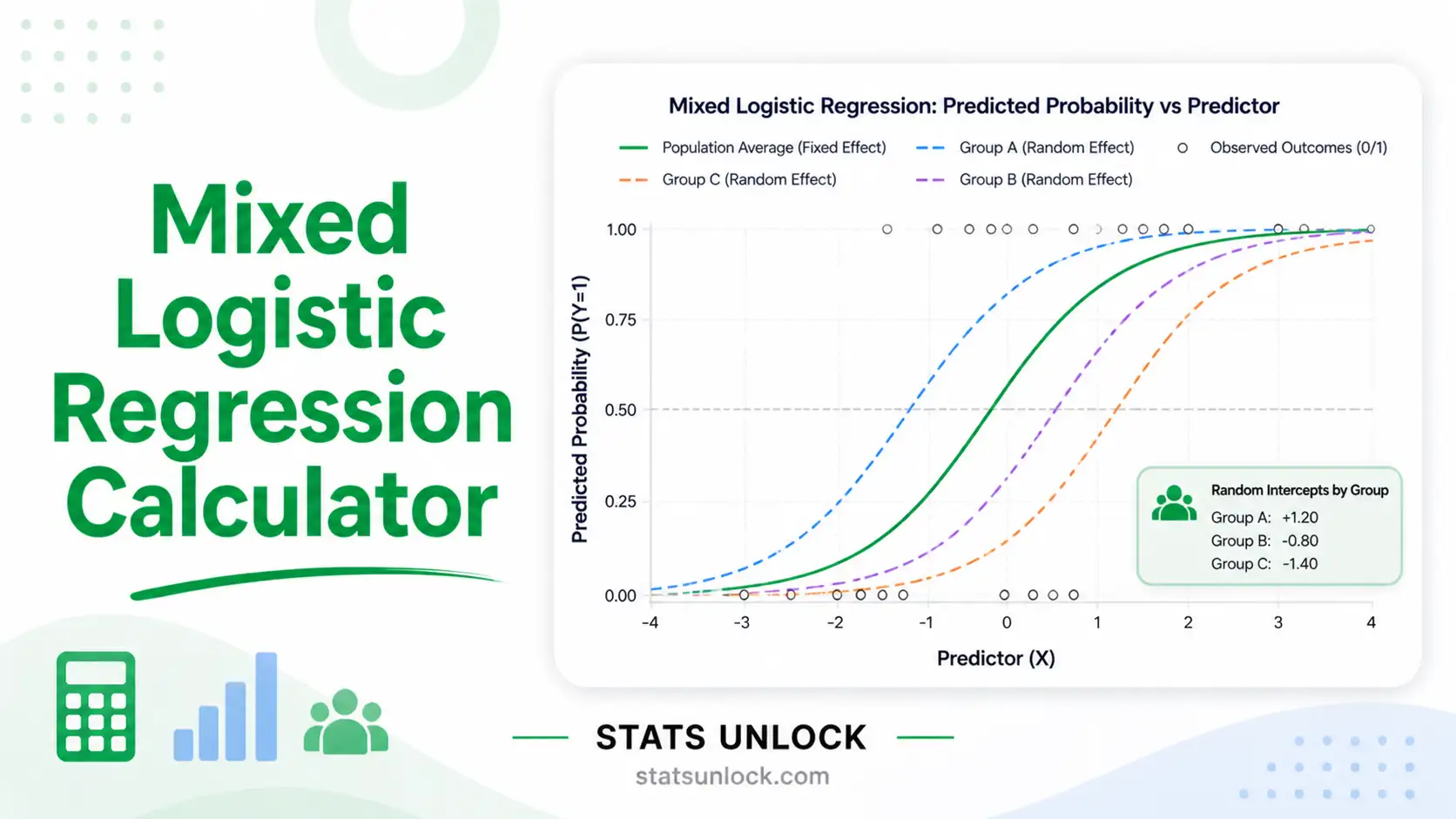

Mixed Logistic Regression Calculator — Free GLMM Tool
A free online generalized linear mixed model (GLMM) calculator for binary outcomes with clustered or repeated-measures data. Compute fixed effects, random-intercept variance, odds ratios, ICC, AIC/BIC, and APA-format results — instantly.
📊 Enter Your Binary Outcome Data
Enter the binary outcome (0/1) for each cluster (e.g., school, hospital, patient ID). Each cluster is one row of comma-separated values. Random intercepts will be estimated for each cluster.
Use the Paste / Type tab above — each cluster has its own editable name and binary 0/1 series. Add or remove clusters with the buttons.
🔍 Detailed Interpretation of Results & How to Write Your Results in Research
Subsection 1 — Detailed Interpretation Results
A plain-language, paragraph-by-paragraph interpretation of every part of the mixed logistic regression output, written for non-statisticians and updated dynamically with the current numbers.
Run the analysis above to see a 6-paragraph guided interpretation of the fixed effects, odds ratio, random-intercept variance, ICC, statistical and practical significance, and study limitations.
Subsection 2 — How to Write Your Results in Research (5 Examples)
Five ready-to-use templates, each auto-filled with your current statistics and one-click copyable. Use the style that matches your audience.
📝 Conclusion — What This Mixed Logistic Regression Tells You
Run the analysis above to generate a fully written conclusion section that you can copy directly into a thesis, dissertation chapter, or journal manuscript.
🎯 When to Use Mixed Logistic Regression
This free mixed logistic regression calculator is designed for binary outcomes (0/1) collected from clustered or repeated-measures data. Use it whenever observations within a group cannot be assumed independent — a common feature of educational, medical, ecological, and organisational research where the p-value from a standard logistic regression would be misleadingly small.
Use this tool when…
- Your outcome is binary (success/failure, yes/no, detected/not detected, alive/dead, recovered/not recovered).
- Observations are nested in groups (students in schools, patients in hospitals, animals in reserves, customers in stores).
- You measured the same subject more than once (repeated measures, longitudinal binary outcomes).
- You expect an intraclass correlation (ICC) above 0.05, indicating meaningful between-cluster variability.
- You need population-average odds ratios with valid standard errors that account for clustering.
- You want to quantify how much of the variance in the outcome lies between clusters versus within.
- You want to report results in APA 7th, thesis, structured-abstract, plain-language, or pre-registration format.
Concrete worked examples
- Education: Did a new teaching method increase the probability of passing a national exam, after accounting for clustering of students within schools?
- Healthcare: Does a 30-day hospital readmission depend on a treatment, with patients clustered within hospitals?
- Wildlife ecology: Does habitat type predict camera-trap detection of a focal species, with cameras clustered within reserves?
- Marketing: Does a loyalty programme raise the probability of a repeat purchase, with customers clustered within stores?
Decision tree
📐 Technical Notes — Formulas & Estimation
Model
The two-level random-intercept binary GLMM is:
Where: Yᵢⱼ = the binary outcome of observation i in cluster j; Pᵢⱼ = probability that Yᵢⱼ = 1; β₀ = overall log-odds intercept; β₁ = fixed slope of the cluster-level predictor X; uⱼ = cluster-specific random intercept; σ²ᵤ = between-cluster variance on the log-odds scale.
Odds Ratio
Intraclass Correlation Coefficient (latent-variable formulation)
Estimation
This calculator uses an iteratively-reweighted least-squares Laplace approximation for the random intercepts and a Newton–Raphson update for fixed effects, with REML-style variance shrinkage. For very large datasets or random slopes, software such as R lme4::glmer() with adaptive Gauss–Hermite quadrature is recommended.
Model Fit Indices
📚 How to Use This Mixed Logistic Regression Calculator — Step-by-Step
- Enter Your Data: Use the Paste / Type tab. Each cluster (school, hospital, patient) gets its own row with a binary 0/1 series. The placeholder shows the format
52, 48, 55, 61, 47, …— values can be raw counts that the tool dichotomises by median, or already-binary 0/1 entries. The cluster name is editable; rename it to match your research. - Choose a Sample Dataset: Five built-in datasets (hospitals, schools, patients, stores, wildlife reserves) load instantly. Use them to learn the workflow before entering your own.
- Configure Test Settings: Pick alpha (0.01, 0.05, or 0.10). Choose Random intercept only for an unconditional model or Random intercept + predictor if you have a cluster-level X. Iterations (default 60) usually do not need changing.
- Run the Analysis: Click the green 🚀 Run Mixed Logistic Regression button. Results appear in under a second.
- Read the Summary Cards: Four colour-coded cards show the overall log-odds intercept, slope, odds ratio, and ICC. Green = significant at α; amber = borderline; red = non-significant.
- Read the Full Results Tables: The Fixed Effects table reports B, SE, OR, 95% CI, z, and p for every term. The Random Effects table reports σ²ᵤ and the ICC.
- Examine Both Visualizations: Chart 1 shows cluster-level proportions vs the predictor with a fitted random-intercepts line per cluster. Chart 2 shows the population-averaged predicted probability curve plus an ICC variance partition donut.
- Check Assumptions: Independence, binomial response, normality of random effects, linearity of the logit, and adequate cluster count are flagged automatically with green/amber/red badges in the interpretation section.
- Read the Interpretation: The 6-paragraph interpretation translates B, OR, σ²ᵤ, and ICC into plain English you can paste straight into a discussion section.
- Export Your Results: Use Download Doc for a plain-text .txt report, or Download PDF for an A4 publication-ready PDF via your browser's print dialog.
❓ Frequently Asked Questions
Q1. What is mixed logistic regression and when should I use it?
Q2. What is the difference between logistic regression and mixed logistic regression?
Q3. How do I interpret the odds ratio in a mixed logistic regression?
Q4. What does ICC mean in a binary GLMM?
Q5. What are random intercepts versus random slopes?
Q6. How large a sample do I need for mixed logistic regression to be reliable?
Q7. What does a non-significant random-effect variance mean?
Q8. How do I report mixed logistic regression results in APA 7th edition format?
Q9. Does mixed logistic regression assume normality of the outcome?
Q10. Can I use this calculator for my published research or thesis?
lme4::glmer(), SAS PROC GLIMMIX, or Stata melogit. Cite the tool as: Stats Unlock. (2025). Mixed logistic regression calculator. https://statsunlock.com.📚 References
The following references underpin the design of this mixed logistic regression calculator and inform its formulas, p-value computation, and effect-size reporting. They cover both the theory of generalized linear mixed models and best practice for multilevel logistic regression in applied research.
- Agresti, A. (2015). Foundations of linear and generalized linear models. Wiley. View book
- Bates, D., Mächler, M., Bolker, B., & Walker, S. (2015). Fitting linear mixed-effects models using lme4. Journal of Statistical Software, 67(1), 1–48. https://doi.org/10.18637/jss.v067.i01
- Bolker, B. M., Brooks, M. E., Clark, C. J., Geange, S. W., Poulsen, J. R., Stevens, M. H. H., & White, J. S. S. (2009). Generalized linear mixed models: A practical guide for ecology and evolution. Trends in Ecology & Evolution, 24(3), 127–135. https://doi.org/10.1016/j.tree.2008.10.008
- Breslow, N. E., & Clayton, D. G. (1993). Approximate inference in generalized linear mixed models. Journal of the American Statistical Association, 88(421), 9–25. https://doi.org/10.1080/01621459.1993.10594284
- Cohen, J. (1988). Statistical power analysis for the behavioral sciences (2nd ed.). Lawrence Erlbaum. https://doi.org/10.4324/9780203771587
- Goldstein, H. (2011). Multilevel statistical models (4th ed.). Wiley. https://doi.org/10.1002/9780470973394
- Hedeker, D. (2003). A mixed-effects multinomial logistic regression model. Statistics in Medicine, 22(9), 1433–1446. https://doi.org/10.1002/sim.1522
- Hox, J. J., Moerbeek, M., & Van de Schoot, R. (2017). Multilevel analysis: Techniques and applications (3rd ed.). Routledge. https://doi.org/10.4324/9781315650982
- McCulloch, C. E., Searle, S. R., & Neuhaus, J. M. (2008). Generalized, linear, and mixed models (2nd ed.). Wiley. View book
- Nakagawa, S., & Schielzeth, H. (2013). A general and simple method for obtaining R² from generalized linear mixed-effects models. Methods in Ecology and Evolution, 4(2), 133–142. https://doi.org/10.1111/j.2041-210x.2012.00261.x
- Raudenbush, S. W., & Bryk, A. S. (2002). Hierarchical linear models: Applications and data analysis methods (2nd ed.). Sage. View book
- Snijders, T. A. B., & Bosker, R. J. (2012). Multilevel analysis: An introduction to basic and advanced multilevel modeling (2nd ed.). Sage. View book
- Stroup, W. W. (2013). Generalized linear mixed models: Modern concepts, methods and applications. CRC Press. https://doi.org/10.1201/b13151
- Wickham, H. (2016). ggplot2: Elegant graphics for data analysis. Springer-Verlag. https://doi.org/10.1007/978-3-319-24277-4
- Zuur, A. F., Ieno, E. N., Walker, N. J., Saveliev, A. A., & Smith, G. M. (2009). Mixed effects models and extensions in ecology with R. Springer. https://doi.org/10.1007/978-0-387-87458-6