

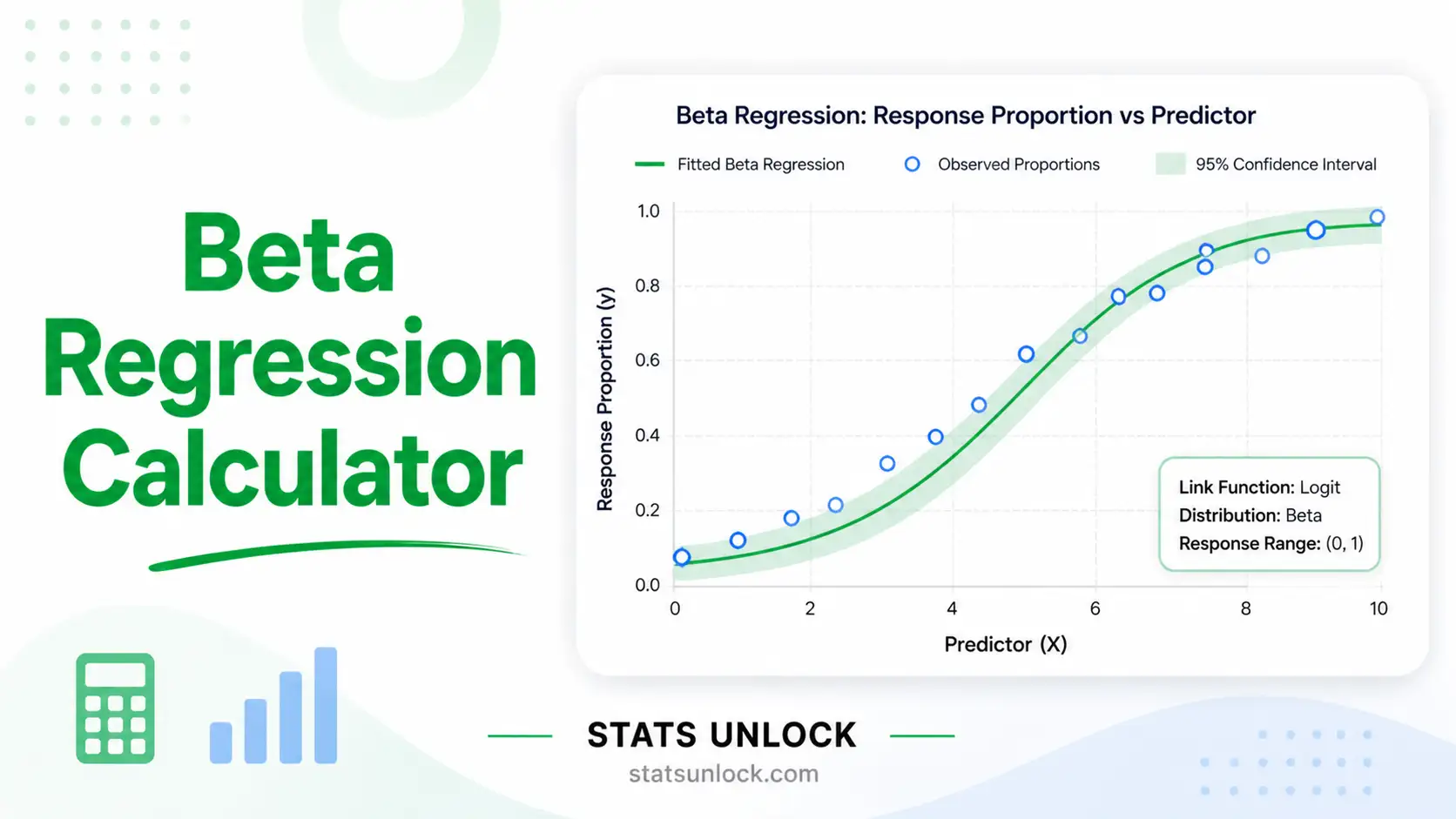

Beta Regression Calculator
A Generalised Linear Model (GLM) for analysing proportions, rates and continuous outcomes bounded between 0 and 1. Fit the model, get coefficients, pseudo R², residual diagnostics and a publication-ready APA report — all in your browser.
📥 1. Data Input
.csv, .txt, .xlsx, .xls — headers detected automatically. Two-column file with predictor (X) and proportion (Y) works best.Add rows of (X, Y) pairs manually:
🔬 Technical Notes — Beta Regression Formulas
Model specification & likelihood
Beta density (mean-precision parameterisation):
f(y | μ, φ) = Γ(φ) / [Γ(μφ) · Γ((1−μ)φ)] · yμφ−1 · (1−y)(1−μ)φ−1, y ∈ (0, 1)
Linear predictor with logit link:
g(μi) = log(μi / (1 − μi)) = β0 + β1xi
Where:
- μi — expected proportion for observation i
- φ — precision parameter (larger φ = lower variance)
- β0, β1 — regression coefficients on the logit scale
- Var(yi) = μi(1 − μi) / (1 + φ)
- Pseudo-R² = squared Pearson correlation between g(y) and η̂ (Ferrari & Cribari-Neto, 2004)
- Pearson residual = (yi − μ̂i) / √[μ̂i(1 − μ̂i)/(1 + φ̂)]
0/1 transformation (Smithson & Verkuilen, 2006):
y' = (y · (n − 1) + 0.5) / n
📋 When to Use Beta Regression
Checklist
- ✅ Outcome is a continuous proportion, rate or fraction in (0, 1)
- ✅ You suspect heteroscedastic errors that depend on the mean
- ✅ Linear regression produces predictions outside (0, 1) on your data
- ✅ The outcome is asymmetric (skewed) and bounded
- ✅ You want a model that respects the natural bounds without ad-hoc transformations
Real-world examples
- Education — proportion of items answered correctly on a test as a function of study hours.
- Health science — body-fat fraction predicted from BMI, age and exercise.
- Ecology — vegetation cover percentage explained by rainfall, soil pH and elevation.
- Marketing — click-through rate as a function of ad spend or impressions.
Decision tree
Outcome bounded in [0, 1]? → If yes → Any exact 0 or 1? → No → Beta Regression. Yes (a few) → Smithson–Verkuilen transform + Beta. Yes (many structural) → Zero/One-Inflated Beta. Outcome binary 0/1 only? → Logistic Regression.
❓ Frequently Asked Questions
Q1. What is Beta Regression and when should I use it?
Beta Regression is a Generalised Linear Model (GLM) for outcomes that are continuous proportions or rates strictly between 0 and 1. Use it whenever the dependent variable is bounded on (0, 1) and ordinary linear regression would produce nonsensical predictions (negative values or values above 1). Typical applications include the proportion of items answered correctly on an exam, the fraction of habitat covered by a species, or the share of household income spent on food.
Q2. What is the difference between Beta Regression and Logistic Regression?
Logistic regression handles a binary 0/1 outcome and models the probability of a single success. Beta regression handles a continuous proportion like 0.32 or 0.78 and models the expected mean on the (0, 1) scale. If the outcome is recorded as a fraction or percentage divided by 100, use Beta; if it is a yes/no event, use logistic.
Q3. Can Beta Regression handle 0 or 1 in the outcome?
The standard Beta density is undefined at 0 and 1. Two practical options exist: (a) apply the Smithson and Verkuilen (2006) transformation y' = (y(n − 1) + 0.5)/n to nudge boundary values just inside the interval, or (b) fit a zero-inflated, one-inflated, or zero-and-one-inflated Beta model that accommodates the boundary values directly. This calculator applies option (a) automatically when needed.
Q4. How do I interpret a Beta Regression coefficient?
Coefficients are on the logit scale. A positive β means the linear predictor — and therefore the expected proportion — increases with the predictor. To convert to a proportion at a chosen X, compute μ̂ = exp(β₀ + β₁X) / (1 + exp(β₀ + β₁X)). The exponentiated coefficient exp(β₁) is the multiplicative effect on the odds of the proportion.
Q5. What is the precision parameter φ?
φ governs how tightly the data cluster around the mean. The variance of y is μ(1 − μ)/(1 + φ); larger φ implies smaller variance and more concentrated proportions, while smaller φ implies wider scatter. Reporting φ alongside the coefficients is recommended for full transparency.
Q6. What pseudo-R² does Beta Regression produce?
Ferrari and Cribari-Neto (2004) defined pseudo-R² as the squared Pearson correlation between the linear predictor η̂ = β₀ + β₁X and the link-transformed response g(y). It ranges from 0 to 1 and is interpreted in the same direction as OLS R² — larger means a better fit — though the absolute scale differs from least-squares R².
Q7. How large a sample do I need?
For a single predictor, a practical minimum is 30 observations. For multiple predictors, aim for at least 10–20 cases per coefficient. Bias and standard-error stability improve markedly above n = 50.
Q8. How do I report Beta Regression results in APA 7th edition?
Report the coefficient (β), standard error, z-statistic, p-value, link function, precision φ̂ and pseudo-R². Example: "A Beta regression with logit link was fitted; X significantly predicted Y, β = 0.42, SE = 0.11, z = 3.82, p < .001, pseudo-R² = .31, φ̂ = 28.4."
Q9. Can I use this calculator for my published research?
The calculator is designed for educational use, teaching demonstrations, and exploratory analysis. For peer-reviewed publication we recommend cross-validating the estimates in dedicated software such as the betareg package in R (Cribari-Neto & Zeileis, 2010). You may cite this tool as: STATS UNLOCK. (2026). Beta Regression Calculator. https://statsunlock.com.
Q10. What if my Beta Regression result is non-significant?
A non-significant coefficient (p > α) does not prove the absence of an effect. It indicates that the data, at your chosen alpha and sample size, do not provide sufficient evidence to reject the null hypothesis of no effect. Consider a power analysis and look at the confidence interval — a wide CI that crosses zero suggests an under-powered design rather than a true null.
📚 How to Use This Tool — Step-by-Step
Show 10-step walkthrough (worked example)
Worked example throughout: education research — does the number of study hours predict the proportion of items answered correctly?
- Enter your data — Paste comma-separated X (study hours) and Y (proportion correct) values, or upload a CSV with two numeric columns. Y must be in (0, 1).
- Choose a sample dataset — Five ready-made datasets are provided. Dataset 1 (study hours) is loaded by default.
- Configure α — 0.05 is the conventional default; choose 0.01 for stricter tests or 0.10 for exploratory work.
- Run the analysis — Click "Run Beta Regression". Estimates use Newton–Raphson on the log-likelihood.
- Read the summary cards — n, β₁, p-value, pseudo-R² and precision φ̂. Green border indicates statistical significance at α.
- Read the coefficient table — Each row gives the estimate, SE, z, p and 95% CI on the logit scale.
- Examine the visualisations — Plot 1 shows the fitted logit curve over the scatter; plot 2 shows Pearson residuals vs fitted values for diagnostic checks.
- Check assumptions — Y in (0,1), independence, correct link function, adequate n. Yellow/red badges flag concerns.
- Read the interpretation — Eight paragraphs translate each statistic into plain language and into your research narrative.
- Export your results — Download a .txt summary or a print-ready PDF including coefficient table, plots, conclusion and reporting templates.
📖 References
Authoritative sources on Beta Regression, Generalised Linear Models, and proportion data analysis.
- Ferrari, S. L. P., & Cribari-Neto, F. (2004). Beta regression for modelling rates and proportions. Journal of Applied Statistics, 31(7), 799–815. https://doi.org/10.1080/0266476042000214501
- Smithson, M., & Verkuilen, J. (2006). A better lemon squeezer? Maximum-likelihood regression with beta-distributed dependent variables. Psychological Methods, 11(1), 54–71. https://doi.org/10.1037/1082-989X.11.1.54
- Cribari-Neto, F., & Zeileis, A. (2010). Beta regression in R. Journal of Statistical Software, 34(2), 1–24. https://doi.org/10.18637/jss.v034.i02
- Simas, A. B., Barreto-Souza, W., & Rocha, A. V. (2010). Improved estimators for a general class of beta regression models. Computational Statistics & Data Analysis, 54(2), 348–366. https://doi.org/10.1016/j.csda.2009.08.017
- Ospina, R., & Ferrari, S. L. P. (2012). A general class of zero-or-one inflated beta regression models. Computational Statistics & Data Analysis, 56(6), 1609–1623. https://doi.org/10.1016/j.csda.2011.10.005
- Papke, L. E., & Wooldridge, J. M. (1996). Econometric methods for fractional response variables with an application to 401(k) plan participation rates. Journal of Applied Econometrics, 11(6), 619–632. https://doi.org/10.1002/(SICI)1099-1255(199611)11:6<619::AID-JAE418>3.0.CO;2-1
- McCullagh, P., & Nelder, J. A. (1989). Generalized Linear Models (2nd ed.). Chapman & Hall/CRC. https://doi.org/10.1201/9780203753736
- Agresti, A. (2015). Foundations of Linear and Generalized Linear Models. Wiley. https://www.wiley.com/en-us/9781118730034
- Hardin, J. W., & Hilbe, J. M. (2018). Generalized Linear Models and Extensions (4th ed.). Stata Press. https://www.stata-press.com/books/generalized-linear-models-and-extensions/
- Douma, J. C., & Weedon, J. T. (2019). Analysing continuous proportions in ecology and evolution: A practical introduction to beta and Dirichlet regression. Methods in Ecology and Evolution, 10(9), 1412–1430. https://doi.org/10.1111/2041-210X.13234
- Geissinger, E. A., Khoo, C. L. L., Richmond, I. C., Faulkner, S. J. M., & Schneider, D. C. (2022). A case for beta regression in the natural sciences. Ecosphere, 13(2), e3940. https://doi.org/10.1002/ecs2.3940
- Kieschnick, R., & McCullough, B. D. (2003). Regression analysis of variates observed on (0, 1): Percentages, proportions and fractions. Statistical Modelling, 3(3), 193–213. https://doi.org/10.1191/1471082X03st053oa
- American Psychological Association. (2020). Publication Manual of the American Psychological Association (7th ed.). https://doi.org/10.1037/0000165-000
- R Core Team. (2024). R: A language and environment for statistical computing. R Foundation for Statistical Computing. https://www.R-project.org/