

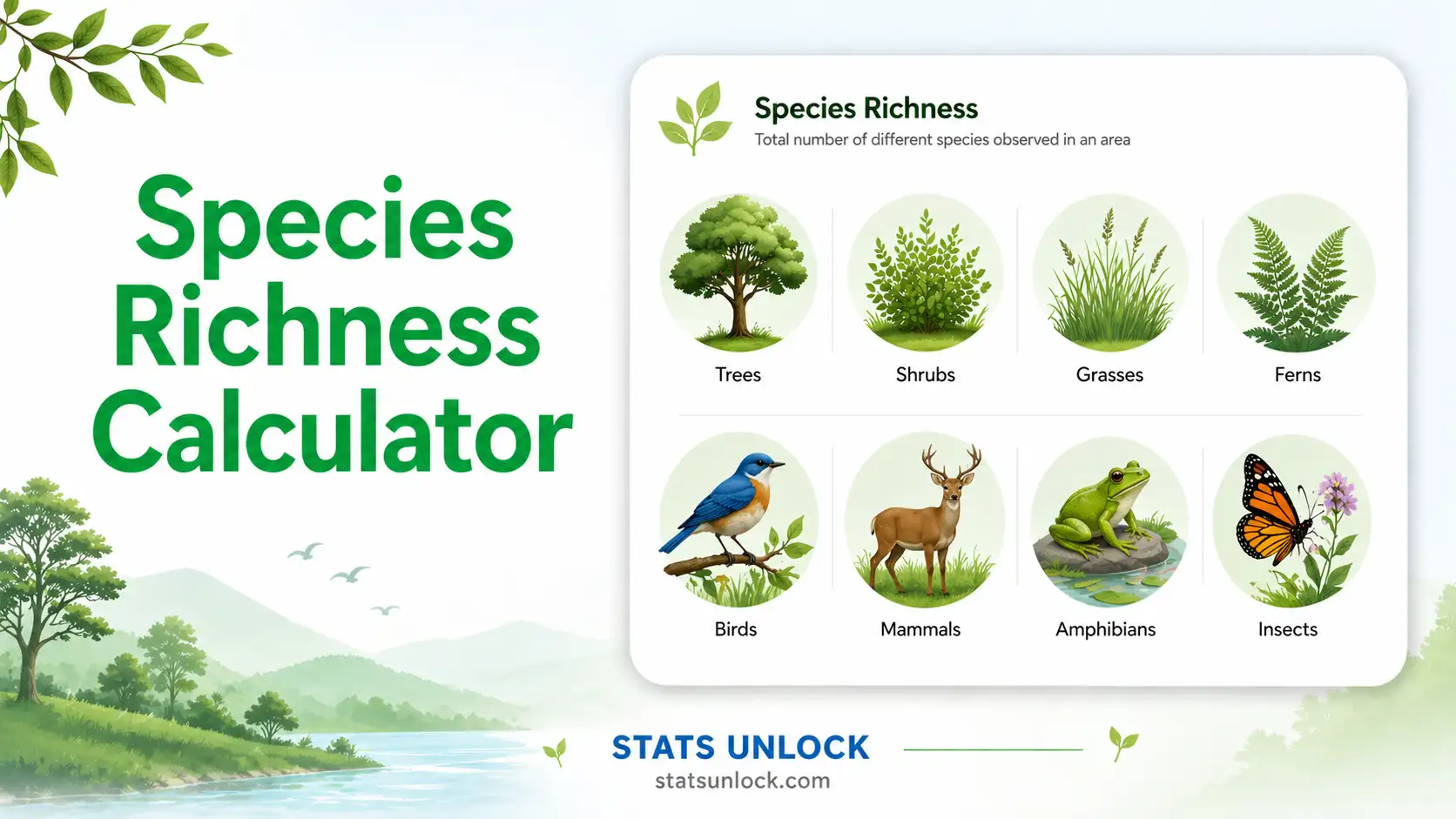

Species Richness Calculator
A free online tool to measure species richness (S) and estimate true richness with Margalef, Menhinick, Chao1, and jackknife from your survey counts, with instant charts and report-ready results.
🌿 Key Takeaways
- The species richness calculator counts how many species are in your sample and estimates how many you may have missed.
- You only need the count of individuals per species. Paste them comma separated, upload a CSV file, or type them in.
- It returns observed richness (S) plus Margalef and Menhinick indices, which adjust for sample size, and Chao1 and jackknife estimators of true richness.
- A higher richness means more species; the estimators tell you whether more sampling would likely reveal even more species.
- Typical field uses: camera trapping, point counts, vegetation plots, transects, and reef fish surveys.
📥 Enter Your Data
0 values entered
🔎 Detailed Interpretation of Results
▶ Run the analysis above to generate a detailed, plain-English interpretation of your species richness result.
✍️ How to Write Your Results in Research
▶ Run the analysis above to auto-fill all six examples with your results.
🪧 Research Poster Panel
A print-ready poster layout that updates with your result. Copy the text or use the visual scaffold for A0 / A1 conference posters.
▶ Run the analysis above to build your poster panel.
📊 Example Results
Scenario 1 — High-richness tropical forest
A bird survey records 28 species across 412 individuals. Chao1 estimates about 31 species, so the survey captured roughly 90% of the community — a rich, well-sampled site.
Scenario 2 — Low-richness degraded site
A logged fragment holds only 6 species across 200 individuals. Margalef = 0.94, low for the region, pointing to a species-poor, disturbed community.
Scenario 3 — Same richness, different effort
Two sites both record 15 species, but Site A sampled 100 individuals and Site B sampled 500. Menhinick corrects for this: Site A = 1.50, Site B = 0.67, showing Site A is richer per unit effort.
Scenario 4 — Undersampling flagged by Chao1
A survey finds 20 species but many singletons. Chao1 estimates 34 species, a big gap that warns you to keep sampling before reporting richness.
Scenario 5 — Camera-trap mammal survey
Across 1,400 trap nights, 8 mammal species are recorded with few rare species. Chao1 = 8.5, so the community is almost fully sampled.
Scenario 6 — Edge case / caution
Only 3 individuals across 3 species gives S = 3, but the sample is far too small to trust. Always build a species accumulation curve before reporting richness.
🥾 Collecting Your Species Data in the Field: A Simple Step-by-Step Guide
Species richness is only as good as the survey behind it. Follow these ready-to-use steps in the field to collect clean, comparable species data. Print this list and take it with you.
- Define your question first. Decide what you are comparing (site vs site, season vs season, before vs after) before you collect any data.
- Pick one taxonomic group and stick to it. Count only birds, only trees, or only mammals. Mixing groups makes richness meaningless.
- Choose a standard sampling method and use it everywhere: point counts, line transects, quadrats, camera traps, pitfall traps, or mist nets.
- Fix your sampling effort. Keep the same transect length, plot size, count duration, or number of trap nights at every site.
- Sample enough to reach a plateau. Richness keeps rising with effort, so keep sampling until few new species appear.
- Use replicates. Place at least 3 stations, plots, or transects per site so you can build accumulation curves.
- Mark station locations with GPS so the exact spot can be resurveyed in future years.
- Record every species, and count individuals too. Counts let you calculate Margalef, Menhinick, and Chao1, not just observed richness.
- Note singletons and doubletons carefully. Chao1 relies on species seen once or twice, so record rare species accurately.
- Avoid double-counting. Move in one direction and use a set detection radius so the same species is logged once per station.
- Log detection method (seen, heard, trapped, photographed) for later corrections.
- Identify to species where possible. If you cannot, use a consistent morphospecies label and keep it identical across sheets.
- Use a prepared datasheet. Columns: Date, Site, Station, Observer, Species, Count, Detection type, Notes.
- Record effort metadata on every sheet: start and end time, weather, observer name, and equipment used.
- Photograph or voucher tricky species to settle identification disputes back at the desk.
- Enter counts as whole numbers, not percentages or densities.
- Back up your data the same day by photographing paper sheets or typing counts into a spreadsheet.
- Keep a field notebook for disturbance, human activity, unexpected species, or equipment problems.
- Combine species across stations before entry, then paste the per-species totals into this calculator (for example
52, 48, 55, 61, 47). - Never invent or round zeros away. A species absent from the sample is simply not listed.
🧭 When to Use This Tool
- ✓ You want the most basic and widely understood measure of biodiversity
- ✓ You have a species list, ideally with counts per species
- ✓ You want to correct for sample size or estimate species you may have missed
- ✓ You need a publication-ready richness metric for a journal or report
- ✗ Do NOT compare raw richness across sites with very different effort — use Margalef, Menhinick, or rarefaction
- ✗ Do NOT rely on observed S alone when many species are rare — check Chao1
- ✗ Do NOT use richness alone if you also care about dominance — add Shannon or Simpson's
Real-world examples: comparing bird richness across habitat types; plant richness in grazed vs ungrazed plots; mammal richness from camera traps; reef fish richness across depth zones.
Sampling guidance: sample until the accumulation curve flattens; use at least 3 replicate stations per site; apply Chao1 or rarefaction when effort differs between sites.
📘 How to Use This Tool — Step by Step
- Enter your data — paste counts like
52, 48, 55, 61, 47, upload a CSV file, or type them in the manual table. - Pick a sample dataset if you want to test the tool — twenty ecological datasets are built in.
- Configure settings — set the site name, group label, which estimator to highlight (S, Chao1, Margalef, Menhinick), and decimal places.
- Run the analysis — click Calculate to compute observed richness and all estimators.
- Read the summary cards — green = high richness/well-sampled, amber = moderate, red = low/undersampled.
- Read the full results table — check each value and its description.
- Examine all four charts — rank-abundance, observed vs estimated, accumulation curve, and abundance-class frequency.
- Read the ecological interpretation — use it for park reports or journal papers.
- Copy a reporting example — six styles from journal to policy brief to poster.
- Export your results — Download Doc for a text report, or Download PDF for printing.
Worked example: a dry-season bird survey at 15 stations records 28 species and 412 individuals, with Chao1 = 31 — a rich, well-sampled community.
🔍 Conclusion
❓ Frequently Asked Questions
📚 References
The following references support the ecological methods used in this species richness calculator, covering biodiversity measurement, species diversity, and best practices in ecological sampling and wildlife analysis.
- Magurran, A. E. (2004). Measuring biological diversity. Blackwell Publishing.
- Margalef, R. (1958). Information theory in ecology. General Systems, 3, 36–71.
- Menhinick, E. F. (1964). A comparison of some species-individuals diversity indices. Ecology, 45(4), 859–861. doi.org/10.2307/1934933
- Chao, A. (1984). Nonparametric estimation of the number of classes in a population. Scandinavian Journal of Statistics, 11(4), 265–270.
- Colwell, R. K., & Coddington, J. A. (1994). Estimating terrestrial biodiversity through extrapolation. Phil. Trans. R. Soc. B, 345(1311), 101–118. doi.org/10.1098/rstb.1994.0091
- Gotelli, N. J., & Colwell, R. K. (2001). Quantifying biodiversity: Procedures and pitfalls. Ecology Letters, 4(4), 379–391. doi.org/10.1046/j.1461-0248.2001.00230.x
- Chao, A., et al. (2014). Rarefaction and extrapolation with Hill numbers. Ecological Monographs, 84(1), 45–67. doi.org/10.1890/13-0133.1
- Hsieh, T. C., Ma, K. H., & Chao, A. (2016). iNEXT: rarefaction and extrapolation of Hill numbers. Methods Ecol. Evol., 7(12), 1451–1456. doi.org/10.1111/2041-210X.12613
- Colwell, R. K. (2013). EstimateS: Statistical estimation of species richness (v9). purl.oclc.org/estimates
- Oksanen, J., et al. (2022). vegan: Community ecology package. R package v2.6-4. CRAN.R-project.org/package=vegan
- Krebs, C. J. (1999). Ecological methodology (2nd ed.). Benjamin Cummings.
- Whittaker, R. H. (1972). Evolution and measurement of species diversity. Taxon, 21(2/3), 213–251. doi.org/10.2307/1218190
- Gotelli, N. J., & Chao, A. (2013). Measuring and estimating species richness. In Encyclopedia of Biodiversity (2nd ed., pp. 195–211). Academic Press.
- Bibby, C. J., Burgess, N. D., Hill, D. A., & Mustoe, S. H. (2000). Bird census techniques (2nd ed.). Academic Press.
- Ahumada, J. A., et al. (2011). Community structure and diversity of tropical forest mammals. Phil. Trans. R. Soc. B, 366(1578), 2703–2711. doi.org/10.1098/rstb.2011.0115
- Niedballa, J., et al. (2016). camtrapR: An R package for camera trap data. Methods Ecol. Evol., 7(12), 1457–1462. doi.org/10.1111/2041-210X.12600
- Roswell, M., Dushoff, J., & Winfree, R. (2021). A conceptual guide to measuring species diversity. Oikos, 130(3), 321–338. doi.org/10.1111/oik.07202
- Peet, R. K. (1974). The measurement of species diversity. Annual Review of Ecology and Systematics, 5, 285–307. doi.org/10.1146/annurev.es.05.110174.001441
- R Core Team. (2024). R: A language and environment for statistical computing. R-project.org
- Chao, A., & Chiu, C. H. (2016). Species richness: Estimation and comparison. Wiley StatsRef: Statistics Reference Online, 1–26. doi.org/10.1002/9781118445112.stat03432.pub2