

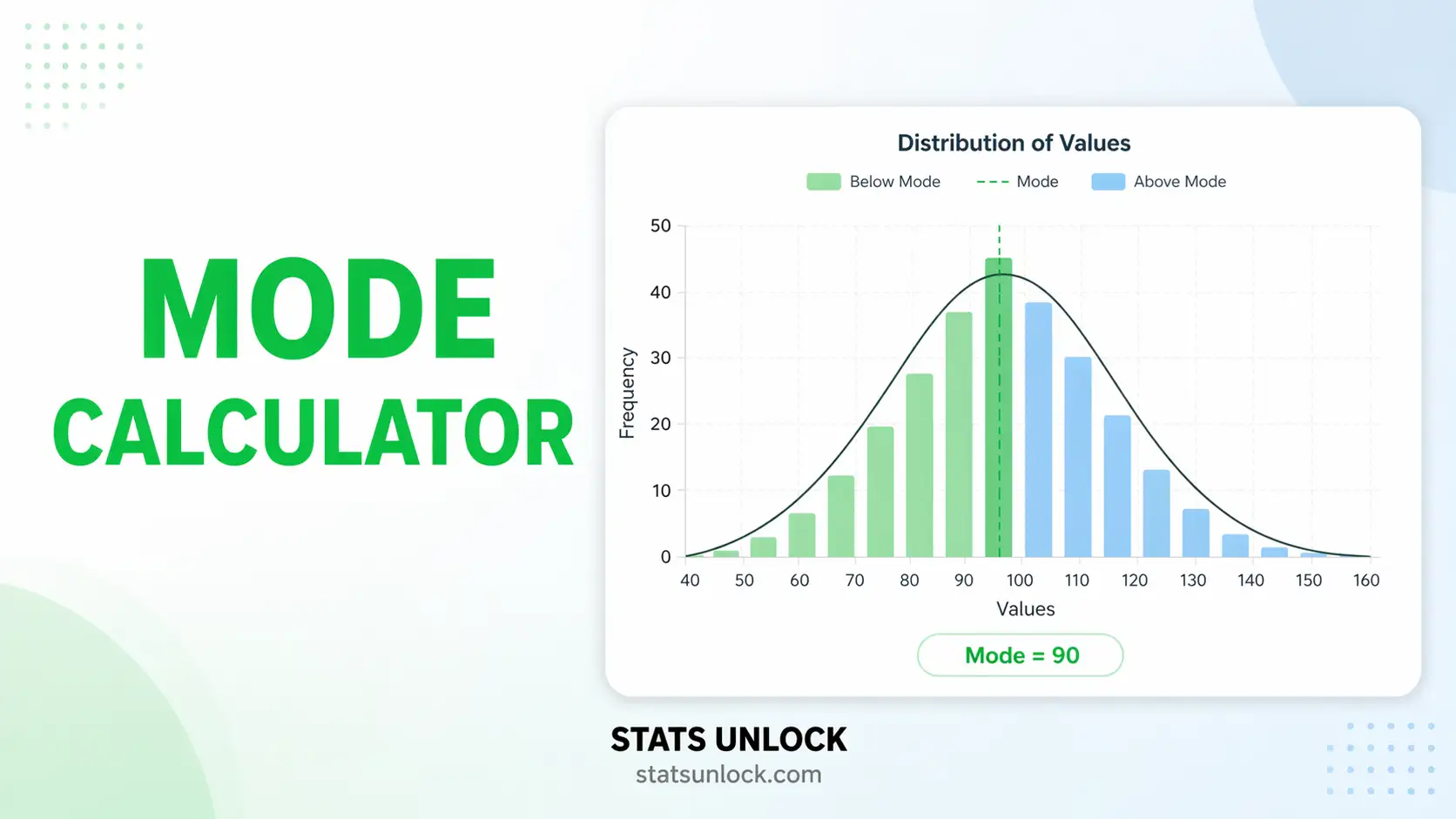

Mode Calculator
Find the Mode of Any Data Set
Instantly calculate mode in statistics — detect unimodal, bimodal & multimodal distributions, view frequency tables, bar charts, and download full reports.
✅ Assumption Checks for Mode Analysis
🔬 Technical Notes & Formulas
Mode (ungrouped data): Mo = value with maximum frequency f(x). Formally, Mo = argmaxx f(x).
Mode (grouped data — Czuber formula): Mo = L + [(f₁ − f₀) / (2f₁ − f₀ − f₂)] × h
Where L = lower boundary of modal class, f₁ = modal class frequency, f₀ = preceding class frequency, f₂ = following class frequency, h = class width.
Relative frequency: p(x) = f(x) / n × 100%
Distribution types: Unimodal (one peak), Bimodal (two equal-frequency peaks), Multimodal (3+ peaks), No mode (all frequencies equal).
📌 When to Use Mode in Statistics
The mode calculator is most appropriate when you need to identify the most frequently occurring value in a dataset. Unlike the mean and median, mode works for all data types.
- Your data is categorical or nominal (e.g., species, colours, brand names)
- You want to identify the most popular or common value in a sample
- The distribution is skewed or bimodal and mean is misleading
- You are analyzing survey responses or Likert scale data
- You need the central tendency measure robust to extreme outliers
- You are working with discrete count data (e.g., number of offspring)
🛠️ How to Use This Mode Calculator
3, 7, 7, 5, 7).❓ Frequently Asked Questions
What is the mode in statistics?
The mode is the value that appears most frequently in a dataset. A dataset can be unimodal (one mode), bimodal (two modes), or multimodal (more than two modes). If no value repeats, there is no mode.
How do I find the mode of a data set step by step?
1) List all values. 2) Count how many times each appears (frequency). 3) Identify the value(s) with the highest frequency. That value is the mode. Use this free calculator to do it instantly.
Can a data set have no mode?
Yes. If every value appears exactly once — meaning all frequencies are equal — the dataset has no mode. Some textbooks call this a uniform distribution.
What is the difference between mean, median, and mode?
The mean is the arithmetic average, the median is the middle value when sorted, and the mode is the most frequent value. Together they are called the three measures of central tendency in descriptive statistics.
Can a data set have more than one mode?
Yes. A bimodal dataset has exactly two modes with equal (and highest) frequency. A multimodal dataset has three or more such values. This calculator detects and reports all modes automatically.
Is mode used for categorical data?
Yes — mode is the only measure of central tendency applicable to nominal (categorical) data such as colours, species names, or survey responses. Mean and median require numerical data; mode does not.
What does bimodal distribution mean?
A bimodal distribution has two peaks of equal or near-equal frequency, suggesting two distinct subgroups in the data. This often signals that two different populations are mixed in the sample.
How is mode used in real life?
Mode is used in retail (most popular shoe size), education (most common grade), ecology (most frequent species), healthcare (most common diagnosis), and manufacturing (most frequent defect type).
What happens when all values appear the same number of times?
When all values share the same frequency, the dataset is considered to have no mode. The distribution is uniform — no single value is more representative than another.
How do I report mode in APA format?
In APA 7th edition: "The mode was X (f = Y, n = Z)." For bimodal data: "The data were bimodal (M₁ = X, M₂ = Y, f = Z each)." Always include sample size and modal frequency.
📚 References
The following peer-reviewed sources were used to define the mode calculator, mode in descriptive statistics, and related measures of central tendency in this tool.
- Agresti, A., & Franklin, C. (2021). Statistics: The art and science of learning from data (5th ed.). Pearson.
- Field, A. (2024). Discovering statistics using IBM SPSS statistics (6th ed.). SAGE Publications.
- Moore, D. S., McCabe, G. P., & Craig, B. A. (2021). Introduction to the practice of statistics (10th ed.). W.H. Freeman.
- Navarro, D. (2019). Learning statistics with R. University of Adelaide. https://learningstatisticswithr.com
- Triola, M. F. (2022). Elementary statistics (14th ed.). Pearson. https://doi.org/10.1093/oso/9780197546000.001.0001
- Westfall, P., & Henning, K. S. (2013). Understanding advanced statistical methods. CRC Press. https://doi.org/10.1201/b14834
- American Psychological Association. (2020). Publication manual of the American Psychological Association (7th ed.). https://doi.org/10.1037/0000165-000
- Dodge, Y. (2008). The concise encyclopedia of statistics. Springer. https://doi.org/10.1007/978-0-387-32833-1
- Pearson, K. (1895). Contributions to the mathematical theory of evolution. Philosophical Transactions of the Royal Society A, 186, 343–414.
- Zwillinger, D., & Kokoska, S. (2000). CRC standard probability and statistics tables and formulae. CRC Press.